Gold spread betting lets you trade changes in the gold price without buying bullion. You choose whether to buy or sell, set a cash stake per point, and make or lose money as the provider’s quote moves. A rising market can benefit a long position; a falling market can benefit a short position.
The practical challenge is translating a gold price move into account risk. A $10 move does not necessarily mean ten betting points, and a small margin requirement does not mean a small potential loss.
This guide covers gold contract types, point values, worked examples, costs and trading decisions. It focuses on UK retail spread betting rather than physical gold ownership. For the wider product category, see our guide to commodity spread betting. All prices, spreads and stakes below are hypothetical, not live quotes or provider offers.
How Gold Spread Betting Works
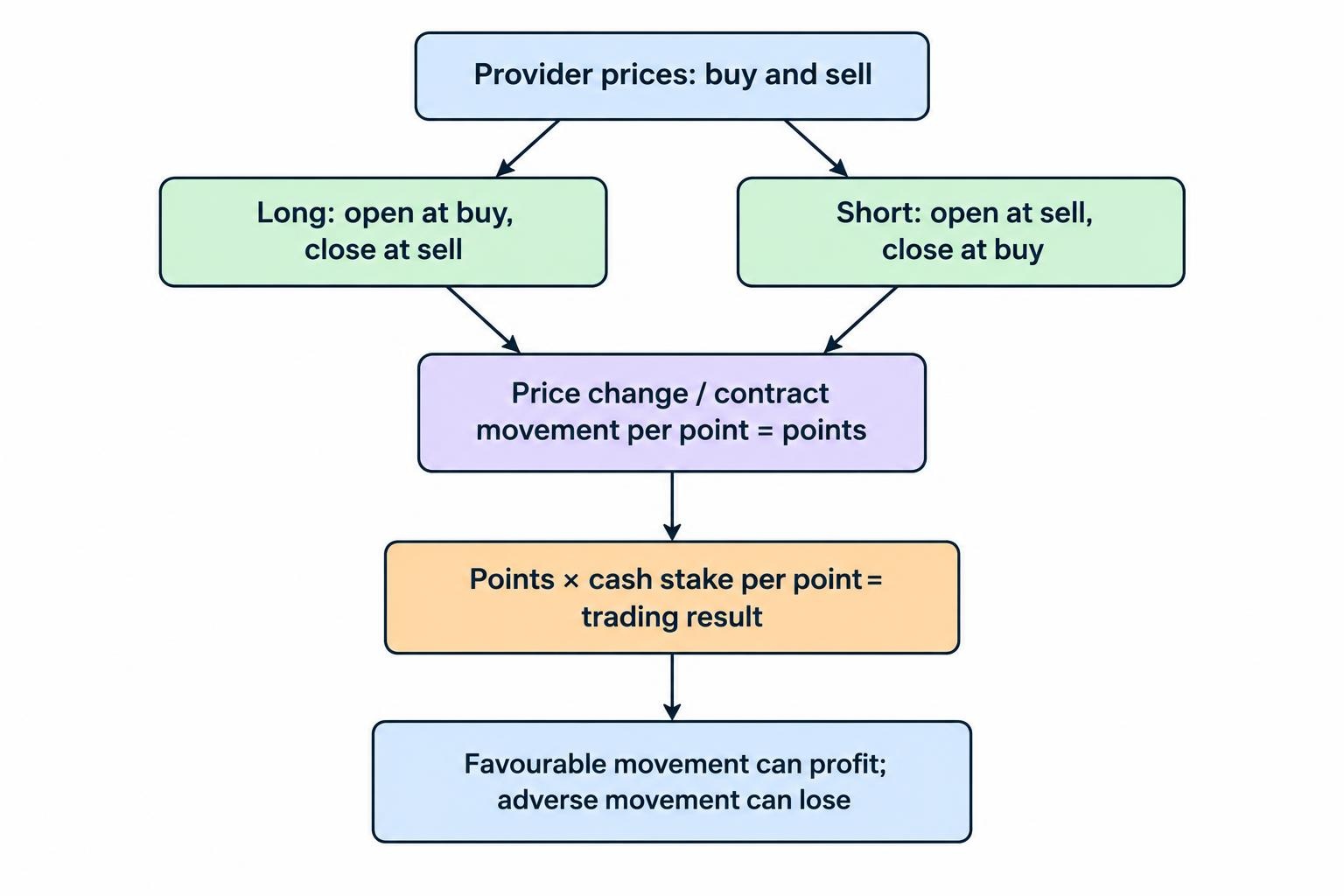
A gold spread betting provider displays two prices: a lower sell price and a higher buy price. You open a long position at the buy price and close it at the sell price. A short position works the other way round.
You do not receive gold bars, own allocated metal or acquire a claim on a vault holding. Your position is a financial contract with the provider, settled through the difference between your opening and closing prices.
Gold benchmarks commonly use US dollars per troy ounce. The LBMA’s daily auction price framework sets the LBMA Gold Price twice daily, at 10:30 and 15:00 London time, in those units. These benchmark auctions are not the same thing as a continuously changing retail trading quote.
A provider’s gold price can differ from a benchmark or another chart because the products, timestamps and quoted sides differ. A spot gold chart, a dated futures chart and your executable sell price need not show identical numbers.
Check What Counts as One Point
The contract’s point definition matters more than the number of decimal places on screen. Never assume that a $1 movement equals one betting point.
Suppose a hypothetical gold contract defines one point as a $0.10 change per ounce. A move from 3,000.0 to 3,001.0 then represents ten points. At £2 per point, that movement changes the position’s value by £20.
If another contract defines one point as $1, the same price movement represents one point. A £2 stake would produce a £2 change instead. Same metal, same price movement, very different exposure.
Check the product details for the point size, minimum stake and stake increment before entering an order. Our explanation of stake per point covers the calculation across different markets.
A sterling stake on a dollar gold quote also deserves attention. If the contract pays £2 for each defined point, the trading result is calculated in pounds using that stake. You do not automatically convert the resulting profit from dollars. However, a contract tracking gold priced in sterling would have a different underlying price exposure.
Spot Gold or a Dated Gold Spread Bet?
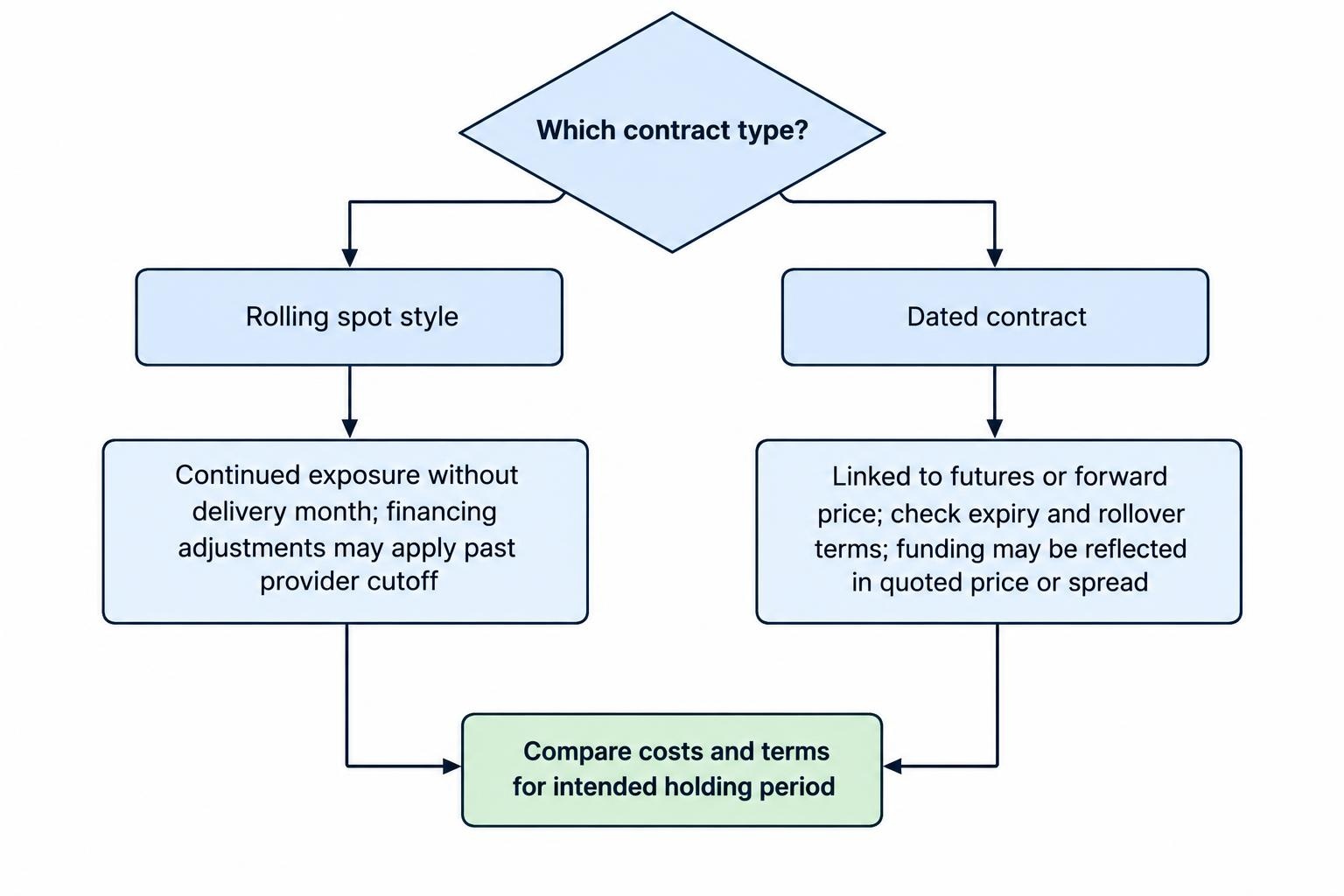
The word “gold” does not tell you enough about the contract. The next question is whether you are trading a rolling spot style product or a bet linked to a dated futures price.
Rolling Spot Gold
A rolling spot style gold bet provides continuing exposure without requiring you to choose a delivery month. Subject to the provider’s terms, it can remain open across trading days, with financing adjustments applied when you hold past the relevant cutoff.
This structure can suit an intraday plan because a position closed before the financing cutoff may avoid that overnight adjustment. For longer holding periods, repeated financing charges become part of the trade’s expected cost.
Dated Gold Contracts
A dated spread bet references a gold futures or forward price and has an expiry arrangement. Its quote can differ from spot because it relates to a later date and reflects the pricing of that contract.
Funding may be reflected in the quoted price or spread rather than charged through the same daily mechanism as a rolling product. That does not make the position cost free.
Check the final trading date, settlement method and rollover terms. A rollover can involve closing one position and opening another, with fresh dealing costs. Compare the structures over your intended holding period using our guide to daily funded bets versus futures spread bets, rather than choosing whichever opening spread looks smaller.
Gold Spread Betting Worked Examples
Assume a hypothetical gold quote of 3,000.0 sell / 3,000.4 buy. One betting point equals $0.10 per ounce, and the stake is £2 per point.
The quoted spread is $0.40, or four points. Buying and immediately selling at unchanged prices would therefore produce an £8 loss: four points multiplied by £2.
| Trade | Opening price | Closing price | Result in points | Trading result |
|---|---|---|---|---|
| Long, price rises | Buy at 3,000.4 | Sell at 3,008.4 | +80 | £160 profit |
| Long, price falls | Buy at 3,000.4 | Sell at 2,994.4 | −60 | £120 loss |
| Short, price falls | Sell at 3,000.0 | Buy at 2,992.0 | +80 | £160 profit |
| Short, price rises | Sell at 3,000.0 | Buy at 3,006.0 | −60 | £120 loss |
These results include the effect of using the appropriate buy and sell prices. They exclude financing, premiums and any other separate charges. Do not subtract the opening spread again after calculating profit from actual execution prices; that would count it twice.
Calculating the Long Position
The winning long position gains $8 per ounce between its opening buy price and closing sell price. Dividing $8 by the $0.10 point size gives 80 points. Multiplying 80 by £2 produces the £160 trading profit.
The losing long position moves $6 against the entry price. That equals 60 points and a £120 loss at the same stake.
Calculating the Short Position
For a short, subtract the closing buy price from the opening sell price. Selling at 3,000.0 and buying back at 2,992.0 captures an $8 decline, again worth 80 points.
Use executable prices rather than a chart’s midpoint when checking a trade. A chart touching your target does not prove that the side needed to close your position reached it.
The Costs of Trading Gold Through Spread Bets
The spread is the first cost to measure. Convert it into cash at your chosen stake, then compare that amount with the profit you expect to pursue. In the example above, an £8 opening spread cost matters much more to a trade targeting £20 than one targeting £200.
Spreads can change, so compare quotes during the hours you intend to trade. A published minimum tells you little about the price available around an economic announcement or near a trading break.
For positions held overnight, read the gold contract’s financing formula. Check the rate, calculation base, charging time and treatment of weekends or holidays. A short position should not be assumed to earn a financing credit. The mechanics are covered in our guide to overnight financing costs.
Also check guaranteed stop premiums, rollover charges and any account currency conversion charges that apply to your chosen product. The quote currency, stake currency and account currency are separate details, even when a platform presents them on one ticket.
Finally, allow for execution differences. If an ordinary stop fills beyond its requested level, the extra loss is an execution cost, not an overnight fee. A comparison based only on the headline spread misses that distinction.
Gold Margin and UK Retail Protections
For UK retail business within the relevant rules, gold positions require initial margin of at least 5% of exposure, equivalent to maximum exposure of 20 times that margin. The rules also require account level close out when net equity falls below 50% of the required margin, as soon as market conditions allow, and cap liability at the funds in the relevant trading account. These requirements appear in FCA COBS 22.5 retail trading protections.
At a 5% margin rate, a hypothetical £10,000 exposure requires £500 to open. A 1% adverse movement represents a £100 trading loss before costs. A 5% adverse movement represents £500.
The margin deposit is therefore not a maximum loss for the individual trade. Nor does negative balance protection prevent the loss of money held in the account.
A provider can require more margin than the regulatory minimum. Check the actual ticket, particularly for larger positions. Our guide to UK retail exposure and margin limits separates the regulatory ceilings from the terms a provider offers.
Do not use the platform’s maximum available stake as a position sizing recommendation. It answers how much exposure the account can support at that moment, not how much loss fits your trading plan.
Sizing a Gold Position and Setting Stops
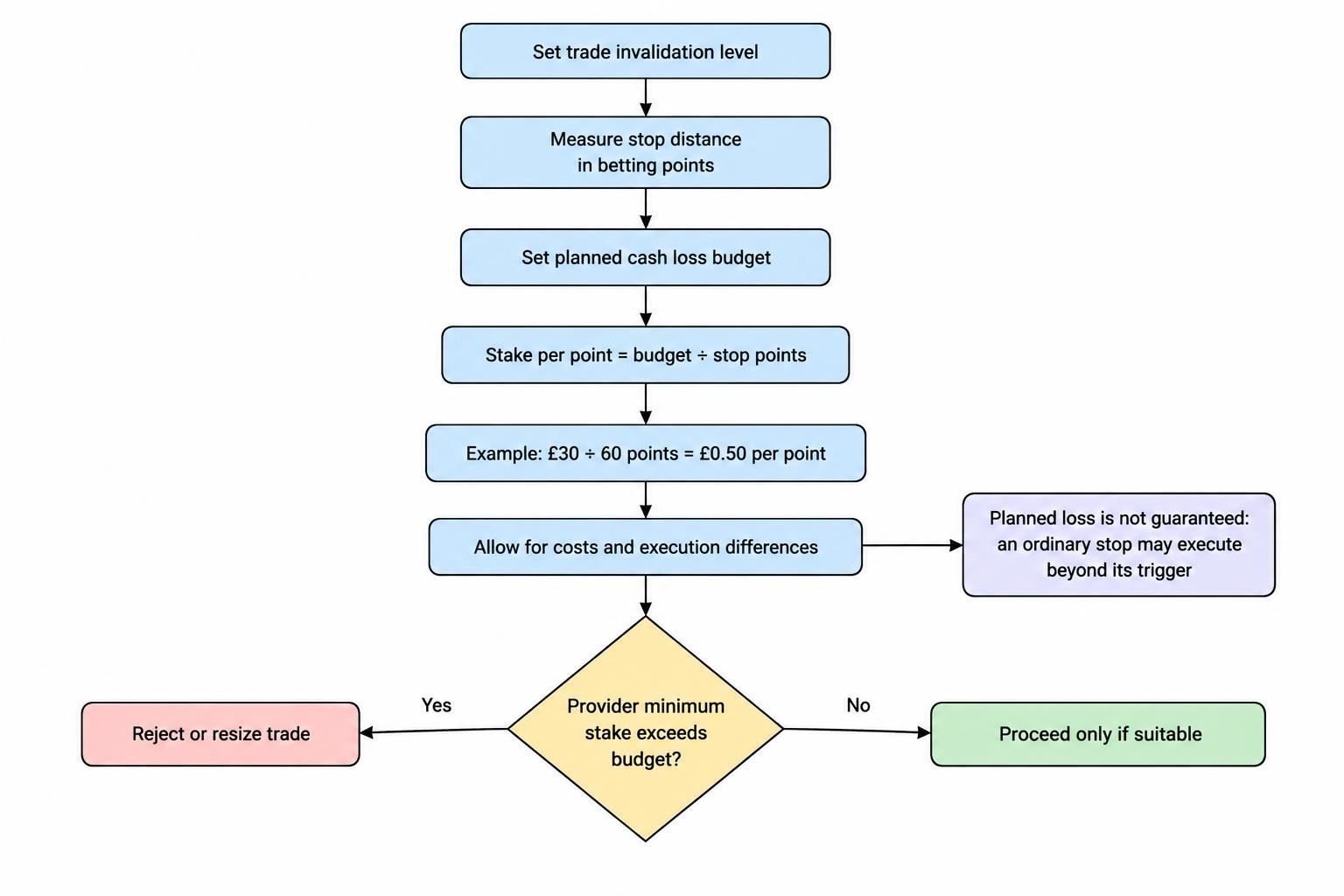
Start with the price at which your trade idea would no longer make sense. Then calculate the stake that fits your loss budget at that distance. Reversing that order often produces an oversized position with a stop placed too close to the entry.
Suppose an account contains £3,000 and the trader chooses a £30 planned loss budget. That is an illustrative 1% allocation, not a universal recommendation.
Using the earlier long entry of 3,000.4, a stop level of 2,994.4 sits 60 betting points away. Before allowing for other costs or execution differences, the stake calculation is:
£30 loss budget ÷ 60 points = £0.50 per point.
If a defensible stop needs to be 120 points away, the equivalent stake falls to £0.25 per point. If the provider’s minimum stake is higher, the trade does not fit that budget. Moving the stop closer solely to make the ticket affordable changes the trade rather than fixing its risk.
Our guide to position sizing for spread betting develops this process, including allowances for costs and multiple open positions.
Ordinary Stops Are Not Price Guarantees
An ordinary stop can execute beyond its trigger during a fast move or price gap. That means the £30 planned loss above is not a guaranteed maximum.
Where offered, a guaranteed stop provides a contractual exit at the agreed level, subject to its terms. Check the premium, minimum distance and restrictions on changing it. The relevant distinctions are covered in our guide to guaranteed stop loss orders.
Allow for the premium when calculating total risk. Also check which quoted side triggers the stop: a long position closes by selling, while a short closes by buying. Looking only at the chart can leave you comparing the wrong prices.
What Moves the Gold Price?
Gold responds to several influences at once. A useful trading explanation must account for the holding period, not just attach a familiar headline to the latest price move.
Interest Rates and the US Dollar
Interest rates affect the attraction of holding gold relative to assets that pay income. Real yields, meaning yields considered against inflation, can help frame that comparison. A stronger dollar can also work against dollar priced gold, though neither relationship should be treated as a mechanical trading rule.
The interactions between rates, currencies, risk and positioning are covered in the World Gold Council’s research on monetary policy and gold. The direction and timing of gold’s response depend on the surrounding conditions.
For a spread bettor, expectations matter as much as the announced decision. A rate cut that traders already anticipated need not create a fresh rise. A hypothetical inflation surprise could support gold through inflation concerns, yet work against it if traders respond by expecting higher interest rates.
Risk, Investment Demand and Physical Demand
Gold’s influences also include consumer demand, investment flows, supply and market risk. The World Gold Council’s framework for gold price drivers treats these as related forces, rather than separate explanations that always point in the same direction.
“Safe haven” describes a possible role, not a promise that the next trade will profit. Even a convincing defensive investment case does not establish where a short duration spread bet should enter or exit.
Separate the background argument from the immediate trigger. A monthly demand theme might support your broader view, but it does not tell you whether the next five minute breakout will hold.
Economic Announcements and Positioning
Build a watchlist around the releases relevant to your thesis, such as US inflation, employment data and Federal Reserve communications. Check the calendar before placing orders rather than discovering the announcement through a sudden change in the quote.
Use fundamental analysis for spread betting to organise the argument. Write down what would contradict it too. A view that cannot be disproved is difficult to turn into a controlled trade.
Gold Trading Hours and Execution
Do not assume that a gold spread betting contract trades continuously. The standard COMEX GC gold futures schedule runs from Sunday to Friday with a daily one hour break, detailed in the CME gold futures contract specifications. Your provider’s spread betting schedule is a separate matter.
Check the instrument’s opening times, daily breaks and holiday arrangements directly in its product details. Do the same for pending orders. An order remaining visible on screen does not necessarily mean it can execute while the relevant market is closed.
For UK traders, verify the displayed timezone and the treatment of daylight saving changes. A saved reminder for a US announcement can become an hour out when the countries change clocks on different dates.
The best trading window is not simply the longest one available. Compare spreads and execution during the periods your strategy uses. A setup tested during an active session should not be assumed to behave identically during a quieter period.
Our guide to commodity trading hours covers the scheduling checks across the wider market group. For gold, pay particular attention to any position that will remain open through a break or weekend.
Building a Gold Trading Plan
A trading plan should explain the setup, entry condition, invalidation level, stake and exit method. “Gold looks strong” is a view, but it is not yet an order plan.
Trend and Pullback Trades
A trend approach might require price to hold above a previously broken resistance area before entering a long position. A pullback entry then needs a defined condition, such as price stabilising near that area, rather than an open ended instruction to buy any decline.
Keep the trade’s timeframe consistent. An entry based on an hourly pattern should not become a long duration investment simply because the first move goes against it.
Breakout Trades
A breakout plan can define a range, require a move beyond it and place invalidation back inside the failed breakout area. The difficulty is deciding how much confirmation to require without paying an entry price that leaves little room before the target.
Our guide to breakout trading with financial spread betting covers that trade off. Test the rule on the gold contract and trading session you actually intend to use, including spreads rather than chart prices alone.
Watch Combined Exposure
A gold position should not be reviewed in isolation if other trades depend on a related economic outcome. A long gold trade and another position built around dollar weakness may both be vulnerable to a reversal in that view.
They are not necessarily independent risks just because they appear under different market headings. Review portfolio correlation and spread betting risk before adding another position, and avoid assuming that every apparent hedge will offset losses during a sharp move.
Choosing a Provider for Gold Spread Betting
Compare the gold contract, not just the platform’s general advertising. Two providers can offer apparently similar products with different point definitions, minimum stakes, financing arrangements and dealing hours.
Start by converting each spread into a cash cost for equivalent exposure. Comparing £1 per point at both providers is meaningless if their definitions of a point differ.
Next, calculate the expected cost over your intended holding period. An intraday trader and someone holding for several weeks may reasonably prefer different contract structures. Check the financing formula and expiry terms rather than assuming one product is cheaper for every use.
Order controls matter too. Look for clear stop triggering rules, visible margin requirements and a straightforward way to review orders before submitting them. If guaranteed stops form part of your plan, confirm that they are offered on the gold instrument, not just elsewhere on the platform.
Our guide to commodity spread betting brokers provides a broader comparison framework. Before funding an account, verify the legal entity you would contract with and your client classification. Do not assume protections apply because a familiar brand name appears on the screen.
Is Gold Spread Betting Tax Free?
For individual financial spread betting within its scope, HMRC’s Capital Gains Manual guidance on financial spread bets states that no chargeable gains or allowable losses arise. The inability to claim an allowable capital loss matters alongside the treatment of winnings.
This is not a blanket statement about every trader, company, business arrangement or country of residence. Nor should the treatment of a spread bet be assumed to match that of bullion, an exchange traded gold product or a futures contract.
Our guide to whether spread betting is tax free covers the wider qualifications. Obtain advice where your circumstances require it. Tax treatment does not turn an unsuitable trade into a suitable one.
Before Placing a Gold Spread Bet
A final ticket check should answer five questions:
- What exact gold contract am I trading, and when can it be dealt?
- How much price movement equals one point?
- What cash loss would the planned stop produce at this stake?
- What financing, spread and premium costs apply?
- What happens if the market gaps beyond an ordinary stop?
A spread betting demo account can help rehearse the point calculation and order process. It does not prove that live execution, available prices or your response to losses will be identical.
Gold spread betting is easiest to assess when every price movement has a known cash consequence. Confirm the contract units, calculate the stake from the risk budget and leave room for costs and execution uncertainty. The gold price can remain unpredictable; the arithmetic on your ticket should not.