Managing risk with stop losses means doing more than attaching an exit order to a spread bet. You need a reason for the stop level, a stake that fits the potential loss, and a plan for occasions when the exit price is worse than expected. A stop placed without those checks can create more confidence than protection.
The practical sequence is straightforward: decide where the trade idea fails, measure the distance from entry to that level, then calculate the stake per point. Do not choose a large stake first and squeeze the stop closer just to make the numbers look comfortable.
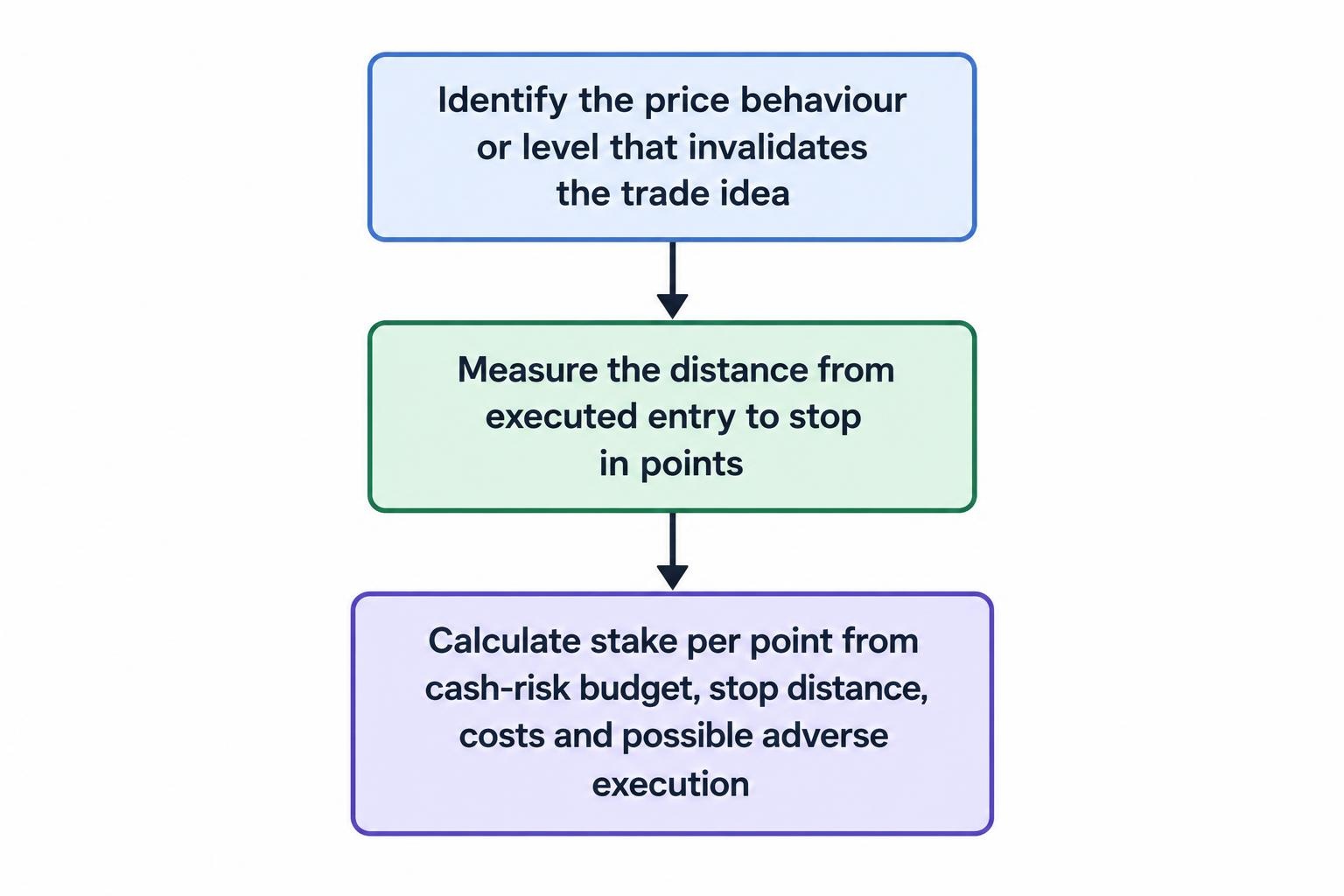
Stop losses belong within a broader spread betting risk management plan. They help control individual trades, but they do not remove market risk, make a weak strategy profitable, or guarantee that an ordinary stop will close a position at its requested price.
What a Stop Loss Should Do for Your Trading
A stop loss gives an unsuccessful trade a defined exit condition. For a long spread bet, the initial protective stop sits below the entry price. For a short spread bet, it sits above. If the relevant trigger price reaches the stop, the provider attempts to close the position under its execution terms.
The order should reflect a trading decision made before losses start affecting your judgement. That decision might be that a support area has failed, a breakout has reversed, or the price has moved beyond the range your strategy allows. The separate guide to how stop-loss orders work covers the order mechanics.
For risk management, distinguish between three figures: the loss calculated at the requested stop, an allowance for costs and adverse execution, and the loss you could tolerate if the market jumps beyond it. Treating the first figure as an absolute maximum is the mistake to avoid.
A stop also separates the decision to enter from the decision to admit the trade has failed. Without that separation, a short trade can become a long-term commitment for no better reason than an unwillingness to close it.
Calculate the Cash Risk Before Choosing the Stake
For a straightforward spread bet, the price loss at the requested stop is:
Planned price loss = distance from executed entry to stop in points × stake per point.
Use the actual entry price, not the chart price you hoped to receive. Also check what one point means for that instrument. Index points, currency points and share price movements do not always use the same quoting convention.
Consider a hypothetical £10,000 account with a £100 trade risk budget. That is 1% of account equity, used here to demonstrate the calculation rather than recommend a risk level. Neither 1% nor any other percentage makes a trade safe.
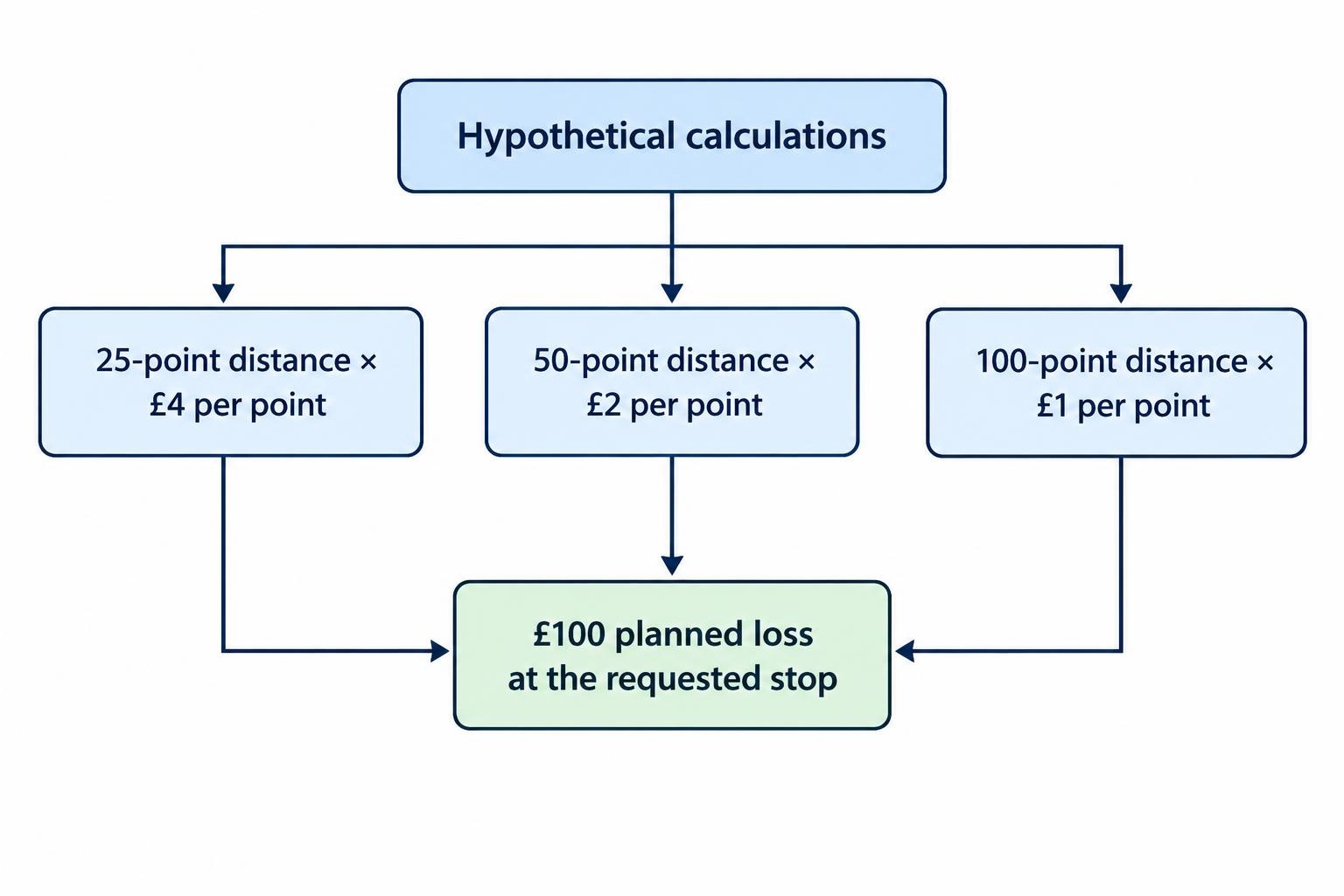
If the entry is 8,000 and the stop is 7,950, the distance is 50 points. A £2 stake per point produces a £100 price loss if the position closes exactly at the stop, before financing and any other charges.
| Entry-to-stop distance | Stake per point | Price loss at requested stop |
|---|---|---|
| 25 points | £4 | £100 |
| 50 points | £2 | £100 |
| 100 points | £1 | £100 |
The table shows why stop distance and stake must work together. A wider stop does not have to mean a larger planned cash loss, provided the stake falls enough. A tighter stop does not automatically mean lower risk if you increase the stake to compensate.
To reserve part of the budget for charges and possible adverse execution, adjust the calculation:
Stake per point = (cash risk budget − planning allowance) ÷ stop distance.
With a £100 budget, a £10 allowance and a 50-point stop, the resulting stake is £1.80 per point. That allowance is a budgeting assumption, not insurance against a larger gap. If the provider’s permitted stake increments prevent the exact amount, round down rather than up.
Use current account equity when applying a percentage rule, and include the exposure already open. The wider process is covered in position sizing for spread betting. If the smallest available stake still creates too much risk at a defensible stop distance, pass on the trade.
Place the Stop Where the Trade Idea Fails
A useful stop answers a clear question: what price behaviour would make the reason for this trade no longer valid? “I do not want to lose more than £100” establishes a cash budget, but it does not establish a meaningful market level. Position sizing connects those two decisions.
Use the Trading Setup, Not an Arbitrary Cash Amount
Suppose a hypothetical long trade depends on a support area holding. A stop below that area may fit the idea better than one placed halfway through it. For a short trade based on resistance, the same reasoning works in reverse. The stop needs to allow for the price behaviour the setup can reasonably tolerate.
That does not mean placing every stop just beyond the nearest swing high or low. A level visible on a chart is not a guarantee that price will turn there. Assess the surrounding price action and whether a brief move through the area invalidates the setup or remains within its rules.
The guide to support and resistance in spread betting covers how those areas can inform a trade. For stop placement, the main discipline is to explain why the level matters before opening the position. A round number is not a trading argument.
Allow for Volatility and Your Holding Period
A stop should fit the timeframe of the trade. An exit designed around a five-minute chart may conflict with an entry intended to follow a move over several days. Decide which timeframe governs the setup and use it consistently when assessing whether the trade has failed.
A volatility measure can provide another check. Average True Range, or ATR, measures past price ranges and can help compare a proposed stop with recent movement. It does not predict the next move or produce a universally correct stop distance.
If your rules use a multiple of ATR, test that rule rather than treating the multiplier as established wisdom. Also check whether the data reflects the session you intend to trade. A distance that fits one trading period may be poorly matched to another.
Where a defensible stop is farther away than expected, reduce the stake or reject the trade. Moving the stop inside an area the strategy expects price to revisit changes the strategy, even if the cash risk calculation looks neater.
Check the Bid, Offer and Spread Before Entering
Stop calculations must use the prices available for dealing. A long spread bet opens at the provider’s buy price and closes at its sell price. A short bet opens at the sell price and closes at the buy price. Check the provider’s trigger rules and which price your chart displays.
Take a hypothetical quote of 7,998–8,000. You buy at 8,000 and set a stop at a sell price of 7,950. The entry-to-stop distance is 50 points. At £2 per point, the planned price loss is £100. The two-point opening spread is already reflected in those dealing prices; adding it again would double count it.
A chart displaying the midpoint or a different price feed may not show the same touch that triggers your order. Spread widening can also change the dealing price without an equivalent move in the midpoint. The Financial Ombudsman’s guidance on spread betting pricing disputes addresses provider quotes and widening spreads.
Before placing a tight stop, compare its distance with the current spread. A trade that leaves little room beyond the cost of opening needs more scrutiny, not a larger stake.
Plan for Slippage and Market Gaps
An ordinary stop is not a fixed cash-loss contract. If the market moves through the trigger before execution, the closing price can be worse than the requested level. Market openings and rapid moves following news or economic data are recognised situations in which this can happen; see the Financial Ombudsman’s guidance on stop-order slippage and gapping.
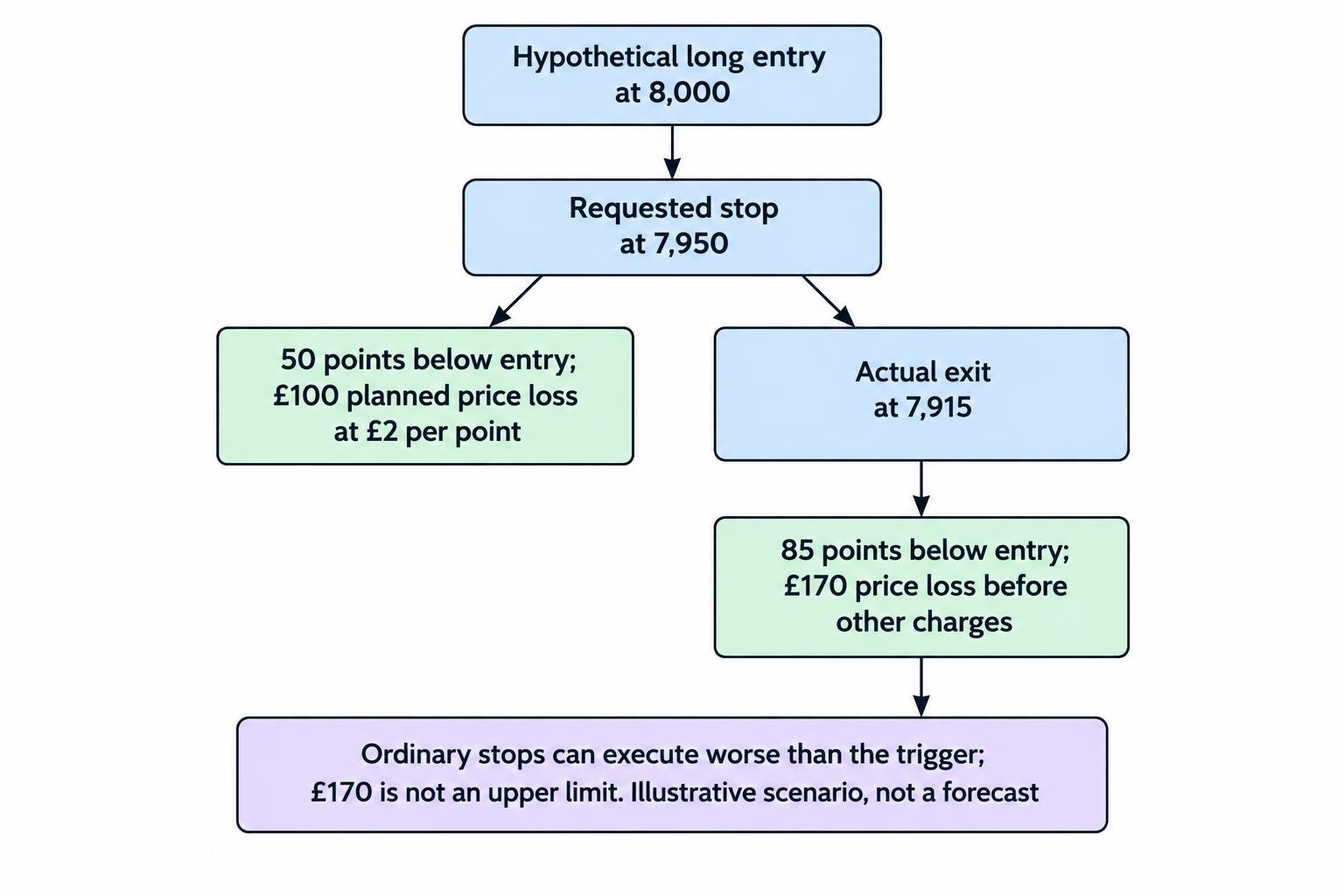
Return to the hypothetical long entry at 8,000, with a stop at 7,950 and a £2 stake. Closing at the requested level produces a £100 price loss. If the actual exit is 7,915, the loss becomes 85 points × £2, or £170, before other charges.
That example is a stress scenario, not a forecast of likely slippage. Its purpose is to test whether your account can absorb a loss beyond the planned figure. A small cash reserve cannot establish an upper bound on an ordinary stop’s execution loss.
Before holding through a market closure or scheduled announcement, reconsider the stake, the need to keep the position open, and whether another form of protection is available. The broader decisions are covered in managing market gap risk.
Do not assume a stop-limit order fixes this problem. It adds an execution-price restriction, which can leave the position open if that price is unavailable. The distinction is set out in the SEC bulletin on stop and stop-limit orders for stocks. That bulletin concerns stock orders, so check your spread betting provider’s available orders and contractual terms rather than assuming identical implementation.
Decide Whether a Guaranteed Stop Fits the Risk
A guaranteed stop offers a different form of protection: execution at the agreed stop level under the product’s terms, rather than exposure to ordinary stop slippage. Check availability, charges, minimum distances and amendment restrictions before relying on it.
Include any premium that would be payable in the cash-risk calculation. A £100 price loss plus a stop premium is not a £100 total loss. Financing or other applicable charges may also remain relevant.
The decision deserves particular attention when your reason for using a stop is a firm trade-level loss boundary rather than an approximate exit budget. The separate guide to managing risk with guaranteed stops covers those trade-offs. A guarantee on execution does not improve the quality of the entry or justify increasing the stake.
Set Rules for Moving the Stop
Decide before entry whether the stop will stay fixed, move with market structure, or trail price mechanically. Otherwise, each fluctuation invites another decision, and those decisions can drift away from the original plan.
Moving a stop closer can reduce the planned loss or protect part of an unrealised gain. It also changes the conditions under which the trade survives. Tightening simply because a position has turned profitable can close it during a pullback that the entry strategy was designed to tolerate.
Moving a stop farther away does the opposite: it increases the planned loss unless you reduce the stake. At £2 per point, widening a stop from 50 to 80 points raises the price risk from £100 to £160. Calling it “giving the trade room” does not change the arithmetic.
Do not widen a stop solely to avoid taking a loss. If new evidence genuinely changes the setup, reassess it as a fresh risk decision, including the remaining position size and total account exposure.
A move to the entry price is not automatically a risk-free trade either. An ordinary stop can still slip, and financing or other charges can leave a net loss. For rule-based adjustments, trailing stops provide another approach, but their distance and update behaviour still need to fit the strategy.
Manage Stops Across the Account, Not in Isolation
Three trades each showing £100 of risk at their stops create £300 of planned price exposure, not three separate risk decisions that can be ignored once entered. Start by adding the losses calculated at the requested stops, then consider how adverse execution could change the total.
Also examine whether the positions express the same market view. Several long index bets may respond to the same sell-off. Two positions with different names can still depend on the same currency move. Assessing portfolio correlation and spread betting risk helps avoid counting related exposures as independent protection.
Margin is a separate constraint. Under the UK retail rules, firms must close positions as soon as market conditions allow when account net equity falls below 50% of the required margin for the open positions. Retail liability for the covered investments is also restricted to funds in the relevant account. These are account-level safeguards, not a promise that each stop will hold its planned loss; see FCA COBS 22.5 on margin close-out and negative balance protection.
Keep enough available equity to support the positions under plausible adverse moves. Do not use a broker’s forced close-out threshold as your intended exit, or assume that having individual stops removes the need to monitor margin.
Use a Repeatable Stop-Loss Routine
A short routine is more useful than a complicated policy you abandon after two losing trades. Before submitting an order, check the decisions that affect the actual exposure:
- Trade invalidation: identify the price behaviour that would make the setup fail.
- Distance and stake: calculate the loss from the expected entry, then confirm it against the executed entry.
- Costs and execution: allow for applicable charges and recognise that ordinary stops can exceed the estimate.
- Order status: confirm that the stop has been accepted, covers the intended position size and uses the correct level.
- Account exposure: review other open trades, shared market risks and available margin.
- Management rules: record when you may tighten, trail or otherwise change the stop.
If you scale into a position, recalculate risk for every entry rather than using the first entry price for the whole trade. After a partial close, check that the remaining stop quantity matches the remaining exposure. Order labels and position netting can differ between platforms.
Use a spread betting demo account to practise placing and amending orders before committing money. Treat it as a workflow check, not proof that live execution during a fast market will match the simulation.
Review Whether Your Stop Rules Are Working
Record the entry, original stop, stake, planned cash risk, amendments, actual exit and charges. Separate the difference caused by execution from the difference caused by your own decisions. Widening a stop and receiving slippage are not the same problem.
Review groups of comparable trades rather than judging the rule by the last painful exit. Note whether stops repeatedly sit inside price movement your strategy expects, whether wider stops would require impractical stakes, and whether early tightening removes trades before their planned holding period.
Do not assess a change only by counting fewer stop-outs. A wider stop may reduce that count while increasing the size of losses. A tighter stop may reduce individual losses while increasing their frequency. Evaluate both sides, including costs.
The working standard is simple: every stop should have a reason, every stake should fit that stop, and every account should allow for outcomes worse than the ordinary-stop estimate. The aim is not to avoid being wrong. It is to prevent an ordinary wrong trade from becoming an unaffordable one.