Leverage risk is the danger that a relatively small market move causes a much larger percentage loss in your spread betting account. Your stake determines how much you gain or lose per point; your account equity determines how much damage that loss does to your capital.
The margin needed to open a bet is not its maximum possible loss. Confusing those two figures can turn an ordinary price movement into a serious account problem. Managing leverage means controlling exposure before you trade, allowing for imperfect exits, and checking what happens when several positions move against you together.
How leverage magnifies account losses
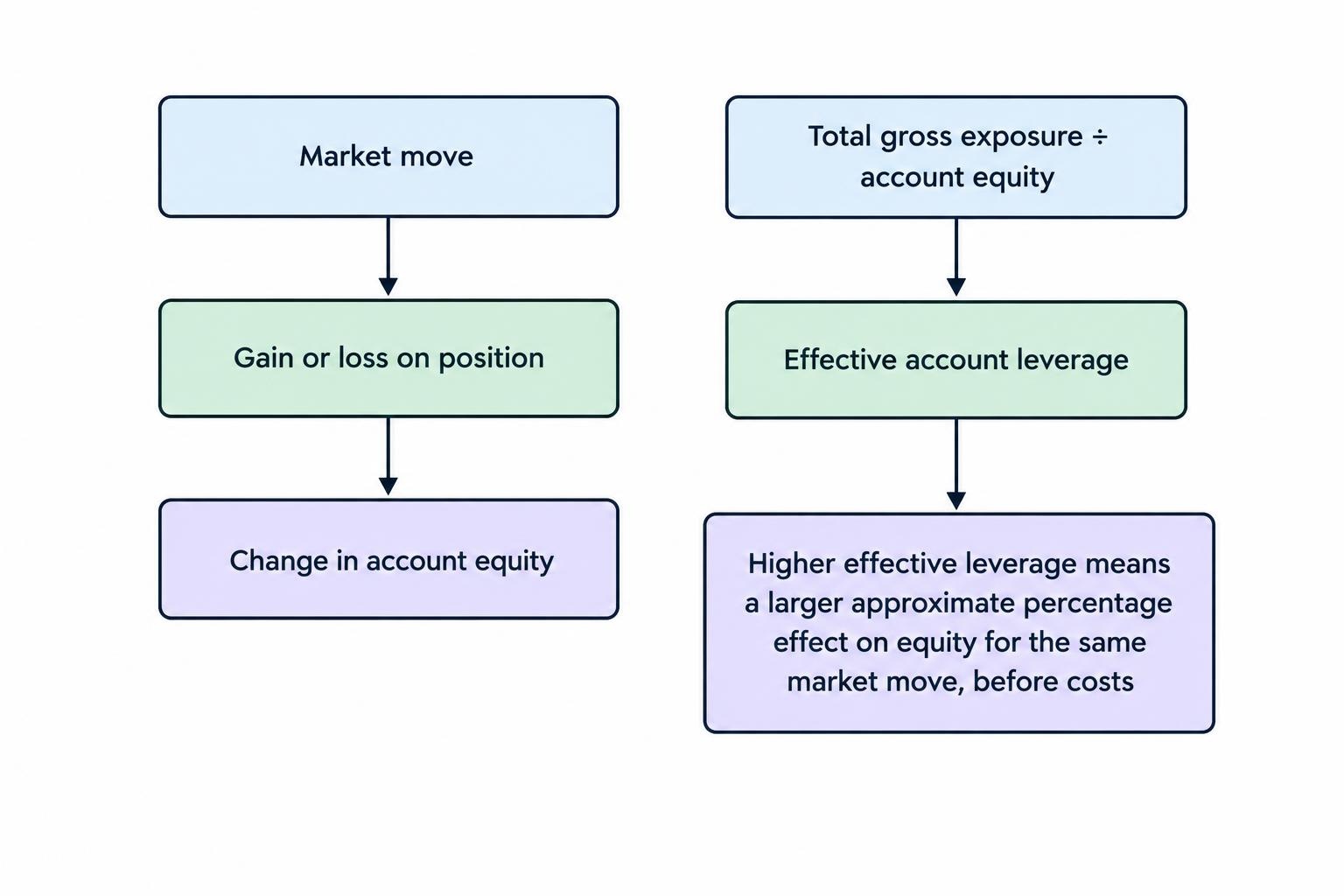
Two different leverage figures matter. The first is the exposure available relative to the margin required. The second is the exposure you actually hold relative to your account equity. This second figure, often called effective account leverage, is more useful for judging the pressure a price movement puts on your balance.
Effective account leverage = total gross exposure ÷ account equity
Account equity includes your cash balance and unrealised profits or losses, after applicable charges. Gross exposure adds the absolute exposure of your open positions rather than subtracting shorts from longs. Our explanation of how spread betting leverage works covers the mechanics behind these measures.
Consider a hypothetical index quoted at 8,000, where one betting point equals one whole index point. With £5,000 of account equity, the following stakes create very different risks:
| Stake per point | Notional exposure | Effective leverage | Loss over 80 points | Loss as percentage of equity |
|---|---|---|---|---|
| £1 | £8,000 | 1.6:1 | £80 | 1.6% |
| £2 | £16,000 | 3.2:1 | £160 | 3.2% |
| £5 | £40,000 | 8:1 | £400 | 8% |
| £10 | £80,000 | 16:1 | £800 | 16% |
These calculations exclude costs and assume each position remains open throughout the move. A fall is adverse for a long bet; a rise is adverse for a short bet. The market movement is identical in every row. Only the stake changes.
For a single linear position, the percentage change in equity is approximately the market’s percentage move multiplied by effective leverage, before costs. Leverage magnifies favourable moves too, but it does not improve the probability that your market view is correct.
Why margin is not a loss limit
Suppose the £5 per point position above requires a hypothetical 5% opening margin. Its £40,000 exposure would require £2,000 of margin, leaving part of the £5,000 account outside that requirement.
An adverse 80 point move still loses £400. That is 20% of the opening margin and 8% of account equity. The loss does not stop accumulating because it reaches the amount initially set aside as margin.
Margin answers the question, “What funds must support this position?” It does not answer, “What loss can this account comfortably absorb?” Those are separate decisions. A platform accepting an order confirms that its opening requirements have been met, not that the trade fits your risk budget.
Keeping unused funds in the account provides headroom, but those funds are not ring fenced against trading losses. The practical difference between funding requirements and capital at risk is covered in our guide to spread betting margin risk.
Set the stake from a loss budget, not buying power
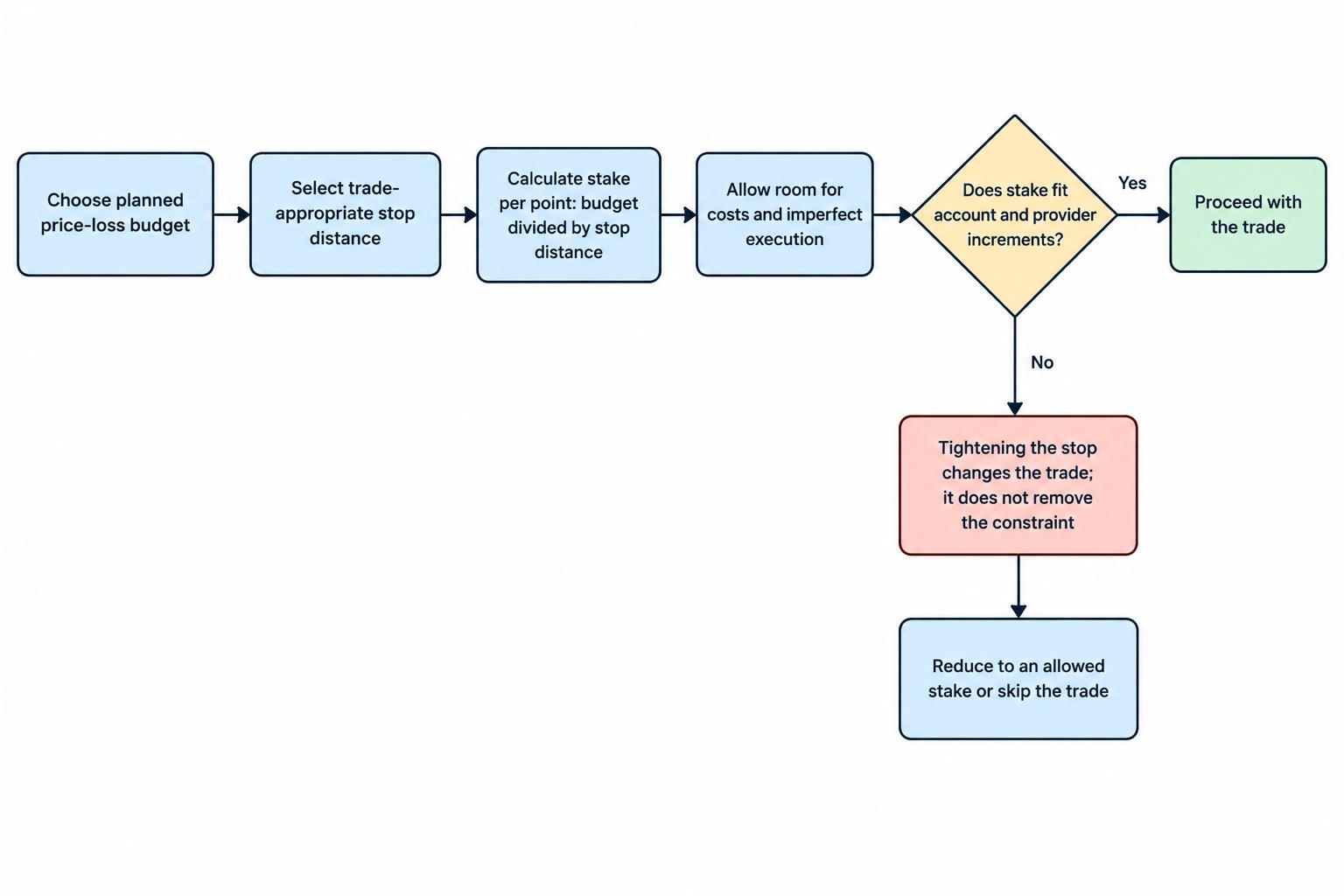
A more disciplined approach starts with the amount you are prepared to lose at your planned exit. Choose a stop location that fits the trade, then calculate a stake that fits the account. Do not start with the largest position the platform will accept and work backwards.
Stake per point = planned price loss budget ÷ stop distance in points
With £5,000 of equity, suppose you choose an illustrative £50 price loss budget and a stop 40 points from entry. The calculation gives a stake of £1.25 per point:
£50 ÷ 40 points = £1.25 per point
At an index level of 8,000, that stake represents £10,000 of exposure, or effective leverage of 2:1. A hypothetical 5% margin requirement would be £500. The £50 planned price loss and £500 opening margin describe different parts of the trade.
The £50 allowance is 1% of equity, but that percentage is an example, not a universally suitable recommendation. Costs need room within the budget, and an ordinary stop may execute at a worse price than requested.
If market conditions call for an 80 point stop, the same £50 price loss budget permits only £0.625 per point. Round down to a permitted stake rather than up. If the provider’s minimum stake makes the trade too large, skip it. Tightening the stop solely to make the arithmetic fit changes the trade, not the risk constraint.
Our guide to position sizing for spread betting develops this process across different point values and account sizes.
Losses can increase leverage without a larger stake
Effective leverage can rise even when you do not add another bet. The reason is simple: losses reduce the equity supporting the remaining exposure.
A portfolio with £40,000 of gross exposure and £5,000 of equity has effective leverage of 8:1. If equity falls to £4,000 while gross exposure remains around £40,000, leverage rises to approximately 10:1. The exact figure also changes with market prices, but the shrinking equity cushion matters.
Keeping the same pound stake after losses also increases the proportion of remaining capital at risk. A £100 planned loss is 2% of £5,000, but 2.5% of £4,000.
Recovery becomes harder as losses grow. A 10% drawdown needs an 11.1% gain to recover; a 25% drawdown needs 33.3%; a 50% drawdown needs 100%. Reducing stakes after losses can interrupt this escalation. Our guide to managing trading drawdown covers the wider response.
Stops do not remove all leverage risk
A stop order helps define an intended exit, but an ordinary stop does not guarantee the execution price. Fast movement, thin trading conditions or a market reopening beyond the stop can produce a larger loss than the calculation used to size the trade. The distinction matters most when a small pricing difference represents a large share of equity.
Use stop losses as part of a risk plan, not as permission to take a position that would otherwise be too large.
Return to the long bet opened at 8,000 with a £1.25 stake and a stop at 7,960. Its planned price loss is £50. If the market gaps lower and the order instead executes at 7,900, the 100 point loss is £125 before costs. The stake has not changed, but the realised loss is two and a half times the plan.
A guaranteed stop can fix the exit level under its contractual terms, usually with a premium and restrictions such as minimum distances. Check availability and conditions before placing the trade. Where no guarantee applies, allow for market gap risk when deciding whether the exposure is acceptable.
Stress testing should include a worse exit than the stop price, especially if the position will remain open through an announcement or a market closure.
Several positions can be one concentrated bet
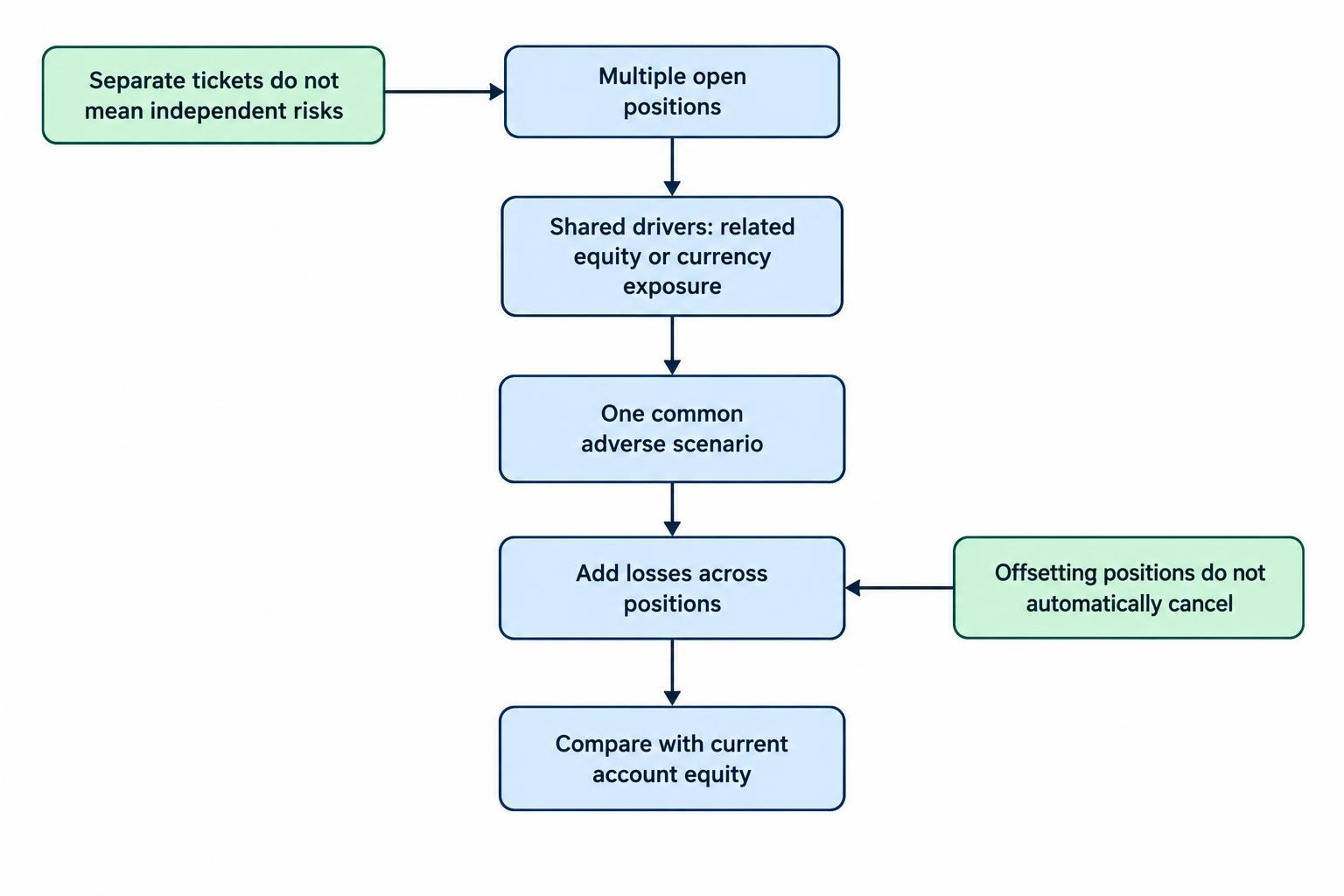
Counting tickets is not the same as measuring diversification. Long positions in a technology index, a broad equity index and several technology shares may all depend on similar market conditions. Separate order numbers do not make their risks independent.
Currency positions can overlap too. A long EUR/USD position and a long GBP/USD position both include exposure to a weakening US dollar. Treating each as an unrelated trade can understate the combined loss if the dollar strengthens.
Review total gross exposure, then group positions by their shared drivers. Ask what happens if equities fall together, the dollar strengthens, or a commodity moves sharply against every related position.
Do not simply subtract a short in one market from a long in another and assume the remaining number captures the risk. Their relationship may change, and their gains and losses may not offset. Our guide to portfolio correlation and spread betting risk explains how to assess that overlap.
A useful stress test adds the losses from a common adverse scenario across all positions, then compares the total with current equity.
Costs can consume the equity supporting exposure
Leverage also changes how trading costs feel at account level. A charge that looks small relative to notional exposure may be much larger relative to the capital supporting it.
For illustration, a hypothetical £5 daily funding debit on a £5,000 account equals 0.1% of equity each day. Over ten chargeable days, £50 would consume 1% of starting equity before any market loss. This is arithmetic, not a quoted provider rate.
Where a product carries overnight financing, check the calculation basis, rate and charging schedule. Do not assume funding is charged only on the opening margin. Our guide to overnight financing costs covers the details.
Spreads and any other applicable charges also reduce equity. A position can therefore become harder to support even when its underlying market has moved very little. A longer holding period belongs in the risk calculation, not just the trading thesis.
What UK retail protections do and do not cover
For UK retail financial spread bets within scope, the FCA’s margin, close-out and negative balance protection rules establish several safeguards. They set minimum opening margins by asset class, require account-level close-out when net equity falls below 50% of required margin as soon as market conditions allow, and restrict liability to the funds dedicated to the account’s relevant speculative investments.
The close-out threshold is not 50% of your original deposit. In a simplified example with £5,000 starting equity and an unchanged £1,000 required margin, half the margin requirement is £500. Reaching that level would mean losing £4,500, ignoring costs and any earlier closure.
Negative balance protection does not protect every pound deposited from trading losses. Funds dedicated to the relevant trading account can still be lost. Nor does the close-out rule promise execution at an exact price during a gap.
Professional classification or a move to an offshore entity can remove protections available to UK retail clients. The FCA warning about giving up retail protections addresses both risks. Access to higher leverage is not, by itself, a sound reason to change classification or contracting entity.
Check exposure before increasing leverage
There is no leverage ratio that makes every trade safe. The same ratio can produce very different losses across markets with different volatility, trading hours and gap behaviour. A planned exit, portfolio overlap and holding costs all affect the result.
Before opening or increasing a position, check:
- Account sensitivity: What would a 1%, 2% or larger adverse market move cost in pounds and as a percentage of current equity?
- Exit risk: What loss would occur if execution were worse than the planned stop?
- Combined exposure: Which other positions could lose money in the same scenario?
- Funding headroom: Could losses and charges bring the account close to forced closure?
- Decision discipline: Is the stake based on a written budget, or on an urge to recover previous losses?
Adding cash can reduce effective leverage if exposure stays unchanged, but it does not reduce the pounds lost per point. Reducing the stake does. Repeatedly topping up an oversized position can put more savings at risk without repairing the original decision.
Keep leverage within a wider spread betting risk management plan. The useful question is not how much exposure the account can open. It is how much adverse movement the account can absorb without forcing an unplanned decision.