A trading drawdown is the fall in account equity from a previous peak. Managing it means deciding, before losses build, how much risk to remove, when to stop opening positions and what evidence you need before trading again.
The aim is not to avoid every losing spell. It is to prevent a manageable decline from becoming an account threatening loss. A drawdown plan turns that aim into rules: measure the damage accurately, reduce exposure when required and investigate the cause without trying to win everything back by Friday.
Financial spread betting carries a high risk of loss and is not suitable for every retail trader. The FCA’s information on CFDs and spread betting sets out the product risks and retail protections. Those protections do not make trading capital safe.
Drawdown controls belong within a broader spread betting risk management plan, rather than being invented after an uncomfortable afternoon.
Measure Drawdown From Account Equity
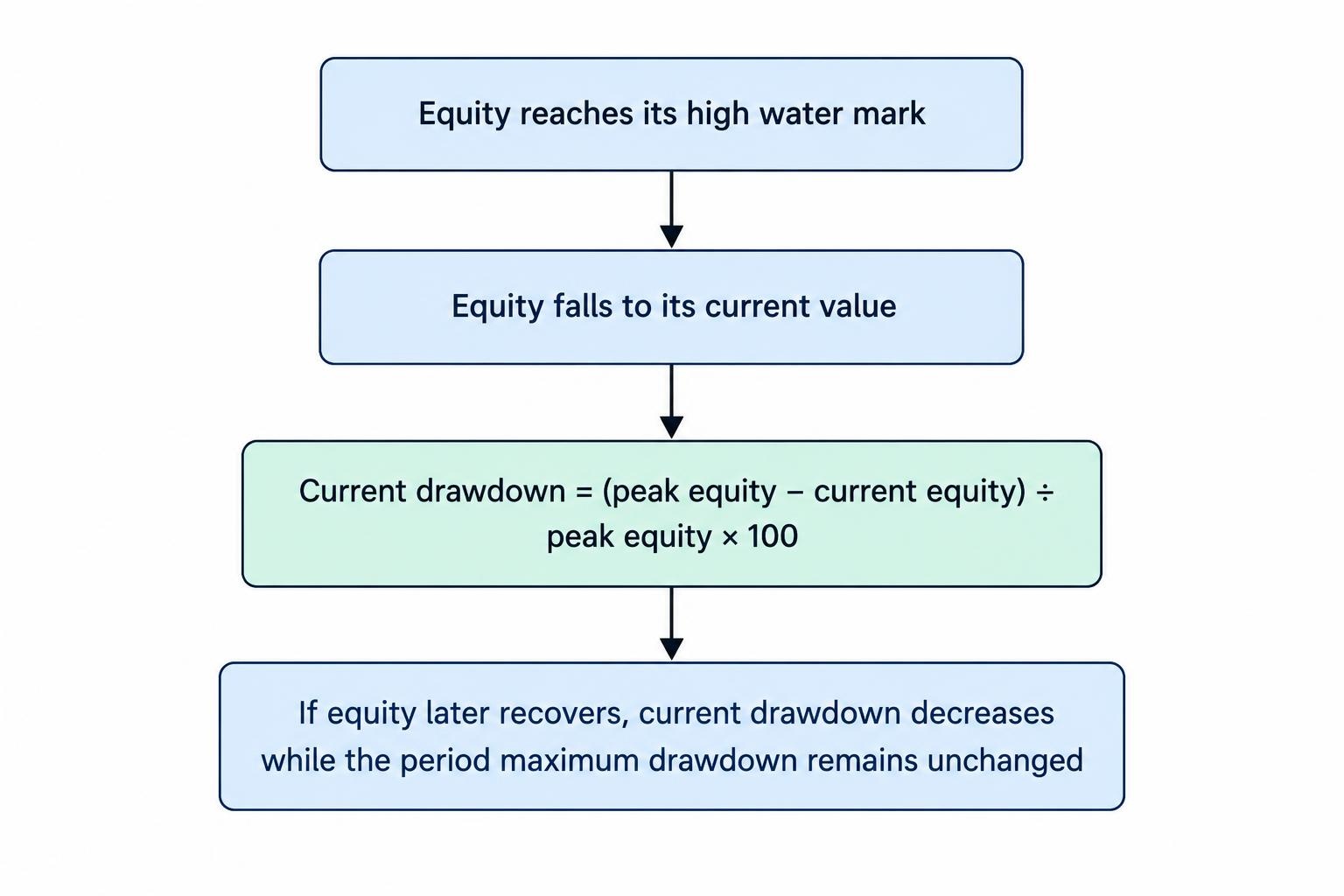
Your equity high water mark is the highest account value recorded under your chosen measurement method. Current drawdown measures the decline from that peak to the present value. Maximum drawdown is the largest decline from a peak to a subsequent trough within the period being examined, a distinction formalised in research on drawdown risk.
For an account without deposits or withdrawals during the measurement period:
Current drawdown (%) = (peak equity − current equity) ÷ peak equity × 100
Suppose an account starts at £10,000, rises to £10,800 and then falls to £9,720. The loss from the peak is £1,080, giving a drawdown of 10%. Measuring only against the opening deposit would hide much of that decline.
If equity then recovers to £10,260, current drawdown falls to 5%. Maximum drawdown remains 10% for that recorded period. The account is above its starting value but still below its peak. Both statements can be true.
Keep the measurement window consistent. A monthly maximum drawdown, a rolling twelve month maximum and an account’s lifetime maximum describe different records. Resetting the window after a bad spell makes the number prettier, not the trading better.
Use Equity, Not Just Closed Trade Results
Account balance records cash movements and settled results. Equity also reflects unrealised profit and loss on open positions. A trader can show a stable balance while carrying a large floating loss.
For live risk control, use equity valued at the prices available to close positions. Include charges already booked to the account and allow for costs still to come. If the platform’s valuation already reflects the bid and offer, do not subtract the spread again.
A closed trade report remains useful for reviewing execution, but it cannot show every risk experienced while positions were open. Keep it alongside the equity record. The guide to calculating spread betting profit and loss covers the underlying trade calculations.
Separate Trading Performance From Cash Transfers
A deposit is not a recovery. If equity falls from £10,000 to £9,000 and you deposit £1,000, the displayed account value returns to £10,000, but the trading loss has not disappeared.
Withdrawals need the same care: taking money out should not be recorded as a trading loss. Maintain a cash flow adjusted performance series, such as a unitised equity index, alongside the actual pounds available in the account. The former measures performance; the latter determines what you can afford to risk now.
Also record when equity is measured. End of day observations can miss a sharper intraday decline. Use a consistent reporting schedule, supported by live equity alerts for risk decisions.
Why Recovering a Loss Takes a Larger Percentage Gain
A percentage loss and the gain needed to reverse it use different starting amounts. After a loss, the recovery starts from a smaller account.
| Drawdown | Remaining equity | Gain needed to recover |
|---|---|---|
| 10% | £9,000 | 11.1% |
| 20% | £8,000 | 25.0% |
| 30% | £7,000 | 42.9% |
| 40% | £6,000 | 66.7% |
| 50% | £5,000 | 100.0% |
The calculation is:
Recovery gain (%) = drawdown (%) ÷ [100 − drawdown (%)] × 100
This arithmetic supports acting before a decline becomes severe. It does not justify chasing a recovery target. The market does not owe an account its previous high, and increasing stakes does not improve the quality of the next trading opportunity.
Drawdown duration matters too. Record how long the account has remained below its previous peak, not just how far it has fallen. A shallow decline lasting months can still tie up capital and expose weaknesses in the approach.
Write Your Drawdown Rules Before You Need Them
A useful policy connects an equity threshold to an action. “Be more careful” is not an action. “Reduce the maximum planned loss on each new position and stop adding correlated exposure” can be checked.
Set thresholds around money you can afford to lose, the strategy’s tested behaviour, trading costs and the practical size of available bets. There is no universal acceptable drawdown. A percentage that suits one trading allocation may be financially unacceptable for another.
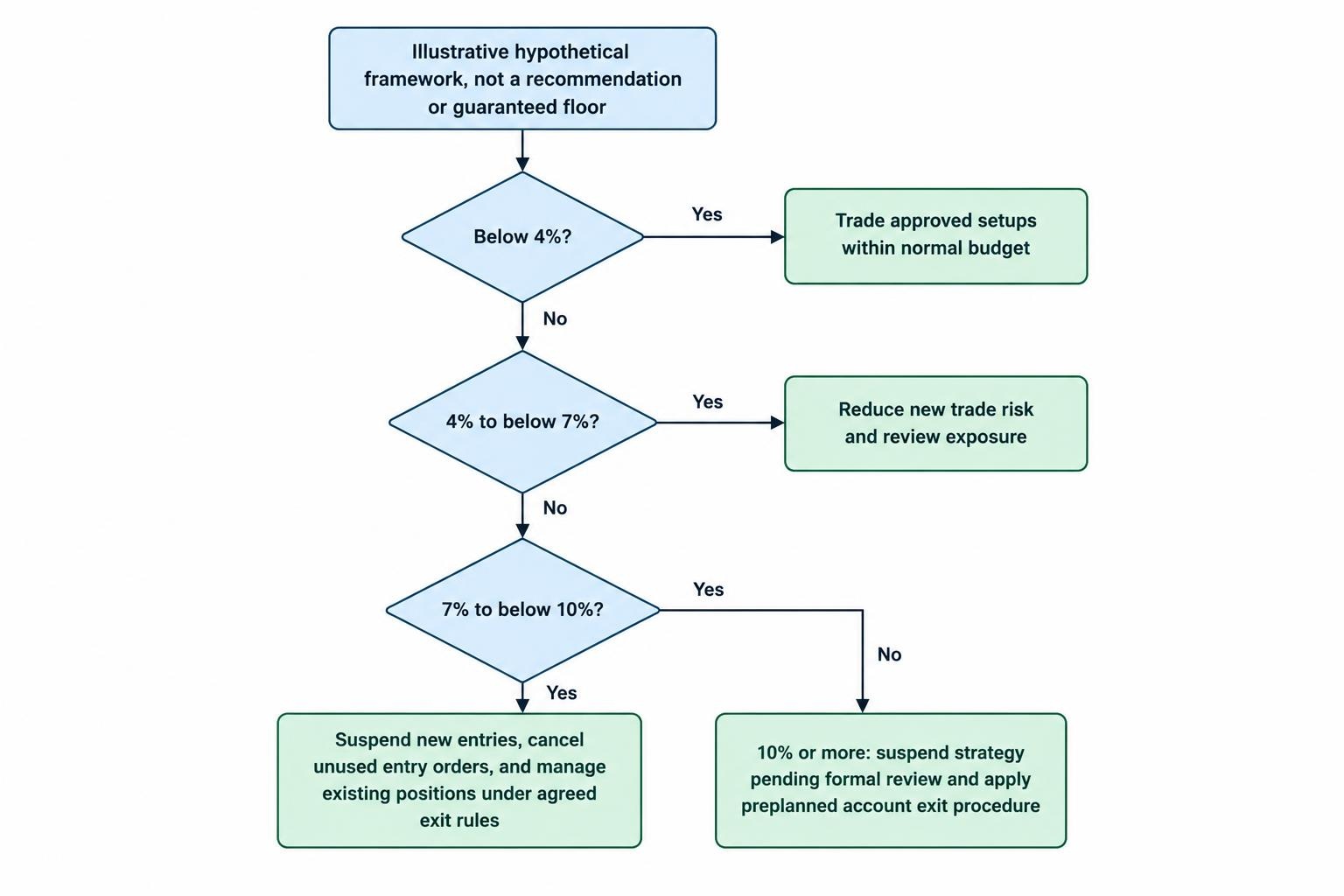
The following is a hypothetical policy, not a recommendation or a set of safe loss levels. It assumes a £10,000 equity peak and no cash transfers.
| Drawdown from peak | Equity level | Prewritten response |
|---|---|---|
| Below 4% | Above £9,600 | Trade only approved setups within the normal risk budget. |
| 4% to below 7% | £9,301 to £9,600, approximately | Reduce new trade risk and review exposure before each entry. |
| 7% to below 10% | £9,001 to £9,300, approximately | Suspend new entries, cancel unused entry orders and manage existing positions under the agreed exit rules. |
| 10% or more | £9,000 or less | Suspend the strategy pending a formal review and apply the preplanned account exit procedure. |
These are action triggers, not guaranteed floors. Existing positions, gaps and execution delays can carry equity through a threshold. If £1,000 is the maximum tolerable monetary loss, waiting until the account has already lost £1,000 leaves no allowance for those risks.
Define what happens to open positions at every stage. A pause on new entries does not remove existing exposure. State whether positions retain their original exits, must be reduced or must be closed, and how pending orders will be handled.
Daily and weekly loss controls can sit alongside the peak equity rule. Keep their purpose clear: a daily control addresses a damaging session; a drawdown rule addresses the account’s decline across sessions. A fresh trading day should not automatically restore a risk allowance that the wider drawdown policy has removed.
Reduce Stake Size as Equity Falls
Keeping the same pound risk after losses increases the percentage of remaining equity at risk. A £100 planned loss equals 1% of a £10,000 account, but 1.25% of an £8,000 account.
Using a fraction of current equity reduces that escalation. A drawdown policy can go further by reducing the fraction itself. In a hypothetical account with £9,600 equity, a 0.5% risk allowance would be £48; cutting the allowance to 0.25% would reduce it to £24. Neither figure is automatically suitable.
The relationship for a simple position is:
Stake per point = money allocated to price risk ÷ stop distance in points
If the total trade budget is £24, with £4 reserved for expected charges and execution uncertainty, £20 remains for price risk. A 40 point stop would imply a stake of £0.50 per point. The reserve is an estimate, not protection against every possible fill.
Place the stop where the trading idea is invalidated, then calculate the stake. Do not squeeze the stop closer just to preserve a larger bet. The full position sizing process for spread betting should remain consistent during a drawdown.
Minimum stakes can make a proposed trade too large for the reduced budget. In that case, skip it. A platform’s minimum deal size is not permission to exceed your own risk allowance.
Simple compounding shows why sizing matters. Ten consecutive losses of exactly 1% of current equity reduce an account by about 9.6%. At 2% each, the decline is about 18.3%, before any extra costs or execution differences.
Control Combined Exposure, Not Just Individual Bets
Small individual positions can still create a large account risk when they respond to the same event. Long bets on several equity indices may amount to repeated exposure to the same broad market direction.
Review positions by their likely loss drivers. Ask what could happen if equities fall together, sterling moves sharply or a scheduled announcement moves several markets at once. Different instrument names do not guarantee different risks.
The guide to portfolio correlation and spread betting risk covers that distinction. During a drawdown, avoid treating each new trade as though the rest of the account did not exist.
Distinguish risk from the original entry price from risk remaining at current prices. A stop above the entry on a profitable long position may protect a gain, yet the account can still surrender equity between the current quote and that stop. That potential giveback matters when measuring risk from today’s equity.
Adding together planned stop losses is a useful first check, not a worst case guarantee. Also consider a scenario in which several positions move adversely and ordinary stops fill beyond their requested levels.
Find Out What Is Causing the Drawdown
A declining equity curve tells you that money has been lost. It does not, by itself, tell you whether the cause is ordinary variation, poor execution, excessive size or a strategy that no longer performs as expected.
Separate those questions before making changes. Otherwise, you risk abandoning a properly executed approach after an ordinary losing spell, or defending a broken approach by calling every loss “part of the process”.
Check Whether the Trading Rules Were Followed
Compare each trade with the written entry, sizing and exit rules. Record whether it qualified, whether the stake was correct and whether the exit followed the plan. Separate valid losses from avoidable rule breaches.
A run of compliant losing trades needs a different response from impulsive entries and widened stops. The guide to managing losing streaks addresses the sequence of losses; drawdown management adds the account level decision about how much exposure can remain.
If rules are being broken, reduce or suspend live trading while addressing the behaviour. Repeatedly changing indicators will not solve a habit of doubling the stake after a loss.
Compare Like With Like
Review results using comparable stake sizes, costs, markets and holding periods. A strategy tested with daily observations cannot provide a clean comparison with live intraday equity swings.
Do not treat the largest historical drawdown as a future ceiling. Backtests benefit from hindsight and may misrepresent liquidity, slippage and the difficulty of following rules with real money at risk. These weaknesses are addressed in the NFA notice on hypothetical trading results.
Examine whether the recent losses cluster around a market condition or execution problem. A range trading approach repeatedly losing during sustained directional moves raises a different question from a sound setup suffering unusually poor fills. Any proposed change should be tested separately rather than fitted to the last few losses.
Review Results After All Costs
Break the decline into trading results and charges. Spreads, financing and other fees can turn a small gross gain into a net loss, particularly when positions are opened frequently or held longer than planned.
Use a total spread betting cost comparison rather than judging the account by entry spreads alone. Identify whether the intended holding period still makes sense after the actual charges.
Reducing stake size controls the amount exposed. It does not repair a strategy with negative results after costs. That distinction should determine whether the next step is smaller trading, further testing or stopping altogether.
Do Not Confuse Stops or Margin Protection With a Drawdown Limit
A stop loss controls an individual position’s exit instructions. An account drawdown rule controls the amount of capital you are prepared to expose across positions and over time. You need both levels of decision.
Ordinary stop orders may execute beyond the requested price during gapping or slippage. Their treatment depends on the contract and market conditions, matters covered by the Financial Ombudsman’s guidance on spread betting execution disputes. A calculated stop loss is therefore a planned loss, not an assured maximum.
Keep a consistent method for managing position risk with stop losses. Moving an exit further away because the account is already down increases exposure precisely when the drawdown plan may require less.
Where available, assess the charges and contractual conditions of guaranteed stop protection. Protecting one exit price does not prevent an account from losing money through repeated stopped trades or accumulated costs.
For UK retail accounts covered by the relevant rules, firms must close open positions as soon as market conditions allow when net equity falls below 50% of the required margin. Negative balance protection also caps liability for the covered investments at the funds in the account. Both requirements appear in the FCA’s retail margin close out and negative balance rules.
That 50% is not a drawdown allowance. If the required margin is £4,000, its 50% reference level is £2,000 of net equity. It does not mean an account with a £10,000 peak will be closed after losing £5,000.
Keep your own action thresholds separate from the margin close out rule. Account level protection can still leave the trading funds exhausted; it is no substitute for an earlier decision to reduce risk.
Restart With Evidence, Not a Recovery Deadline
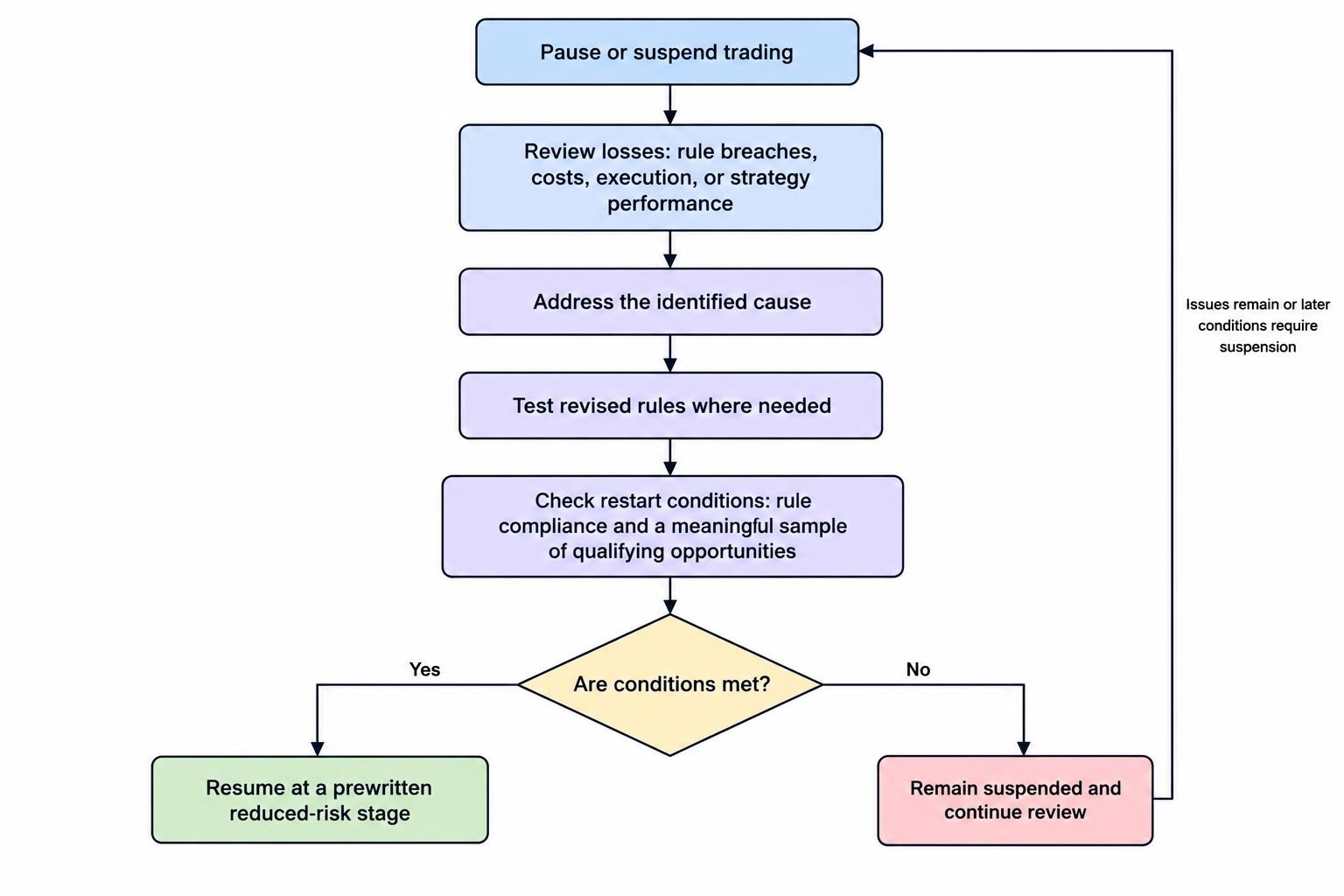
A pause should have a purpose and a restart condition. “I feel ready” is difficult to audit. A documented explanation of the losses, corrected sizing and a tested execution process provide a firmer basis.
Check that the cause has been addressed. If losses came from rule breaches, require evidence of compliance. If costs were miscalculated, rebuild the results after those charges. If the strategy’s behaviour changed, test the revised approach before committing further capital.
A spread betting demo account can help rehearse order handling and check that revised rules are workable. Treat simulated profits cautiously: they do not establish that the same outcome will occur with live execution and real financial pressure.
If live trading resumes, use a prewritten reduced risk stage. Judge it on execution quality, rule compliance and results after costs across a meaningful sample of qualifying opportunities. One winning trade is not evidence that the problem has gone away.
Set the conditions for increasing risk before the restart. Those conditions might include a review date, an adequate trade sample and no unresolved rule breaches. Define what sends the strategy back into suspension too.
Avoid a fixed deadline for returning to the old equity peak. Such a deadline can turn an ordinary decision about the next trade into an attempt to repair the whole account at once.
Keep a Record That Supports the Next Decision
A drawdown log should be short enough to maintain and complete enough to explain what happened. Record equity and its high water mark, current and maximum drawdown, time below the peak, cash transfers, open exposure and the action required by your policy.
Alongside those figures, note whether trades followed the plan and whether charges or execution differed from expectations. Record the decision made at each threshold. This creates an audit trail rather than a collection of explanations written after prices recover.
Do not erase the record by opening another account, depositing replacement funds or relabelling the same approach. A genuinely new strategy can have a separate performance record, but the earlier losses still belong in the assessment of total trading capital.
Stopping is a valid outcome. If the strategy cannot justify further risk, the stake required is too large or the losses affect money needed elsewhere, there is no obligation to trade back to breakeven.
Managing drawdown means keeping control of the next decision while accepting the loss already incurred. Measure equity honestly, reduce exposure when the plan requires it and demand evidence before adding risk again.