Overtrading in spread betting means taking more trades than your strategy, risk budget or decision process can justify. It includes entering weak setups, repeatedly reopening a stopped position, and increasing activity because you want to recover a loss. The problem is not simply a high trade count. It is trading without enough reason.
The practical response is to make trading permission explicit: define what qualifies as an entry, how much risk remains available, and what ends the session. “Be more disciplined” is not much of a rule. A written restriction you can check before placing an order is far more useful.
Spread betting remains high risk even with careful controls; reducing unnecessary activity does not make it safe. The FCA’s warning on spread betting and other CFD products makes clear that these products are not suitable for all retail consumers.
What Counts as Overtrading?
There is no universal number of trades that separates sensible activity from overtrading. A trader following a tested intraday method may take several qualifying entries. Someone using a slower strategy might overtrade by opening just one position that their rules do not permit.
The distinction is whether each decision has a valid purpose. A planned entry, a protective exit and a scheduled reduction in exposure are not equivalent to three impulsive bets. Count decisions and trade ideas, not just the number of order confirmations.
This matters when assessing scalping with spread bets. Frequent trading is part of that approach, but frequency does not excuse weak entries or costs that consume the expected return. Conversely, closing a position to control risk is not overtrading simply because it creates another transaction.
Use a straightforward test: would you take this trade, at this stake, if your previous result were hidden? If the answer changes because you are down £100 or pleased with three consecutive winners, pause before submitting the order.
Why Unnecessary Trades Become Expensive
Each additional completed trade must overcome its trading costs. Repeatedly entering and exiting can turn small price movements into a steady drain, even when the account appears to be going nowhere.
Consider a hypothetical index market with a constant 1.2-point spread and a £2 stake per point. If the quoted market does not move between entry and exit, the spread represents a £2.40 loss per completed trade.
| Completed trades | Spread cost per trade | Combined spread cost |
|---|---|---|
| 4 | £2.40 | £9.60 |
| 10 | £2.40 | £24.00 |
| 20 | £2.40 | £48.00 |
These figures isolate the spread. They exclude price gains and losses, slippage, financing and any other applicable charges. Actual spreads can change. The calculation also treats the spread as one cost per completed trade, not a full spread charged twice.
A cheaper quote helps, but it does not rescue an entry with no defensible rationale. Review spread betting costs alongside trade frequency rather than treating them as separate issues.
Evidence from share dealing supports caution about excessive turnover. In Barber and Odean’s research on household trading and investment returns, the most active households earned poorer net returns than the average household. The study used share accounts from 1991 to 1996, not spread betting accounts, so it does not establish an optimal trade count for spread bettors.
Do not subtract an estimated spread cost again from profit and loss already calculated using actual opening and closing prices. Those prices already reflect the spread. A cost estimate helps explain performance; it should not create a second charge in your records.
Recognise the Change in Your Decision Process
Overtrading is easier to spot through changes in behaviour than through a fixed daily number. Watch for an entry standard that gets weaker as the session continues. A setup that needed a confirmed breakout at the start of the day becomes “close enough” after an hour of waiting.
Another warning is repeated entry around the same failed idea. Reopening after a stop can be legitimate if your strategy defines a fresh signal. Reopening because the market “must turn here” is a different decision, even if the chart looks familiar.
Check stake changes too. Moving from £1 to £3 per point after a loss may leave your trade count unchanged while tripling the exposure of the next bet. Avoiding excessive activity therefore requires control over both frequency and size.
Common prompts worth recording include boredom, frustration after a missed move, the urge to recover a loss, and confidence after a profitable run. Treat these as journal observations, not excuses. The wider subject of spread betting psychology deserves attention, but the immediate task is simpler: identify which prompt preceded the rule breach.
Set Rules Before the Session Starts
A useful anti-overtrading plan removes decisions from the moment when you most want another trade. Keep it short enough to consult before an order. If checking the rules requires opening a lengthy document, simplify the working version.
Define What Qualifies as an Entry
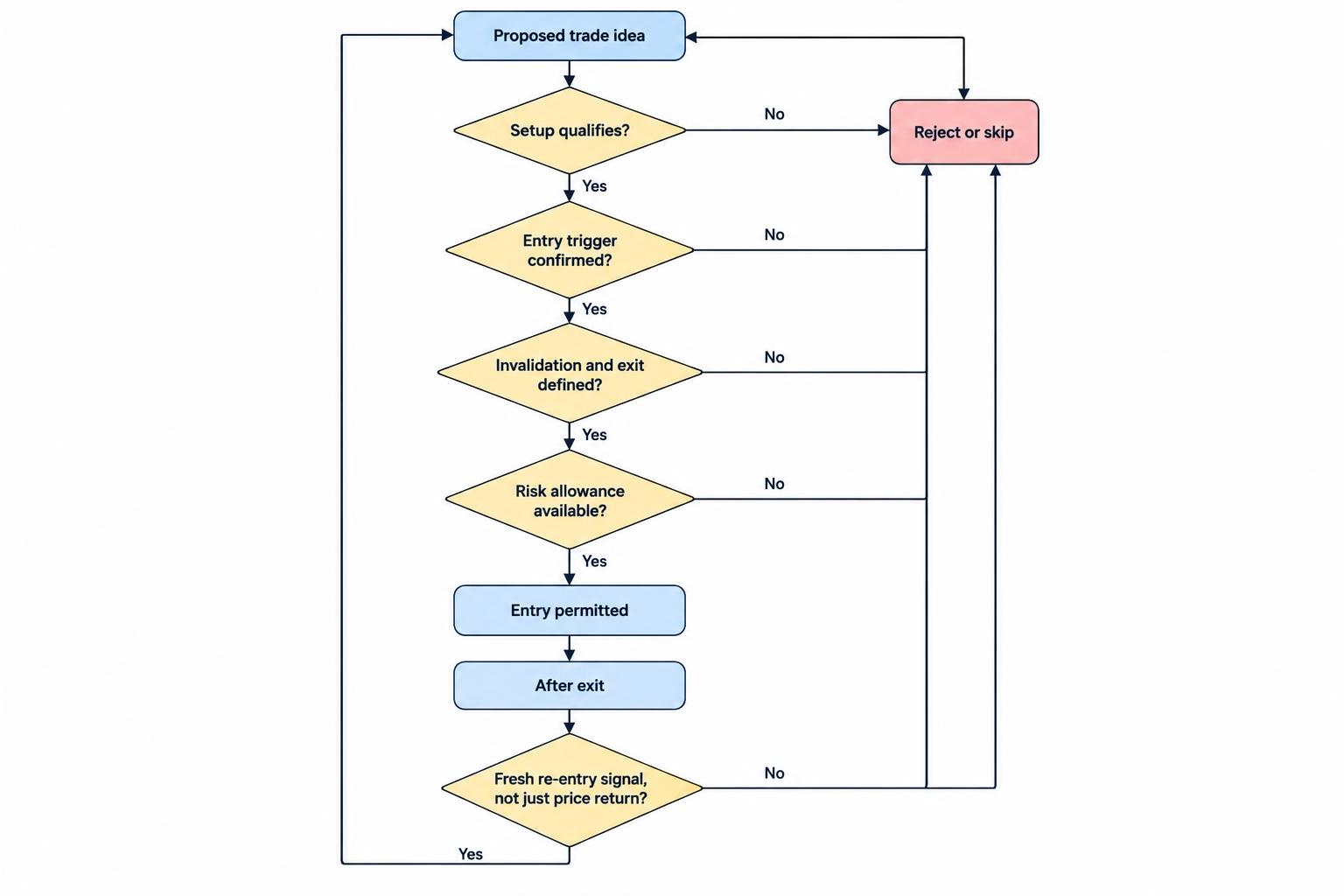
Write down the conditions that must exist before you trade. These should cover the setup, entry trigger, invalidation point and exit method. Include any market conditions that make the setup unacceptable, such as a spread above your chosen threshold.
“Buy near support” leaves plenty of room for improvisation. “Buy only after the planned confirmation, with the invalidation level identified before entry” creates a decision you can review later. The exact confirmation belongs to your strategy; the control is requiring it consistently.
Give re-entry its own rule. State what must change after an exit before the same idea becomes eligible again. A fresh signal is not simply the price returning to your previous entry.
If a setup fails one required condition, label it rejected. Do not keep adjusting the description until it qualifies. A busy order history is not a productivity report.
Set a Risk Budget, Not Just a Trade Budget
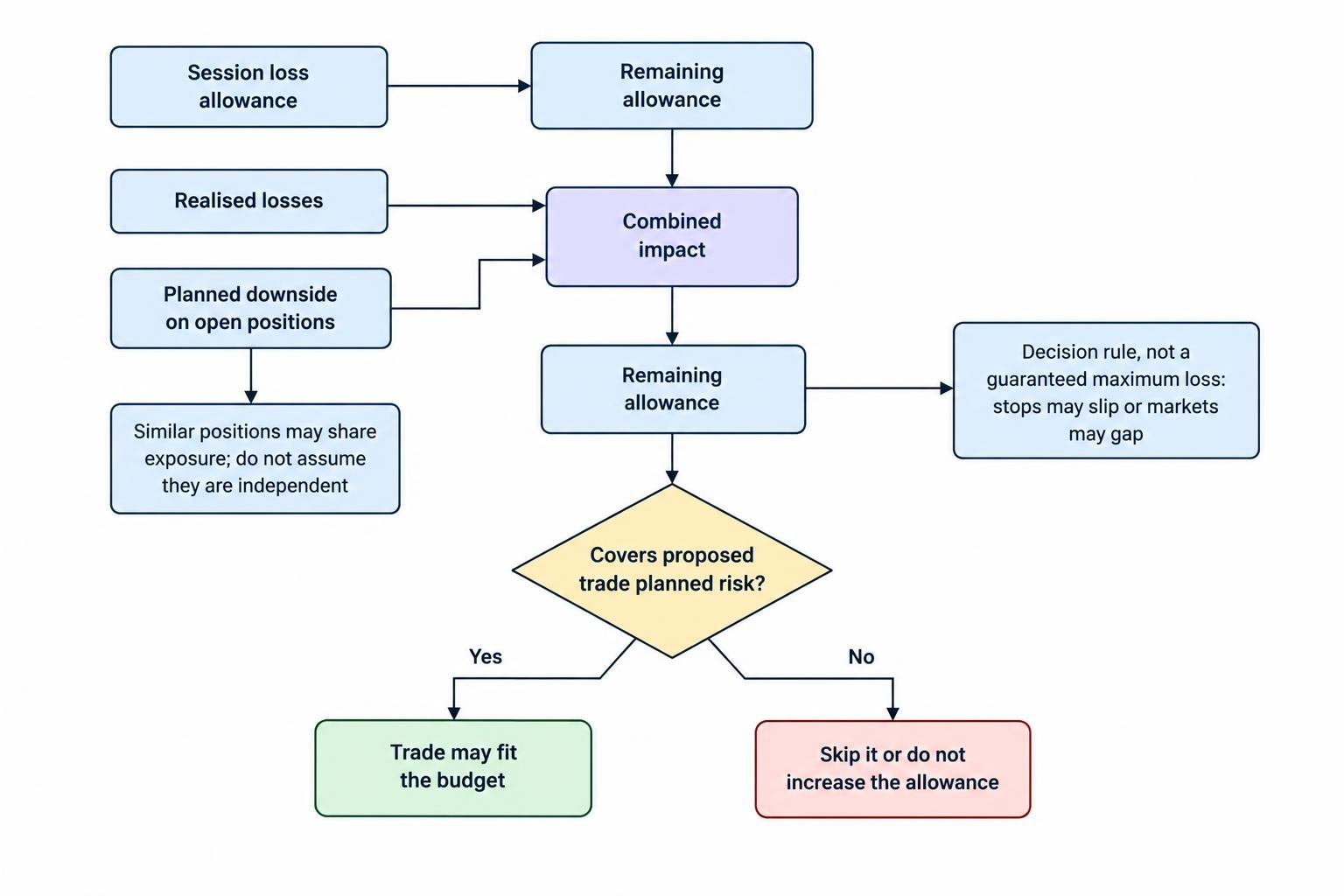
Choose the maximum planned loss per trade and for the session before placing the first order. These amounts must fit money you can afford to lose. Any numerical example is a planning illustration, not a suitable allowance for every account.
Suppose a trader sets a £25 planned loss allowance. With a stop 10 points from the intended entry and £5 reserved for costs and execution uncertainty, the remaining £20 permits a £2 stake per point. The calculation connects activity to a cash amount rather than to whatever margin happens to be available.
Use position sizing for spread betting to calculate the stake from the intended risk. If the platform’s minimum stake exceeds the allowance, skip the trade rather than increase the budget to accommodate it.
Ordinary stops do not guarantee the exit price. Slippage or a market gap can produce a larger loss than planned, so a session limit is a decision rule, not an absolute financial ceiling.
Include open positions when checking the remaining budget. If a hypothetical £75 session allowance already has £50 of realised losses and £20 of planned downside on open positions against it, only £5 remains. Earlier profits should not automatically grant permission to expand the original allowance.
Also check whether apparently separate entries share the same market exposure. Three similar index positions can behave like one larger bet. The guide to portfolio correlation and spread betting risk covers that problem without relying on trade count alone.
Use a Trade Cap as a Ceiling
A maximum number of trade ideas can provide a useful administrative brake. Set it around your strategy and review records, rather than copying another trader’s number.
Define what counts. If one idea is split across three entries, record both the single idea and the three executions. Otherwise, splitting orders or opening another account can disguise the same behaviour.
The cap is not a quota. Permission to take up to three ideas does not mean you need to find a third. If no setup appears there is nothing to complete.
Do not raise the cap during the session because conditions suddenly feel promising. Review any proposed change later, using records rather than the appeal of the next chart.
Write a Pause Rule and an End Rule
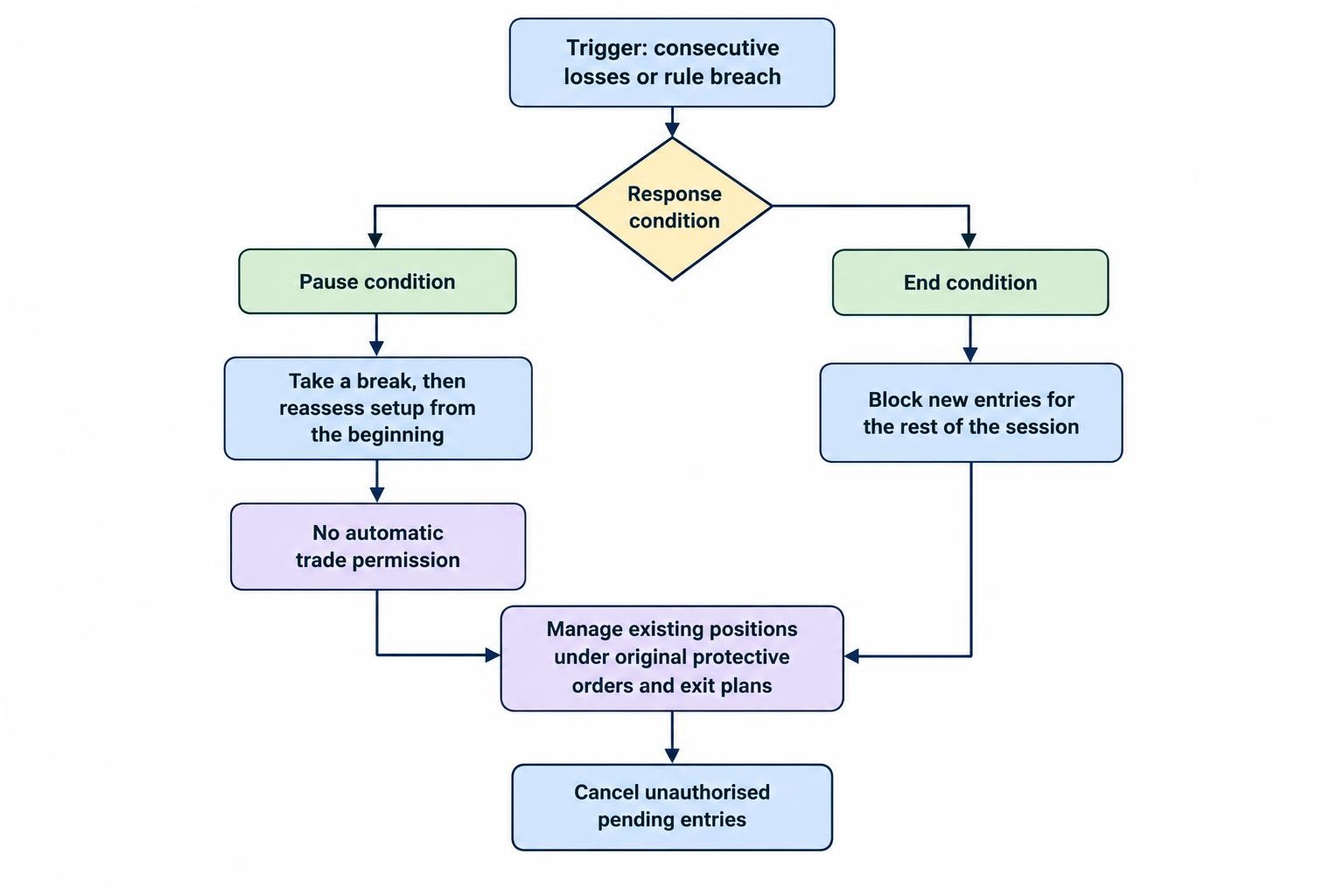
A pause interrupts the sequence between one result and the next decision. An end rule removes permission to open more positions for the rest of the session.
An illustrative policy might require a 20-minute break after two consecutive losses and end new entries after a deliberate rule breach. Those thresholds are not proven optimal. Their purpose is to make the response predetermined and observable.
After the break, reassess the setup from the beginning. Waiting 20 minutes is not itself a reason to trade. Keep the broader process for managing losing streaks separate from the urge to recover today’s balance.
Stopping new entries does not mean abandoning existing positions. Continue managing protective orders and exits under the original plan. Cancel pending entries that are no longer authorised.
Control Screen Time and Trading Prompts
Set trading windows that match your method and availability. Outside those windows, use planned price alerts instead of repeatedly checking charts for something to do. An alert should prompt assessment, not an automatic order.
There is direct experimental evidence that app design can affect activity. In a study involving more than 9,000 consumers, push notifications and points with prize draws increased trading frequency. The FCA trading-app experiment tested these features in an experimental setting; it was not a measurement of your broker or your likely returns.
Turn off promotional prompts that do not serve your written process. Retain account security, margin and order notifications. Adding friction to new entries can be useful, but never make protective exits harder to execute.
Avoid imposing a daily profit requirement. A cash target can pressure you to manufacture opportunities when the strategy offers none. Judge the session by whether you followed valid signals within the budget, not whether the account delivered a chosen amount.
Measure Rule Compliance in Your Trading Journal
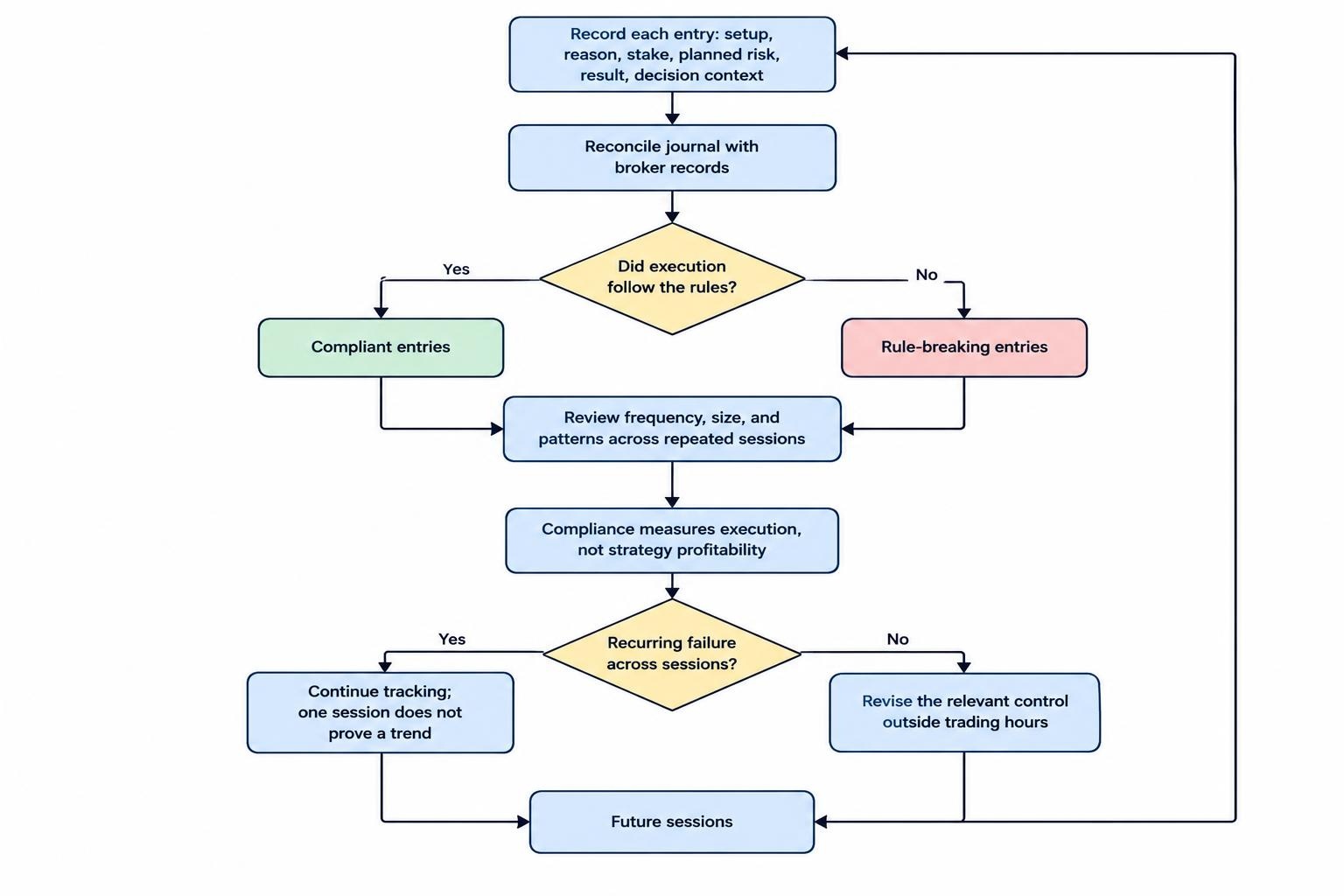
A journal should show whether additional trades were justified. Record the setup category, entry reason, stake, planned loss, actual result, and whether the entry followed the rules. Add a short note on the decision context: planned session, missed move, boredom or an attempt to recover a loss.
Save the reason before entry where possible. A profitable outcome can make an impulsive decision look more sensible in hindsight. A screenshot and a sentence written at the time are harder to rewrite mentally.
At review, separate compliant trades from rule-breaking trades. Calculate their combined results after applicable costs, but also compare their frequency and size. A few oversized breaches may matter more than many small ones.
A simple process measure is:
Rule compliance rate = compliant entries ÷ total entries × 100
If 16 of 20 entries followed the written conditions, compliance was 80%. That does not prove the strategy works. It shows how consistently you executed it. A fully compliant strategy can still lose money.
Use a broker export or spread betting account statements to reconcile the journal with actual transactions and charges. Keep timestamps so you can examine whether unplanned activity clusters after losses, outside your trading window or late in a session.
Review patterns across repeated sessions rather than declaring success after one profitable afternoon. Fewer trades and a better result on one day may be coincidence. The more useful question is whether avoidable entries and risk breaches are becoming less frequent.
What to Do If You Keep Breaking the Limits
If you repeatedly override the plan, stop opening live positions while you review the behaviour. Lowering the stake is not enough if you compensate by placing more bets or repeatedly depositing money to continue.
Identify the point at which the process failed. Was the rule vague? Did you remove an order confirmation? Did you continue after the session allowance was reached? Change the control that failed rather than adding another motivational sentence to the plan.
A spread betting demo account can provide a place to rehearse entry restrictions and journalling without risking more cash. Simulation does not reproduce the pressure of live losses, and profitable demo results are not proof of readiness. Use it to check whether you can follow the process at all.
If trading feels difficult to control, involves borrowed money, or is affecting bills, sleep or relationships, do not frame the problem as needing a better entry signal. Pause trading, protect essential spending and seek appropriate independent support. Recovering a previous loss is not a requirement to resume.
Make “No Trade” a Valid Session Result
An anti-overtrading plan should leave you with three clear permissions: enter only when the setup qualifies, size the position within the remaining allowance, and stop new entries when an end condition occurs.
Put those permissions inside your broader spread betting risk management plan. Review them outside trading hours, then apply them without renegotiating every time a chart moves.
The aim is not to achieve the lowest possible trade count. It is to remove decisions that your strategy cannot justify. Some sessions will contain several valid opportunities. Others will finish with no position opened. Both can represent correct execution.