Managing a losing streak in spread betting means controlling what happens after a run of losses, not finding a trade that will win everything back. The immediate priorities are to contain further exposure, check whether you followed your rules and establish whether the strategy still has a sound basis.
A streak can contain perfectly valid trades. It can also reveal poor execution, unsuitable market conditions or a strategy that never had a reliable advantage. Those situations need different responses. Your spread betting risk management plan should give you a procedure for telling them apart before frustration starts choosing your next stake.
What a Losing Streak Does—and Does Not—Tell You
A losing streak usually means consecutive trades that close at a net loss. Count the result after relevant trading costs, rather than treating a small price gain as a winning trade when charges have pushed it below zero.
The number of consecutive losses does not, by itself, establish whether a strategy is broken. Consider a hypothetical strategy with a 40% chance of winning each trade. If outcomes were independent and that probability stayed constant, the chance that the next five trades would all lose would be 0.6 multiplied by itself five times: about 7.8%.
That is the probability for one specified block of five trades, not the probability of encountering a five trade losing streak anywhere in a long trading history. Real trades may also share the same market driver, so the independence assumption can fail.
Win rate alone is not enough either. Suppose the assumed net outcomes are winners of 2R and losers of 1R, where R represents the amount initially risked. At a 40% win rate, the hypothetical average result is positive: 0.4 × 2R minus 0.6 × 1R equals 0.2R per trade. That calculation illustrates why losses can occur within a profitable model. It does not establish that your own strategy has that expectation.
Keep the streak count separate from your account drawdown. Six small losses may cause less damage than two oversized ones. A small winner can end a losing streak without doing much to repair the account.
Set Your Response Rules Before the Next Trade
There is no universally correct number of losses after which every trader should stop. A strategy that wins infrequently needs a different review threshold from one designed to take frequent, smaller profits. Account size, trade frequency and the quality of the strategy’s supporting evidence also matter.
Write down separate triggers for consecutive losses, money lost and rule breaches. A sequence trigger prompts a review. A cash loss threshold restricts the damage you are prepared to accept. A rule breach signals that your actual trading has departed from the process you intended to follow.
An illustrative plan might require a short review after three consecutive losses and suspend new entries after five until a fuller check is complete. Those numbers are examples, not tested recommendations. Choose thresholds using relevant trading records, and do not assume that the longest historical streak is the worst one that can happen.
Define how the loss budget works too. Does it cover a session, a day or a rolling period? Include open losses when assessing account equity, and do not treat a fresh deposit as improved trading performance. Opening another account should not reset the same risk budget.
A serious execution mistake can justify stopping new entries immediately, even after just one trade. You do not need to wait for a qualifying collection of losses before dealing with a problem.
What to Do When Your Threshold Is Reached
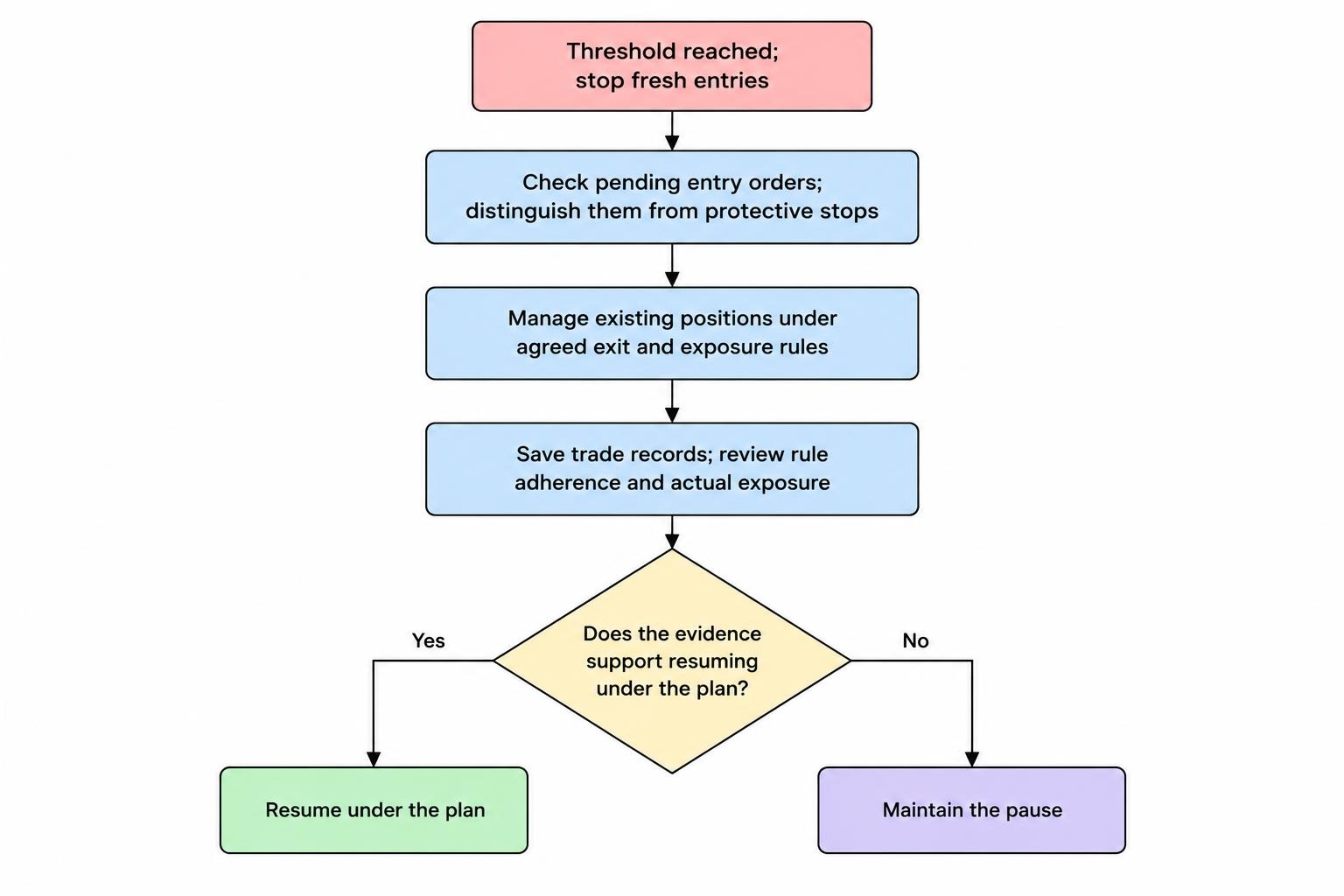
Stop placing fresh trades while you check the situation. Review pending entry orders so an old instruction does not open another position during the pause. Distinguish those orders from protective stops attached to positions that remain open.
For existing positions, follow the exit and exposure rules already agreed in your plan. Do not remove protection, widen a stop or open an opposing bet simply because the latest loss feels uncomfortable. If you need to reduce exposure, make that decision explicitly rather than disguising it as a new trading opportunity.
The pause does not make an ordinary stop a guaranteed exit price. Gaps and adverse execution can still increase the loss. Keep the mechanics of managing risk with stop losses separate from the decision to stop taking new trades.
Save the trade records before changing anything: entry and exit times, intended prices, actual fills, stakes, stop distances and charges. Add a short factual note about any departure from your rules. “Entered before the signal closed” is useful. “The market was ridiculous” is less useful, however satisfying it feels to type.
Consider disabling promotional notifications during the review. An FCA experiment on trading app design found that certain digital features can increase trading frequency and risk taking. Removing prompts is a practical precaution, not evidence that notifications caused your losses.
Reduce Risk Without Distorting the Trade
If your plan allows continued trading at reduced risk, lower the cash exposure rather than squeezing the stop into a place that no longer fits the setup. A smaller stake with a defensible stop preserves the trade’s logic. A tighter stop chosen only to make the numbers fit changes the trade.
Recalculate from current equity. In a simplified example, an account starts at £10,000 and loses exactly 0.5% of its remaining equity on each of five trades. With no other balance changes, it falls to about £9,752.49. If the next permitted risk budget is 0.25% of current equity, that budget is approximately £24.38.
With a 40 point stop distance, £24.38 divided by 40 gives about £0.61 per point before allowing for charges or adverse execution. The permitted stake may need to be lower. If the broker’s minimum stake cannot fit the budget, skip the trade rather than moving the stop or rounding the exposure up.
This is an illustration of position sizing for spread betting, not a claim that either percentage is suitable for every account. Ordinary stops do not impose an absolute cash loss ceiling.
Reducing size lowers the money exposed to subsequent trades. It does not turn a losing strategy into a profitable one, and it also reduces the cash earned by subsequent winners. Any planned size adjustment should therefore be assessed as part of the strategy, not treated as a repair button.
Do not confuse your risk budget with regulatory account protections. For UK retail accounts covered by the rules, the FCA margin close out and negative balance protection requirements provide account level safeguards. They do not protect an individual stake or prevent you from losing the funds dedicated to that account.
Diagnose the Streak Before Changing the Strategy
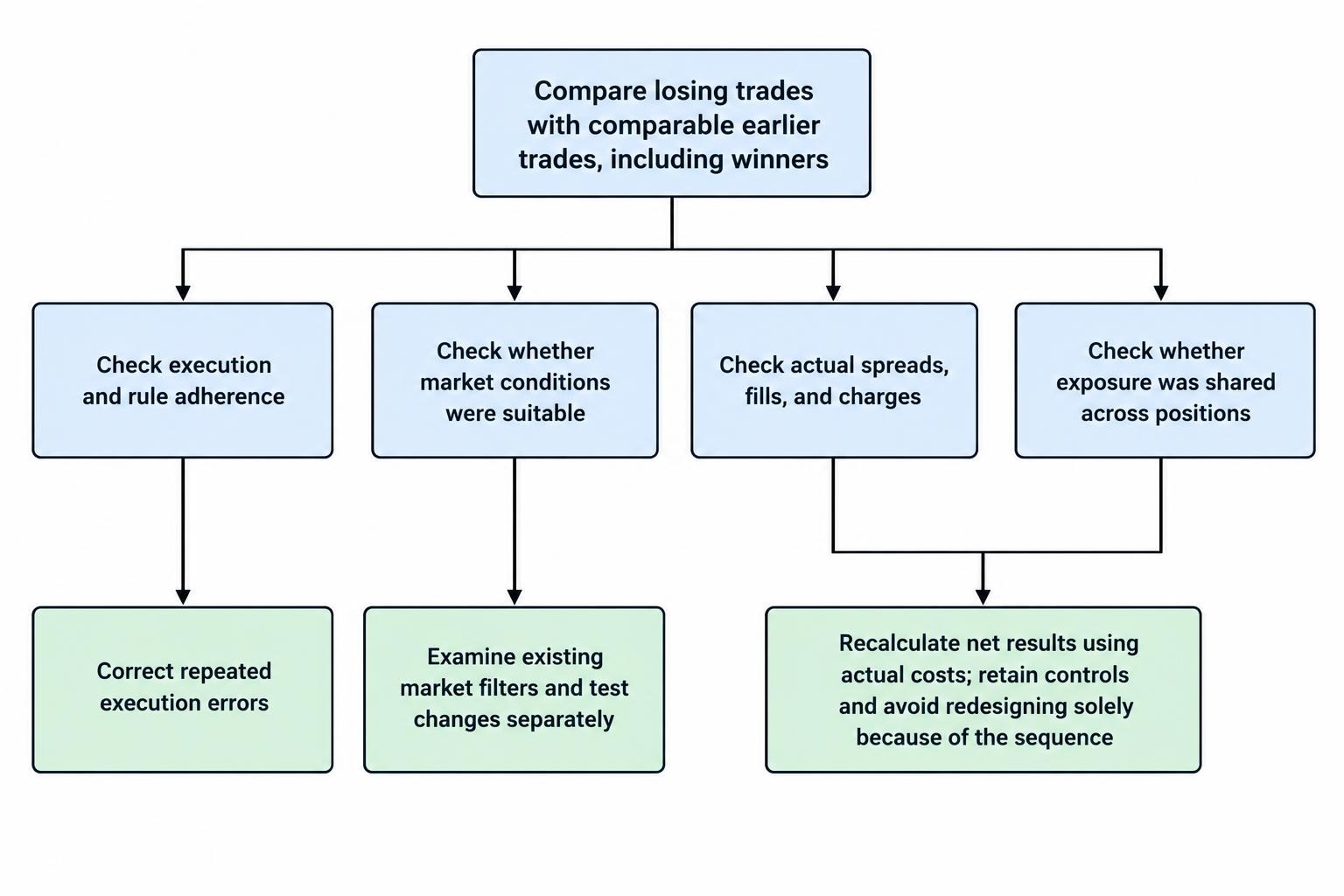
Review the losing trades alongside a comparable group of earlier trades, including winners. Looking only at losses encourages explanations that fit the result after the event. A missed entry rule matters whether that trade happened to win or lose.
Use the same measurements throughout the review. Record the setup, market, session, planned risk, realised result and whether each rule was followed. Expressing results in R can help compare trades taken at different stakes, provided you also retain the cash figures and record costs consistently.
| Possible cause | Evidence to check | Practical response |
|---|---|---|
| Execution drift | Early entries, missed signals, moved stops or stakes above plan | Pause new entries and correct the repeated behaviour before resuming |
| Changed market conditions | Losses concentrated in conditions outside the strategy’s intended use | Check existing market filters and test proposed changes separately |
| Higher trading costs | Wider spreads, worse fills or longer holding periods | Recalculate net results using actual charges and execution records |
| Variation within the model | Rules followed, conditions suitable and losses compatible with prior evidence | Keep the risk controls; do not redesign the strategy solely because of the sequence |
Check execution before rewriting entry rules
Separate a valid losing trade from an avoidable error. If the strategy required confirmation at a candle close but you entered early, that trade does not offer a clean test of the strategy. Equally, an impulsive trade that made money is still evidence of a process problem.
Compare intended and actual fills. If execution has become more expensive, recalculate the outcome after spread betting costs. A strategy’s gross price advantage may not survive the spread, financing and other applicable charges. Make sure costs are included once, rather than omitted or counted twice.
Look for shared exposure
Several losing trades may represent one repeated view. Buying multiple equity indices during the same sell off, or taking several positions exposed to the same currency move, is not necessarily a collection of separate opportunities.
Review simultaneous positions and repeated entries around the same event. The principles of portfolio correlation in spread betting help identify whether the streak reflects concentrated exposure rather than a broad failure across unrelated setups.
Treat strategy failure as a possibility, not a verdict
A short sequence cannot reliably establish that an advantage has disappeared. Nor should “it is just variance” become a permanent excuse for mounting losses. Compare results with the assumptions behind the strategy: win rate, average winner, average loser, costs and market conditions.
If the strategy was never tested with realistic costs or checked on data not used to develop it, the streak may be exposing weak evidence rather than a newly broken method. Stay out of live trading while investigating that gap. There is no obligation to keep paying for evidence.
Avoid Recovery Trades and Stake Escalation
The next trade should qualify on its own merits. “I need £300 back” is an account problem, not an entry signal. A recovery target can push you into larger stakes, lower quality setups or trades outside your usual market and session.
Doubling exposure after each loss makes the arithmetic deteriorate quickly. With otherwise identical losing trades, cash losses of £50, £100, £200, £400 and £800 total £1,550. Five losses at a constant £50 would total £250. This simplified comparison excludes extra costs and execution differences, but shows what the escalation itself does.
Increasing frequency can create the same problem without an obvious stake increase. Ten hurried trades at a smaller size may expose more money than a few planned trades. Include the number of entries and total exposure in your controls for avoiding overtrading.
Do not swing to the opposite extreme either. Taking every profit early because you need a winner changes the payoff pattern. If the strategy depends on occasional larger gains, repeatedly cutting them short can undermine the very results you are trying to restore.
Use a brief written check before any permitted entry: does the setup qualify, does the stake fit current equity, and would you take this trade without knowing the previous result? That creates a practical boundary between trading psychology and the order ticket.
Resume Trading on Evidence, Not on One Winning Trade
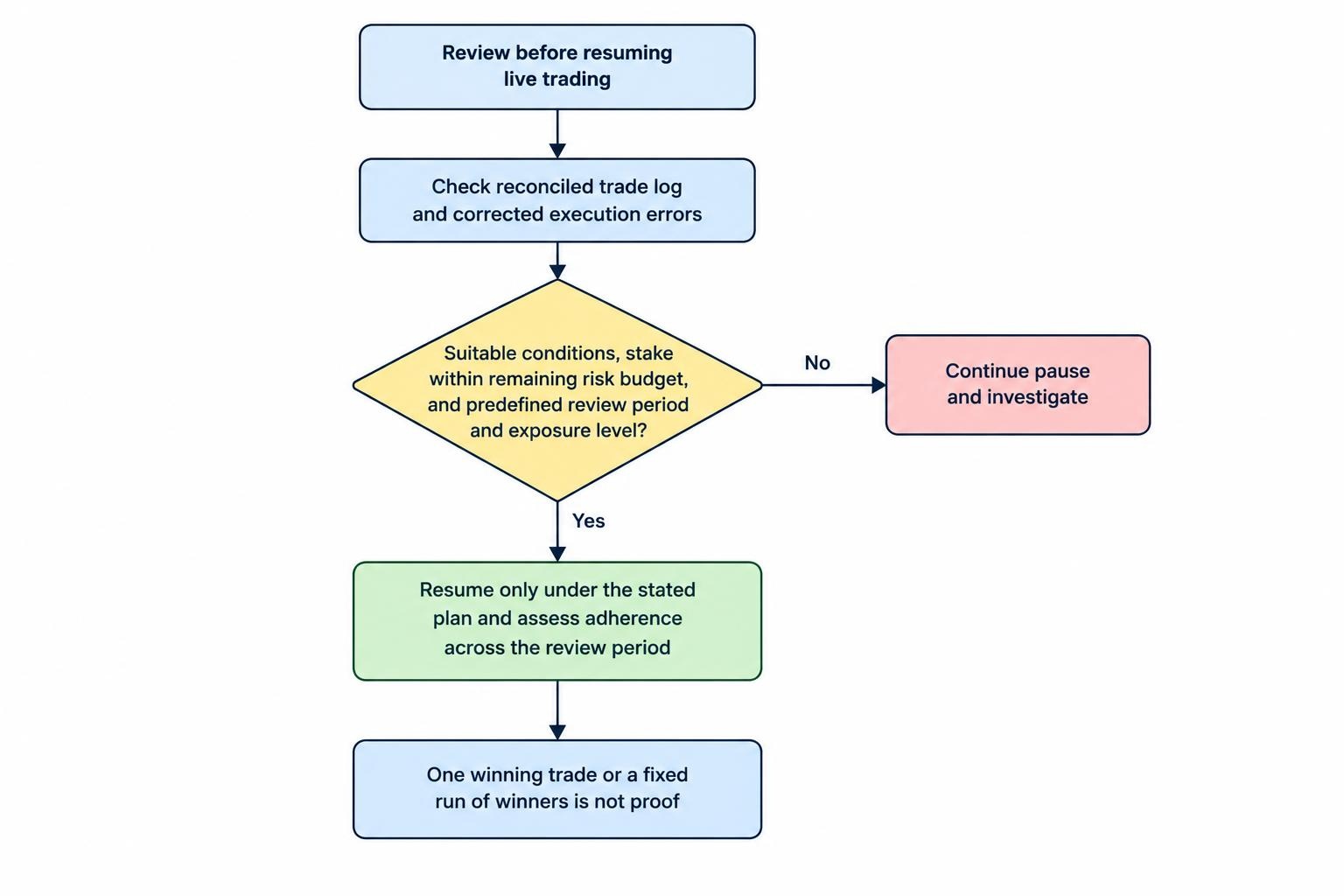
A return plan should state what needs to be true before live trading resumes. Relevant conditions might include a reconciled trade log, an identified execution error that has been corrected, suitable market conditions and a stake that fits the remaining risk budget.
If the problem was a rule breach, demonstrate that you can follow the rules again without exposing more money. If you changed the strategy, evaluate the change separately. Do not apply three new filters, alter the stop distance and change the target, then credit the first winner to better discipline.
A spread betting demo account can help rehearse execution and check whether revised rules are clear enough to follow. Demo results do not reproduce every aspect of live fills, costs or the pressure of risking money, so they are not proof that the problem is solved.
Where a return to live trading is justified, use a predefined review period and exposure level. Judge adherence and results across that period rather than restoring full size after one winner. Equally, do not invent a requirement to win a fixed number of trades before returning; a small run of winners offers little assurance.
Remove the deadline for getting back to the previous account peak. A recovery deadline does not improve the available opportunities. It only adds pressure to take them.
When the Pause Should Become a Longer Stop
Some warning signs call for more than a smaller stake. Stop risking money if losses threaten essential spending, you are borrowing to continue, or you repeatedly override controls despite intending not to. The same applies if trading is damaging sleep, work or relationships.
Do not label every difficult session an addiction. But do not dismiss repeated loss chasing as ordinary discipline trouble either. The NHS guidance on gambling related harms and support identifies chasing losses and borrowing to continue among warning signs, and lists routes to confidential help.
You do not need to recover the money before asking for support. You also do not have to resume spread betting because you have already spent time learning it.
A well managed losing streak may still end with a financial loss. The useful outcome is that exposure stayed within the plan, the review identified what could be established from the evidence, and the next decision was not dictated by the previous loss. Recovery is uncertain. Following a clear stopping procedure is a decision you can control.