Protecting your trading capital means controlling how much you can lose, how quickly losses can accumulate and how much money remains exposed to your spread betting provider. A stop loss helps, but it cannot do all three jobs.
The aim is not to avoid every losing trade. It is to prevent an ordinary loss, a market gap or a broken rule from damaging money you cannot afford to lose. That requires boundaries around your trading account, your open positions and your decisions after a setback.
No capital protection plan makes spread betting safe or turns an unprofitable strategy into a profitable one. It can, however, put firm conditions around when you trade, reduce exposure or stop.
Separate Trading Capital From Money You Need
Start with the amount you can afford to lose without changing how you pay bills, service debts or meet savings commitments. That amount is your trading allocation. It is not your entire savings balance, the credit available on a card or money you expect to earn next month.
Keep emergency savings and money needed for foreseeable expenses outside the trading account. If losing your deposit would force you to borrow, postpone an essential payment or sell another asset, the allocation is too large.
Also distinguish between your total trading allocation and the cash you need with a provider. There is no requirement in your own plan to deposit the whole allocation immediately. Keep enough cash in the account to support the positions you have deliberately approved, with room for adverse moves and charges. Leave the rest outside until a scheduled review justifies a transfer.
This is not a reason to run an account with almost no spare margin. An underfunded account and an oversized deposit create different problems. The balance should follow your planned exposure, rather than the largest position the platform will accept.
Set a rule for additional deposits before trading begins. A planned funding review is different from sending more money because an open position is losing. Fresh cash should not become an emergency service for trades that have already breached your rules.
Choose a Cash Loss Budget Before Choosing Your Stake
A stake can look small in isolation. Its effect depends on the distance the market moves, the number of positions open and the costs of holding them. Begin with a cash loss budget, then work backwards to a stake that fits the intended exit.
Suppose an illustrative account has £10,000 of equity and the trader sets a planned loss allowance of £50 for one trade. That is 0.5% of equity, not a recommended percentage or a promise of safety.
If the intended entry and stop execution prices are 25 points apart, £2 per point produces a £50 price loss. It leaves nothing within that allowance for other charges or execution beyond the intended stop price.
If the trader instead reserves £10 for additional costs and execution uncertainty, the calculation becomes:
Maximum stake under these assumptions = (£50 − £10) ÷ 25 points = £1.60 per point.
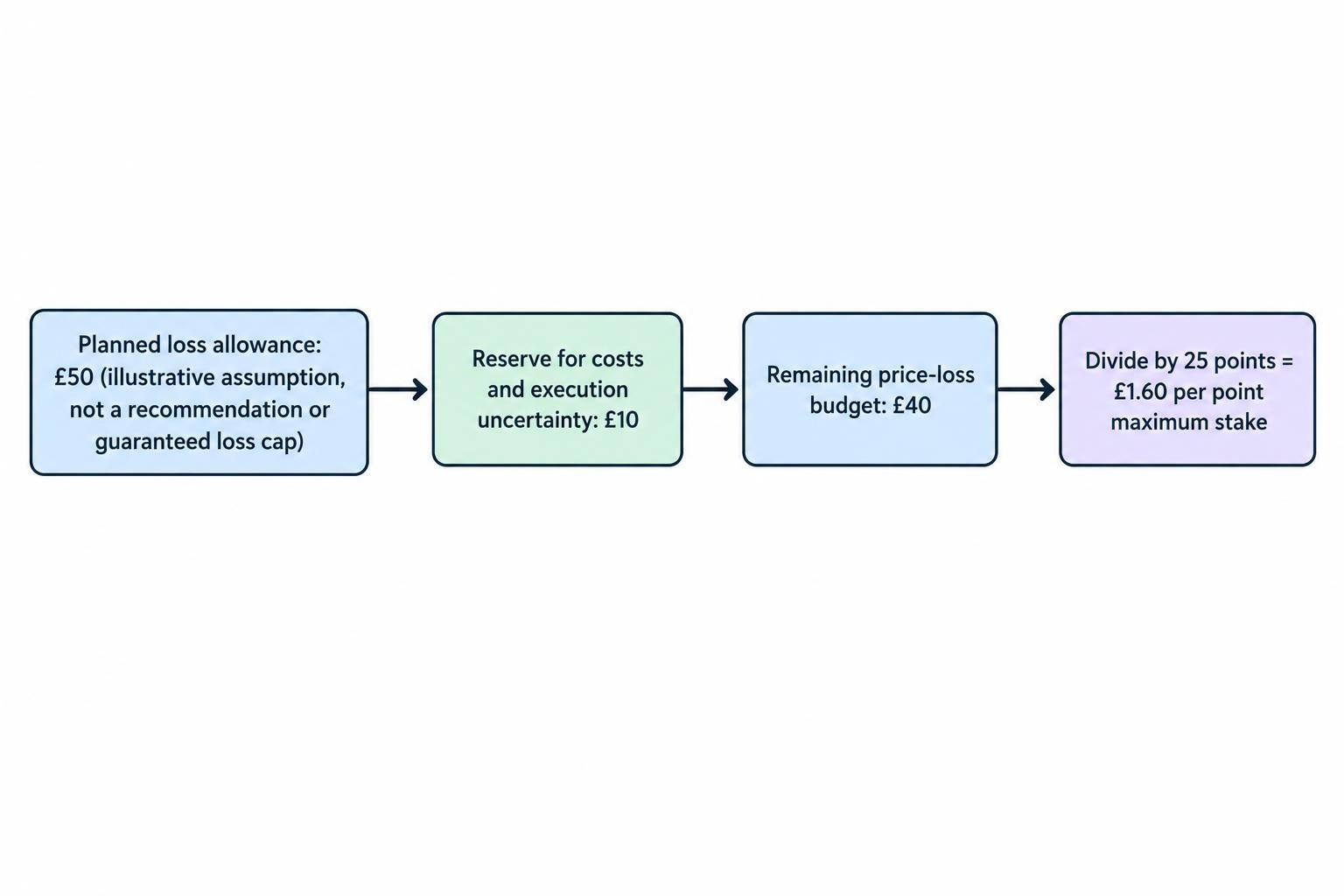
The £10 allowance is only a planning assumption. It does not cap losses during a gap. Use actual dealing prices rather than a chart midpoint, so the spread is neither overlooked nor counted twice.
The wider process of position sizing for spread betting should also account for minimum stakes and permitted increments. If the smallest available stake exceeds your budget, skip the trade. Moving the stop closer simply to make the calculation fit changes the trade rather than solving the funding problem.
Recalculate from current equity after losses. Continuing to use an old, higher balance makes the same cash risk a larger percentage of the money that remains. A deposit should not automatically justify bigger stakes either.
Protect the Whole Account, Not Just Each Trade
Five positions with modest individual loss budgets can still create an uncomfortable account loss. Set a separate ceiling for the combined planned loss across all open positions.
For example, three trades with £50 planned losses create £150 of combined planned exposure before extra costs and adverse execution. That figure belongs in the account decision even if each trade passed its own entry checks.
Then group positions by what could hurt them together. A long equity index bet, a long bank share bet and another long regional index may all depend on a favourable outlook for shares. Three dealing tickets do not necessarily represent three independent risks.
Use portfolio correlation and spread betting risk to assess these shared exposures. For capital protection, ask a direct question: if the main reason for these trades proves wrong, what could the combined loss look like?
Check pending orders too. Two orders that appear harmless while inactive may both trigger during the same market move. Your exposure review should include the positions those orders could create, not just those currently open.
Do not treat unrealised profit as free money. Adding another bet because an existing position is showing a gain can leave you exposed to both a reversal and the new trade’s loss. Count the cash you could give back from current equity, as well as the original amount risked.
Leave Room Between Your Account and Forced Closure
Margin is collateral supporting exposure, not a personal loss budget. A platform accepting an order tells you that its opening requirements have been met. It does not tell you that the position suits your finances.
Set your own margin headroom rule and review it before adding positions, carrying exposure overnight or withdrawing money. Stress the account using adverse price moves rather than assuming the displayed spare margin will remain unchanged. The margin risk guide covers why an account can come under pressure while positions remain open.
For UK retail accounts covered by the rules, firms must close positions when account net equity falls below 50% of the required margin, as soon as market conditions allow. Account-level negative balance protection also limits liability for covered investments to the funds in that account. These are protections under the FCA rules for retail speculative investments, not guarantees that your deposit will survive.
Your own action point should come before dependence on forced closure. Decide what you will reduce if equity falls, which orders you will cancel and when you will stop opening positions. Do not assume you can deposit funds quickly enough to resolve a fast-moving problem.
Make Your Exit Protection Match the Exposure
An ordinary stop loss provides an exit instruction, not a guaranteed cash ceiling. If the market gaps through the stop or execution occurs at a worse price, the realised loss can exceed the planned amount.
That distinction matters when deciding whether to hold through an earnings announcement, an economic release or a market closure. Ask whether the account could absorb a worse exit without breaking your wider capital limits. If not, reducing the stake, closing the position or avoiding the event may be more appropriate than relying on the stop alone.
Where available, guaranteed stops for risk management can provide a contractual exit level, subject to the provider’s terms. Check the premium, eligible markets, minimum distances and rules for changing or removing the order. Include applicable charges in the cash budget.
After placing any protective order, verify its status, stake coverage and trigger level. Repeat that check after partially closing or increasing a position. An order left at the wrong size is not the protection you intended.
Avoid widening a stop simply because the price approaches it. If you revise the trade for a valid reason, recalculate the cash exposure before making the change. Otherwise, a £50 decision can become a £150 decision without a fresh risk assessment.
Use Drawdown Limits That Change What You Do
A drawdown limit is useful only if it triggers an action. “Be more careful” is not an action. Reducing stakes, suspending new entries or returning a strategy to simulation are.
The recovery arithmetic explains why early intervention matters. These figures assume no deposits or withdrawals:
| Fall from starting capital | Capital remaining from £10,000 | Gain needed to return to £10,000 |
|---|---|---|
| 5% | £9,500 | 5.26% |
| 10% | £9,000 | 11.11% |
| 20% | £8,000 | 25% |
| 40% | £6,000 | 66.67% |
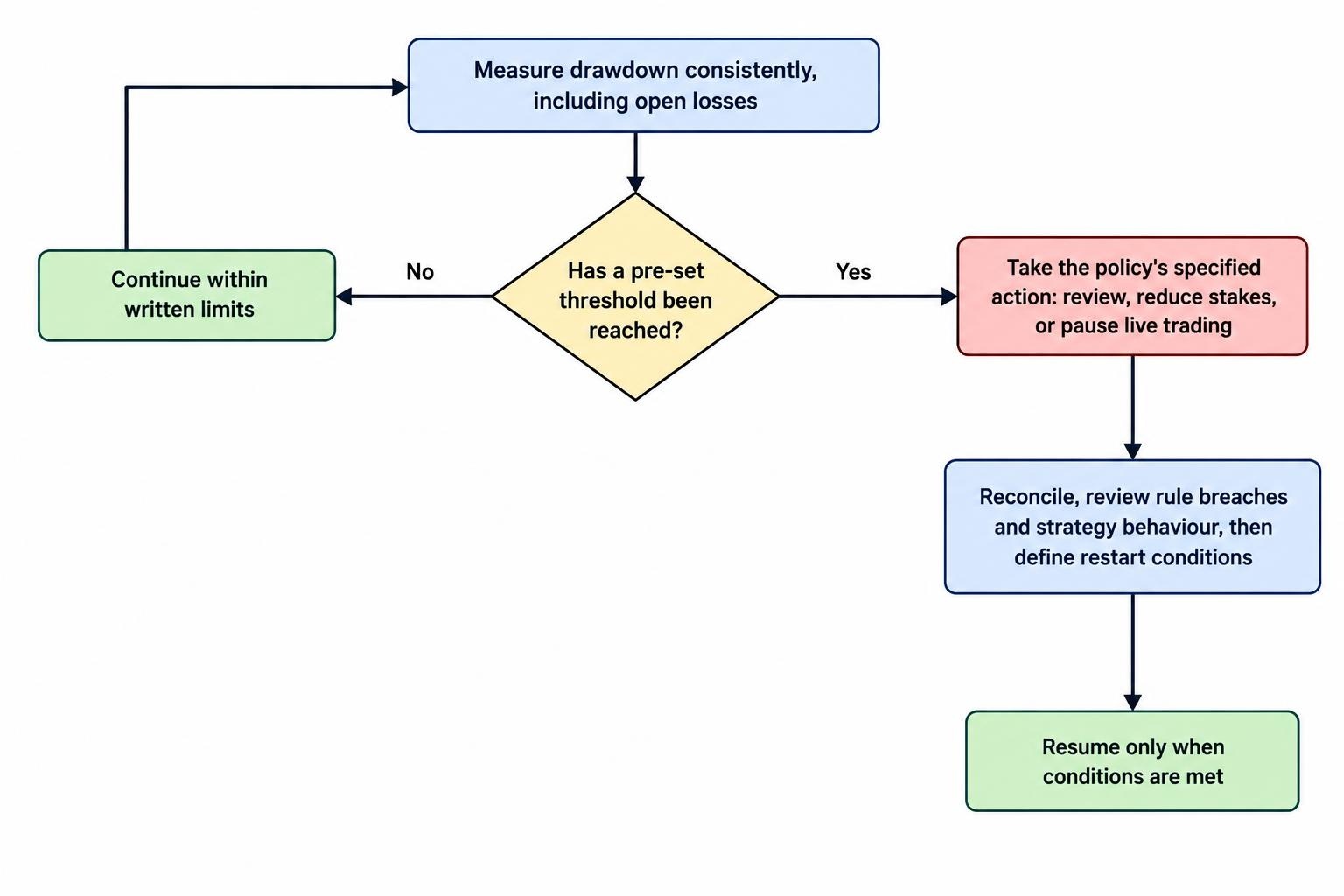
Build your response around thresholds chosen before losses occur. An illustrative policy might require a review after a 3% drawdown, lower stakes at 5% and a pause in live trading at 8%. These figures are examples, not universal settings. The thresholds must suit the strategy, trading frequency and amount you can afford to lose.
Measure drawdown consistently, allowing for deposits and withdrawals. A deposit is not a trading recovery. Include open losses when assessing current account health rather than waiting until positions close. The guide to managing trading drawdown examines that process in more detail.
Set a session loss limit as well. Once reached, stop opening new trades and follow the written plan for remaining positions. Do not use a profitable morning as permission to ignore an afternoon limit.
Restart conditions should be written down too: reconcile the account, identify any rule breaches, review whether the strategy remains within its expected behaviour and decide the stake before returning. A pause ends when its conditions are met, not when the urge to win the money back becomes louder.
Stop Costs From Becoming an Unnoticed Loss Budget
Capital can shrink through trading costs even when individual price losses look manageable. Review results after spreads, financing, premiums and other applicable charges, not just the movement between entry and exit.
Consider a hypothetical routine of four round trips per day, each with an assumed £3 spread cost. Over 20 trading days, that is £240 before financing or other charges. The figures are illustrative, but the budgeting point is straightforward: activity has a price.
Use the guide to spread betting costs to identify which charges apply to your approach. Then record them separately so you can distinguish losses caused by the trade idea from money spent executing and holding it.
Do not keep trading simply to make back fees or justify time already spent watching the market. Those costs have already occurred. The next position needs to stand on its own merits.
Protect Cash Held With Your Provider
Trading decisions are only one part of capital protection. Before funding an account, verify the legal entity receiving your money, its permissions and the contact details you are using. Follow the process for checking a broker on the FCA Register rather than relying on a logo or a registration number copied into an email.
Ask how your money will be held. Segregation separates client money from a firm’s own money under the FCA client money segregation rules. It addresses the treatment of funds, not the losses you choose to incur through trading.
Compensation is another separate issue. Eligible investment claims may qualify for up to £85,000 per person, per firm when a provider fails, subject to the relevant conditions. Poor investment performance is not covered. Check the FSCS investment protection requirements for the firm, service and activity involved rather than assuming every account balance is insured.
Keep your own copies of statements, account terms, deposit confirmations and withdrawal records. The guide to what happens when a spread betting broker fails covers that separate risk.
Review whether cash is genuinely surplus before withdrawing it. A withdrawal should leave the remaining account compatible with its open positions and stress allowance. Equally, do not leave profits exposed indefinitely simply because transferring them out feels like reducing your trading potential.
Prevent Operational Errors From Becoming Trading Losses
Before submitting an order, check the market, direction, stake, order type and protective exit. Pay particular attention after switching between instruments with different point conventions. A correct market view does not rescue an incorrectly entered stake.
Have a plan for losing access to the platform. Keep verified dealing and support contact details somewhere accessible without logging in. If an order appears not to have gone through, check its status before sending another one. Uncertainty is a reason to verify, not double-click.
Protect account access with a separate password and multifactor authentication where offered. Do not share login details or approve unexpected access requests. Keep trading devices and account recovery details under your control.
Reconcile the account regularly. Compare your trade log with the provider’s spread betting account statements, including open positions, charges, deposits and withdrawals. Investigate differences promptly rather than carrying an unexplained figure into the next trading session.
Write a Capital Protection Policy You Can Enforce
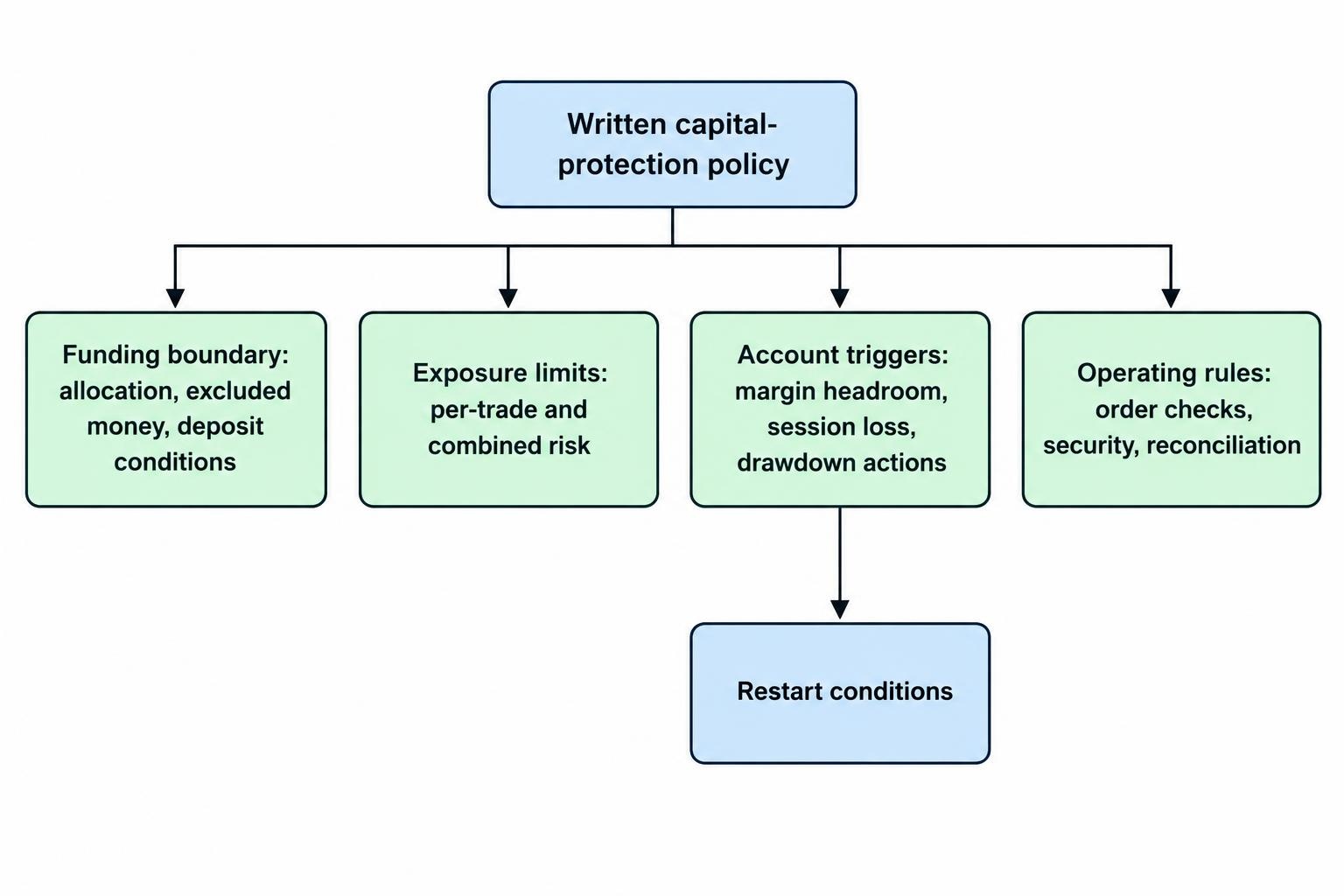
A useful policy should fit on a page and produce decisions without negotiation. Write down:
- Your funding boundary: the total allocation, money excluded from trading and conditions for further deposits.
- Your exposure limits: planned cash loss per trade, combined open risk and treatment of related positions.
- Your account triggers: minimum margin headroom, session loss limit and drawdown actions.
- Your operating rules: order checks, event exposure, account security and reconciliation schedule.
- Your restart conditions: what must change or be verified before live trading resumes after a pause.
Review the policy on a schedule, not while trying to rescue a position. Change it when the evidence supports a change, and record the reason.
The strongest boundary is the one that still applies when you dislike the outcome. Protecting capital means accepting a manageable loss, passing on an unsuitable trade and stopping when your rules require it—even when the platform remains perfectly happy to accept another order.