Spread betting costs and fees include more than the difference between the buy and sell price. Funding, execution, optional protection and account charges can all affect what remains after a trade closes. A “commission free” account is not a cost free account.
This section brings together the main charges and the checks worth making before placing a bet. Start with the detailed explanation of spread betting costs for the calculation methods, then compare charges against your market, stake and expected holding period.
Which spread betting costs can apply?
Separate costs built into prices from charges deducted from your balance. Not every item below applies to every account or trade.
| Cost | How it affects you | What to check |
|---|---|---|
| Bid-ask spread | The gap between the quoted selling and buying prices creates a trading hurdle. | The spread during your usual trading hours, not just its advertised minimum. |
| Overnight financing | Holding an eligible position beyond the funding cutoff can generate a debit or credit. | The calculation, applicable rate and number of chargeable days. |
| Commission | A separate dealing charge, where the product terms provide for one. | The spread betting schedule rather than another product’s pricing. |
| Guaranteed stop premium | A charge for contractual protection against execution beyond the agreed stop level. | The premium and the event that makes it payable. |
| Currency conversion | A conversion charge or exchange rate markup where money changes currency. | Which cash movements require conversion. |
| Market data and platform fees | Subscriptions for chargeable services. | Monthly prices, eligibility conditions and any waiver requirements. |
| Inactivity fees | An account charge if the provider’s inactivity conditions are met. | The qualifying period and what counts as activity. |
The spread and execution price
The bid-ask spread converts into pounds through your stake per point. A spread of 1.5 points at £2 per point represents £3. If you open and immediately close at an unchanged quote, that is the loss before any other applicable charges.
Do not automatically count two full spreads for opening and closing. With an unchanged spread, the complete trade crosses one spread relative to an unchanged market midpoint. Changing quotes and spreads make actual results less tidy.
Execution also matters. Slippage is the difference between the expected price and the price obtained; it can work for or against you. Adverse slippage is an economic cost, even when no separate fee appears on your statement. Compare actual fills rather than treating the displayed quote as a guaranteed execution price.
Holding costs depend on the contract
For positions subject to daily funding, the holding period can change the cost comparison. A narrow spread may save money at entry, only for repeated funding debits to outweigh that saving.
Funding is generally calculated using the position’s full exposure, not just the margin deposited. The FCA’s review of CFD and spread betting pricing identified this calculation basis as an area where disclosures needed greater clarity. Margin is collateral, not a cap on the amount used to calculate funding.
Check the cutoff time, the rate for your trade direction, and how weekends and holidays enter the calculation. Do not assume that selling short produces a credit. The guide to overnight financing costs covers these checks in more detail.
Dated contracts may build financing into their price rather than apply a separate daily debit. That changes how the cost appears, not whether holding exposure has a cost. On October 15, 2026, the FCA’s follow-up findings on trading charges flagged continuing concerns about overnight funding levels and the information given to clients.
A worked example of costs reducing profit
Consider a hypothetical index spread bet. The opening quote is 8,000 bid and 8,001.5 ask. You buy at 8,001.5 for £2 per point. Later, the quote reaches 8,020 bid and 8,021.5 ask, and you close by selling at 8,020.
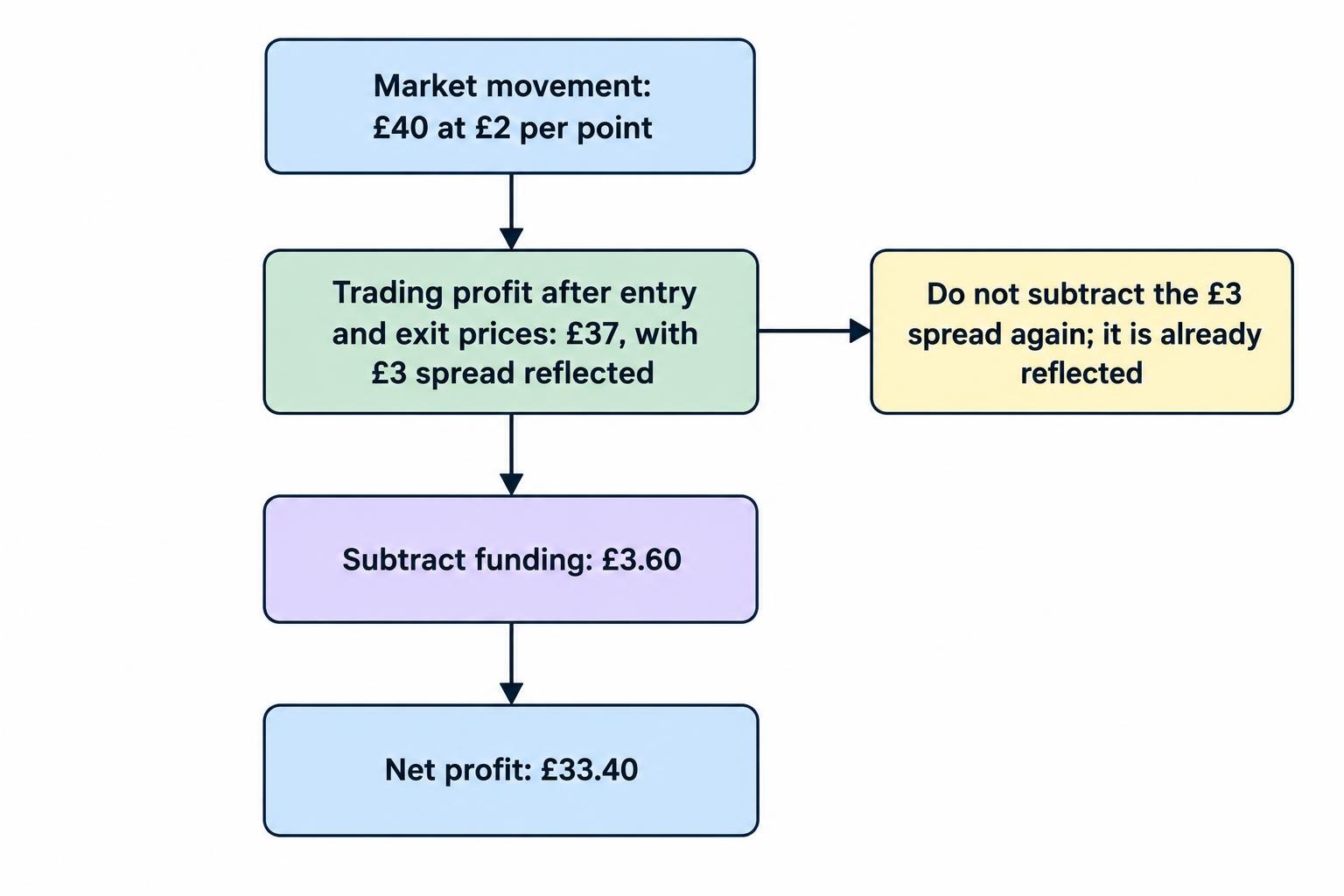
Your trading profit is (8,020 − 8,001.5) × £2 = £37. Assume funding costs £1.20 for each of three chargeable nights: £3.60 in total. With no other charges, the net profit is £33.40.
The quoted market moved up 20 points, equivalent to £40 at your stake. The £3 spread cost and £3.60 funding debit reduced that result by £6.60. These figures illustrate the mechanics; they are not a provider’s quoted rates.
The £37 trading profit already includes the spread through the opening and closing prices. Subtracting another £3 would count it twice.
Optional protection and account charges
Where guaranteed stops are available, establish when the premium becomes payable and how it scales with the position. Compare guaranteed stop premiums against the protection purchased, rather than treating the charge as interchangeable with ordinary execution costs. Removing protection solely to reduce a fee changes the risk as well as the price.
Account charges need a different check. Read the conditions for data subscriptions, paid platform features and inactivity fees before enabling services or leaving an account unused. For currency conversion, identify the cash flow being converted; an overseas market name alone does not tell you whether a conversion charge applies.
Compare the cost of the trade you intend to place
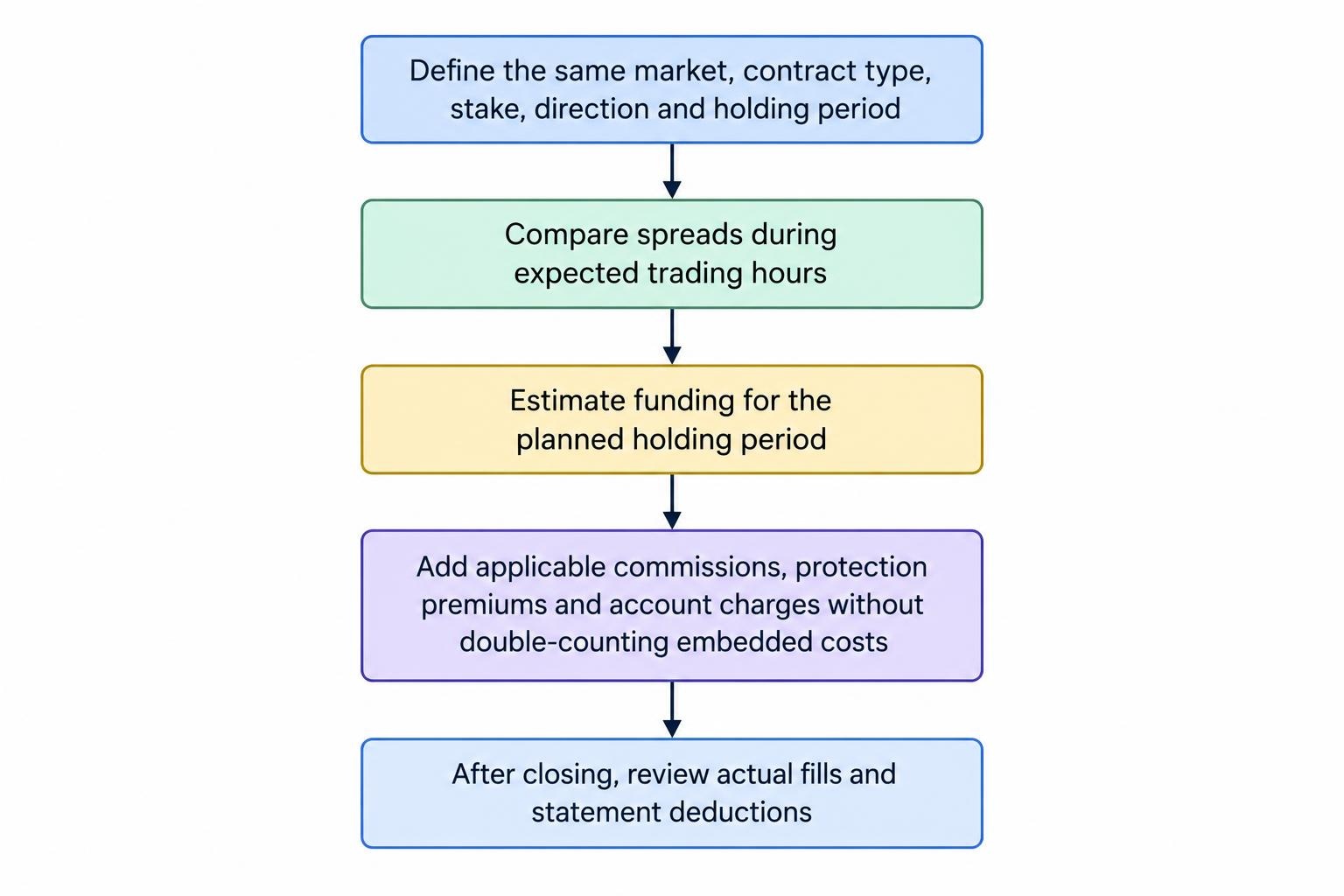
Use the same market, contract type, stake, direction and holding period when comparing providers. A minimum spread on one contract is not a fair comparison with the total cost of another.
- Record the spread at the times you expect to trade.
- Estimate funding across the planned holding period, including chargeable non-trading days.
- Add applicable commissions, protection premiums and account charges without counting embedded costs twice.
- Review actual fills and statement deductions after closing.
The method for comparing total spread betting costs brings these amounts into one calculation. Frequent intraday trading puts more weight on spreads and execution; holding positions across funding cutoffs adds a recurring cost to assess.
Keep transaction costs separate from market losses. Cheaper execution can improve a result, but it cannot make an unsuitable trade sensible. Budget for charges before entry, then reconcile the estimate with what the account actually records.