Spread betting commissions are dealing fees charged separately from the quoted market price. A spread bet can have no separate commission and still cost money to trade: the charge may sit inside the difference between the buy and sell prices instead.
The useful question is not simply whether an account is “commission-free”. It is how much opening, holding and closing your position will cost in pounds. That distinction matters when comparing accounts, reading a fee schedule or checking why a trade starts with a loss.
What Does Commission-Free Spread Betting Mean?
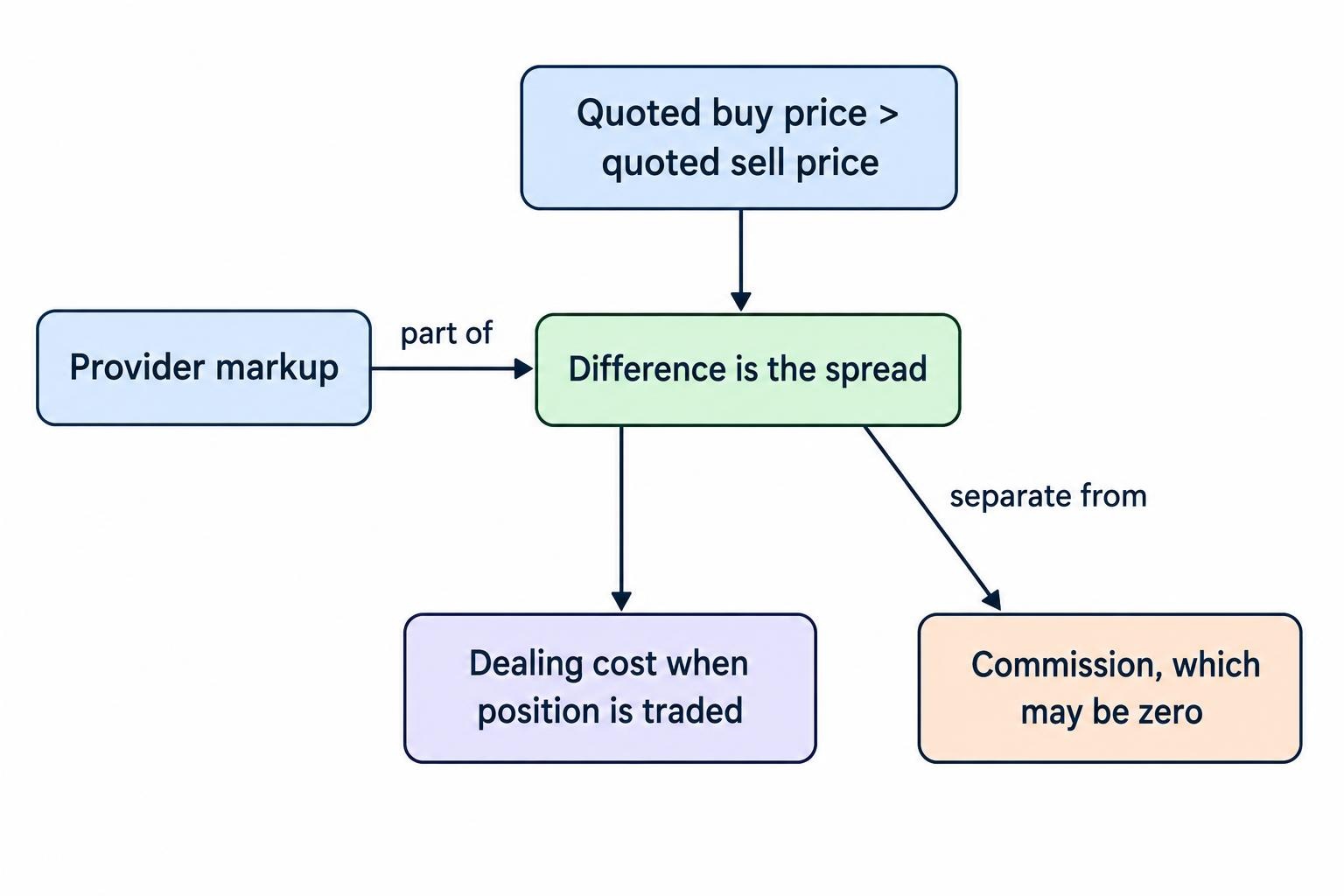
Commission-free means there is no separate dealing commission for the transaction covered by that pricing offer. It does not mean the buy and sell prices are identical, or that holding the position carries no further charges.
With spread-based pricing, you buy at the higher quoted price and sell at the lower one. The bid-ask spread creates a trading cost without requiring a separate debit labelled “commission”. Any provider markup built into those prices forms part of that spread; it is not another amount to add afterwards.
This distinction has appeared in actual complaints. In Financial Ombudsman decision DRN-5901557 on spread betting charges, the evidence supported charging through the spread, with no evidence of additional commissions applied to the customer’s trades or account. That finding concerned one account, not a promise about every provider’s pricing.
How to Calculate the Dealing Cost
For a straightforward spread bet, multiply the quoted spread in points by your stake per point. This estimates the loss from opening and immediately closing the position at unchanged prices, before any separate charges or execution differences.
Spread cost = spread in points × stake per point.
Suppose an index is quoted at 8,000 to sell and 8,002 to buy. You buy at £5 per point:
| Calculation | Result |
|---|---|
| Quoted spread | 2 points |
| Stake | £5 per point |
| Immediate close: (8,000 − 8,002) × £5 | £10 loss |
| Separate dealing commission assumed | £0 |
You have paid no separate commission, but crossing the spread has still cost £10. To break even before other charges, the sell quote must rise to your entry price of 8,002.
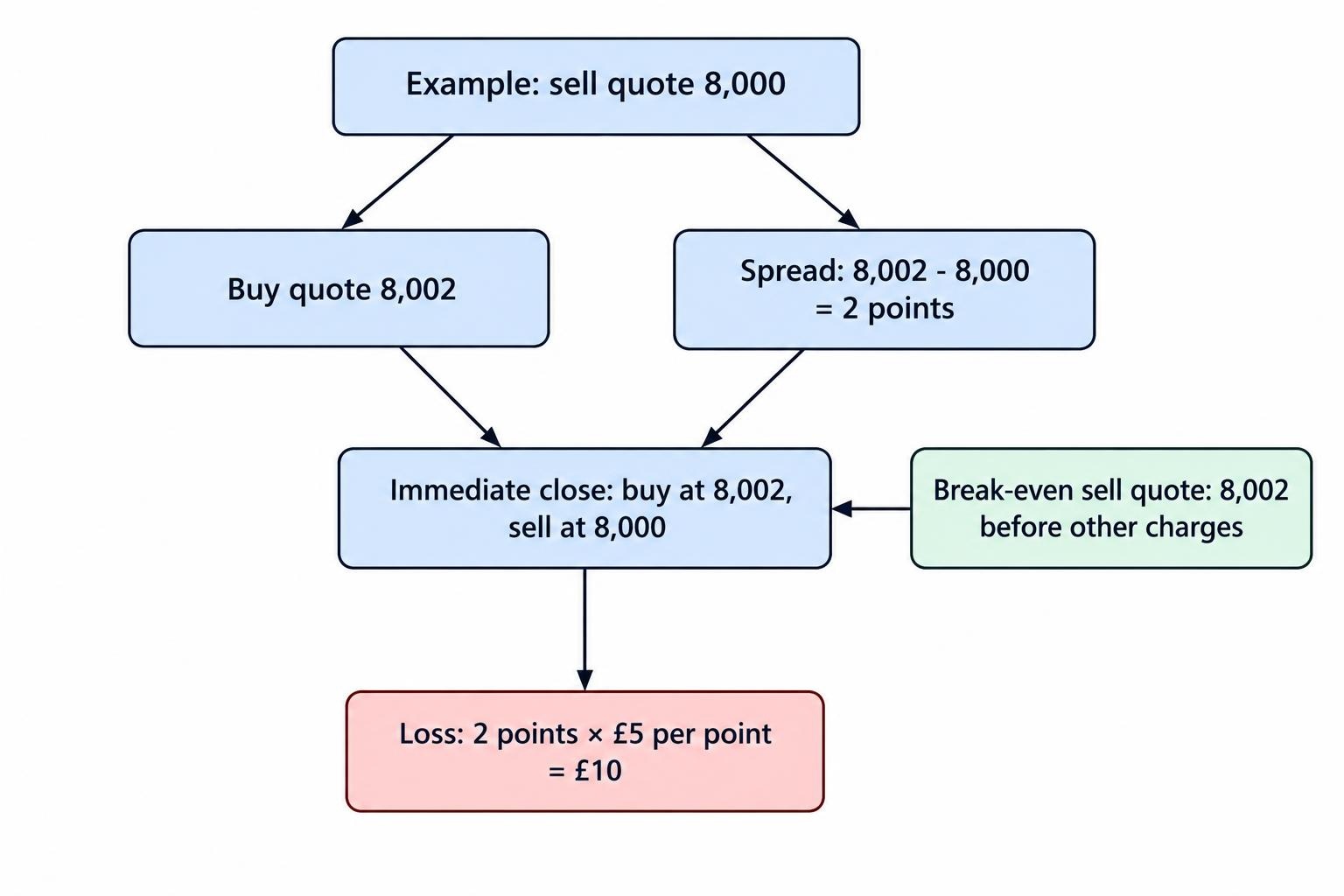
Do not automatically double the £10 because there is an opening transaction and a closing transaction. Buying at the ask and selling at the bid at an unchanged quote already produces one full spread of loss. With a constant spread, the same result can be expressed as half the spread on entry and half on exit, measured against the midpoint.
Also avoid subtracting the spread twice when reviewing performance. Profit or loss calculated from actual opening and closing execution prices already reflects those prices’ spreads. Only genuinely separate charges need deducting afterwards.
What If a Separate Commission Applies?
Read the charging basis before calculating the amount. A commission might be quoted per transaction, per side or for the complete opening and closing trade. “£2 per side” means £4 for opening and closing, assuming the same charge applies to each.
Using the example above, a hypothetical £2 opening commission and £2 closing commission would bring the dealing cost to £14: £10 from the spread plus £4 in separate fees. These figures illustrate the calculation; they are not a provider’s advertised tariff.
Where a schedule uses a percentage, establish what that percentage applies to. Do not substitute your margin deposit for the stated transaction value. Check for a minimum charge too: a percentage fee subject to a minimum can make smaller transactions proportionately more expensive.
Confirm that you are reading the correct product schedule. A provider offering spread bets, CFDs and share dealing may publish different charging terms for each. A commission shown for another product does not establish what your spread bet costs. The spread betting versus CFD comparison covers the wider differences without treating their fee structures as interchangeable.
Which Costs Are Not Commissions?
Keep separate dealing commissions distinct from holding costs. A commission relates to transacting; an overnight funding charge relates to keeping a position open under the product’s funding terms. Removing one does not remove the other.
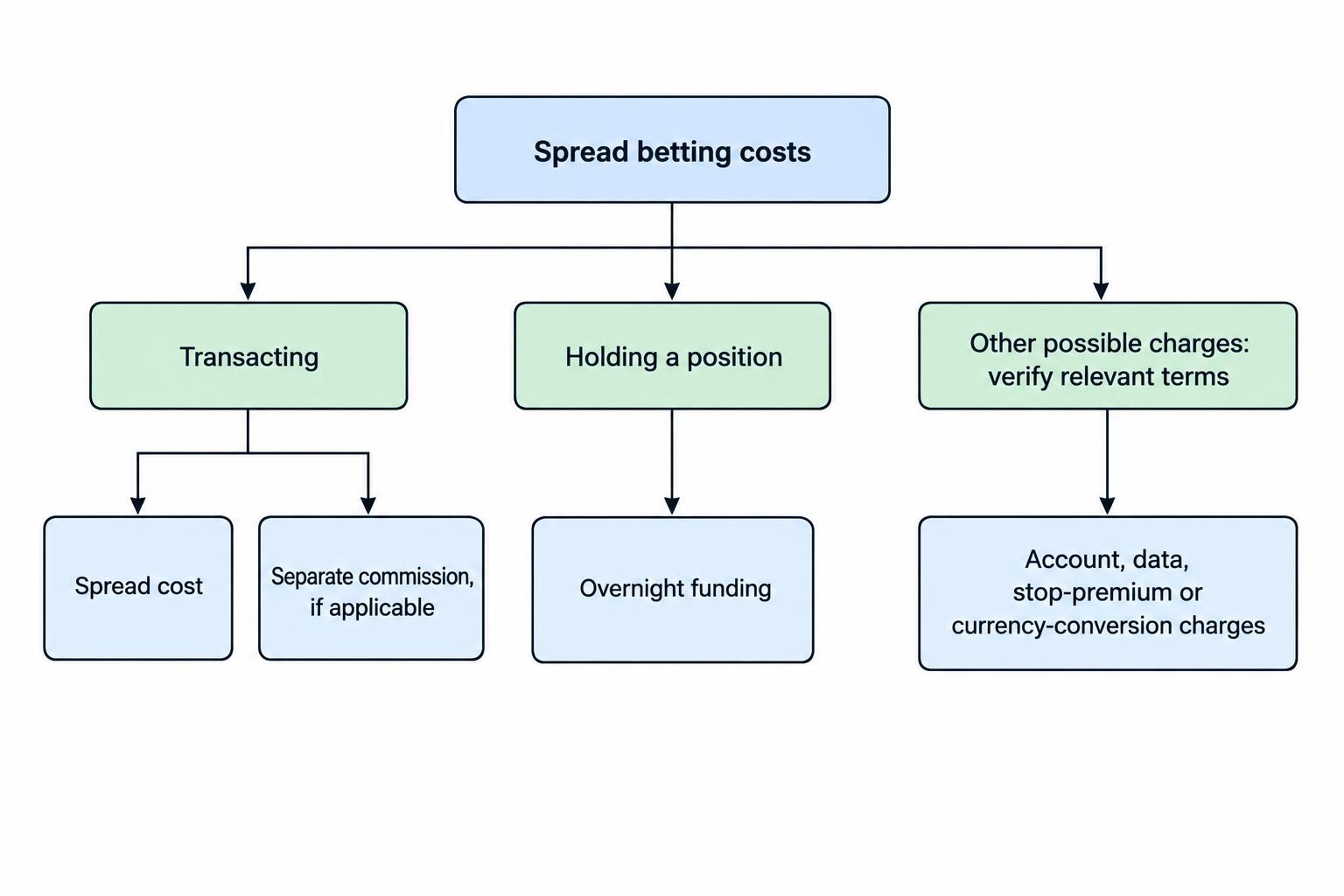
Overnight charges deserve particular attention if you plan to hold positions for several days. The FCA’s October 2026 findings on CFD and spread betting pricing identified considerable variation in funding charges between firms and across underlying assets, alongside concerns about how clearly those charges were presented.
For your own comparison, ask whether stop premiums, account charges, data subscriptions or currency conversion charges apply. Treat these as separate questions rather than assuming that a commission-free label answers them. Equally, do not add a fee that the relevant product terms do not impose.
How to Check What You Actually Paid
Start with the product’s current charges document and your trade confirmation. Match the market, account type, stake, opening price and closing price. Then identify any separate debits associated with that position.
A blank commission column does not establish that execution was costless. Reconcile the trade using the actual prices, then check funding and other adjustments separately. The guide to spread betting account statements explains how to separate trading results from account movements.
Comparisons should extend beyond the most visible dealing charge. The FCA’s review of providers’ price and value assessments identified a material gap where firms focused on spread costs without giving sufficient consideration to other costs paid by customers.
If an unfamiliar debit appears, ask the provider for its calculation and the charging term that authorises it. Keep the confirmation, statement and relevant fee schedule rather than relying on a headline pricing claim.
Compare the Cost of Your Intended Trade
Compare identical markets, stakes, trading times and holding periods. In a hypothetical comparison, a 2.5-point spread costs £12.50 at £5 per point, while a 2-point spread costs £10. Both could carry zero separate commission; one still costs £2.50 more to cross.
Use total spread betting costs as the comparison measure, not the commission label alone. Calculate the spread in pounds, add only applicable separate charges, and check the holding terms. That gives you a usable figure rather than an attractive zero.