Currency conversion costs arise when money is exchanged from one currency into another. In spread betting, they are not an automatic charge for trading an overseas market. A US share, a European index or a dollar quoted commodity can support a bet whose stake and settlement are both in sterling.
The practical question is which cash flows actually need converting, at what rate and with what charge. Keep that separate from the trading spread and financing charges covered in our guide to spread betting costs. Otherwise, you can count a fee twice or budget for one that does not apply.
The Three Currencies to Check Before Trading
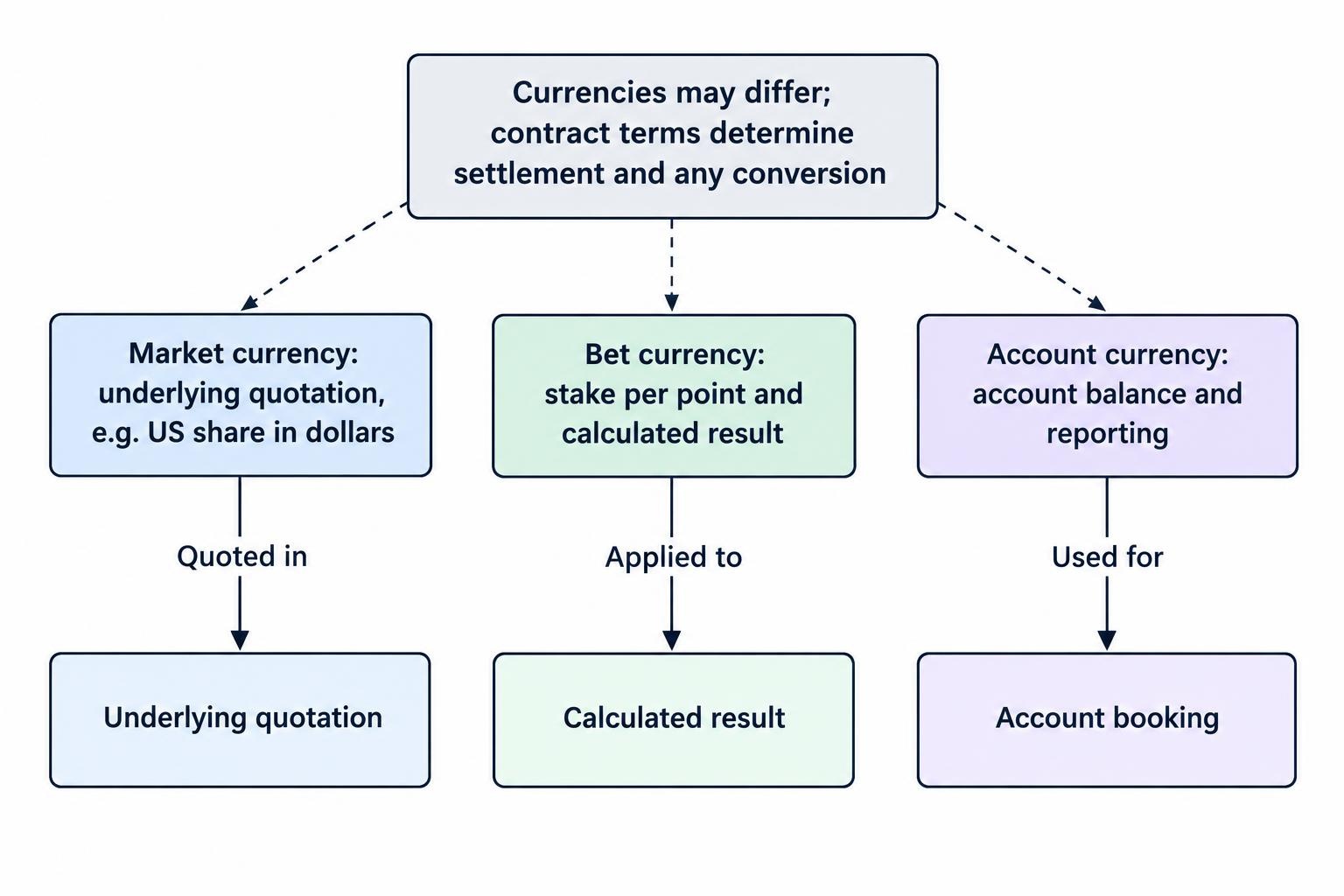
A market’s quoted currency, your bet’s currency and your account currency do different jobs.
The market currency describes the underlying quotation. A US share might be priced in dollars, for example. The bet currency determines the money gained or lost for each point of movement. The account currency is the currency used for your account balance or reporting.
These do not have to match. Currency selection within a spread betting account, including the choice between sterling and dollar denominated positions on a dollar quoted market, is documented in Financial Ombudsman decision DRN-3720165. That decision concerns one account arrangement, not a promise that every provider offers the same choices.
Check the deal ticket and contract terms rather than inferring the settlement currency from the instrument’s name. A dollar sign beside the underlying price does not establish that your trading result will be paid in dollars. Equally, a sterling account balance does not prove that every transaction within the account is denominated in pounds.
Example: A Sterling Stake on a US Index
Suppose you buy a US index at an executed price of 5,000 and close at an executed price of 5,060. Your contract defines one point as one whole index point, with a fixed stake of £2 per point and sterling settlement.
Your trading profit before separate charges is:
60 points × £2 per point = £120
There is no dollar profit to convert in that calculation. Dividing the £120 by GBP/USD would introduce a conversion that the stated contract does not require. The executed opening and closing prices already reflect the prices at which you traded; do not subtract the trading spread again.
The point size still needs checking. Our explanation of stake per point covers how the quoted movement translates into money.
When Currency Conversion Charges Can Arise
Deposits, Withdrawals and Transfers
Start with the funding route. If you send dollars into an account that accepts and holds only sterling, establish who performs the conversion: your bank, a payment provider or the spread betting firm. Check the same route in reverse before withdrawing.
Compare the amount leaving one account with the amount arriving in the other. A transfer can involve an exchange rate adjustment, a separate payment fee or both. Looking only at the broker’s fee schedule may miss a charge made by the sending bank.
For international payments, advertising “zero cost” while charging an exchange rate markup is identified as poor practice in the FCA review of payment pricing transparency. No transfer fee is not the same as no conversion cost.
Bets Denominated in Another Currency
If a contract pays $2 per point, a favourable 60 point movement produces $120 before separate charges. Where that result must be settled into sterling, a conversion is required. The contract and account terms determine the conversion timing and whether a fee or markup applies.
Do not assume that a sterling displayed profit is already a completed conversion. Check whether it represents a settled cash entry or a translated valuation of a foreign currency amount.
Financing and Other Adjustments
Check the currency of each financing debit, dividend adjustment and other account entry. Where an amount is calculated in one currency and booked in another, establish whether the conversion carries a charge or simply uses a stated exchange rate.
Keep the original adjustment separate from any exchange cost. A financing debit remains a financing cost even if currency conversion changes its sterling value. Our guide to overnight financing costs explains the underlying charge; the currency check concerns how that amount reaches your account.
How to Calculate a Currency Conversion Cost
Identify the amount actually being converted before applying a percentage. Do not automatically apply an FX fee to the position’s full exposure or its margin deposit. Those figures are not interchangeable with a realised profit, loss or payment.
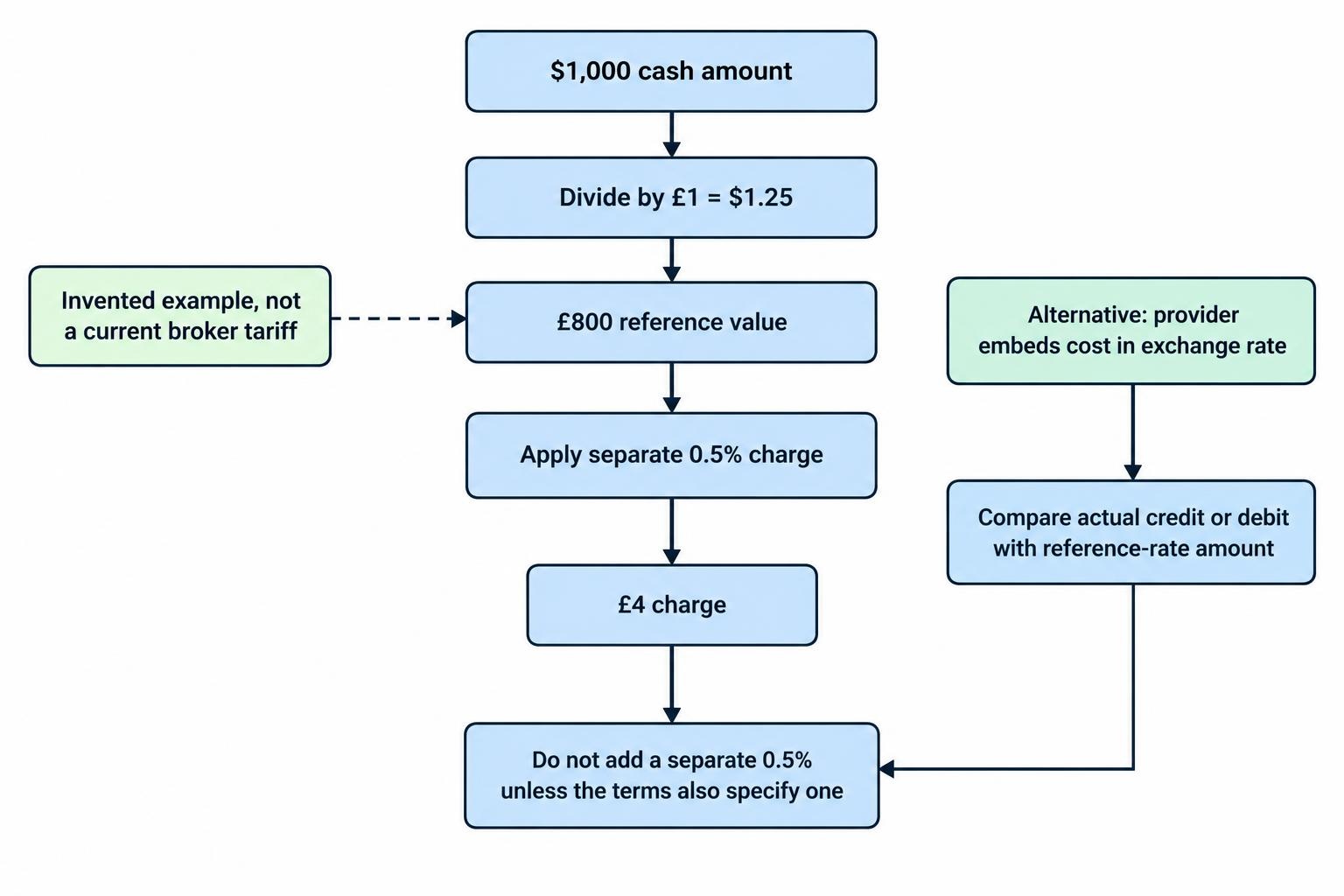
The following example uses an invented fee structure, not a current broker tariff. Assume a $1,000 cash amount, a reference rate of £1 = $1.25, and a separate conversion charge equal to 0.5% of the sterling equivalent.
Reference sterling value = $1,000 ÷ 1.25 = £800
Conversion charge = £800 × 0.005 = £4
| Cash flow | Sterling value before charge | Conversion charge | Final account effect |
|---|---|---|---|
| $1,000 profit | £800 credit | £4 debit | £796 credit |
| $1,000 loss | £800 debit | £4 debit | £804 debit |
A charge reduces a credit or increases a debit. It does not become a benefit because the underlying trade lost money.
A rate markup needs a different calculation. If the provider embeds its charge in the exchange rate, calculate the sterling amount using the reference rate, then compare it with the actual credit or debit. Do not add another 0.5% unless the terms also impose a separate charge. That would charge the same cost twice on paper, which is quite enough charging for one transaction.
Why Conversion Frequency Matters
Where charges apply separately to each converted cash flow, calculate them using those flows rather than the final net trading result.
Suppose converted winning trades total £400 before conversion charges and converted losing trades total £350. At an illustrative 0.5% charge on both sets of flows, the cost is:
(£400 + £350) × 0.005 = £3.75
Applying 0.5% only to the £50 net profit would produce £0.25, understating the assumed charge. This example applies only where the conversion policy charges each flow separately. If the account nets amounts before conversion, use that policy instead.
Conversion Fees Are Not the Same as Currency Risk
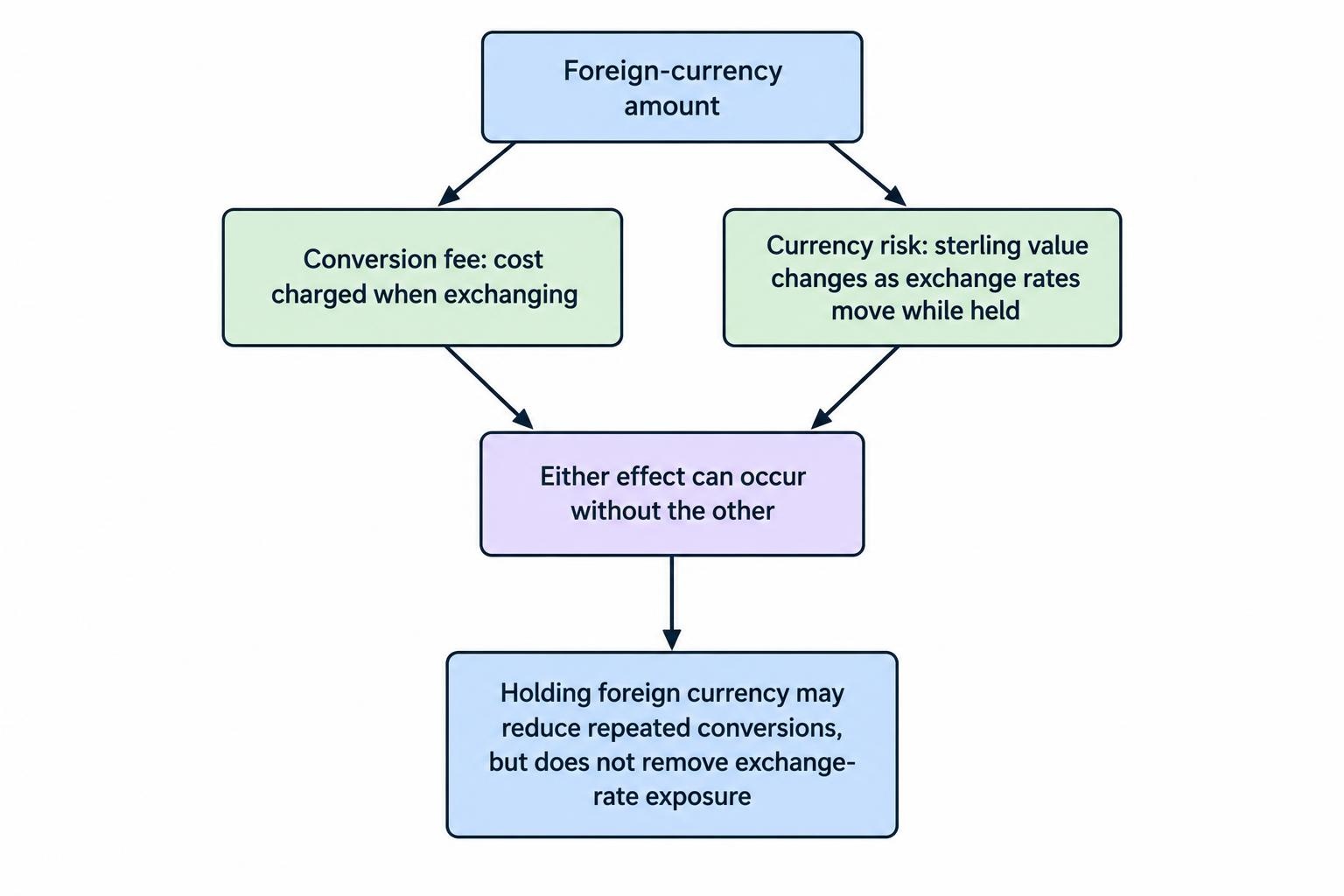
An exchange fee is a transaction cost. Currency risk is the possibility that exchange rate movements change an amount’s value. You can have one without the other.
Take a fixed $1,000 cash balance. At £1 = $1.25 it is worth £800 before charges. At £1 = $1.30 it is worth about £769.23. The £30.77 difference comes from sterling strengthening against the dollar, not from a conversion fee.
For a contract with a fixed sterling stake and sterling settlement, there is no separate dollar payoff to revalue in this manner. That does not make the underlying market immune to currencies: exchange rates can still affect share prices, company earnings and commodity prices.
A forex spread bet is another separate case. A sterling denominated EUR/USD bet can settle its point based result in pounds without exchanging a cash euro holding for dollars. The currency pair’s trading spread is not automatically an account conversion charge. See how forex spread betting works for the contract mechanics.
Holding foreign currency to reduce repeated conversions also leaves that balance exposed to exchange rate movements. Avoid treating a smaller conversion bill as a free hedge.
How to Check the Exchange Rate Used
For any conversion, retain the original currency amount, converted amount, conversion time and separately charged fees. Record which direction the quoted rate runs. “Dollars per pound” and “pounds per dollar” are reciprocals, not interchangeable numbers.
For a dollar credit converted into sterling, dividing the original dollars by the sterling received gives an effective dollars per pound rate. If a separate fee was deducted from the credit, add it back before comparing exchange rates; otherwise, you are measuring the combined rate and fee rather than the rate alone.
The Bank of England’s daily sterling exchange rate data provides a reference, but the Bank states that these are not official rates. Do not treat a daily observation as a guaranteed executable price at the moment of your conversion.
A difference between that reference and your account entry does not, by itself, prove an undisclosed charge. First match the timestamp, quotation direction and contractual conversion method. Then ask the provider to reconcile any remaining difference.
Reducing Avoidable Currency Conversion Costs
Begin with the paperwork rather than changing your trading strategy. FCA investment cost disclosure rules require a reasonable estimate of relevant costs before the service and an itemised breakdown on request. Use the FCA rules on investment cost disclosure when requesting a clear explanation of the charges applicable to your account.
Four checks will usually settle the practical questions:
- Confirm the contract currency. Check the stake and settlement currency on each unfamiliar market rather than relying on the account’s display currency.
- Match funding currencies where practical. Compare a direct sterling payment with any alternative route after including bank charges and exchange markups.
- Check conversion timing. Establish whether foreign amounts are converted individually, netted periodically or retained as currency balances, where those choices exist.
- Reconcile the cash entries. Separate the trading result, financing, adjustments and conversion costs instead of treating every difference as an FX fee.
Use the guide to spread betting account statements to organise that reconciliation. Keep the relevant tariff alongside the statement so you can reproduce the calculation rather than guess at it later.
Once the currency treatment is clear, include it in a comparison of total spread betting costs. A smaller conversion charge can be outweighed by a wider trading spread or higher financing cost. The useful comparison is the cost of your intended cash flows and holding period, not the most attractive percentage in isolation.
Avoiding an unnecessary conversion is sensible. Increasing a stake to compensate for fees is not: the potential trading loss remains a separate and much larger consideration.