For a UK resident individual placing genuine financial spread bets as private wagers, winnings are generally outside Capital Gains Tax (CGT). They do not become taxable simply because the profit exceeds the annual CGT allowance. The other side of that treatment matters just as much: spread betting losses are not allowable capital losses.
The practical task is to keep spread bets separate from taxable investments, identify the contract you actually hold and recognise situations that need individual advice. This article concentrates on CGT; the wider UK spread betting tax guide covers the related tax questions.
Why spread betting winnings are outside Capital Gains Tax
The starting point is the legal treatment of betting winnings, rather than the financial market being traded. Section 51 of the Taxation of Chargeable Gains Act 1992 excludes winnings from betting from chargeable gains. An ordinary personal spread bet therefore does not produce a taxable capital gain in the way that selling a chargeable investment can.
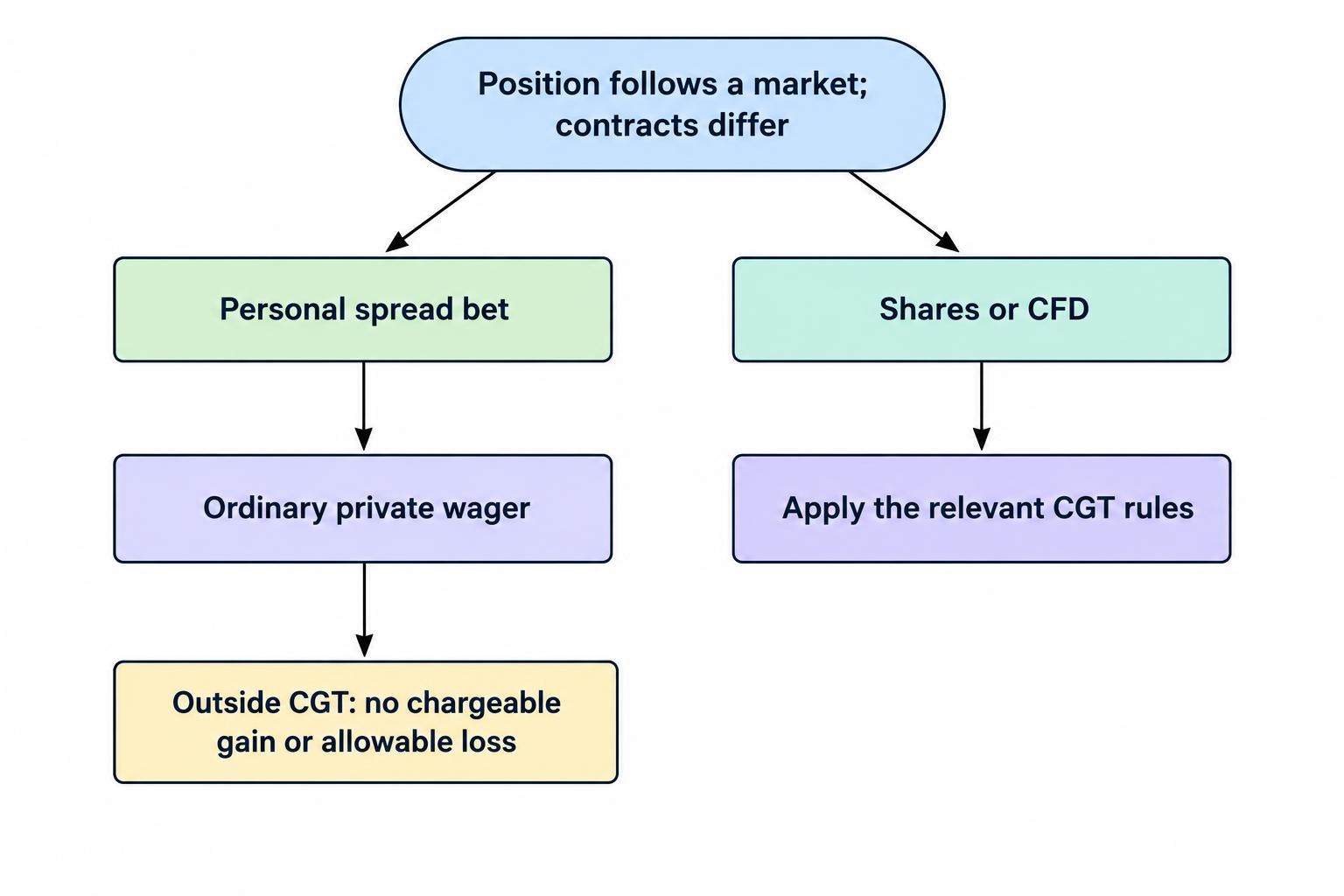
A spread bet on a company’s share price is not ownership of its shares. You agree a stake per point and settle the result against the provider’s prices. Calling the position a “buy”, “sell” or “trade” does not turn it into a shareholding.
That distinction also explains why the underlying market is not enough to establish the tax result. Two positions can follow the same index and produce similar cash returns, yet have different tax treatment because one is a spread bet and the other is a different contract.
Does the annual CGT allowance limit spread betting profits?
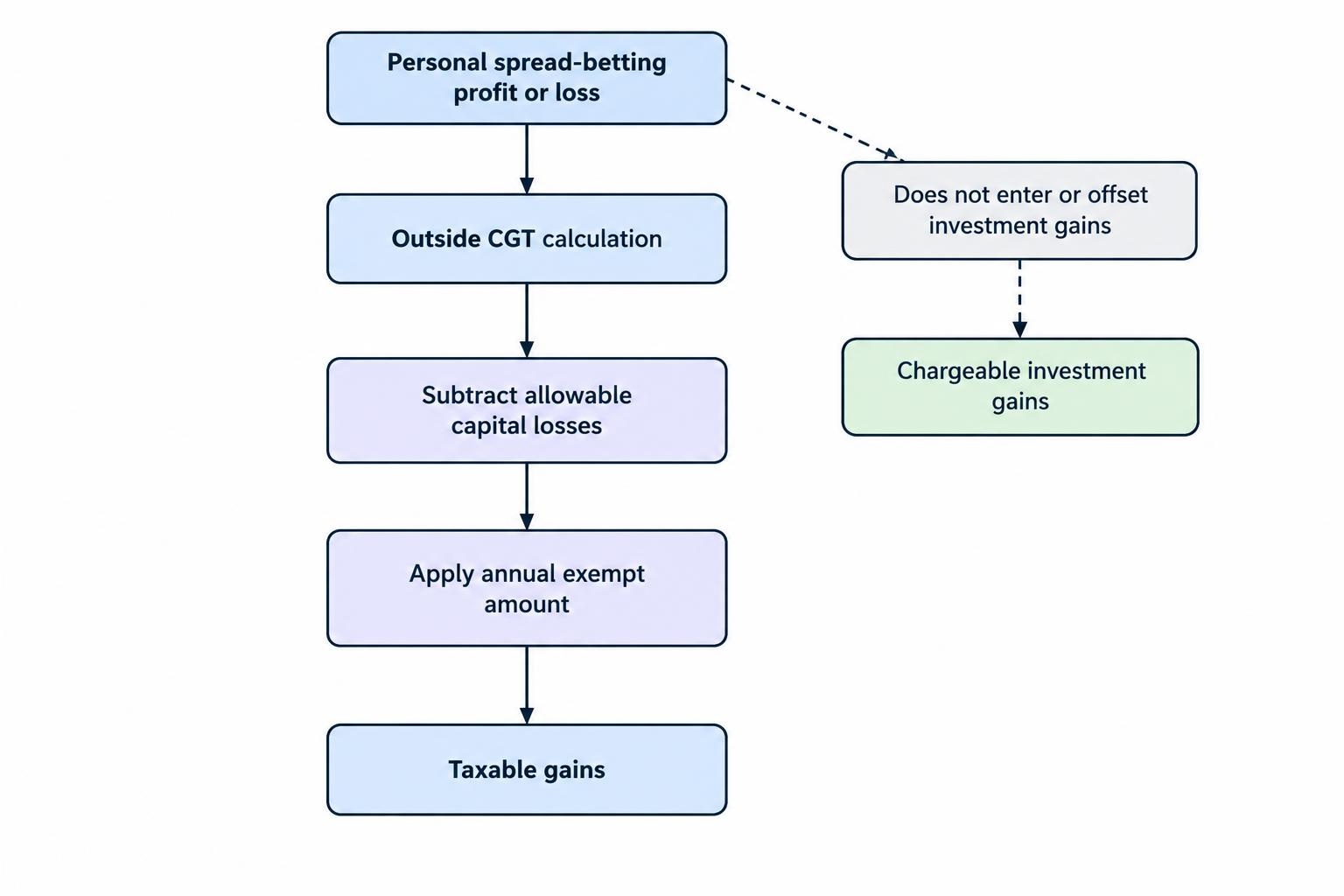
No. The annual exempt amount applies to gains within the CGT calculation. It is not a ceiling on exempt betting winnings.
For the 2026/27 tax year, running from 6 April 2026 to 5 April 2027, the annual exempt amount is £3,000 for eligible individuals. Eligibility is not universal, including where certain foreign income and gains relief claims are made. The current amounts and exclusions appear in HMRC’s CGT rates and allowances guidance.
Suppose an individual makes £10,000 from ordinary personal spread bets. The calculation is not £10,000 minus £3,000, leaving £7,000 taxable. The winnings sit outside that calculation from the start.
Equally, exempt winnings do not use up the allowance available against separate chargeable gains. Someone with both spread betting profits and taxable investments needs two distinct records, not one combined trading profit figure.
Can spread betting losses reduce taxable capital gains?
No, not where the bets are ordinary private wagers. HMRC’s financial spread betting guidance expressly states that spread betting produces neither chargeable gains nor allowable losses. A loss therefore cannot reduce gains from shares, property or other chargeable assets.
This also means a personal spread betting loss does not create an allowable capital loss to carry forward. Keeping a losing position open until the end of the tax year, or closing it just before that date, does not turn the loss into CGT relief.
The distinction is between an economic loss and an allowable tax loss. Your account balance can fall without creating anything deductible in your capital gains calculation. The separate guide to the tax treatment of spread betting losses covers that issue in more detail.
Worked example: spread bets alongside taxable investments
Assume an individual has £12,000 of chargeable investment gains in 2026/27 and qualifies for the full £3,000 annual exempt amount. The following are alternative scenarios, not transactions to combine. All spread bets are private wagers, and no other reliefs or losses apply unless shown.
| Additional result | Investment gains after allowable losses | Taxable gains after £3,000 allowance |
|---|---|---|
| £8,000 spread betting profit | £12,000 | £9,000 |
| £4,000 spread betting loss | £12,000 | £9,000 |
| £4,000 separate allowable capital loss | £8,000 | £5,000 |
The spread betting profit does not increase the taxable gains. The spread betting loss does not reduce them. Only the assumed allowable capital loss changes the calculation.
These figures show the amount subject to CGT, not the final tax bill. They also show why a platform’s combined profit and loss total is not a substitute for a tax calculation.
Spread bets and CFDs do not share the same CGT treatment
A contract for difference (CFD) should not be treated as an exempt spread bet because it follows the same market. Retail CFD outcomes generally fall within the capital gains regime unless the profits are taxable as trading income. HMRC’s guidance on retail contracts for differences also sets out how contract debits and credits enter the calculation when the contract closes.
Check the account agreement and transaction confirmations rather than relying on how familiar the dealing screen looks. A pound figure beside a position does not establish that the contract is a spread bet. Nor does a provider’s general advertising establish the treatment of every product it offers.
Before preparing your figures, separate transactions by product type. If a statement contains unfamiliar adjustments, ask for an explanation of what each entry represents before assigning it a tax category.
For a fuller comparison, see spread betting versus CFD tax treatment. The point here is straightforward: establish the product before applying the tax rule.
Does trading full time change the answer?
Earning a living from betting does not, by itself, make the activity a taxable trade. Having a betting system does not settle the question either. Those principles appear in HMRC’s guidance on professional gamblers.
It is therefore misleading to use a simple rule such as “part time is exempt, full time is taxable”. Profit size and reliance on winnings are not standalone tests that switch ordinary betting winnings into capital gains.
However, that is not a reason to assume every arrangement described as spread betting receives identical treatment. The distinction between personal wagering and activity connected with a business still needs attention. The guide to spread betting tax for professional traders addresses the broader classification questions without treating a job title as a tax answer.
When the usual personal treatment needs closer review
Commercial arrangements and company accounts require separate analysis. HMRC’s guidance on derivatives outside the corporate derivative rules distinguishes an individual’s pure wager from a spread bet used for a commercial purpose, such as a hedge. It also identifies the different position for contracts entered into by companies.
Spread bets connected with a business
Consider a sole trader using a currency position to offset exchange rate exposure on business receipts. That calls for a different review from an unrelated personal bet on the same currency pair. Do not assume the personal wagering treatment answers the business tax question.
Ask an adviser to review the contract, its purpose and the relationship with the exposure being protected. Keep evidence of why the position was opened. The guide to hedging with spread bets and tax covers this boundary in greater detail.
Spread bets held by a company
A company should not import an individual’s betting exemption into its accounts. A spread bet entered into by a company can fall within the corporate derivative contracts rules. “No personal CGT” is not the same statement as “no corporation tax”.
Before using company funds, obtain advice on both the contract’s tax treatment and its accounting treatment. This article’s ordinary personal examples are not company tax calculations.
Do spread betting profits go on a CGT return?
Where genuine personal spread bets produce no chargeable gains or allowable losses, they are not entered as taxable gains or claimed capital losses on the capital gains pages. That follows from their treatment outside the CGT calculation, rather than from their value being below the annual allowance.
Keep that narrow answer separate from your wider filing position. Exempt spread betting results do not remove any obligations arising from other transactions. Do not leave taxable investment disposals out of a return because the cash has since moved into a spread betting account.
For preparation purposes, reconcile the investment and spread betting accounts separately before considering your tax return. Avoid netting every account into one number and then trying to work backwards. That approach makes a simple distinction needlessly difficult.
If the arrangement involves a business, a company or an uncertain contract classification, settle that question before deciding what to report. A tax return is not a good place to guess what the product was.
What records should you keep?
Even where no CGT calculation is required for the bets, retaining clear records is sensible. The aim is to show what you traded and distinguish winnings from deposits, withdrawals and unrelated investment proceeds.
- Product documents: retain the agreement identifying the account and contract type.
- Transaction history: save opening and closing details, stakes, results and adjustments.
- Cash movements: keep statements showing deposits, withdrawals and transfers.
- Purpose and ownership: record whose account it is and flag any connection with a business or hedge.
Download records periodically rather than relying entirely on continued access to a platform. A withdrawal is not necessarily profit: it may include money originally deposited. An account balance is not a realised trading result either.
The practical spread betting record keeping guide provides a fuller framework. For this article’s purpose, the priority is a clear boundary between exempt wagers and transactions that belong in a capital gains calculation.
Assess the trade before the tax benefit
The absence of CGT on ordinary personal winnings does not make a spread bet a suitable replacement for an investment. Start with the exposure you want, how long you expect to hold it and how much you can afford to lose. Tax treatment comes after those decisions, not before them.
Include dealing costs in that assessment. A position can be exempt from CGT and still deliver a poor result after spreads, funding and other applicable charges. Use the guide to spread betting costs to assess the cash economics separately from the tax position.
Then check the cash effect of an adverse move. At £5 per point, a 100 point movement against the position represents a £500 trading loss before applicable charges. The tax exemption does not reduce that loss.
Set the stake through position sizing, rather than increasing it because potential winnings are exempt. For ordinary private spread bets, the CGT treatment is favourable on profits and unforgiving on losses. Both sides belong in the decision.
This article provides general UK tax information, not personal tax advice. Obtain advice where the contract, account ownership, commercial purpose or your tax residence makes the ordinary personal treatment uncertain. Do not assume the UK position establishes your obligations in another country.