Treating spread betting as a business raises two separate questions: whether you manage the activity commercially, and whether UK tax law treats it as a taxable trade. Those questions do not necessarily have the same answer.
You can keep detailed accounts, follow a written strategy and depend on withdrawals for living costs without those facts alone establishing a trade for tax purposes. A business connection, a company account or payment for services requires a different examination.
This article focuses on that boundary and the practical decisions involved in running a serious spread betting operation. The wider UK spread betting tax guide covers the surrounding tax topics. The discussion below concerns UK treatment; do not assume it applies in another country.
Running an activity commercially does not settle its tax status
For an individual placing ordinary personal wagers, spread betting does not normally constitute a trade. The usual result is that profits are not taxable and losses do not qualify for relief. The position of the customer placing bets differs from that of the bookmaker accepting them. These distinctions appear in HMRC’s guidance on betting, gambling and trading.
This matters because the word “business” gets used rather loosely. A trader might use it to mean a disciplined occupation, an accountant might use it to describe an income producing activity, and a broker might use it as an account category. None of those descriptions, taken alone, answers the tax question.
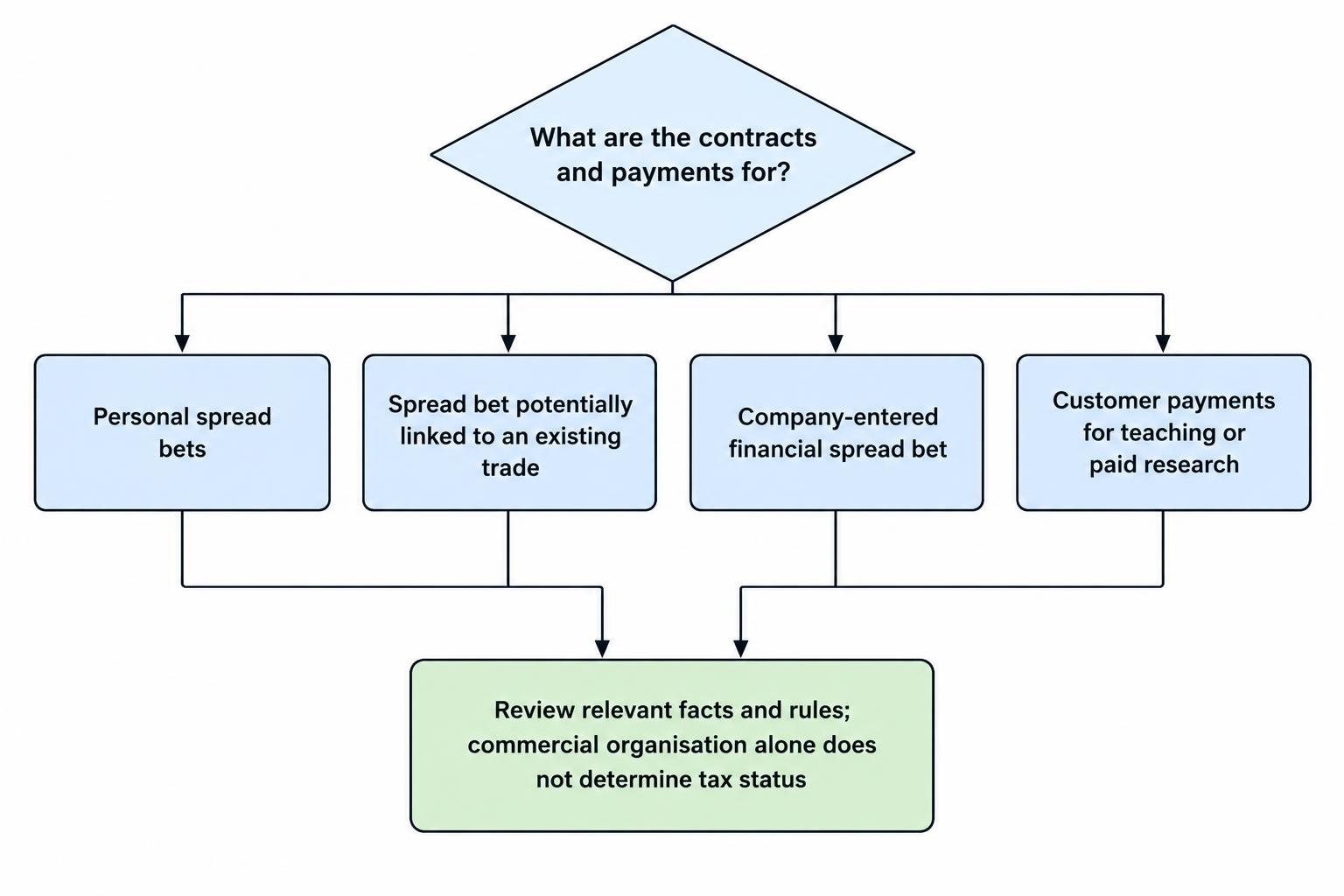
Start with the arrangement rather than the label. Who enters the contract? What does the contract pay for? Is the individual betting personally, delivering a service to a customer, or using a contract within another commercial activity?
A sensible business plan should record those facts before forecasting profits. Otherwise, it risks combining three different subjects: personal betting results, revenue from customers and company transactions. Keep those categories separate from the outset.
Does full time spread betting become a taxable business?
Having a betting system, developing expertise or earning a living from gambling does not, by itself, turn the activity into a trade. That remains the starting point even where betting supplies someone’s sole livelihood. HMRC’s guidance on professional gamblers expressly addresses systematic betting and earnings sufficient to support the bettor.
There is therefore no sound basis for assuming that leaving employment automatically changes the tax treatment of personal spread bets. Nor should an adviser replace the legal analysis with a homemade threshold based on hours at the screen or monthly withdrawals.
Consider someone who researches index markets each morning, records every position and pays household bills from their account. Those details describe how the activity is organised. The adviser still needs to examine what the person actually does and the contracts involved.
For planning purposes, separate two decisions: whether to rely financially on spread betting, and how the activity should be treated for tax. The first needs evidence about capital, costs and cashflow. The second needs a review of the facts and applicable rules. The related guide to spread betting tax for professional traders examines the professional label in more detail.
When a connection with another business matters
A spread bet can require different treatment where it forms part of carrying on an existing trade. The test is not simply whether the person has a business or encountered an opportunity through their work. The winnings must arise from carrying on that trade. Contract terms and economic substance matter, as set out in HMRC’s spread betting trading guidance.
That distinction prevents an easy but unreliable shortcut: “I work in finance, so all my bets are business transactions.” Employment, professional knowledge and access to market research do not explain the purpose of an individual contract.
A commercial hedge deserves closer examination. Suppose a sole trader faces a currency exposure from an overseas purchase and enters a financial contract intended to offset that exposure. The review should consider the purchase commitment, contract size, timing and purpose, rather than treating the position as an unrelated personal wager.
Prepare that evidence when entering the arrangement. A note written at the time, supported by the underlying invoice or commitment, is more useful to an adviser than a later description chosen after the result becomes known. Document any change in purpose too.
Do not assume every transaction called a hedge receives identical treatment. Hedging a personal investment portfolio and hedging a trading liability are different fact patterns. The separate guide to hedging with spread bets and tax covers that distinction without turning every personal position into business income.
Trading through a company changes the analysis
A company account is not a way to package ordinary personal betting treatment inside a corporate structure. A financial spread bet entered into by a company is a contract for differences for the relevant corporate tax rules and, unless excluded because of its underlying subject matter, a derivative contract. HMRC’s corporate derivative contract guidance distinguishes this from an individual entering a spread bet purely as a wager.
Before incorporating, ask an accountant to compare the proposed company arrangement with continued personal activity. The review should address the contracts, accounting treatment, tax consequences, funding and intended use of any proceeds. Do not start with an assumed tax saving and work backwards.
The operational questions deserve attention as well. Whose money will fund the account? Who will own the contractual rights? How will transfers between the owner and company be recorded? What records will support those transfers?
A useful written comparison should show what happens in both profitable and losing periods. It should also identify unresolved questions rather than hiding them behind a single estimated tax figure. A structure that looks attractive under one optimistic forecast may be unsuitable under another.
The guide to spread betting through a company examines corporate arrangements in more detail. Obtain that analysis before moving money, not after the first company positions have closed.
A business around spread betting is not the same as personal betting
Someone can operate a business connected with spread betting while also placing personal bets. Teaching, producing paid research and providing other services introduce customers and payment obligations that need their own analysis. Income tax is charged on the profits of a trade, profession or vocation under section 5 of the Income Tax (Trading and Other Income) Act 2005.
Suppose someone receives course fees and also has results from a personal spread betting account. Do not put both amounts into one spreadsheet column called “trading income”. Record the course receipts, related costs and betting account movements separately, then have the treatment of each reviewed.
Apply the same discipline to arrangements advertised as funded trading. Establish whether a payment comes from a personal betting contract, employment, a service agreement or another contractual entitlement. The marketing description is not a substitute for reading the agreement.
This is also a reason to ask broader questions before expanding. If you plan to sell research, promote financial products or handle someone else’s money, request advice on the proposed service and any regulatory implications before accepting customers.
The guide to spread betting and income tax provides further context. The practical rule is simple: identify what each payment is for before deciding where it belongs.
Can you claim business expenses or deduct losses?
For ordinary personal spread betting, a losing period does not create an allowable capital loss. The corresponding winnings do not create chargeable gains. HMRC’s guidance on financial spread betting and capital gains states both sides of that treatment.
Keep the financial loss visible in your records even where it produces no tax deduction. An account statement remains evidence of money lost; it does not need a tax benefit to matter. The separate guide to the tax treatment of spread betting losses covers relief questions more fully.
Business expense claims require their own justification. For an unincorporated trade, section 34 prevents deductions for expenses not incurred wholly and exclusively for that trade, and for losses unconnected with it. An identifiable business portion of a mixed purpose expense can be considered separately under the same provision. See the statutory restriction on trade expenses and unconnected losses.
Do not assume that buying a computer, data subscription or training course establishes a deductible business cost. Start by identifying the activity the purchase serves. If you also operate a genuine service business, document how shared equipment or subscriptions are used rather than assigning everything to that business by default.
Maintain two views of expenditure. Your management records should include every cost relevant to deciding whether the activity is worthwhile. Your tax calculation should include only amounts that qualify under the applicable rules. Those records serve different purposes and need not produce the same figure.
A subscription can be poor value even if deductible elsewhere. It can also be useful without qualifying for a deduction. “Can I claim it?” should not replace “Do I need it?”
Professional client status is a separate regulatory question
A broker’s professional client classification concerns the regulatory treatment of the relationship, not whether someone’s personal betting constitutes a taxable trade. Elective professional classification involves an assessment and a formal procedure. The broker must warn the client about protections and compensation rights they may lose under the FCA’s client categorisation rules.
Keep that decision separate from business planning and tax advice. Ask the broker to explain the proposed classification in writing, then assess the consequences on their own merits. Do not treat “professional” as a badge that makes a business plan more convincing.
The comparison of retail and professional client classification covers the regulatory distinction. There is no need to surrender protections simply to make an occupation sound more established.
Test financial viability before relying on withdrawals
Once the legal structure is clear, the commercial question remains: can the activity support its costs and your intended withdrawals without an unacceptable reduction in capital?
Build the answer from actual account records where available. Label assumptions clearly and keep forecasts separate from recorded results. Do not use a promising month to fill twelve identical boxes in an annual budget. Markets have not agreed to your household payment schedule.
Calculate the result after all relevant costs
For management purposes, include dealing costs, overnight charges, data subscriptions, software and other expenditure connected with the operation. Check the account statement carefully so that you do not subtract charges twice where the reported result already includes them.
Use a consistent method across review periods. If one month includes every subscription and another ignores them, the comparison says more about the spreadsheet than the strategy. The guide to comparing total spread betting costs helps organise that review.
Record time as well as cash expenditure if spread betting is intended to replace paid work. You do not need to assign a precise hourly value, but track the hours committed. A modest cash profit can look different after accounting for the work required to produce it.
Distinguish profit from available cash
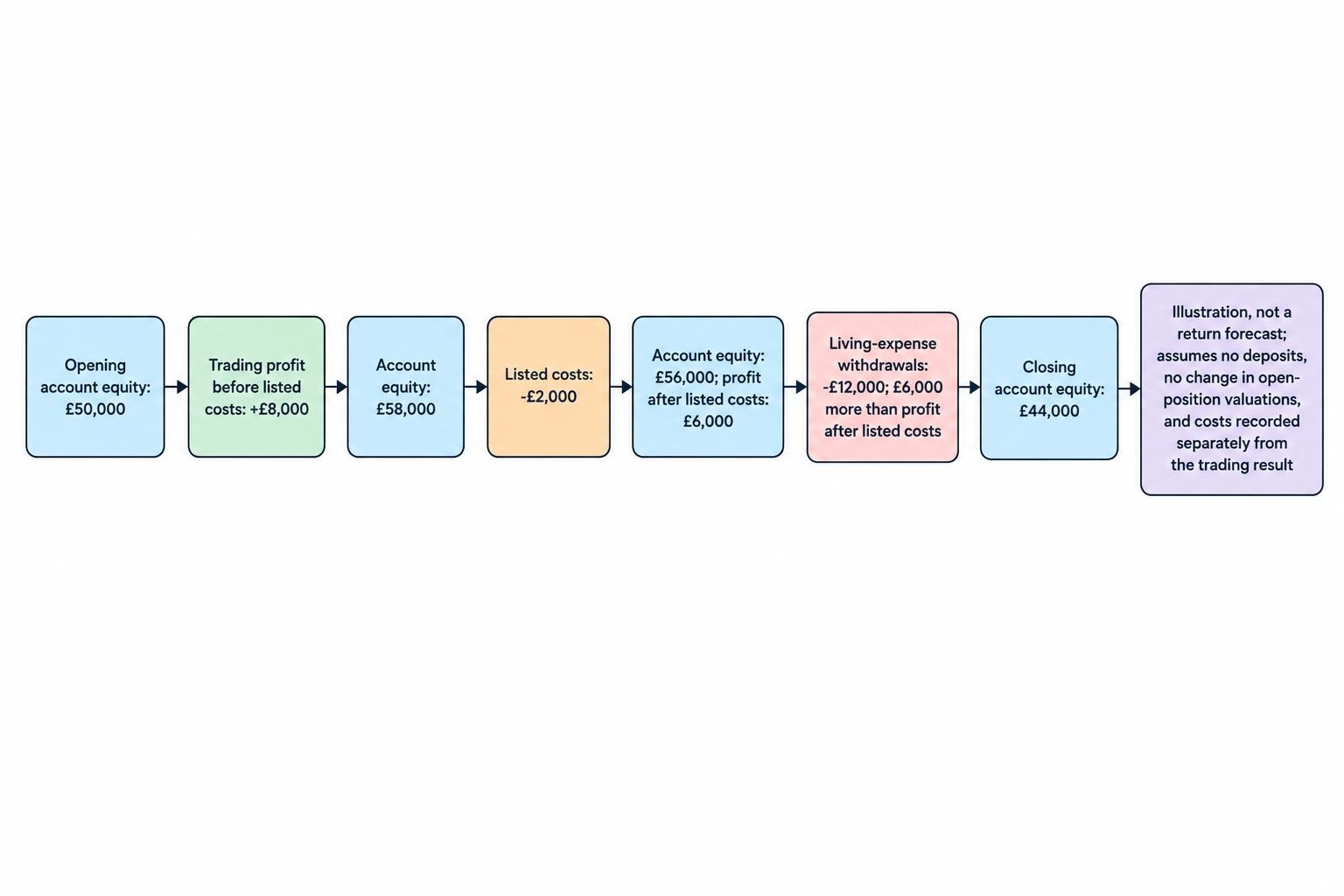
The following illustration assumes no deposits during the period, no change in open position valuations and costs recorded separately from the trading result.
| Account movement | Amount |
|---|---|
| Opening account equity | £50,000 |
| Trading profit before the listed costs | £8,000 |
| Costs charged during the period | £2,000 |
| Withdrawals for living expenses | £12,000 |
| Closing account equity | £44,000 |
The activity made £6,000 after the listed costs, but withdrawals exceeded that amount by £6,000. Account capital therefore fell despite profitable trading. Calling the withdrawals “income” would conceal the amount taken from the original capital.
Build a separate household budget showing the amount needed and its timing. Then test a period with no trading profit, followed by a losing period. Work out how those bills would be paid without assuming that the next trade repairs the shortfall.
Set capital and withdrawal rules in advance
Consider keeping living expenses outside the trading account so that routine bills do not depend on closing positions. Set a review process for withdrawals rather than taking whatever amount the household needs each month.
Write down when you would reduce exposure, pause trading or stop relying on withdrawals. Include circumstances beyond a losing streak, such as a change in working hours, health or household commitments. A plan should still function when trading receives less attention than expected.
Measure performance separately from deposits and withdrawals. The guide to managing trading drawdown addresses account declines, but your business records should also show whether money leaving the account is consuming the operating capital.
Do not increase stakes simply because the budget has a gap. Start with an acceptable potential loss and available capital, using a consistent position sizing process. If the resulting activity cannot support the desired withdrawals, revise the income plan rather than forcing the position size.
Keep records that explain both the contracts and the money
A useful record should allow an adviser to follow the arrangement without relying on memory. Keep the account agreement, product description, statements and transaction exports alongside your own calculations.
For each account, make it easy to identify the legal account holder, source of funds, deposits, withdrawals, closed results, charges and open positions at the review date. Record transfers between accounts clearly so that moving the same money twice does not resemble additional profit.
Where another business is involved, keep the related evidence together. That might include a purchase commitment supporting a proposed hedge, a customer agreement explaining service payments, or documents recording company funding. Preserve the original agreements, not just your summary of them.
Write short notes when circumstances change. Starting a paid service, opening a company account or changing the purpose of a position should trigger a review rather than an assumption that an earlier answer still applies.
The spread betting record keeping guide covers the documents in more detail. Store copies outside the dealing platform and check that the files can actually be opened. An export you cannot read is not much of an archive.
What to ask an accountant before formalising the activity
Ask for a review of the proposed facts, not an answer to the broad question “Is spread betting tax free?” Provide the contracts and a short description of who supplies the money, who takes the risk and why each account exists.
A focused briefing can address four questions:
- Which receipts arise from personal bets, services or another arrangement?
- Does any position form part of carrying on an existing trade?
- Would using a company change the tax and accounting treatment?
- What reporting, record retention and expense treatment follows from those findings?
Request written advice that identifies assumptions and the changes that would require another review. If the arrangement remains uncertain, ask how to handle that uncertainty before filing anything or moving funds.
Do not begin with a business registration and then try to make the analysis fit it. Equally, do not assume that a broker’s account label provides a complete tax answer. Give the adviser enough evidence to distinguish the actual transactions from the language used to market them.
Decide the structure before committing more capital
Approach the decision in order: establish the contracts and account holder, obtain advice where business or corporate connections exist, and then test the economics using costs, withdrawals and a losing scenario.
Write down what would make you abandon the plan. That could be insufficient capital after withdrawals, costs that absorb the expected result, or an arrangement whose legal treatment has not been resolved. Defining those limits before committing funds makes the review more useful.
A professional approach means accepting an unhelpful answer when the evidence supports it. You may decide to continue as a personal activity, retain another income source, postpone expansion or reject a proposed company structure. The aim is not to make spread betting look like a business. It is to know what you are doing, what it costs and whether the arrangement can withstand a period that goes badly.