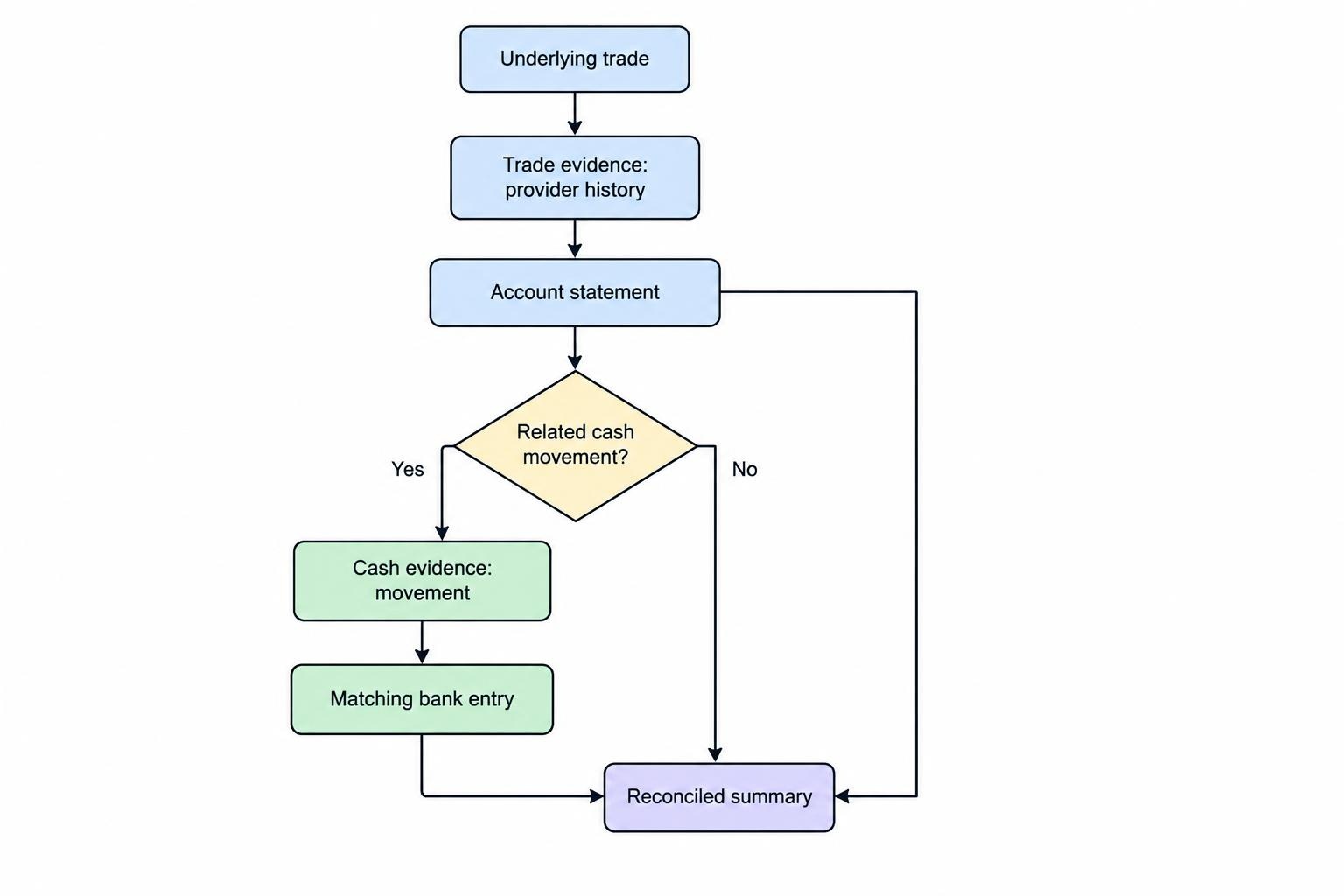
Spread betting record keeping should leave a clear trail from each trade to the broker statement and, where money moves, to your bank account. Keep original statements, transaction exports, payment evidence and a reconciled summary. A spreadsheet helps organise those records, but it should not replace them.
The aim is to explain what happened without reconstructing months of activity from memory. This guide covers the practical records to retain and the difference between a sensible archive policy and a legal retention requirement. For the wider treatment of profits and losses, see our UK spread betting tax guide.
Why Keep Records If Spread Betting Profits Are Normally Tax Free?
An individual placing ordinary speculative spread bets is not normally carrying on a trade for tax purposes. Profits are normally not taxable, and losses do not receive tax relief. That starting point appears in HMRC’s guidance on betting, gambling and spread betting.
Nevertheless, retain enough evidence to establish what the transactions actually were. A bank credit identifies money received, but it does not show whether that money represents returned deposits, betting profits or proceeds from another product.
Separate two purposes: supporting your tax position and measuring trading performance. The same documents can serve both, but a performance spreadsheet does not determine tax treatment. Nor does calling an account “personal” settle how every transaction within it should be treated.
Which Spread Betting Records Should You Keep?
Build the archive around documents supplied by the provider, then add your own calculations and explanations. The following is a practical record set, not a claim that every private bettor must retain every item under a dedicated spread betting rule.
| Record | What to retain | Purpose |
|---|---|---|
| Account statements | Monthly statements and any annual summary | Establish balances, transactions and account ownership |
| Trade history | Opening and closing executions, deal references, stakes and prices | Reconstruct individual positions and results |
| Cash transactions | Deposits, withdrawals, transfers and matching bank entries | Separate funding movements from trading returns |
| Charges and adjustments | Financing, premiums, conversion charges, credits and corrections | Explain differences between trade results and account balances |
| Account documentation | Client agreement, product descriptions and relevant amendments | Identify the provider, account holder and contract type |
| Correspondence | Disputed transactions, agreed corrections and relevant tax advice | Preserve explanations that figures alone cannot provide |
Save statements in their original format and download transaction data as CSV files where available. Use the CSV for calculations; preserve the original separately. Our guide to reading spread betting account statements covers how to interpret the entries.
Do not use screenshots as your main archive. Treat them as supporting evidence for a disputed quote or platform display, alongside the complete transaction record. Download the account history before closing an account rather than making future access part of your filing system.
Set Up a Spreadsheet That Can Be Checked
Use separate sheets for positions and cash movements. A position sheet explains trading results. A cash sheet explains money entering or leaving the account and other posted entries. Keeping those jobs separate makes duplicate counting easier to spot.
For each position, record the provider and account reference, deal reference, product type, market, direction, stake per point, opening date and price, closing date and price, and realised result. Preserve execution times and the stated time zone. Give each partial closure its own row, linked to the original position.
On the cash sheet, record transaction dates, descriptions, amounts, currencies and statement references. Add a column showing whether a charge is already included in another reported figure. Financing or a premium deducted twice will make the spreadsheet look precise and still leave it wrong.
Keep the provider’s wording for unfamiliar entries until you have checked them. Use our guide to spread betting costs and fees to distinguish charges, then document any changes to your categories.
Reconcile Deposits, Withdrawals and Trading Results
A withdrawal is not a measure of profit. You can withdraw deposited capital after a losing period, or leave profits in the account without withdrawing anything. Record funding movements separately from gains and losses.
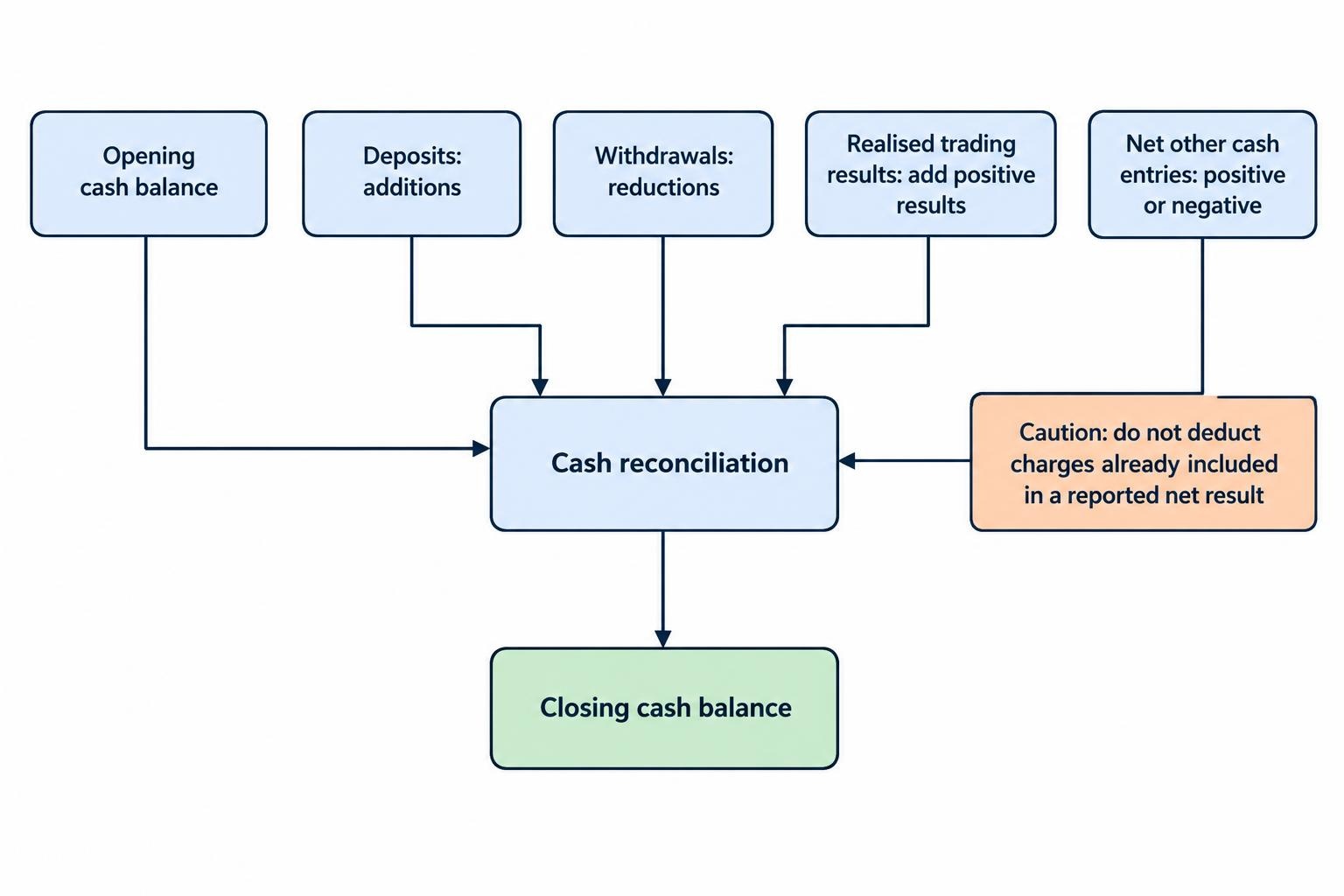
For an account whose cash balance records settled entries, a useful reconciliation is:
Closing cash balance = opening cash balance + deposits − withdrawals + realised trading results + net other cash entries.
Suppose an account starts with £5,000. During the month, you deposit £2,000, withdraw £1,500, realise £650 of trading profit, pay £90 in financing and receive £40 in other credits. The closing cash balance should be £6,100. The net result from trading and those charges and credits is £600, not the £1,500 withdrawn.
That illustration assumes each amount is recorded separately. If a report already includes financing within its net result, do not subtract it again. Check the report’s definitions before applying a formula. The guide to calculating spread betting profit and loss covers the underlying trade calculation.
Keep cash balance, equity and available funds in separate columns. Open position valuations and margin requirements make them different measures. Save a dated open position report at your reporting cutoff, and investigate any reconciliation difference rather than adding an unexplained balancing entry.
Keep Spread Bets Separate From Other Products
Maintain distinct records for spread bets, CFDs, shares and other investments, even when you access them through the same provider. A combined performance total is useful for reviewing your finances, but it should not erase the product labels needed for tax work.
For an individual’s ordinary financial spread betting, no chargeable capital gains or allowable capital losses arise. This treatment is set out in HMRC’s Capital Gains Manual guidance on financial spread betting.
Do not therefore sweep a spread betting loss into a combined capital gains calculation for other investments. Retain the loss in your performance records, with its product classification intact. Our guide to the tax treatment of spread betting losses covers that distinction.
Preserve the exact description of cash adjustments too. Avoid relabelling a share related spread bet adjustment as a dividend from shares you owned. Clear descriptions now prevent unnecessary questions later.
How Long Should You Keep Spread Betting Records?
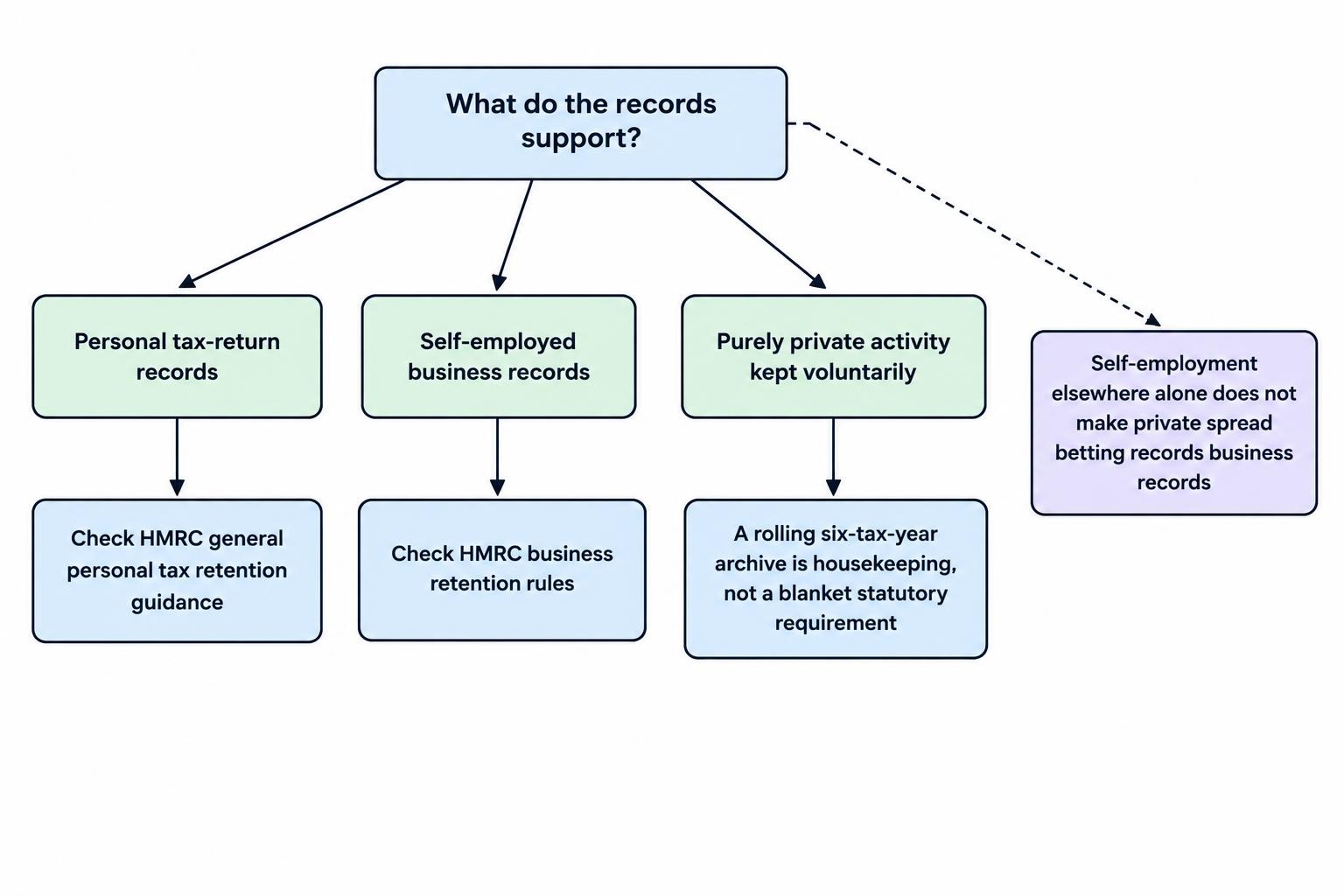
There is no useful single answer that treats every private spread betting archive as a self-employed business ledger. Start by identifying whether documents support a tax return or business calculation, or whether you are keeping them voluntarily for evidence and performance review.
Records Supporting a Personal Tax Return
For personal tax records covered by its general guidance, HMRC says records should normally be kept for at least 22 months after the tax year ends when the return is submitted on time. For a late return, the guidance states at least 15 months after submission. See HMRC’s personal tax record retention guidance.
Its example is concrete: if you submit the 2024 to 2025 online return by 31 January 2026, retain the relevant records until at least the end of January 2027. These are general personal tax record periods, not an instruction that every private spread bet requires a tax return.
Records Supporting a Self-Employed Business
Business records for self-employment must normally be retained for at least five years after the relevant 31 January submission deadline. For records supporting the 2025 to 2026 return, that means at least until the end of January 2032. Different provisions apply to very late returns; check HMRC’s business record retention rules.
Being self-employed elsewhere does not, by itself, turn private spread betting records into business records. Establish the connection before choosing the retention rule.
A Voluntary Archive Policy
For purely private activity, consider retaining a rolling six tax years of statements and supporting files as a practical archive policy. This is a suggested housekeeping period, not a blanket statutory requirement or a limit on HMRC’s powers.
Suspend routine deletion while records support an unresolved tax question, complaint or dispute. Keep account opening documents and relevant advice while you still rely on them.
Preserve More Evidence for Commercial or Company Activity
Commercial use needs a closer review. Gambling treatment does not automatically apply where a spread bet serves a commercial purpose such as a business hedge. Companies also generally fall within the derivative contracts regime for these contracts. Both distinctions appear in HMRC’s guidance on spread bets, commercial hedges and companies.
For a potential business hedge, retain the underlying invoice or exposure, the reason for the position, its size and dates, and how it relates to the business transaction. Write that explanation when the position opens, not after its outcome is known. Our guide to hedging with spread bets and tax covers the questions to raise with an adviser.
For company activity, preserve evidence of account ownership, funding, authorisation and accounting treatment. Keep personal and company transfers clearly identified rather than treating all money movements as interchangeable.
Before applying private betting assumptions to company accounts, review spread betting through a company and obtain advice on the actual contracts and transactions.
Use a Monthly Filing Routine
A manageable routine is better than an ambitious spreadsheet you stop updating. Aim to complete these tasks each month:
- Download statements, trade exports, cash transactions and an open position report.
- Match deposits and withdrawals to bank records, noting transfers between trading accounts.
- Reconcile balances, resolve differences and save explanations beside the relevant documents.
- Back up the archive and check that a sample of the saved files opens correctly.
Organise folders by tax year, provider and account. Use clear filenames containing the account reference, reporting period and document type. Keep original exports unchanged, with calculations in a separate working folder and corrections recorded in a dated note.
Protect the archive with restricted access, strong passwords and multi-factor authentication where available. Keep a separate backup rather than relying on one laptop or the trading platform.
The standard to aim for is straightforward: another person should be able to trace a summary figure to a statement entry, then to the underlying trade or payment. If they can do that without guessing, the records are doing their job.