UK financial spread betting is regulated by the Financial Conduct Authority (FCA). The rules cover who can provide the service, how firms assess customers, the exposure retail traders can take and what happens when an account runs short of margin.
Regulation does not make spread betting safe. It places boundaries around the product and the provider’s conduct, but a compliant account can still lose all the money dedicated to trading. The distinction matters: protection against an account debt is not protection against a bad trade.
Before depositing, establish three things: which legal entity will hold your account, whether you will be classified as a retail client, and which protections apply to that account. Those answers matter more than the platform’s branding or the location of its head office.
Who Regulates Financial Spread Betting in the UK?
The FCA regulates financial spread betting, rather than the Gambling Commission. The word “betting” can cause confusion, but the Gambling Commission’s explanation of activities outside its remit expressly identifies spread betting as an FCA responsibility.
Financial spread bets allow you to speculate on price movements without buying the underlying asset. Their regulatory treatment sits within the financial derivatives framework. Article 85 of the Regulated Activities Order covers contracts for differences and certain other contracts whose purpose is to secure a profit or avoid a loss by reference to fluctuations in prices, values or an index.
That framework is separate from the question of whether a particular trade makes commercial sense. A provider can follow the rules, execute an order correctly and still offer a product that is unsuitable for your finances or appetite for risk. Authorisation is permission to conduct regulated business, not an endorsement of your trading plan.
Is Financial Spread Betting Legal?
Financial spread betting can lawfully be offered in the UK within the applicable regulatory framework. Providers carrying on regulated activities must have the necessary authorisation or an applicable exemption. The starting point is the general prohibition in section 19 of the Financial Services and Markets Act 2000.
For a customer, the useful question is therefore not just “Is spread betting legal?” It is “Does this firm have permission to provide this service to me?” An entry relating to another financial activity does not answer that question.
Product restrictions also matter. Permission to provide financial spread betting does not mean a firm can offer every underlying market to every customer. Retail and professional accounts can have different terms, and some products face separate restrictions.
Check the Firm Behind the Trading Account
Start with the legal company named in the account agreement, not the trading name on the app. Then check its authorisation, relevant permissions and contact details through the official FCA services. The FCA’s guidance on checking a firm’s authorisation explains the roles of its Firm Checker and Financial Services Register, including checks for clone firms.
A firm reference number is not enough on its own. A fraudster can copy a genuine number and attach it to an unrelated website, email address or payment request. You need to establish that the business contacting you is the authorised business, not just that an authorised business with that name exists.
Make the checks independently. Do not rely entirely on a register screenshot supplied by a salesperson, or a link sent through a messaging app. Match the details against the official record and contact the firm using independently verified details if anything differs.
A practical review should cover:
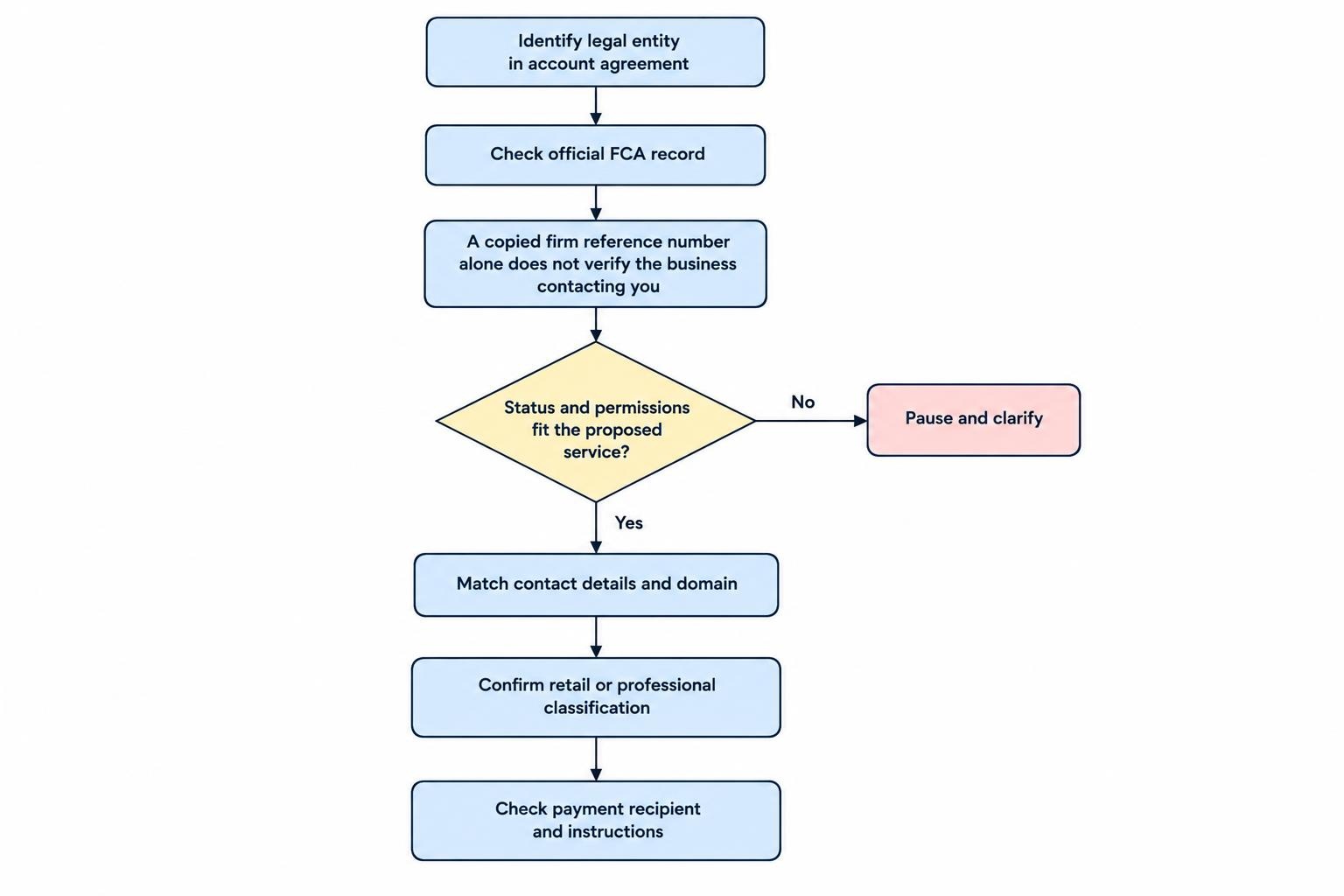
- Legal entity: the company entering into the agreement with you.
- Regulatory status: whether its status allows the proposed business.
- Permissions: whether they cover the service being offered.
- Contact details: whether the domain, telephone number and address match.
- Account classification: whether the agreement describes you as retail or professional.
- Payment instructions: whether the recipient and transfer instructions are consistent with the verified firm.
Keep a copy of the agreement and your checks. The separate guide to checking a broker on the FCA Register covers the process in more detail.
A UK Brand Does Not Necessarily Mean a UK Account
Do not treat a group name as a substitute for identifying your contractual counterparty. If an application names an overseas company, pause and ask which regulator, client money arrangements and dispute process will apply. An answer about another company in the group is not an answer about your account.
Be especially cautious if an account transfer is presented mainly as a route to larger positions. Compare the protections you would retain and lose before comparing the margin rates. Our guide to offshore spread betting brokers examines those trade-offs.
The Main UK Retail Spread Betting Protections
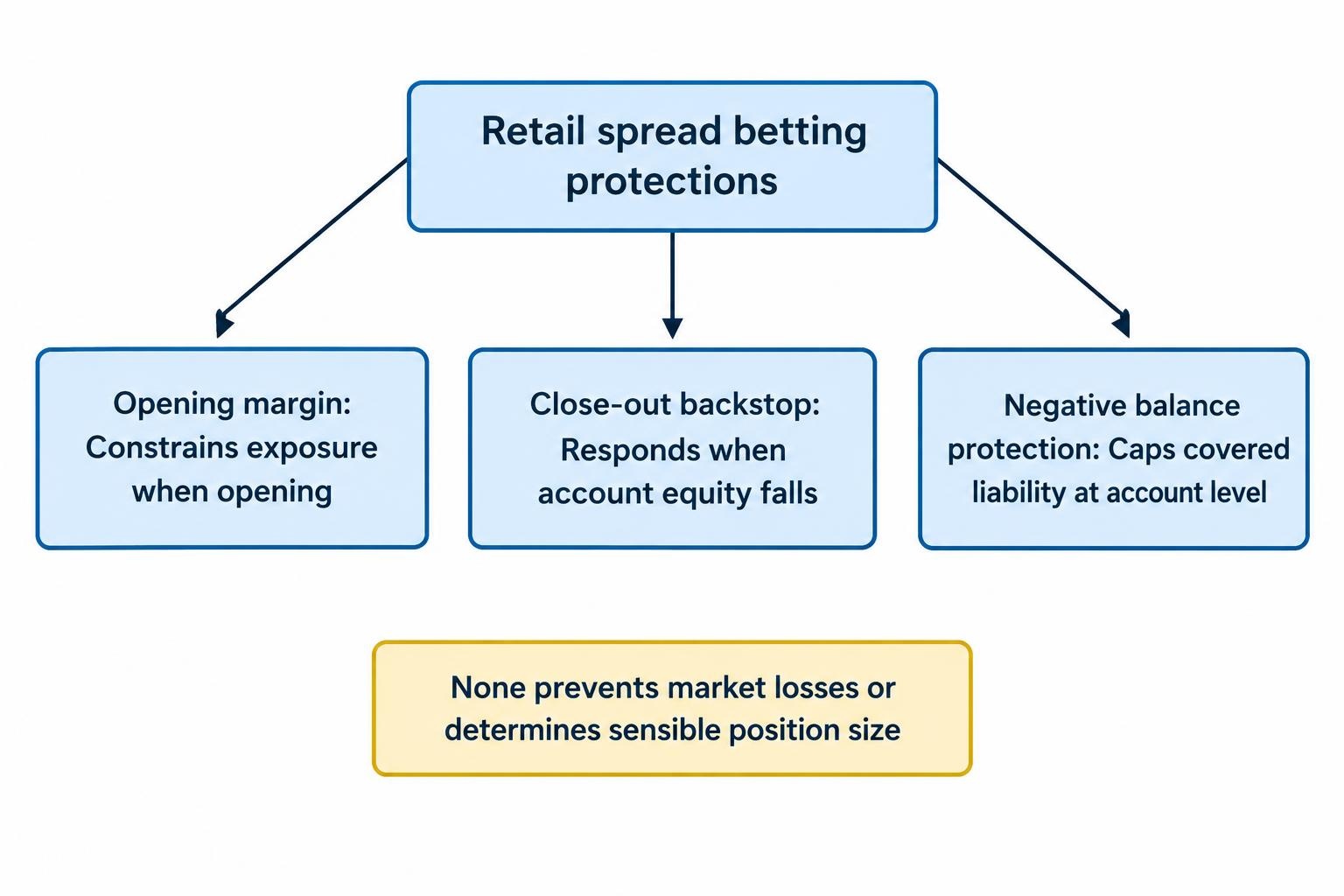
The retail framework combines margin requirements, an account close-out backstop, negative balance protection, risk warnings and restrictions on trading incentives. These measures were introduced as a package through the FCA’s policy statement on restrictions for CFDs and similar products, which includes financial spread bets within its scope.
Each measure addresses a different problem. Margin requirements constrain opening exposure. Close-out rules address deteriorating account equity. Negative balance protection addresses liability beyond the account’s trading funds. None tells you whether a position is sensibly sized.
Retail Margin Requirements and Leverage Limits
The current FCA Handbook rules for complex investment products set the following minimum opening margins for the relevant retail products. The leverage figures below express the corresponding conventional exposure ratios.
| Underlying market category | Minimum opening margin | Corresponding leverage |
|---|---|---|
| Major foreign exchange pairs and relevant sovereign debt | 3.33% | Approximately 30:1 |
| Major stock market indices, minor foreign exchange pairs and gold | 5% | 20:1 |
| Minor stock market indices and commodities other than gold | 10% | 10:1 |
| Shares and other assets not otherwise covered by these categories | 20% | 5:1 |
These are regulatory minimum margins, not a promise that a broker will offer every position at those rates. Check the actual dealing ticket and account terms rather than calculating available exposure from a headline maximum.
Suppose a spread bet provides £10,000 of exposure to a qualifying major stock market index. At a 5% opening margin, the margin requirement is £500. A 1% adverse movement in that exposure represents approximately £100 before charges: one fifth of the opening margin.
The £500 is not the purchase price of an investment and it is not a loss limit. It is the money required to support the exposure. The account’s available funds and the provider’s close-out arrangements are separate parts of the calculation.
Use the spread betting leverage limits guide for the market categories and their application. For an actual trade, calculate the pound loss from the proposed stake and price movement before considering how much margin the platform asks you to post.
The 50% Margin Close-Out Rule
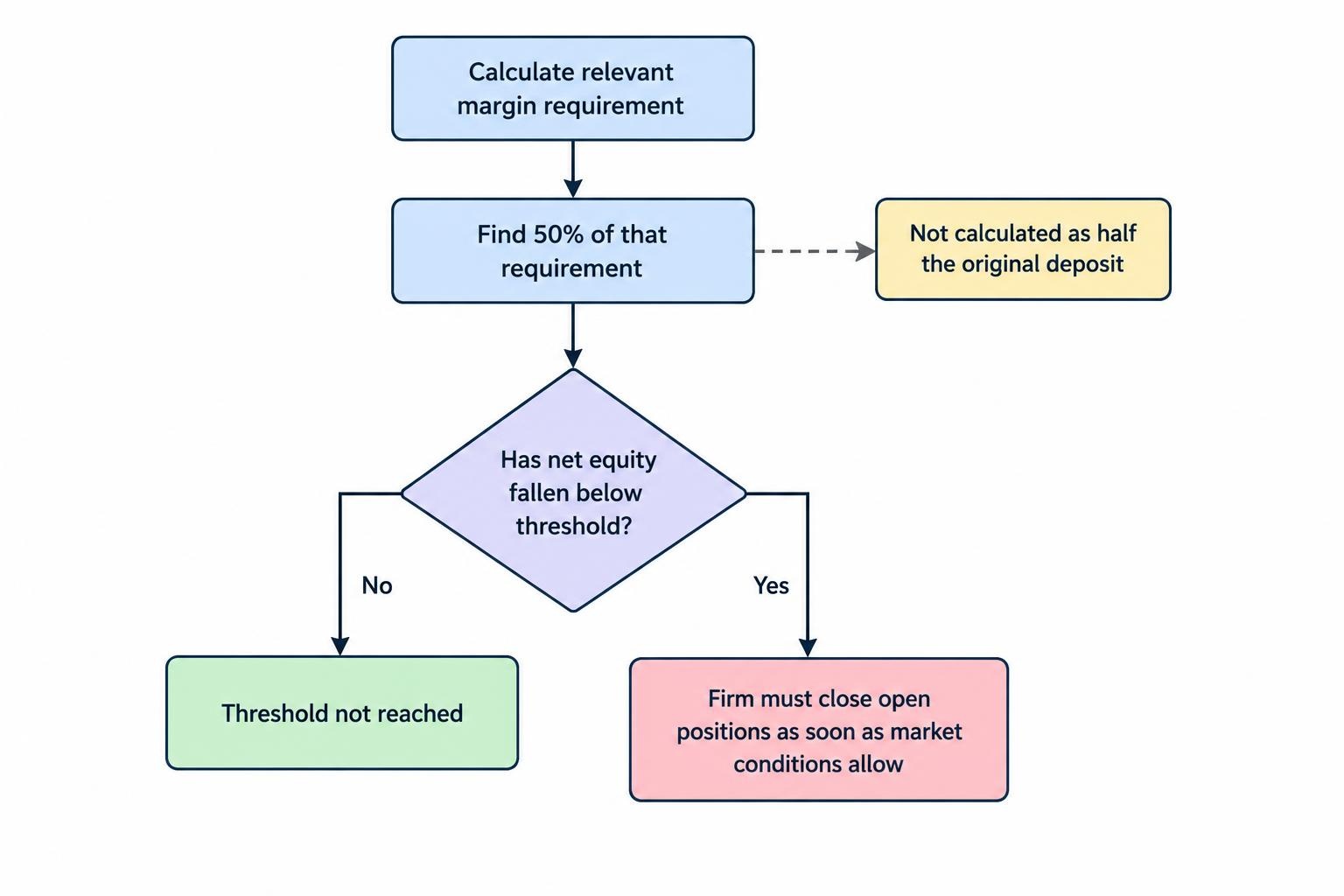
Under COBS 22.5.13, when a retail account’s net equity falls below 50% of the relevant margin requirement, the firm must close open positions as soon as market conditions allow. This is an account-level backstop, not a rule that protects half your original deposit.
Consider a simplified account with £2,000 deposited and positions carrying a combined regulatory margin requirement of £1,000. Half that requirement is £500. If the requirement stayed unchanged, an unrealised loss of £1,500 would leave equity of £500, at the threshold. The rule would not activate simply because the account had lost £1,000.
In practice, read the provider’s own calculation and contractual closure terms. Check what its displayed margin percentage means, which positions it may close and how it communicates with you. A percentage on a screen is only useful if you know its denominator.
Do not plan around receiving a telephone call before positions close. A margin warning is not a convenient appointment with the market. The margin close-out rule guide separates the regulatory threshold from account notifications and trade management.
Negative Balance Protection
For retail accounts within these rules, liability for the covered speculative investments is capped at the funds dedicated to them in the account. Those funds include cash and unrealised net trading profits. Protection operates at account level, rather than limiting each trade to its opening margin.
Suppose you dedicate £3,000 to a covered retail trading account and a sharp market move produces losses that would otherwise exceed that amount. Negative balance protection addresses the excess liability. It does not preserve the £3,000, reimburse a losing position or promise execution at your intended stop price.
It also does not turn repeated deposits into protected spending. Losing £3,000, depositing another £3,000 and losing that money would still mean £6,000 lost. The account debt boundary and your cumulative trading losses are different measures.
The detailed guide to negative balance protection covers its scope. Treat it as a final boundary on liability, not a position-sizing method.
Retail and Professional Accounts Are Not Interchangeable
The product protections described above apply to retail clients. Moving to professional classification changes that position; do not assume that retail margin limits, the retail close-out backstop and mandatory negative balance protection remain in place. Any additional contractual protection needs checking on its own terms.
A professional label is not a reward for trading frequently, and a larger deposit is not a reason to disregard the consequences. The practical question is what changes in your agreement, not whether the label sounds flattering.
Ask the firm to explain the differences in writing before accepting a reclassification. Separate mandatory protections from benefits it chooses to provide contractually. If negative balance protection is offered voluntarily, ask about its conditions rather than assuming it matches the retail rule.
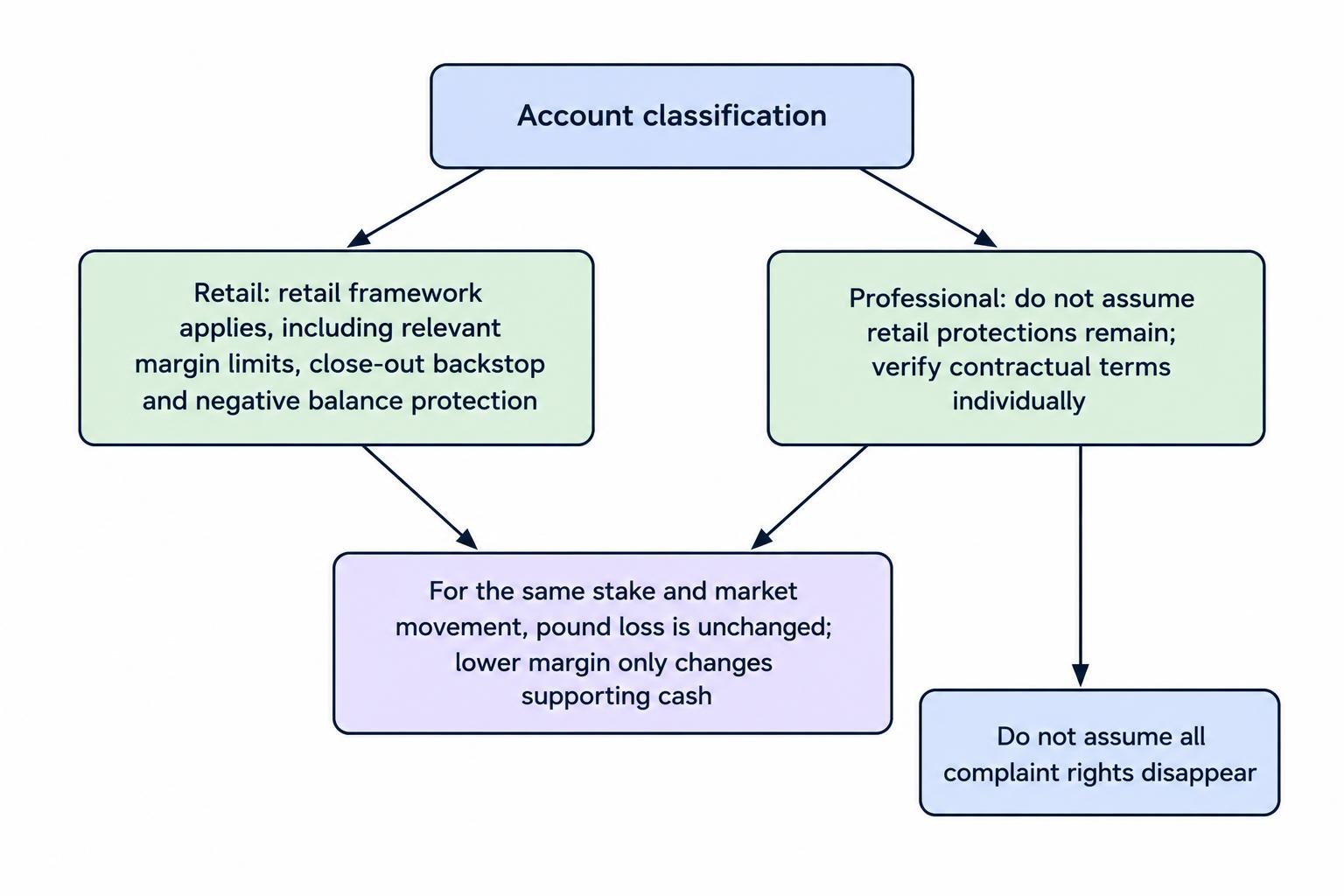
Compare the same proposed position under both arrangements. A lower margin requirement changes how much cash supports the position; it does not change the pound loss caused by the same stake and market movement. The temptation is to increase the stake because more exposure becomes available.
Our guide to retail versus professional client classification covers that distinction. Do not assume professional status either preserves every retail safeguard or removes every possible complaint right. Check each issue separately.
What the Appropriateness Assessment Actually Checks
Before providing the relevant non-advised service, a firm must obtain information about your knowledge and experience to assess whether you can understand its risks. The FCA’s appropriateness assessment rules cover matters such as familiarity with financial instruments, previous transactions and relevant education or employment.
This is not an examination to beat by finding the expected answers online. Answer honestly. An inaccurate picture of your experience makes the assessment less useful to both you and the firm.
Keep three questions separate: do you understand the product, can you afford the possible loss, and is the proposed trade sensible? Demonstrating knowledge does not automatically settle the other two. An appropriateness assessment is not a personal recommendation to place a trade.
A useful self-check is whether you can explain your own position without reading the dealing ticket aloud. You should be able to state the stake per point, the effect of an adverse movement, the opening margin, the likely charges and the conditions under which the broker may close the position.
If those answers are uncertain, stop at the uncertain part. The spread betting appropriateness test guide explains the assessment without treating it as an obstacle to work around.
Client Money Rules: Protection from the Firm, Not the Market
The FCA’s client money regime addresses the handling of customers’ money. The CASS rules on segregation of client money require separation from the firm’s own money under the applicable arrangements and set requirements for where client money is placed.
That is a different safeguard from negative balance protection. Segregation concerns custody and handling; negative balance protection concerns trading liability. Neither changes the gain or loss produced by a market movement.
Ask how your money will be treated under the agreement and whether the stated arrangements apply to your account classification. A general statement that a group “protects client funds” is less useful than a clear explanation tied to the company you are contracting with.
Also separate an account balance from money you can withdraw immediately. Before committing funds, examine the withdrawal process, the treatment of money supporting open positions and the documents you would need if there were a dispute over a balance.
Keep funding receipts and statements that reconcile deposits, withdrawals, realised results and charges. They provide a clearer record than a screenshot showing only the final balance. Our client money rules guide covers the regulatory arrangements in greater detail.
Does FSCS Protection Cover Spread Betting?
The Financial Services Compensation Scheme is a potential backstop for eligible claims when an authorised financial firm fails. Its investment compensation rules state a limit of up to £85,000 per eligible person, per firm for failures after 1 April 2019. Coverage depends on the claimant, activity and circumstances, not just the presence of an FCA number.
For a spread betting account, ask the firm to confirm the protection applicable to the regulated service it provides. Do not interpret the £85,000 limit as an insured trading balance or an allowance for market losses. Nor should you assume that opening several accounts with the same firm creates several compensation limits.
Ordinary investment performance is not insured. The FSCS’s explanation of checking financial protection makes clear that it cannot compensate for poor investment performance. Losing money because the market moves against a correctly administered position is a different issue from an eligible claim against a failed provider.
A useful way to assess the distinction is to identify why money is missing. Was it lost through trading, deducted as a charge, disputed because of an execution problem, or owed by a firm that has failed? Those are different questions with different routes for investigation.
Read the guide to FSCS protection and spread betting before relying on a compensation figure. Protection eligibility deserves the same attention as the limit.
Risk Warnings, Trading Incentives and Sales Pressure
The retail rules require standardised risk warnings and, where applicable, disclosure of the provider’s percentage of loss-making retail accounts. They also prohibit monetary and non-monetary trading incentives within the scope of the restrictions. A deposit bonus should prompt questions, not an automatic transfer.
Read the warning rather than treating it as decoration. A provider’s loss percentage is not your personal probability of losing, nor does a lower figure establish that its service will produce better results for you. It is a prescribed account-level disclosure, not a forecast.
Evaluate the sales conversation alongside the written terms. If the discussion concentrates on larger positions, rapid funding or recovering previous losses, return to the account’s actual risks. Ask for explanations in writing and take time to consider them away from the call or chat.
Claims of guaranteed returns deserve particular scepticism. An authorisation check cannot make an implausible trading promise sensible. Verify the identity of the firm independently, then evaluate the product and the claim separately.
The guide to spread betting financial promotions covers advertising issues in more detail. For an initial account review, focus on whether you can locate and understand the risks and charges without a salesperson translating them into a success story.
Regulation Does Not Guarantee Every Execution Price
Distinguish an unwanted trading outcome from evidence of a problem. A loss, a wider spread or a position closed for insufficient margin does not, by itself, establish misconduct. Equally, a reference to market conditions should not end a reasonable enquiry about how an order was handled.
For an execution dispute, start with the order instructions and the relevant price. Record whether the position was long or short, whether the order depended on the bid or offer, the trigger level and the execution time. Comparing a fill with an unrelated chart price can send the investigation in the wrong direction.
Ordinary stops and guaranteed stops also need distinguishing. An ordinary stop is not a promise of execution at an exact price through a gap. The mechanics of slippage matter when deciding whether an outcome requires an explanation.
Ask what happened and request the records needed to check the answer. A useful complaint identifies the disputed instruction, the expected treatment and the financial difference, rather than resting entirely on the fact that the result was disappointing.
Cryptocurrency Spread Betting Has Separate Restrictions
The same COBS 22 chapter cited above separately prohibits firms within its scope from marketing, distributing or selling cryptoasset derivatives to retail clients in or from the UK. That restriction covers the relevant cryptoasset spread betting products; the ordinary retail margin table is not permission to offer them.
Do not confuse a derivative with a cryptoasset exchange traded note. The rules distinguish those products, including qualifying UK exchange traded notes. A change affecting one category does not automatically change the treatment of another.
When an advertisement offers retail crypto spread betting, verify the product, entity and proposed account classification before doing anything else. Our cryptocurrency spread betting rules guide addresses that narrower topic. Do not use an overseas account or a classification change as a casual workaround.
How to Complain About a Spread Betting Provider
Complain to the firm first and explain the issue clearly. The Financial Ombudsman Service’s spread betting complaints guidance covers matters including advice, stop orders and margin calls. Eligible complaints can generally be referred after an unsatisfactory final response, or if the firm has not issued one within eight weeks.
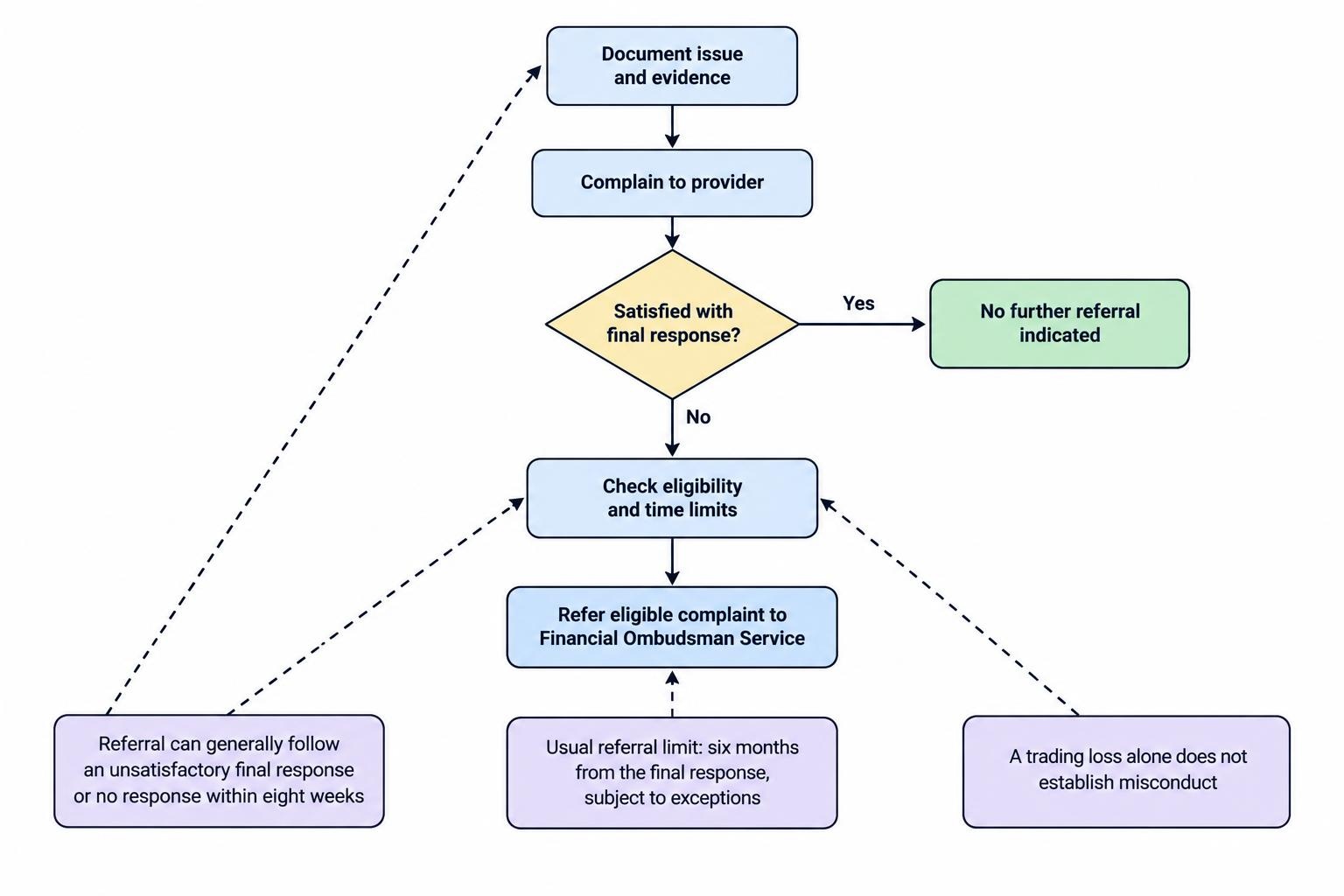
Build a short chronology. Include account and order references, relevant dates, the instruction you gave, what the firm did and why you think it was wrong. Attach the agreement, statements and correspondence that support those points.
Keep calculation and argument separate. If you dispute a charge, show the amount and the contractual basis you expected. If you dispute a closure, identify the account equity, margin requirement and closure terms. If you dispute a fill, identify the order type and relevant prices.
You normally have six months from the date of the firm’s final response to refer a complaint. Other time limits and exceptions can affect eligibility, so check the Financial Ombudsman Service’s complaint time limits promptly rather than assuming ongoing correspondence stops the clock.
A complaint is not automatically upheld because a position lost money. The issue is whether the firm’s conduct, advice or handling of the account gives grounds for redress. Our guide to spread betting complaints and the Financial Ombudsman develops the process further.
What to Establish Before Funding an Account
Finish the regulatory review before comparing platform extras. You should be able to identify the contracting company, verify its status and permissions, state your client classification and explain the account’s margin, closure and liability terms.
Next, read the documents in the order a problem would make them relevant: the customer agreement, client money explanation, margin policy, execution terms, charges and complaints procedure. Save dated copies. If two documents appear inconsistent, ask the firm to resolve the inconsistency before paying in.
Then test the account with a hypothetical adverse move. Work out the pound loss, the remaining equity and whether other positions could be affected. This makes the difference between regulatory protection and trade risk much easier to see.
Finally, decide how much money you are prepared to lose independently of the platform’s maximum exposure. The spread betting risk management guide deals with that separate responsibility.
UK regulation provides boundaries for firms and protections for eligible customers. It does not supply a profitable strategy or preserve trading capital. A sound account review establishes both sides of that distinction: what the provider must do, and what remains your risk.