The Financial Conduct Authority (FCA) regulates financial spread betting providers in the UK. It sets standards for firms, supervises their conduct and can act when they break the rules. For traders, that affects everything from account opening and margin requirements to advertising and the treatment of customers.
FCA authorisation is not a promise that your money is safe from trading losses. It establishes a regulatory framework around the provider, not a safety net beneath every position. The distinction matters: a properly regulated account can still lose its entire trading balance.
What does the FCA do for spread betting customers?
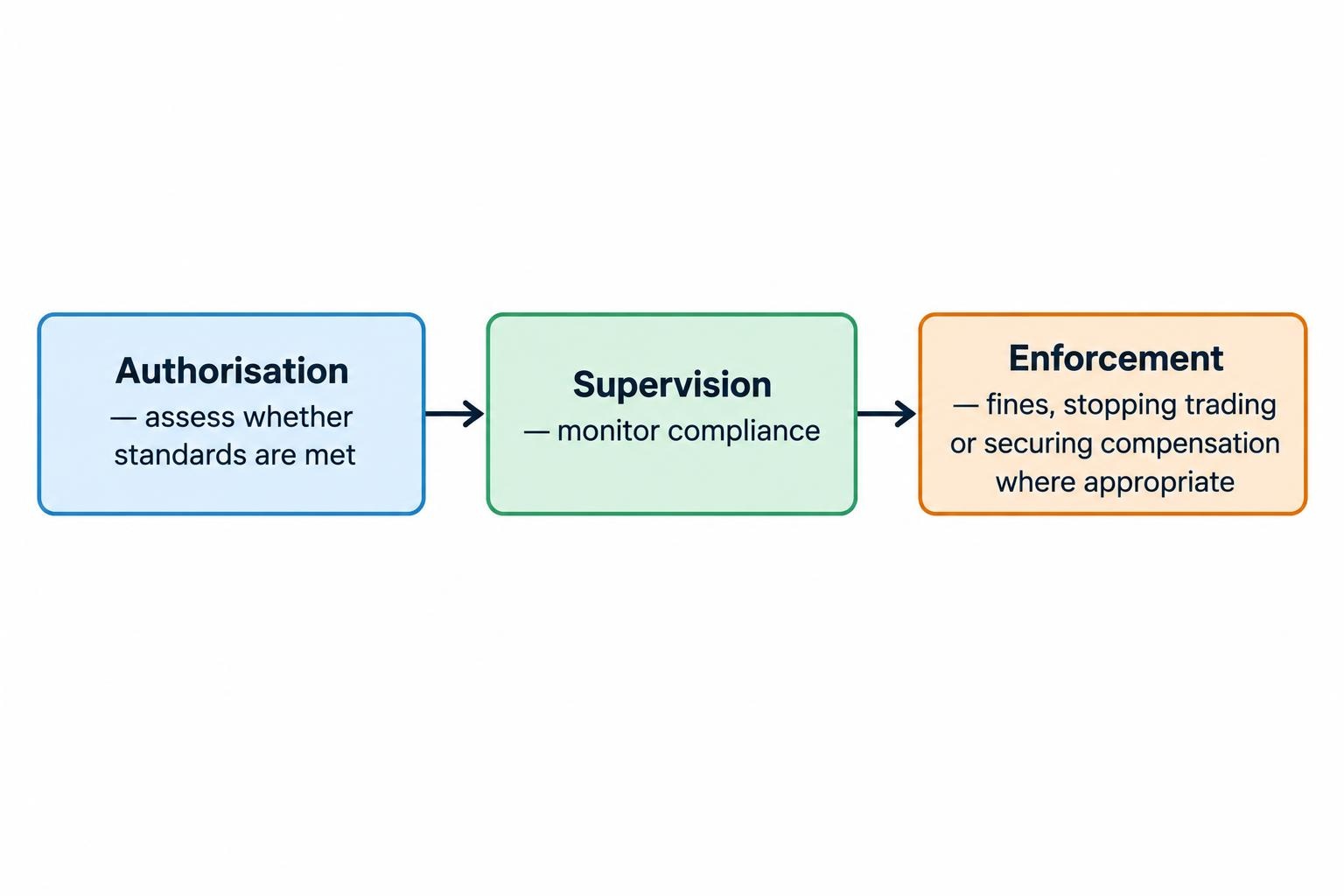
The FCA’s work has three practical stages: authorisation, supervision and enforcement. It assesses whether firms meet its standards before authorising them, monitors their compliance afterwards, and can impose fines, stop firms from trading or secure compensation where appropriate. These powers form part of the FCA’s consumer protection responsibilities.
For a spread bettor, the useful question is not simply whether a provider displays an FCA statement. It is whether the company holding the account has the right permissions and whether the account’s terms reflect the protections that apply to you.
Think of authorisation as a starting requirement rather than a broker recommendation. It does not rank platforms by pricing, customer service or execution quality. Nor does it tell you whether a particular market or stake is appropriate for your finances.
The wider framework also involves complaint resolution, compensation arrangements and rules governing how firms handle customers’ money. Our guide to spread betting regulation covers those connected subjects. The FCA’s role is to set and enforce standards across the activities within its remit.
What FCA authorisation actually tells you
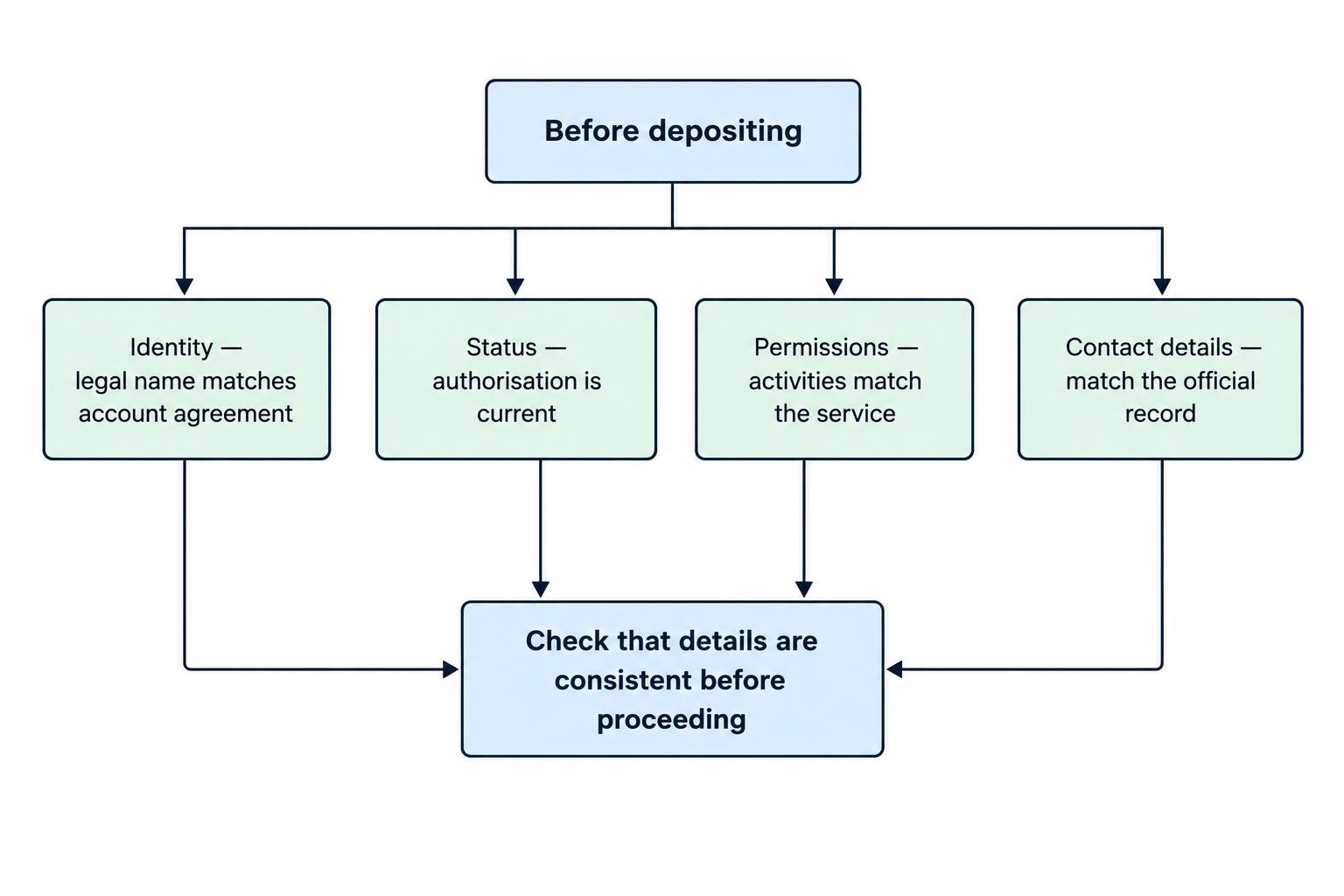
Authorisation concerns a legal entity and its permitted activities. A trading brand, mobile app or familiar company name is not enough on its own. Before depositing money, identify the company named in the account agreement and compare it with the official regulatory record.
The FCA’s guidance on checking authorised firms distinguishes between the Firm Checker and the Financial Services Register. Firm Checker helps establish whether a firm is authorised and has permission for the service offered. The Register contains a fuller regulatory history, including past fines and information about permissions.
Keep the initial check focused on four points:
- Identity: Does the legal company name match the account agreement?
- Status: Is its authorisation current?
- Permissions: Do its permitted activities match the service you want?
- Contact details: Do the domain, telephone number and other details match the official record?
Matching contact details helps guard against clone firms: fraudsters impersonating genuine authorised businesses. Copying a real firm’s reference number does not make the impersonator regulated.
Do not treat a screenshot of a register entry supplied by a salesperson as verification. Carry out the check independently and use the contact details in the official record if anything looks inconsistent. The separate guide to checking a broker on the FCA Register covers the process in more detail.
How FCA rules affect a retail spread betting account
The FCA’s COBS 22.5 rules for retail speculative products cover leveraged spread bets. They impose several protections that affect how providers offer and operate retail accounts.
| Requirement | Practical effect |
|---|---|
| Minimum opening margin | Required margin depends on the underlying asset, restricting the exposure a deposit can support. |
| Margin close out | If account equity falls below 50% of the required margin, positions must be closed as soon as market conditions allow. |
| Negative balance protection | Retail liability for the covered products is capped at the funds dedicated to trading them in that account. |
| Risk warnings | Providers must display prescribed warnings, including their retail account loss percentage where applicable. |
| Restrictions on incentives | Monetary and non-monetary incentives to trade are prohibited, subject to the distinctions in the rules. |
These are account safeguards, not profit safeguards. Negative balance protection does not stop losses consuming the account balance, and margin close out does not guarantee an exit at an exact price.
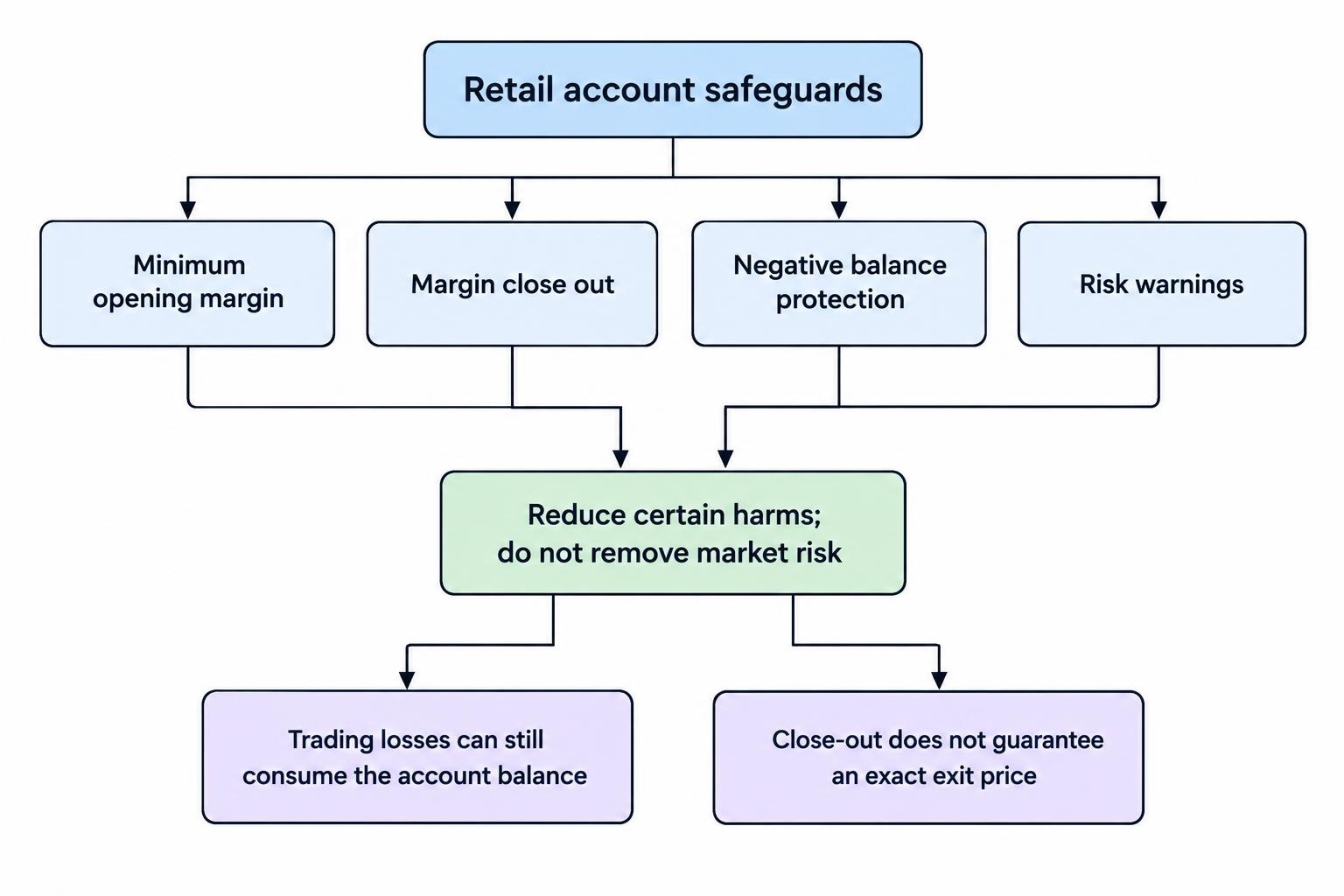
The guide to retail client protections examines the rules separately. Their shared purpose is to reduce certain forms of harm, not remove market risk.
A regulated account can still lose money quickly
Consider a hypothetical index quoted at 8,000 points. A position of £1 per point has £8,000 of notional exposure. If its opening margin is 5%, the margin required is £400.
A 100-point adverse move produces a £100 trading loss before charges. That is 25% of the opening margin, even though the index has moved only 1.25%. The smaller margin deposit has not made the exposure smaller.
This is why the amount needed to open a position should not be mistaken for a sensible loss budget. Decide what you can afford to lose before choosing the stake, rather than letting the platform’s available margin make that decision for you.
Supervision extends beyond margin limits
Broker conduct also includes how products are priced, how charges are communicated and whether customers receive fair value. The Consumer Duty makes these matters part of the regulatory assessment, rather than leaving them entirely to the small print.
On 15 October 2026, the FCA published findings on CFD providers’ pricing and customer communications, expressly covering spread betting firms. It continued to raise concerns about overnight funding charges, the way firms applied them and whether customers received enough information. It also highlighted concerns about charges on matched long and short positions.
The practical lesson is straightforward: authorisation does not mean every regulated provider charges the same price. Nor should you assume that an apparently narrow dealing spread makes an account inexpensive over your intended holding period.
For a position held across several nights, ask for the financing calculation in pounds, not just a daily percentage. Check which position value the calculation uses, when charges arise and whether other fees apply. A price that looks modest beside a large notional exposure can still make a noticeable dent in a small account.
Use the same hypothetical trade and holding period when comparing total spread betting costs. Otherwise, you may be comparing one firm’s headline spread with another firm’s fuller bill.
Professional status and overseas entities change the assessment
A broker’s FCA authorisation does not mean that every account offered under its brand has identical protections. Customer classification and the contracting company both matter.
The FCA’s information for CFD and spread betting customers warns about losing protections when opting up to professional status or dealing with an overseas entity. It also identifies inappropriate professional classification and redirection to associated overseas providers as concerns.
Treat an invitation to become a professional client as a change in legal treatment, not a loyalty reward. Before agreeing, ask the provider to set out which protections will no longer apply and which, if any, it will retain voluntarily. A promise made in a sales conversation is no substitute for clear contractual terms.
Our comparison of retail and professional client classification covers those differences. Do not assume that professional status automatically removes every complaint or compensation right; eligibility needs its own assessment.
The same caution applies if registration redirects you to another company within a group. Pause and establish who would owe you money, which regulator oversees that entity and where a dispute would be handled. A familiar logo does not answer those questions.
Who helps when something goes wrong?
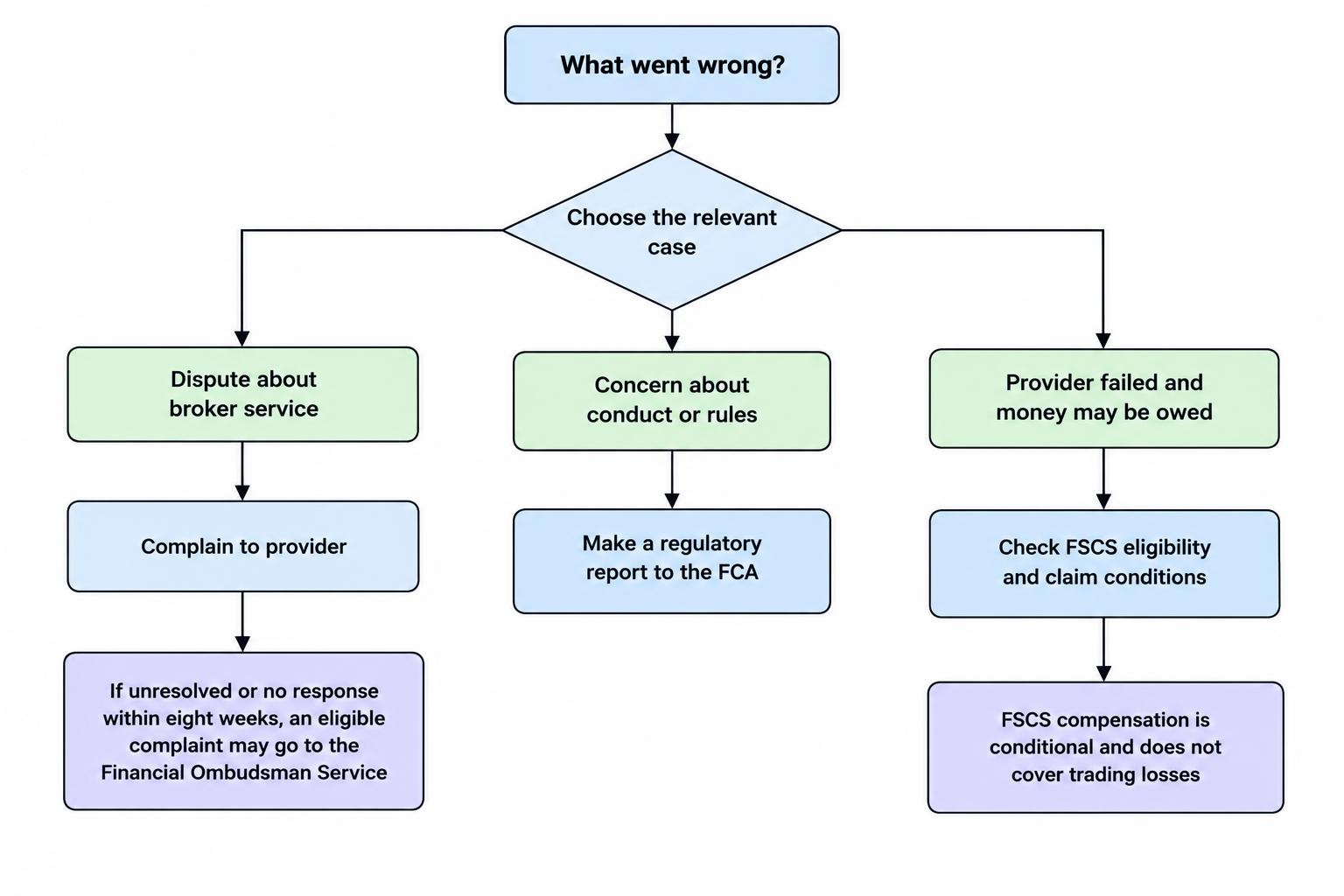
Regulatory reporting, complaints and claims following a firm’s failure serve different purposes. Choosing the right route saves time and helps you present the evidence that matters.
Disputes about the broker’s service
Start with a formal complaint to the provider. Describe what happened, identify the trades involved and explain the remedy you want. Keep account statements, order records, relevant messages and any screenshots showing the problem.
The Financial Ombudsman Service’s spread betting complaints process allows eligible complaints to be referred after an unsatisfactory final response, or if the firm has not issued one within eight weeks. Its review can consider the agreement, relevant rules, communications and how the business handled events such as a margin shortfall.
A losing trade does not, by itself, establish wrongdoing. A useful complaint identifies the disputed conduct: an order handled contrary to the terms, an unexplained charge or an unfair account closure, rather than simply an unfavourable market outcome.
The guide to spread betting complaints and the Financial Ombudsman covers the escalation route. Keep any regulatory report separate from the request for personal redress, so neither purpose gets lost in a long account of events.
Claims when a provider fails
The Financial Services Compensation Scheme is a separate body. Its investment protection conditions explain that compensation may be available when an eligible provider or adviser has failed. Authorisation, the regulated activity and the circumstances of the claim all matter.
This is not insurance against a market moving against your position. Distinguish money lost through trading from money that a failed firm should return but cannot. Those are different problems, even if both leave the account holder out of pocket.
Before relying on compensation arrangements, review FSCS protection for spread betting and ask the provider to explain the position for your account. Avoid treating a general protection statement as confirmation that every balance or claim qualifies.
Use FCA status as a filter, not the final decision
A sensible assessment begins with the legal company, its current permissions and your customer classification. It then moves to the account terms: margin policy, charges, order handling, withdrawals and the complaint process.
Read those documents before funding the account, not after a disputed trade. Ask questions wherever the agreement leaves you uncertain, especially if the answer affects how much you could lose or which company would be responsible.
Regulation and personal risk control do different jobs. The FCA sets standards for the firm; you still choose the exposure, the holding period and the amount of capital at risk. A practical approach to protecting trading capital remains necessary even after every regulatory check has passed.
The useful outcome is not confidence in a badge. It is a clear view of who you are dealing with, what protections apply and what risks remain yours.