Checking a spread betting broker on the FCA Register means checking more than whether its name appears in a search. Match the legal company, its current permissions and its official contact details to the business offering you the account. Then confirm that the account agreement names that same company.
Do this before sending money or identity documents. Treat it as an identity and permissions check, not a judgement on whether a trade will succeed. The wider UK spread betting regulation guide covers the rules behind the checks below.
1. Identify the company behind the trading name
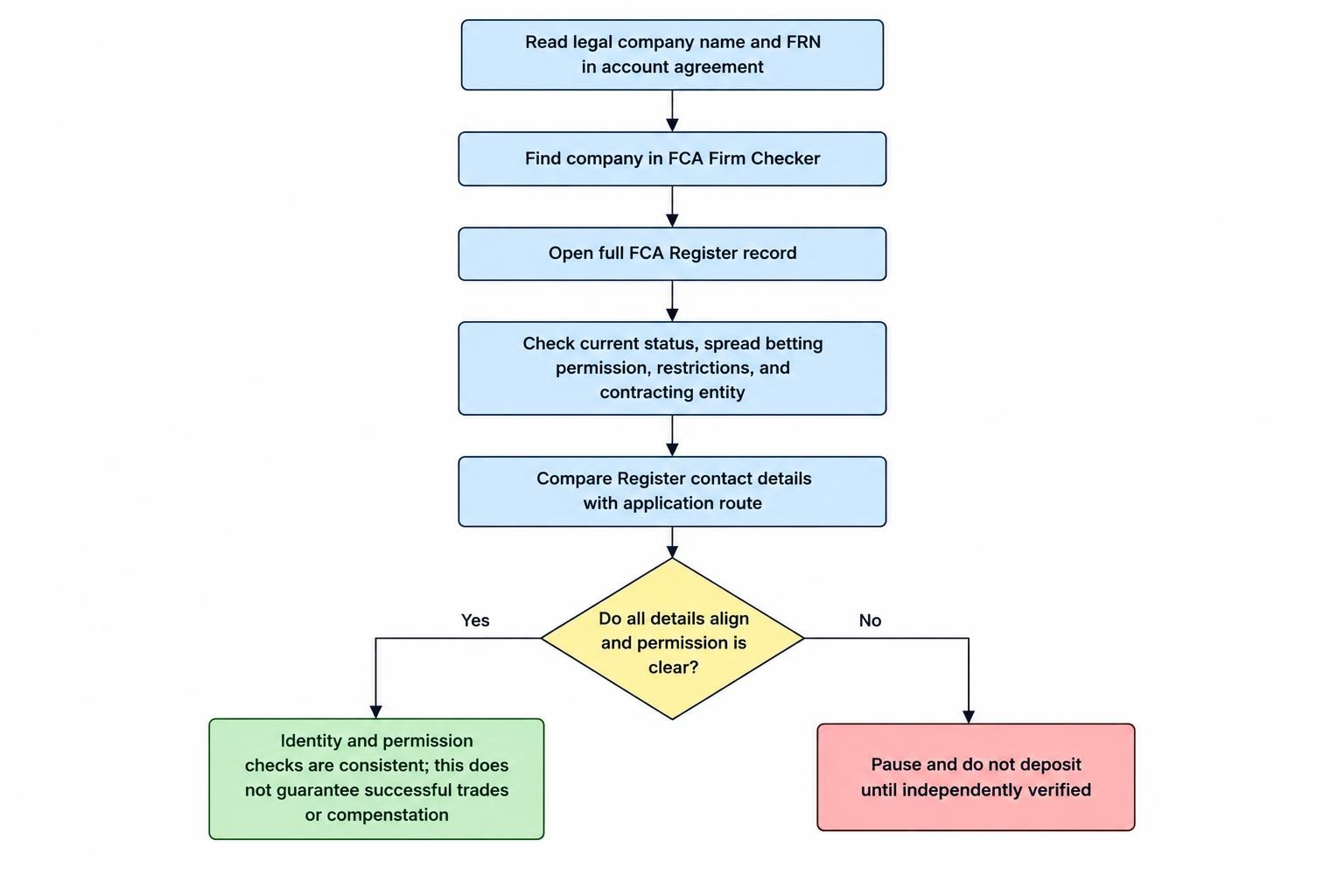
Start with the broker’s account agreement and legal disclosures. Write down the full legal company name and the claimed firm reference number, usually shortened to FRN. Keep the website address beside them so you can compare all three during your search.
Do not search only for the name printed above the trading platform. Your task is to identify the company that will enter into the spread betting contract with you. Look for wording such as “your agreement is with” rather than relying on a general statement about the group.
For example, suppose a fictional brand called Northbridge Trading names Northbridge Markets UK Ltd in its footer, but Northbridge Markets International Ltd in the agreement presented during registration. Do not treat those names as interchangeable. Pause the application and ask which company would operate your account.
Use the broker legal entities research to help separate brand names from contracting companies. Record the company named in your own documents rather than copying a name from an old review.
2. Use the FCA Firm Checker, then open the full Register
The FCA Firm Checker is the consumer starting point. It checks whether a firm is authorised and has permission to provide the service you want. Search for the firm and select the relevant product or service rather than stopping after finding a familiar name.
Compare the result with the details you collected. If several companies have similar names, use the reference number and other identifying details to narrow the search. A close spelling match is not enough.
Next, search the Financial Services Register by company name or reference number. The full Register provides more regulatory detail, including historical information. Check the complete firm record rather than relying on a search result summary.
Keep the agreement and Register entry open together. This makes mismatches easier to spot and avoids relying on memory halfway through an application. Do not accept a screenshot supplied by a salesperson as a substitute for opening the official record yourself.
3. Check current status and the permitted service
Work through the record in order: current status, permitted activities, relevant products and any restrictions or requirements. Finding a firm’s name answers only the first part of the question. You still need to establish whether the service being offered fits its permissions.
| Check | What to compare | When to pause |
|---|---|---|
| Identity | The legal name and FRN against your agreement | The agreement names a different company |
| Current status | The live status, not an old authorisation claim | The record does not support opening the proposed account |
| Service permissions | The proposed spread betting service against the firm’s permitted business | The permission relates to another service |
| Client category | Your intended account classification | The offer requires a classification you have not checked |
| Requirements | Any restrictions against what the firm proposes to do | The wording is unclear or appears inconsistent with the offer |
Do not guess your way through unfamiliar permission wording. Ask the firm to identify the permission covering your proposed account, then verify the answer independently with the FCA if anything remains unclear. “We are regulated” is not a useful answer to a question about which service the firm may provide.
Check whether the firm should be accepting new clients
For CFD providers, including spread betting firms, entries marked “Applied to cancel” and EEA firms in “Supervised run-off” should not be taking on new UK clients. Overseas companies may also share trading names with UK firms, so check the contracting entity and where it is incorporated. These checks form part of the FCA’s investor information for CFD and spread betting customers.
If an application redirects you to another company, restart the identity check for that company. Do not carry forward your earlier result simply because the logo, login screen and customer support team look unchanged. The guide to offshore spread betting brokers covers the questions to ask before accepting an overseas account.
Also establish whether the offer is for a retail or professional account. Check the retail client protections guide before agreeing to any change in classification. Keep that decision separate from checking the company’s identity.
4. Read registration and appointed representative status carefully
Registration is not interchangeable with authorisation. A firm registered for one purpose does not automatically have permission to provide services requiring authorisation. If the record says “No longer authorised” or “Revoked”, do not open a new spread betting account with that firm.
An appointed representative, or AR, carries out agreed activities on behalf of an authorised principal. Check the principal and ask it to confirm that the proposed service falls within the representative’s permitted business. Protection may not apply where an AR acts outside that arrangement; the FCA’s authorisation and appointed representative guidance sets out this distinction.
Ask a practical question: which company will actually provide the trading account? Write down the answer. Do not assume that the business introducing you, the platform operator and the contracting company are the same entity.
5. Verify contact details to avoid a clone firm
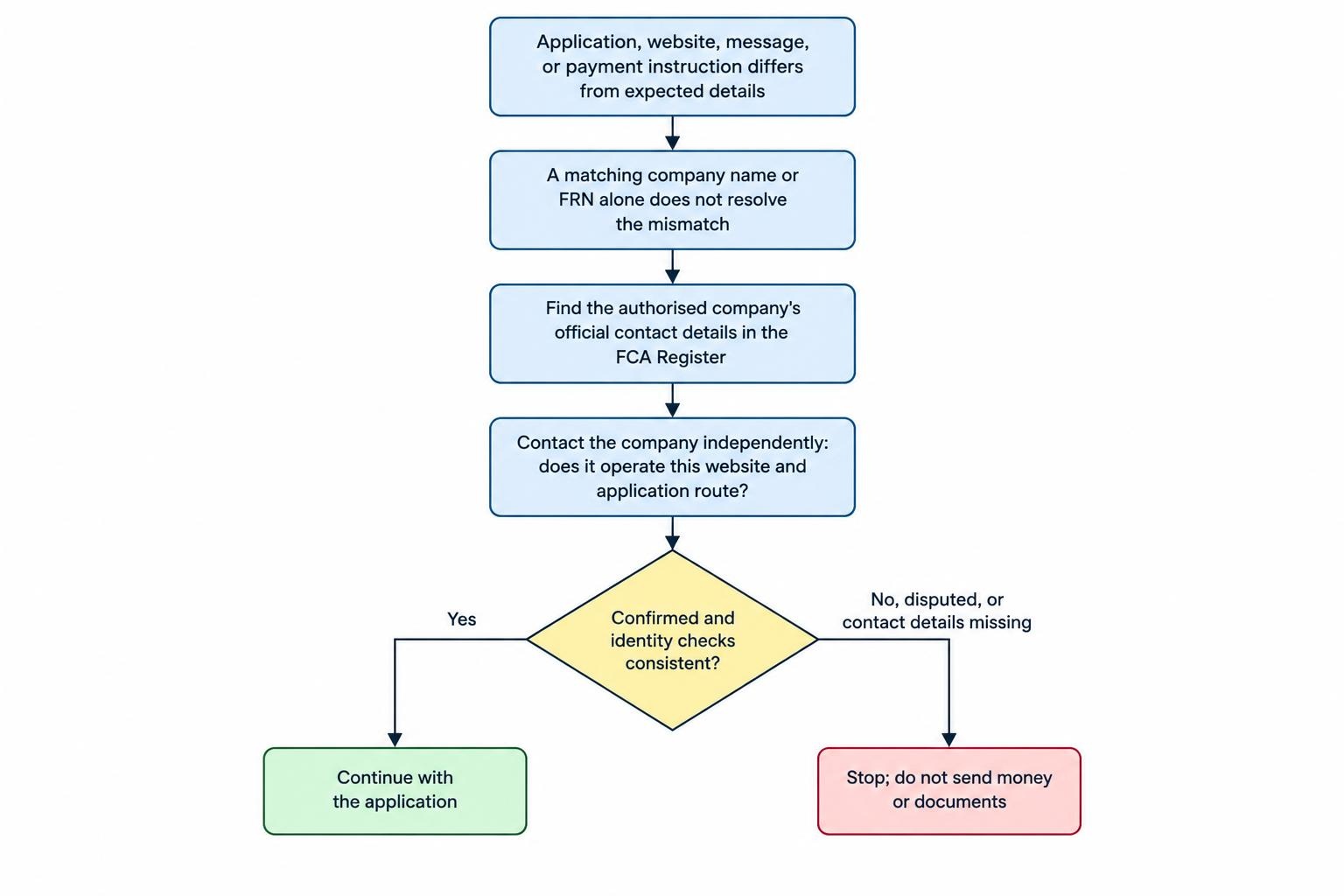
A genuine FRN does not prove that the person contacting you represents the authorised company. Clone firms copy genuine names, addresses and reference numbers. They may alter a website address, use a similar email address or claim that the regulator’s contact details are outdated. Check these details against the official record using the FCA’s clone firm checks.
Contact the firm through the details on its official regulatory entry, not the number in an unexpected message. Ask it to confirm the website, the person who approached you and the account opening route. If no contact details appear, or someone disputes them, stop and contact the FCA independently.
A matching number can still lead to the wrong business
Consider another hypothetical example. An advertisement gives the correct name and FRN of an authorised company, but the application runs through a different website. Its representative asks you to continue through a messaging app and provides separate payment instructions.
The matching FRN has not resolved the mismatch. Before proceeding, call the genuine company using its listed contact details and ask whether it operates that application address. Do not let the person whose identity you are checking choose the verification route. That defeats the point of the exercise.
Check addresses character by character. Read the full domain, not just the company name appearing somewhere within it. Keep screenshots of discrepancies, but do not continue an application simply to collect more evidence.
6. Check client money arrangements and protection separately
Use the full record to review whether the firm can handle client money, then compare that information with the proposed account’s terms. Ask who receives your payment, which company is responsible for your account and how the arrangement works. The client money rules guide covers the subject beyond this identity check.
Neither the Firm Checker nor the Register guarantees that Financial Services Compensation Scheme or Financial Ombudsman Service protection will apply to a particular dispute or failure. Keep authorisation, complaint eligibility and compensation eligibility as separate questions.
FSCS investment protection can pay up to £85,000 per eligible person, per firm, subject to its conditions. It does not cover poor investment performance. The provider and relevant activity must qualify, and a claim may arise where a failed firm leaves a shortfall in money or assets it held. Check the FSCS investment compensation conditions rather than treating authorisation as blanket insurance.
Ask the company to confirm in writing how protection applies to the account you are opening. Name the legal entity and product in your question. “Are you covered?” invites a vague response; asking about your proposed spread betting account is harder to misunderstand.
The separate FSCS protection and spread betting guide examines these conditions in more detail. A broker’s failure and a losing trade are different problems; do not budget on compensation reimbursing trading losses.
What to do if a check fails
If you cannot find the company, try its full legal name and claimed FRN. Recheck spelling against the agreement. Do not choose a similarly named entry simply to finish the process. Contact the FCA if you cannot reconcile the result.
If the identity, permissions or contact details remain inconsistent, do not deposit. Avoid sending further documents while the mismatch is unresolved. A deadline from a salesperson is not a reason to lower the standard of your checks.
If you have already paid, contact your bank or payment provider promptly and explain the concern. Preserve the agreement, messages, payment details and screenshots, and report the suspected firm to the FCA through its official contact route. The spread betting scams guide covers warning signs and practical responses.
Keep a dated record of your checks
Save the firm entry or a dated screenshot, the agreement you reviewed and any written answers about the contracting entity. Record the website and official contact details you used. Keep this material with your account opening documents, not only in a browser’s history.
Repeat the checks before accepting a transfer to another legal entity, changing client classification or following changed funding instructions. Review what has changed rather than assuming the original result still answers every question.
Your final test is straightforward: can you connect the authorised company, the permitted service, the verified contact details and your account agreement without an unexplained gap? If not, leave the application unfinished. The deposit can wait.