Retail client protections place boundaries around how financial spread betting firms can offer leveraged trading to ordinary customers. They address several different risks: excessive exposure, losses beyond the trading account, the handling of client money and disputes with the provider.
They do not make spread betting a protected investment. You can still lose all the money committed to trading. The useful distinction is between protection against certain consequences of trading and protection against the market moving against you. This article covers the UK retail framework; the broader guide to UK spread betting regulation covers authorisation and supervision.
Who receives retail client protections?
Start with the legal entity holding your account and the client classification recorded in your agreement. A familiar trading name, a British telephone number or prices displayed in pounds does not establish which regulatory framework covers the account.
Read the account opening documents before depositing. Identify the contracting company, its regulatory details and whether it classifies you as a retail client. Check that those details match the account you are actually opening, rather than another company within the same group.
Our guide to checking a broker on the FCA Register covers the verification process. Keep a copy of the relevant agreement and classification notice, rather than relying on a promotional page that could change.
Retail is a regulatory category, not a description of trading ability. Do not treat the label as a judgement about your competence. The practical question is whether the account gives you the protections you expect, under terms you have checked.
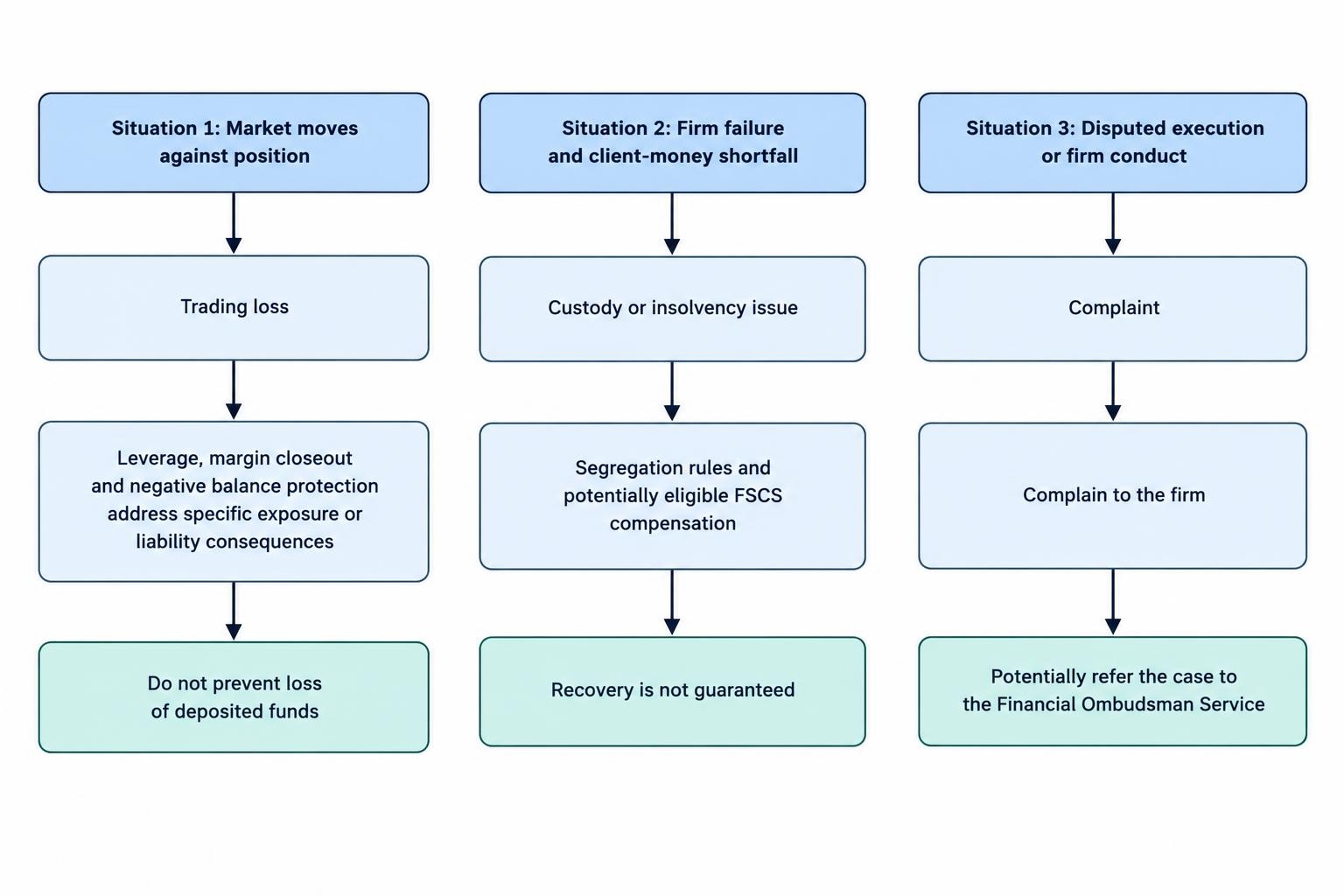
It also helps to separate three situations. A losing trade concerns market risk. Money missing after a firm fails concerns custody and insolvency risk. A disputed execution concerns the firm’s conduct. Different safeguards address each situation, and one cannot automatically substitute for another.
Leverage limits restrict the exposure you can open
The FCA rules for retail speculative products set minimum opening margin by underlying asset. The following categories are relevant to financial spread betting. Firms may require more margin than these regulatory floors.
| Underlying asset category | Minimum opening margin | Equivalent maximum leverage |
|---|---|---|
| Major currency pairs and relevant sovereign debt | 3.33% | Approximately 30:1 |
| Major stock market indices, minor currency pairs and gold | 5% | 20:1 |
| Minor stock market indices and commodities other than gold | 10% | 10:1 |
| Individual shares and other permitted assets not covered above | 20% | 5:1 |
These figures describe the relationship between opening margin and exposure. They are not suggested trading sizes. The separate spread betting leverage limits guide covers the categories in more detail.
Consider a hypothetical major index position with £20,000 of exposure and a 5% margin requirement. Opening it requires £1,000 of margin. A 1% adverse move produces a £200 loss before costs: 20% of that opening margin.
If the account contains £2,500, that same £200 loss represents 8% of account equity. Neither calculation is wrong. They measure different things, which is why a percentage shown beside a trade can be misleading without its denominator.
The safer planning question is not “How much exposure will the platform allow?” It is “What does a plausible adverse move cost in pounds?” Work backwards from an affordable loss and the proposed exit level. Opening margin tells you whether a position can be opened, not whether it fits your finances.
Margin closeout is an account safeguard, not a personal exit plan
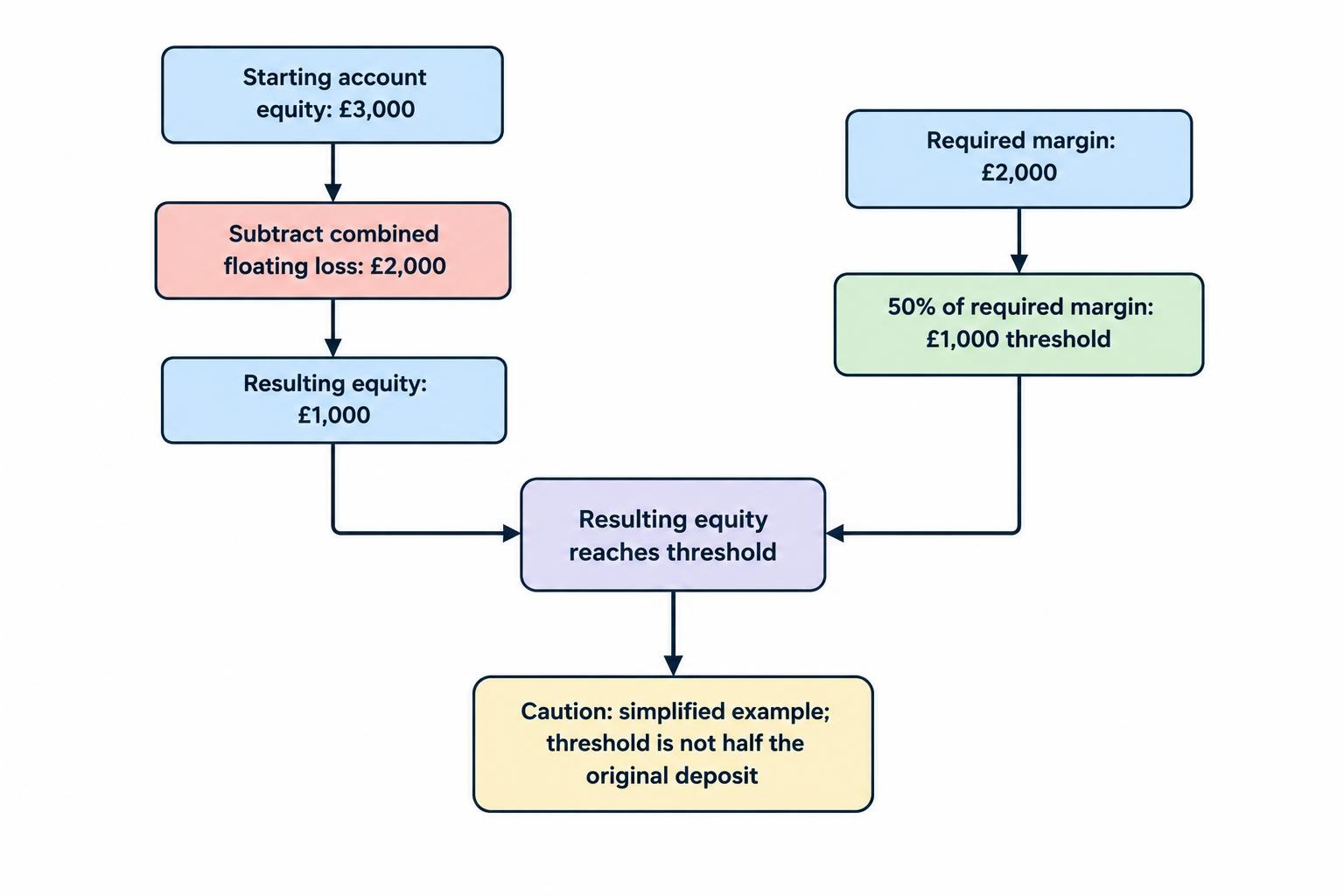
The retail closeout trigger is 50% of the required margin for the account’s open positions. If net equity falls below that level, the firm must close positions as soon as market conditions allow. The FCA policy statement establishing permanent retail protections also covers negative balance protection, risk warnings and trading incentives.
For a simplified example, assume an account starts with £3,000 and holds positions requiring £2,000 of regulatory margin. Ignore charges and changes in margin requirements. The 50% threshold is £1,000. A combined floating loss of £2,000 brings equity to that level.
Notice what the calculation does not mean. It does not mean the account can lose only half its original deposit. In this example, reaching £1,000 equity means losing two thirds of the starting £3,000. Confusing a margin percentage with a deposit percentage produces a very different risk estimate.
Keep your own exit plan separate from this threshold. If your intended loss on a trade is £100, an account closeout level reached after much larger losses is not a substitute. Our explanation of the margin closeout rule covers the account calculation.
A closeout is not automatically evidence that the firm acted wrongly. The Financial Ombudsman’s approach to spread betting disputes considers the agreement, promised communications and how positions were selected for closure. It also recognises that stops can execute at worse prices during gaps or rapid moves.
Before trading, find the provider’s explanation of its closeout process. Check how it displays equity and margin, what alerts it sends and how it chooses positions to close. Do not build a plan around receiving a telephone call or having enough time to transfer money.
Keep a buffer for practical reasons too. If every available pound supports existing positions, you leave little room for costs or adverse movement before a decision becomes urgent. That is a poor moment to start reading the account terms.
Negative balance protection does not protect your deposit
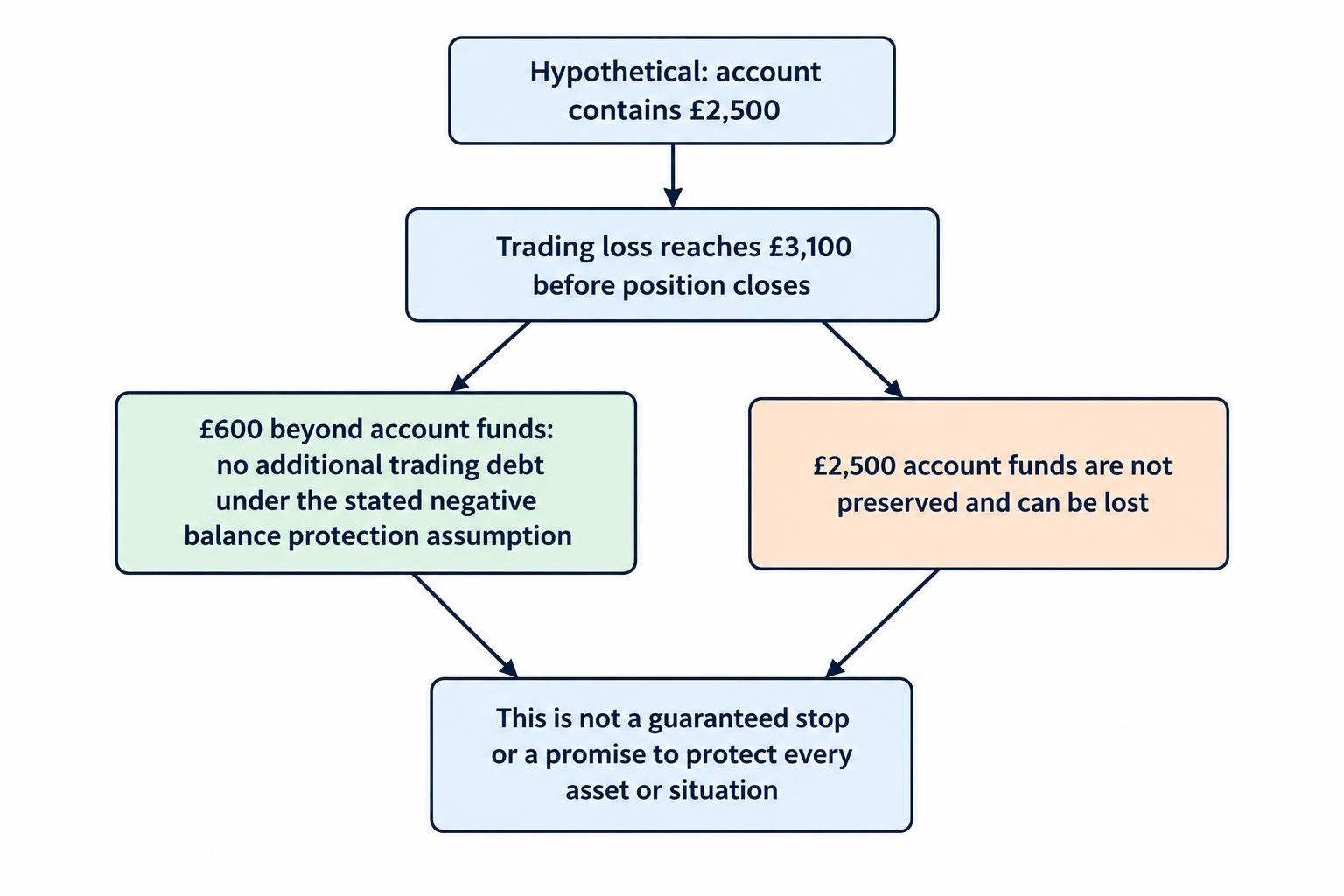
For covered retail trading, negative balance protection caps liability for the account’s restricted speculative investments at the funds in that account. It does not cap each trade’s loss at its opening margin.
Suppose an account contains £2,500 and one position uses £500 of margin. A sudden price gap creates a £3,100 trading loss before the position can close. Under these simplified assumptions, negative balance protection prevents the £600 excess becoming an additional trading debt. It does not preserve the £2,500.
The unused £2,000 was not necessarily safe simply because the trade initially required £500. This distinction matters more than the reassuring name of the protection. An account can avoid a negative balance and still suffer a complete loss of its trading funds.
Our negative balance protection guide covers the account boundary. When reviewing terms, distinguish the money allocated to trading from money held for another purpose.
Do not confuse this safeguard with a guaranteed stop. A guaranteed stop concerns the exit level of an individual position, subject to the provider’s terms. Negative balance protection concerns the account’s trading liability. They answer different questions.
If controlling a particular trade’s exit price matters to your plan, review how guaranteed stop orders work, including premiums and restrictions. Neither protection makes a badly sized position sensible.
There is also a budgeting point: replenishing an exhausted account exposes fresh money. An account safeguard should not become permission to repeat deposits that were never part of the original trading budget. Decide in advance what would make you stop trading, not just what would make you fund the account again.
Appropriateness checks assess knowledge and experience
For non-advised services covered by the rules, firms must assess whether customers have the knowledge and experience needed to understand the relevant risks. Information can include familiarity with products, previous transactions, education and occupation. These obligations appear in the FCA appropriateness assessment rules.
This is not the same as receiving a recommendation to spread bet. An assessment of whether you understand a product does not establish that a proposed position, trading strategy or loss would suit your circumstances.
Answer the questions honestly. If you need help distinguishing margin from exposure or a stop from a guaranteed stop, address that gap before funding. Copying answers gets an account opened without resolving the reason the questions exist.
The spread betting appropriateness test guide examines this stage of account opening. Treat the process as a check on what you know, not a hurdle to clear as quickly as possible.
A useful personal check is to explain a proposed trade without platform shorthand. State the stake per point, the loss from the planned adverse move, the opening margin and what happens if the exit price is worse than expected. If those figures do not fit together, pause.
Being accepted by a platform should not replace that exercise. The account opening decision and your decision to risk money remain separate.
Risk warnings and incentive restrictions address sales pressure
Retail product rules require standardised risk warnings, normally including the provider’s percentage of loss-making retail accounts. That calculation covers the preceding 12 months and is refreshed every three months. Trading incentives such as account opening bonuses and volume-based rebates are restricted; ordinary information and research tools are not treated the same way.
Read the warning as a description of past account outcomes, not your personal probability of losing. It does not tell you how much each losing customer lost, how much exposure they took or whether their trading resembled yours.
Nor should a lower loss percentage become a shortcut for choosing a provider. Compare the service you intend to use: its terms, charges, execution arrangements and account safeguards. A single percentage cannot answer all those questions.
Apply the same discipline to promotional benefits. Ask whether an offer changes how often you would trade, how much you would deposit or which market you would choose. If the answer is yes, remove the promotion from the calculation and reassess the trade on its own.
A research tool may help you organise a decision. It does not make the resulting position lower risk. Keep the usefulness of the tool separate from the merits of the transaction.
Client money rules address how funds are held
The FCA client money segregation rules require relevant client money to be held in accounts identified separately from accounts holding the firm’s own money. The rules provide different permitted approaches to segregation.
This safeguard serves a different purpose from a trading loss cap. Segregation concerns the handling of money held for clients. It does not prevent losses on open positions or make money spent on trading charges recoverable.
Consider two simplified situations. In the first, a trade loses £500 and the account balance falls accordingly. In the second, the account records £500 that the firm cannot return following its failure. Those are not interchangeable losses, even though the missing amount looks identical on a household budget.
Our guide to spread betting client money rules covers the custody arrangements in more detail. Before funding, ask how the provider treats your money and where it describes those arrangements in the agreement.
Keep your own records as well. Download statements showing deposits, withdrawals, realised results, open positions and charges. Reconcile unexplained differences while the account is operating normally, rather than leaving the first review until a problem arises.
For personal cash planning, avoid treating a trading account as a substitute for money needed for bills or emergencies. Even apart from market risk, keeping essential spending money elsewhere avoids depending on a trading withdrawal arriving at the exact moment you need it.
FSCS protection is conditional compensation, not trading insurance
The Financial Services Compensation Scheme’s investment protection rules provide compensation of up to £85,000 per eligible person, per firm for qualifying claims. Eligibility depends on the firm, the regulated activity and the claim. The scheme does not compensate for poor investment performance.
That distinction rules out a common misunderstanding. An account losing money because an index fell is not, by itself, an FSCS claim. Compensation eligibility concerns a qualifying liability, not disappointment with a trade’s result.
There is direct evidence that eligible spread betting customers can receive protection for client money shortfalls. The FSCS notice concerning FIXI’s failure identifies financial spread betting among its services and confirms cover for eligible customers with protected shortfall claims.
Do not convert that example into a promise covering every account. Check the contracting entity and the applicable compensation arrangements before depositing. A statement that a group is regulated somewhere does not answer the eligibility question for your account.
Our FSCS protection guide for spread betting separates the compensation conditions from ordinary trading risk.
A simple hypothetical shows why the distinction matters. Suppose records establish that £40,000 belongs to a customer, but only £30,000 is returned from the failed firm’s available client money. The remaining £10,000 is the potential shortfall requiring assessment. It is not the same as a £10,000 loss already incurred through market movements.
Do not assume that every account creates a separate compensation allowance either: the stated investment limit is per eligible person, per firm. When reviewing several accounts, identify the legal companies behind them rather than counting app icons or trading names.
Professional classification and overseas accounts can change the protections
The FCA warns that inappropriate moves to elective professional status and redirection to overseas providers can deprive customers of retail safeguards. Its information on CFD and spread betting firms also stresses checking the actual contracting entity and its location.
Treat any proposed change as a new risk decision. Ask what happens to leverage restrictions, closeout arrangements, negative balance protection, client money treatment and complaint routes. Request the answers in writing before accepting.
Higher permitted exposure is not an upgrade in safety. If an account change makes the same position cheaper to open, that does not reduce the pounds lost for each adverse point. It changes the funding requirement, not the market exposure.
The retail versus professional client classification guide covers the distinction. Do not assume that every protection either disappears or survives unchanged; assess each one.
Use the same approach when considering an overseas entity. Compare the proposed agreement against the account you currently have. Identify the regulator, dispute process and compensation arrangements rather than accepting “the same group” as an answer.
Our guide to offshore spread betting brokers covers those checks. If a representative cannot give a clear written explanation of what changes, do not fill the gap with assumptions.
Complaints provide a route to challenge the firm’s conduct
Complain to the business first. For a typical spread betting complaint, you can approach the Financial Ombudsman Service after an unsatisfactory final response or if the firm has not responded within eight weeks. Referral is normally required within six months of the final response, subject to applicable exceptions. The Ombudsman’s consumer complaints instructions set out this sequence.
Make the complaint factual. Identify the account, trade reference, date, time and disputed action. Explain what you believe the firm should have done, which term or communication supports that view and what financial difference the alleged failure made.
Preserve order confirmations, account statements, messages and the terms applicable at the time. Screenshots can help, but add enough context to show the market, time and account position. A cropped loss figure rarely tells the whole story.
The spread betting complaints and Ombudsman guide covers escalation. Keep complaint correspondence separate from routine support messages so the timeline remains clear.
Distinguish the trade result from the disputed conduct. “The position lost money” and “the firm failed to follow its agreed procedure” are different arguments. A clear complaint explains the second without relying solely on the first.
Checks before funding a retail account
Use the protections as separate checks rather than one broad promise that an account is safe.
- Confirm the account: record the contracting entity, regulatory details and retail classification.
- Check trading safeguards: read the margin, closeout and negative balance terms.
- Check money handling: locate the client money explanation and applicable compensation information.
- Check the dispute route: save the complaints procedure and relevant deadlines.
- Set your own budget: decide what you can afford to lose without relying on compensation or further deposits.
Your first line of defence remains position sizing. Regulatory protections address failures and extreme outcomes; a sensible stake addresses the loss you are choosing to take in the first place.