Negative balance protection prevents covered spread betting losses from leaving you owing more than the funds dedicated to trading in your account. It does not protect that money from loss: the account can still be wiped out.
For retail clients trading financial spread bets under the relevant UK rules, this is a regulatory requirement, not an optional broker perk. The FCA’s permanent restrictions on retail CFD products, which include financial spread bets, require protection against losses exceeding account funds. The distinction matters most when a sudden price move prevents positions from closing before the account runs out of money.
What Negative Balance Protection Covers
Negative balance protection caps liability across the covered investments connected to an account. It does not place a separate loss limit around every trade, and it does not restrict losses to the margin used to open a position.
The relevant funds include cash and unrealised net profits from open positions, with gains and losses across those positions netted together. Funds or assets held for purposes other than trading these restricted speculative investments should be disregarded. These boundaries appear in COBS 22.5.17R and the FCA’s accompanying guidance.
Suppose you have £2,000 in a spread betting account and open a position requiring £400 margin. The remaining £1,600 is not protected simply because it is labelled available funds. A loss can consume money beyond the opening margin.
Accumulated profits are not sheltered either. If earlier trades increase the account from £2,000 to £2,700, leaving those profits available for trading exposes them to later losses. Negative balance protection is an account liability limit, not a promise to preserve your original deposit.
Do not assume that separate account numbers, currency balances or platform tabs create separate protection boundaries. Ask the provider which funds form the relevant trading account and how transfers between accounts work. A display label is not a substitute for the account agreement.
Worked Example: A Market Gap Creates a Deficit
Consider a hypothetical retail account with £2,000 cash and one open spread bet at £5 per point. There are no other positions. To keep the arithmetic clear, the example excludes financing and other charges.
The market gaps sharply against the position. By the time an executable closing price becomes available, the loss is 500 points. The trading loss before applying negative balance protection is £2,500: 500 points multiplied by £5.
| Account item | Amount |
|---|---|
| Starting account funds | £2,000 |
| Loss at the available closing price | £2,500 |
| Calculated balance before protection | −£500 |
| Loss borne by the protected client | £2,000 |
| Excess covered trading loss not payable by the client | £500 |
Applying the account liability cap, the client loses the £2,000 but does not owe the additional £500 arising from those covered trades. The protection does not restore the original £2,000 or provide funds for another trade.
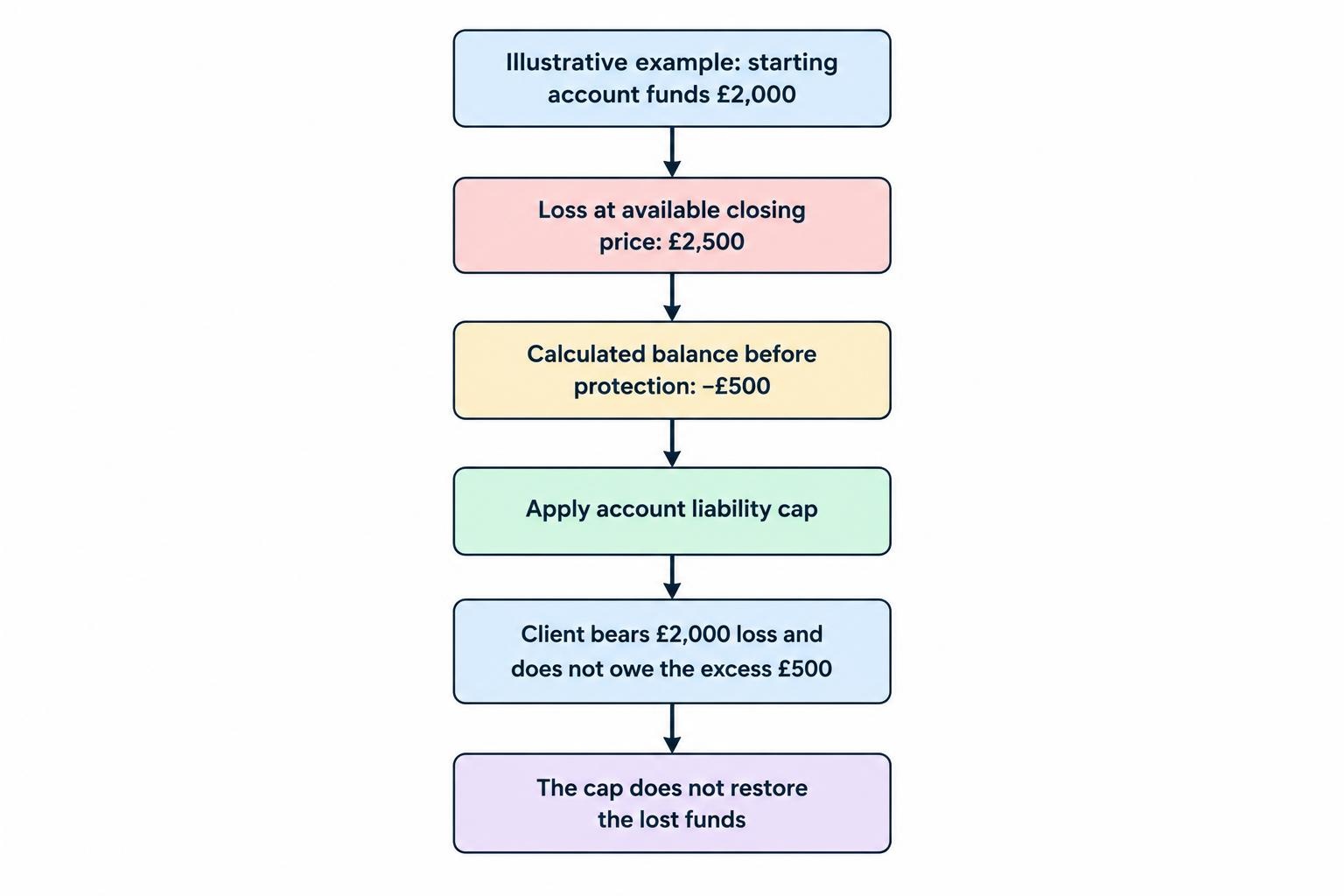
This example assumes that closure could not happen earlier because of the gap. It is not how every losing position develops. The practical issue is market gap risk: prices can jump past an intended exit rather than trade through every point along the way.
Negative Balance Protection vs Margin Close-Out
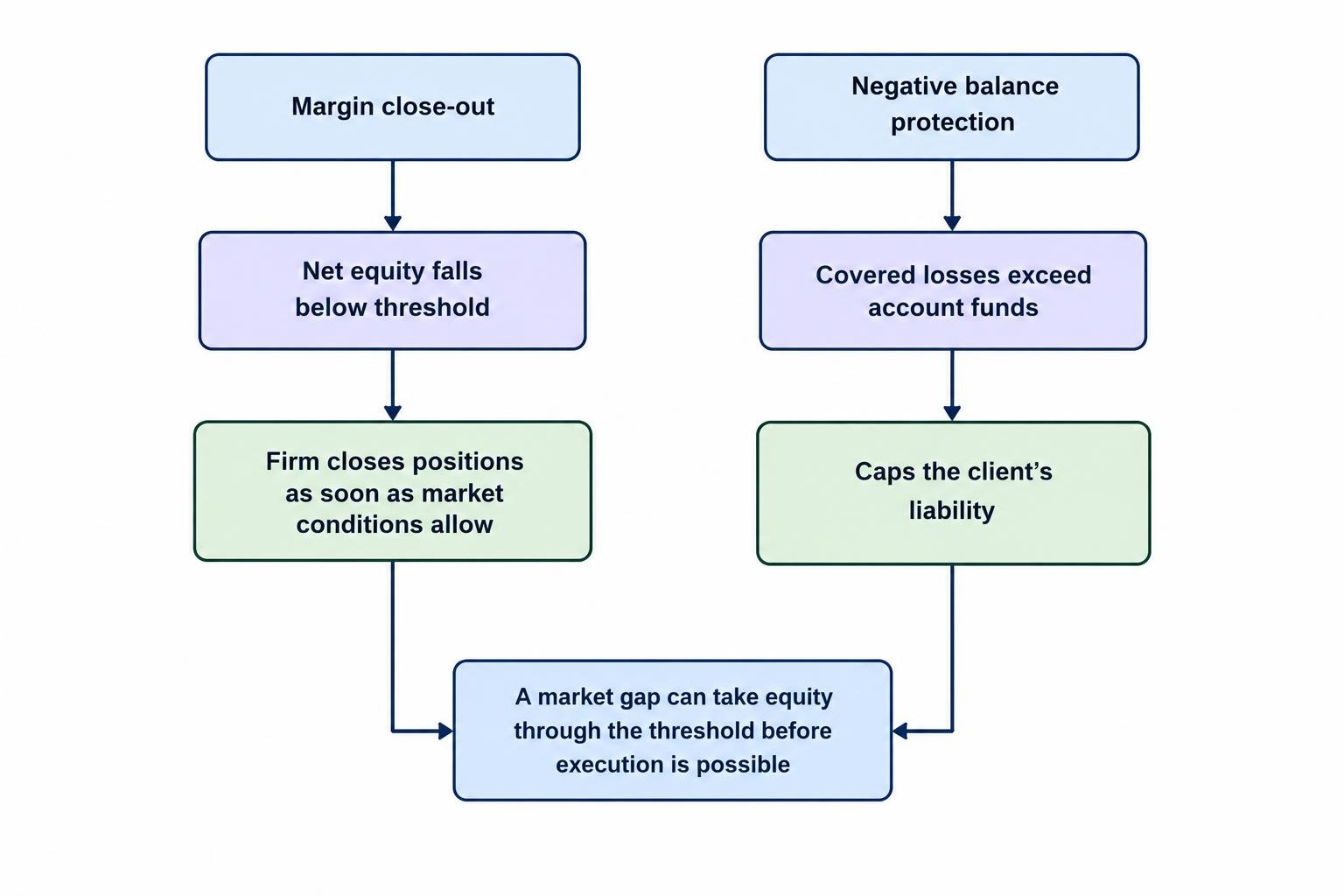
Margin close-out and negative balance protection address different stages of a loss. Close-out requires action while account equity is falling. Negative balance protection caps the client’s liability if losses nevertheless exceed the relevant account funds.
Under the retail close-out rule, when net equity falls below 50% of the margin requirement for open positions, the firm must close positions as soon as market conditions allow. Providers may set a higher close-out percentage in their terms. The FCA’s PS19/18 policy statement confirms that 50% is a minimum regulatory threshold, not a requirement to wait until that level.
If the applicable margin requirement is £1,000, its 50% threshold is £500. That does not mean the trader is guaranteed to retain £500. A price gap can take equity through the threshold before execution becomes possible.
The margin close-out rule is therefore not an account-wide guaranteed stop. Check both the provider’s trigger and its explanation of which positions it may close. Do not build a trading plan around automatic liquidation preserving a chosen amount of capital.
Negative Balance Protection vs Guaranteed Stops
A guaranteed stop and negative balance protection answer different questions. A guaranteed stop addresses the exit price of an individual position under its contractual terms. Negative balance protection addresses how much the client can owe across the covered account.
An ordinary stop-loss order can execute at a worse price if the market gaps through its trigger. A guaranteed stop is intended to honour the agreed stop level despite that gap, subject to the product’s terms. Availability, minimum distances and premiums need checking before placing the order.
Use the guide to guaranteed stop-loss orders when assessing trade-level protection. Negative balance protection should not be treated as its replacement: avoiding an account debt is a much weaker objective than keeping a planned loss within budget.
Who Receives the UK Protection?
The FCA requirement discussed here applies to retail clients within the scope of its rules. Professional clients do not receive this mandatory retail protection. A provider may offer contractual protection to professional clients, but its wording needs separate examination.
Moving to an overseas entity can also change the applicable protections. The provider’s trading name alone does not establish which rules govern your account. The FCA’s investor information on CFD providers warns about losing protections through professional classification or overseas arrangements and tells clients to identify the actual contracting entity.
Trading frequently, having a large account or calling yourself a professional trader does not by itself tell you your regulatory classification. Check the status recorded in your agreement. The broader differences are covered in retail versus professional client classification.
Before funding an account, match the legal entity in the agreement to its regulatory record. Follow the steps for checking a broker on the FCA Register, rather than relying on a logo or a group-wide statement about regulation.
What Negative Balance Protection Does Not Do
The account-level cap leaves several financial risks untouched. You can lose all the trading funds in the account. You can also deposit again and lose again. A cap on account liability does not create a lifetime ceiling on losses across repeated deposits.
Protection does not remove spreads, financing charges or other agreed trading costs. Those costs belong in the risk budget alongside price movements. Nor does the rule cancel a separate loan used to fund trading: avoiding a debt to the spread betting provider does not repay a lender.
It is also different from compensation following a provider’s failure. The FSCS guide to investment protection distinguishes potentially eligible claims involving failed providers from poor investment performance, which it does not compensate. Negative balance protection is not insurance against ordinary trading losses or a guarantee that a provider cannot fail.
Questions about money owed back after insolvency belong under FSCS protection and spread betting. Keep that assessment separate from the question of whether covered trading losses can create a payable deficit.
What to Do If Your Account Shows a Negative Balance
A negative figure on a screen does not, by itself, establish that a protected retail client owes that amount. Establish whether it represents closed trading losses, open positions, charges or an account correction. The liability cap and the platform’s accounting entries are related, but they are not the same thing.
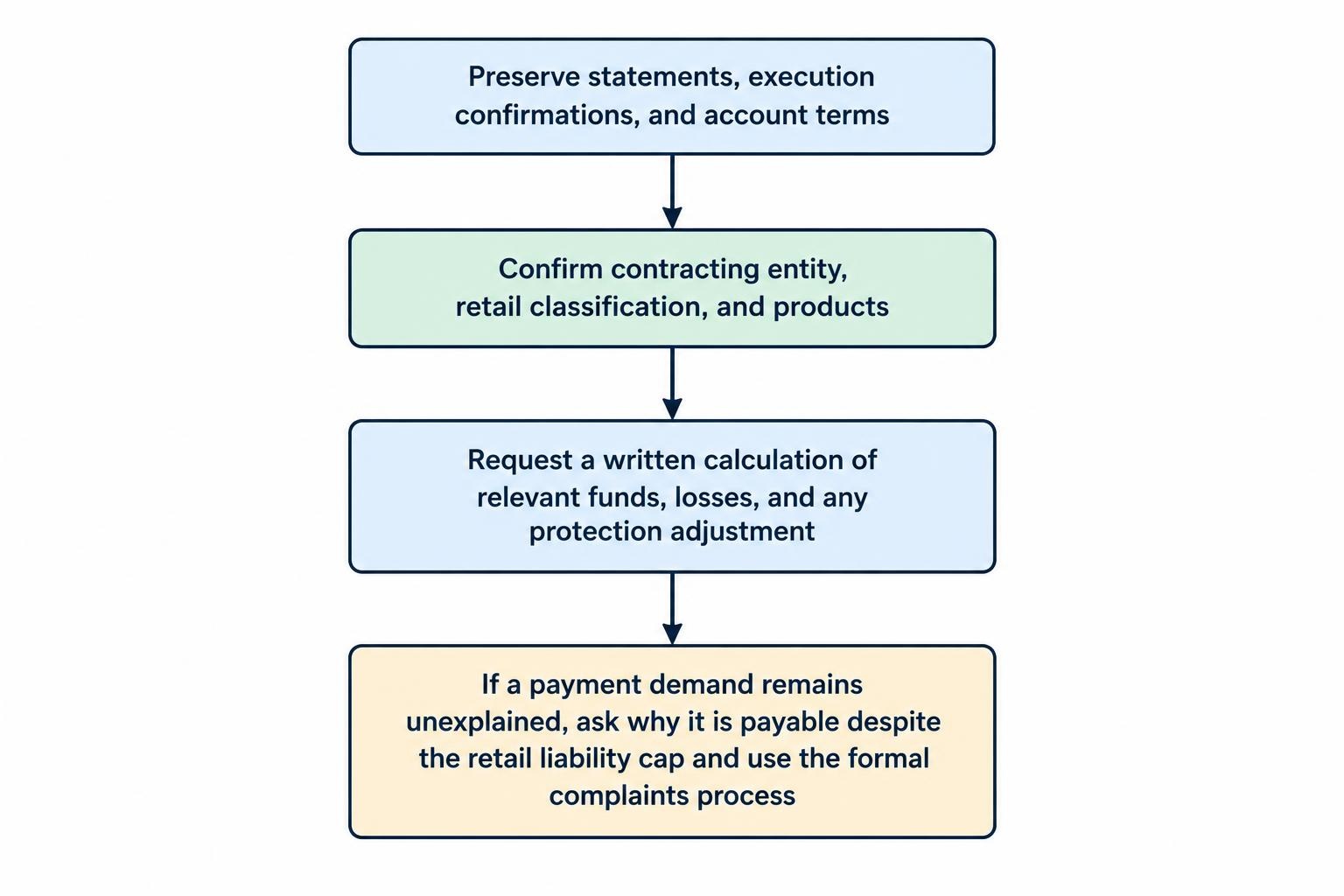
If the account appears to have gone below zero after a sharp move:
- Preserve the records. Download statements, execution confirmations and the applicable account terms. Record when the negative figure appeared.
- Confirm the account’s status. Check the contracting entity, retail classification and products involved.
- Request a written calculation. Ask the provider to identify the relevant account funds, losses and any negative balance protection adjustment.
- Challenge an unexplained payment demand. Ask why the amount is payable despite the retail liability cap, and use the formal complaints process if the explanation does not resolve the issue.
Do not deposit money solely because a platform displays a deficit. First establish whether the sum is actually payable. Equally, do not ignore correspondence: respond in writing and retain a copy.
For most complaints, the business has eight weeks to provide its response. An eligible complaint can generally go to the Financial Ombudsman Service after an unsatisfactory final response or when that period expires without one. Referral normally needs to happen within six months of the final response date, subject to exceptions in the Financial Ombudsman Service’s complaint time limits.
The guide to spread betting complaints and the Financial Ombudsman covers that process in more detail. A dispute about excess liability should identify the relevant trades and account figures, not just state that the trading result was unexpected.
Keep the Liability Cap Separate from Your Risk Budget
Negative balance protection is a final boundary, not a sensible loss target. Plan each position around the money you are prepared to lose, the stake per point, the intended exit and the possibility of a worse execution price.
For example, a £2 stake with a stop 40 points away represents an intended £80 price loss before costs and any slippage. That calculation remains useful whether the account holds £1,000 or £10,000. The entire balance should not become the trade’s risk budget by default.
Use position sizing for spread betting to set exposure before opening the trade. Negative balance protection can prevent a covered account deficit becoming a larger liability; careful sizing aims to keep you well away from losing the account in the first place.