A spread betting complaint needs to identify what the broker did wrong, not just show that a trade lost money. A disputed execution price, an incorrectly closed position or a cancelled profit raises different questions from an ordinary market loss.
The practical route is to complain to the broker, preserve the evidence and watch the referral deadline. If the dispute remains unresolved, the Financial Ombudsman Service may be able to investigate. Your account provider, client status, complaint dates and the activity involved all affect whether it can consider the case.
Can you take a spread betting complaint to the Financial Ombudsman?
Start with the legal entity named in your account agreement. Check its name against your statements and complaint correspondence, rather than relying on the trading brand. Our guide to checking a broker on the FCA Register covers how to identify the firm behind an account.
You must also qualify as an eligible complainant. Consumers can qualify, as can certain businesses, charities and trusts that meet the relevant tests. A company account does not automatically qualify just because its balance is small. The FCA rules on eligible complainants set out the categories, relationships and exclusions.
Professional client status needs care. The rules contain an exclusion for professional clients in relation to the firm and activity complained about, but also an exception where the complainant is a consumer in relation to that activity. It is therefore unsafe to assume that every professional client has lost all access to the Ombudsman.
If classification is disputed, include the application, reclassification request and any warnings you received. Explain whether you were trading personally or for a business. The distinction between retail and professional client classification matters, but ask the Ombudsman to assess jurisdiction rather than treating a broker’s rejection as the final answer.
For an overseas provider, ask which legal entity accepted your account and which complaint scheme applies. A familiar brand, sterling account balance or English language platform is not enough to settle that question.
What spread betting complaints can the Ombudsman examine?
The Ombudsman’s approach to spread betting disputes covers issues including execution prices, position closures, cancelled trades and platform mistakes. It considers the evidence, account terms, communications and rules that applied when the event happened. A complaint is not upheld simply because the outcome was expensive.
Execution prices, stops and disputed quotes
A stop filled below your chosen level is not, by itself, proof of an execution error. An ordinary stop can suffer slippage when prices move quickly or gap. The complaint should distinguish between the price you wanted and the price at which the broker should reasonably have executed the order.
Record the instrument, order type, stake, trigger level and execution time. Explain whether you dispute the trigger, the delay after triggering or the eventual fill. These are separate questions; combining them into “the stop failed” makes the investigation harder.
If the order was guaranteed, preserve the confirmation showing that protection was attached. A standard stop and a guaranteed stop-loss order are different arrangements. Identify the promise you believe the broker failed to honour, including any relevant conditions.
Margin calls and forced closures
A margin complaint should reconstruct the account immediately before the closure. Ask for the equity calculation, margin requirement, prices used and sequence of positions closed. If you added funds, record when the payment was made and when it reached the trading account.
The Ombudsman examines what the agreement allowed and whether the firm acted reasonably. A later market recovery does not, on its own, make an earlier closure unfair.
Do not build the complaint solely around an expectation of a telephone warning. Identify any promised notification and explain how it affected what you could have done. Where your argument concerns the margin close-out rule, separate that issue from the broker’s other contractual rights.
Account opening, appropriateness and advice
For relevant business, the FCA appropriateness assessment rules require firms to obtain information about a client’s knowledge and experience so they can assess whether the product or service is appropriate. This concerns the client’s ability to understand the risks involved.
An execution only account is different from an advised service. If you selected your own trades, focus on the application questions, answers, warnings and communications. If someone recommended an account or transaction, identify who made the recommendation and what they knew about your circumstances.
Preserve the original answers, including anything that weakens your argument. Claiming no trading knowledge after declaring years of derivatives experience needs an explanation. Our guide to the spread betting appropriateness test covers that process without confusing it with a promise that trading will be profitable.
Cancelled profits, fees and withdrawals
If the broker cancels a profitable trade, ask it to identify the relevant contract term and the evidence supporting its decision. In a pricing error dispute, the Ombudsman considers both the fairness of the term and whether the error would have been obvious to a reasonable customer.
For a disputed fee or withdrawal, narrow the complaint to the transaction. Identify the charge, request date, explanation received and amount outstanding. Separate the disagreement about entitlement to money from any complaint about delays or poor communication.
How to complain to the spread betting broker
Use the firm’s published complaints contact and make the purpose clear. A subject line such as “Formal complaint: disputed execution on account…” helps distinguish the complaint from a general support enquiry. Keep proof of delivery and a copy of everything submitted.
Your opening page should answer four questions: what happened, why you believe it was wrong, what loss or inconvenience followed, and what you want the broker to do. Put the detailed chronology and supporting documents behind that summary.
- Identify the account and transactions. Include order references, instrument names, dates and times, with the time zone.
- Describe the alleged error. State the action, omission or calculation you dispute.
- Connect the error to the outcome. Explain how the problem changed your position or account balance.
- Request a remedy and explanation. Give a calculation where possible and ask for any records needed to complete it.
A useful complaint might distinguish an incorrectly charged financing amount from the trading loss on the same position. Another might accept that an ordinary stop could slip, but dispute an unexplained delay between the trigger and execution. Precision gives the broker something it can investigate.
Download your records before relying on platform access remaining available. The guide to spread betting account statements can help you separate trade results, cash movements, financing and adjustments.
What response should you receive?
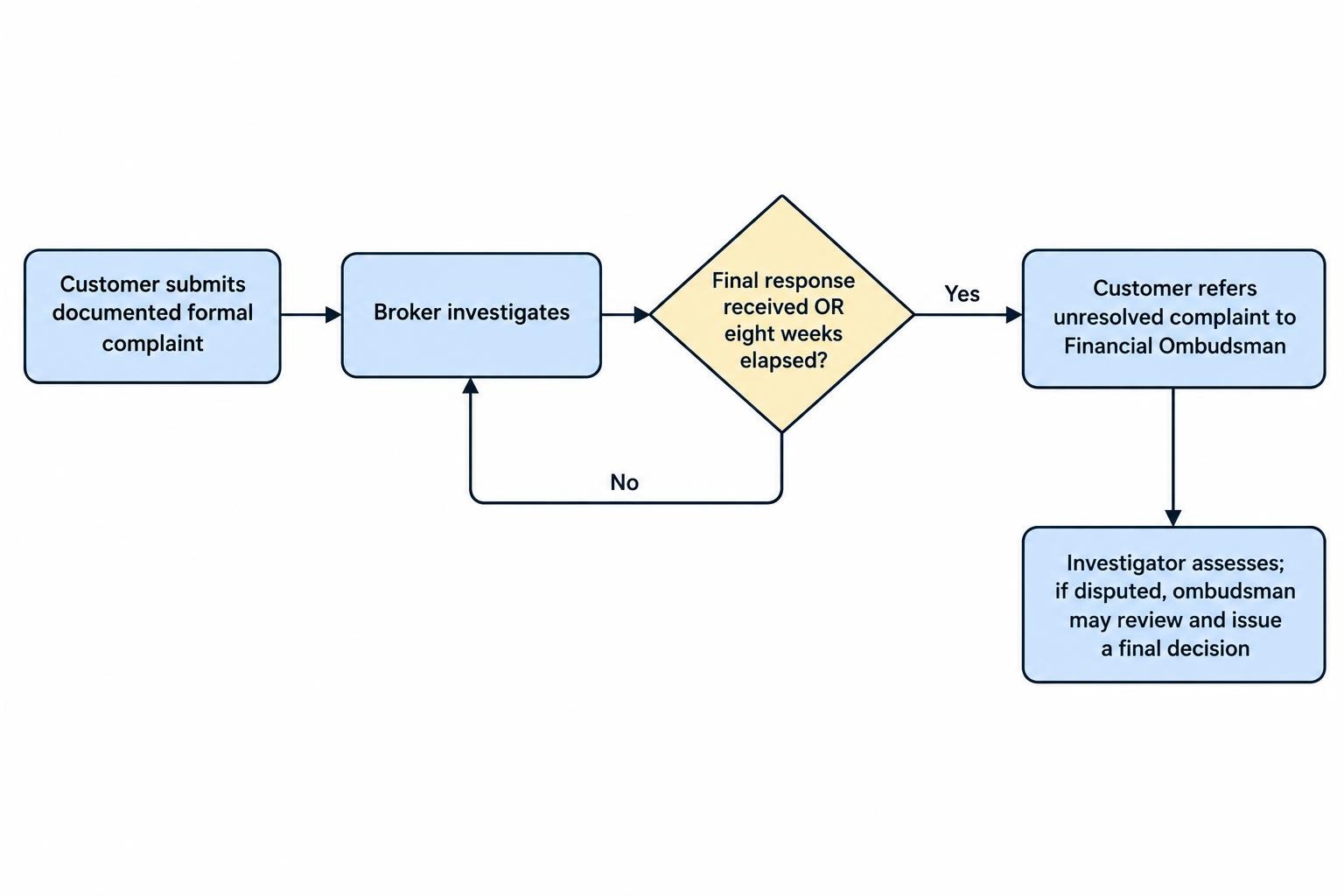
Under the usual complaint procedure, the firm must promptly acknowledge the complaint in writing and keep you informed. By the end of eight weeks after receiving an ordinary spread betting complaint, it must send either a final response or a written explanation of the delay that tells you about referring the matter to the Ombudsman. These duties appear in the FCA complaint response rules.
Read the response against your original complaint. Has the firm answered each disputed transaction? Does its calculation use the correct stake and price? Has it addressed your evidence, or only repeated the account terms?
If something is missing, identify it in writing. Keep the message short and numbered. Repeatedly sending the entire history makes it harder to see what remains unresolved.
Spread betting complaint deadlines
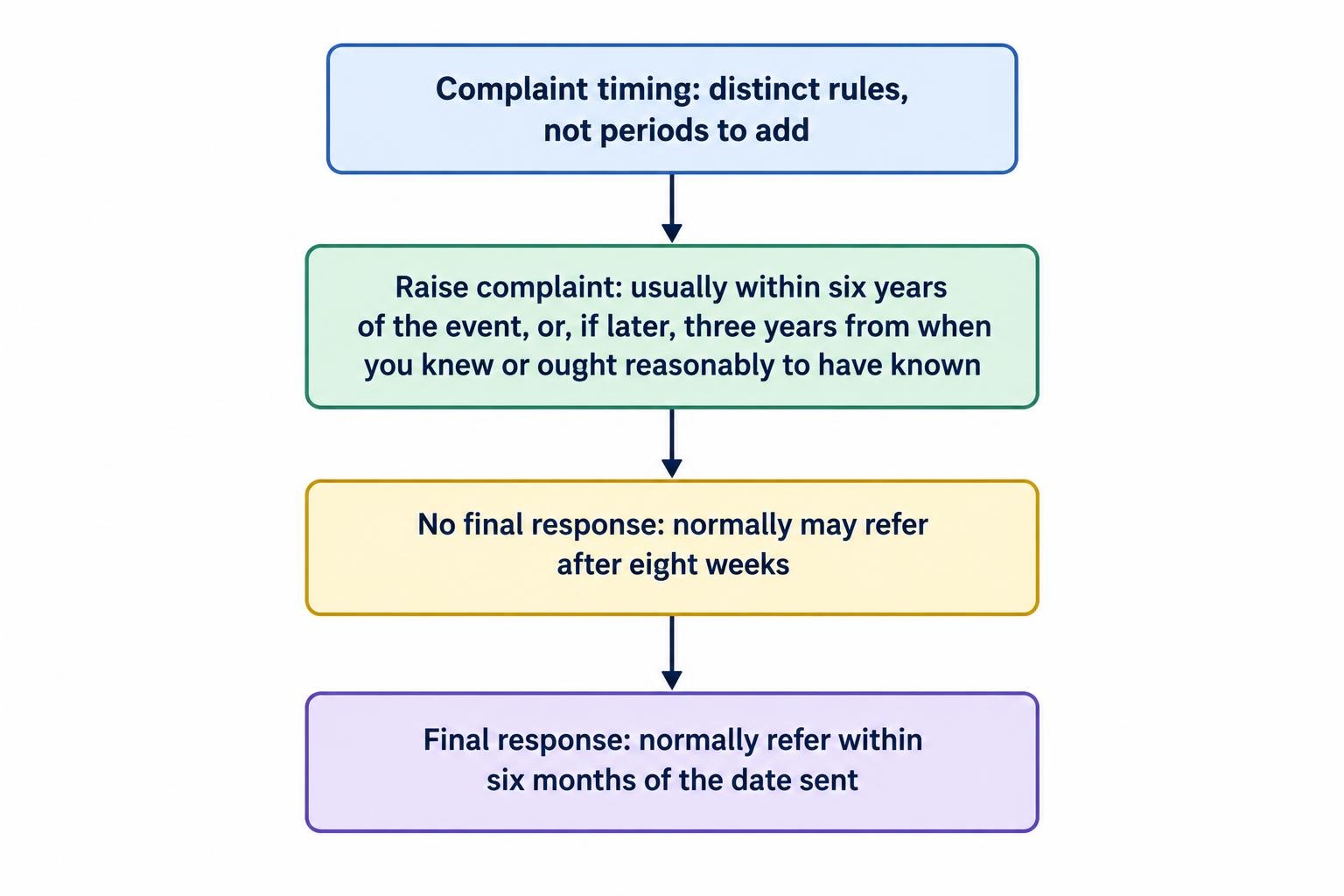
There are different clocks for raising an old complaint, allowing the broker to investigate and referring the dispute to the Ombudsman. The FCA rules on Ombudsman referral time limits distinguish them.
| Stage | Usual time rule | Practical action |
|---|---|---|
| Raising the complaint | Within six years of the event, or, if later, three years from when you knew or ought reasonably to have known you had cause to complain. | Keep evidence of when the firm received it. |
| Referring after no final response | For an ordinary spread betting complaint, you can normally refer once eight weeks have elapsed from the firm receiving it. | Do not wait indefinitely for the investigation to finish. |
| Referring after a final response | Normally within six months of the date the firm sent its final response. | Record the referral deadline immediately. |
You do not have to wait out eight weeks if the broker has already issued its final response. A summary resolution communication can also permit referral and start the six month clock where the required information is provided.
The six month period uses calendar months. In an illustrative case, a final response sent on 5 August 2026 would normally give a referral deadline of 5 February 2027. Submit before the last day rather than relying on a last minute upload.
Late complaints are not always excluded. Exceptional circumstances, an invalid final response or the firm’s consent can affect whether the Ombudsman can proceed. Serious illness must have prevented timely referral, not simply occurred at some point. The Ombudsman guidance on deadlines and exceptions sets out its approach.
Do not treat continuing negotiations as permission to miss the referral deadline. If you are close to it, submit the complaint and explain which documents or answers remain outstanding.
Build an evidence pack that answers the dispute
The aim is not to send the largest possible bundle. It is to make the disputed event easy to reconstruct. Start with a short chronology and label each supporting file so a reader can connect it to the relevant entry.
Preserve the transaction and price records
Keep order confirmations, execution reports, account statements and the terms that applied at the time. For screenshots, retain the original files as well as annotated copies. Include the full instrument name, visible timestamp and whether the displayed price was a bid, offer or another chart value.
For a long position, compare the relevant selling price when examining an exit. For a short position, compare the relevant buying price. A chart showing a midpoint is not the same thing as an executable quote. The bid-ask spread matters when checking whether a trigger level was reached.
Use outside market data carefully. Record whether it concerns the cash market, a futures contract or another instrument. Identify any delay and the chart’s time zone. A price difference is a reason to investigate, not automatic evidence of manipulation.
For an outage, show what you attempted to do
Record when access failed, the device and connection used, any error message and when service returned. Keep support tickets and evidence of attempts to use an available alternative dealing channel.
Explain the intended action precisely: closing an existing position, amending a stop or placing a new order. Distinguish a rejected instruction from an instruction you never managed to submit. If your argument depends on a price that was available for only a moment, identify the evidence for that price and timing.
Ask for records you do not hold
Request relevant server timestamps, order audit trails, call recordings, quote history and the calculation behind a disputed closure or charge. Say why each record matters. A request for “everything” is less useful than asking which price triggered a named order at a recorded time.
Separate facts from inferences. “The order confirmation shows 10:03:18” is a fact supported by a document. “The broker deliberately delayed the order” is an allegation that needs further evidence. Presenting that distinction clearly strengthens the complaint.
How to refer the complaint to the Financial Ombudsman
The Ombudsman is free for consumers to use, and you do not need a lawyer or claims management company. Its consumer complaint process allows complaints online or by telephone. Provide the firm’s details, your complaint, the final response if available and the main supporting records.
An investigator considers both sides and gives an assessment. If either party disagrees, it can ask for an ombudsman to review the case and issue a final decision. Investigation times vary; a complex trading dispute should not be treated as a quick account adjustment.
Make the referral readable on its own. A case handler should not have to reconstruct your argument from a chain of forwarded emails. Explain the remaining disagreement, including why you reject the broker’s explanation or offer.
If financial hardship or serious ill health makes the case urgent, tell the service when you submit it. Explain the effect on your circumstances rather than assuming the size of the trading loss speaks for itself.
During the investigation, answer requests directly and flag corrections promptly. Keep later developments separate from the original chronology. If you discover that a timestamp was in a different time zone, correct it rather than leaving an avoidable contradiction in the file.
What compensation can the Ombudsman award?
Redress can include reimbursing financial loss, refunding a charge or directing the business to calculate compensation. Distress or inconvenience may also be considered, and interest can apply. The remedy depends on what went wrong and its consequences; it is not automatically the amount originally deposited.
For complaints referred on or after 1 April 2026, the monetary award limit is £455,000 for acts or omissions on or after 1 April 2019, and £205,000 for earlier acts or omissions. Different limits apply to earlier referrals. The Ombudsman compensation guidance also explains that it can recommend payment above the applicable limit, but cannot require the firm to follow that recommendation.
Separate the trading loss from the alleged error
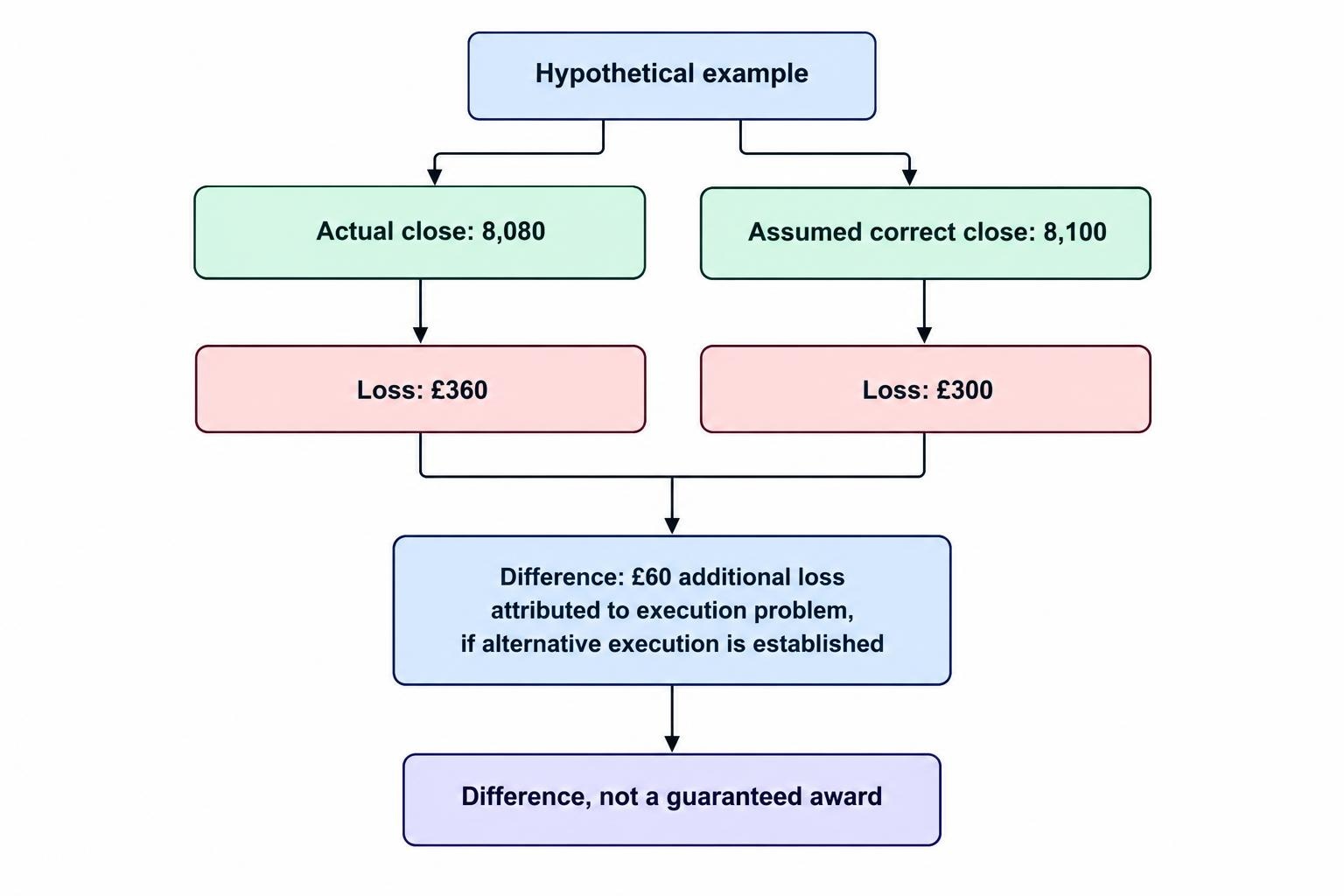
Consider a hypothetical long spread bet opened at 8,200 for £3 per point and closed at 8,080. Ignoring other charges, the loss is £360.
Assume the evidence establishes that the broker should instead have closed it at 8,100. The loss would then have been £300. On those assumptions, the additional loss attributable to the execution problem is £60, not £360.
This example does not assume every stop should fill at its requested level. It assumes the correct alternative execution has been established. Use the same discipline in your own spread betting profit and loss calculation: identify the disputed difference, show the arithmetic and explain the evidence behind the alternative outcome.
Avoid valuing a complaint by selecting the most profitable exit visible afterwards. State what action should have happened at the time and why. If several outcomes remain possible, acknowledge the uncertainty rather than presenting hindsight as a trading instruction.
Accepting or rejecting an Ombudsman decision
A broker’s final response and an ombudsman’s final decision are different documents. The broker’s response opens the escalation route; the ombudsman’s decision follows the independent review.
The Ombudsman determines complaints by reference to what is fair and reasonable, taking account of relevant law, rules and practice at the time. If you accept its final decision within the stated deadline, it becomes final and binding on both parties under the FCA rules on Ombudsman determinations.
Before accepting, check the remedy, calculation method and payment instructions. Ask about anything unclear. Do not assume you can accept an award and then sue for the balance of the same complaint.
Court time limits continue to run while the Ombudsman handles a case. If court action is under consideration, particularly where the alleged loss exceeds the award limit, obtain independent legal advice before accepting an award or choosing your next step.
When another route needs attention
If the broker has failed, check the administrator’s instructions and the separate rules on FSCS protection for spread betting accounts. Do not assume an Ombudsman complaint alone will secure payment from an insolvent firm.
If you suspect the provider is an impersonator or fraudulent operation, preserve payment records and verify contact details independently before sending more money or identification. The guide to spread betting scams covers that separate problem.
For an unresolved dispute with an operating broker, focus on the immediate job: identify the firm, state the alleged error, preserve the records and refer within the deadline. A clear chronology and a defensible loss calculation give the complaint a sound basis for investigation.