Retail and professional client classification determines which protections apply to your UK spread betting account. The practical difference is not the label on the trading platform. It is the margin you must provide, the safeguards around account losses and the terms that apply if something goes wrong.
Professional status may allow lower margin requirements, but it does not make a position less risky. Retail status is not a beginner’s badge, either. An experienced trader can reasonably prefer stronger account protections to greater borrowing power. The right comparison starts with potential liabilities, not the largest position the platform will accept.
What Retail and Professional Client Classification Means
A retail client is a client who is neither a professional client nor an eligible counterparty. Professional clients fall into two groups: per se professionals, including regulated financial institutions, and elective professionals, who request professional treatment and satisfy the applicable assessment requirements. These categories sit within the FCA client categorisation rules.
For an individual spread bettor, elective professional status is the relevant route. It is a regulatory classification for the relationship with the firm, not an award for profitability. A profitable trader is not automatically professional, and a professional client is not necessarily profitable. Markets remain disappointingly indifferent to account labels.
Keep three questions separate:
- Eligibility: can the broker properly classify you as professional?
- Contract terms: what changes if it does?
- Commercial value: do those changes serve your trading needs?
Passing an eligibility assessment does not answer the other two questions. Nor should employment in finance, a large account balance or trading full time replace a careful comparison of the terms.
This article concerns UK regulated spread betting relationships. The wider UK spread betting regulation guide covers the framework around firms, accounts and investor safeguards.
Retail vs Professional Spread Betting: The Main Differences
The FCA rules for retail CFDs and similar speculative investments establish protections that apply to leveraged spread betting. Professional clients do not receive these retail safeguards simply because they trade through an FCA authorised firm.
| Account feature | Retail client | Professional client |
|---|---|---|
| Opening margin | Regulatory minimum rates depend on the underlying asset. | The retail minimum rates do not apply; check the broker’s professional margin schedule. |
| Margin close out | Positions must be closed as soon as market conditions allow when account net equity falls below 50% of the required margin. | Do not assume the retail threshold applies; the professional agreement determines the contractual arrangements. |
| Negative balance protection | Liability for covered trades is capped at the funds dedicated to those trades in the account. | The retail regulatory protection does not apply automatically. |
| Standardised risk warnings | Prescribed warnings include the provider’s retail account loss percentage. | The same retail warning requirements do not apply. |
These differences concern regulatory safeguards. They do not establish that a professional account offers better spreads, faster execution or more useful support. Ask for the actual pricing and service terms rather than treating “professional” as a synonym for “better”.
The separate guide to retail client protections examines the safeguards individually. For classification decisions, the task is to compare the package you have with the package you would receive.
Lower Margin Does Not Mean Lower Trading Risk
Margin is collateral supporting a position. It is not the amount that the position can lose. Reducing the margin requirement changes how much cash must support the exposure; it does not change the cash effect of each market point.
Consider an illustrative index spread bet with these assumptions:
- The index is quoted at 8,000.
- You buy at £5 per point.
- The approximate notional exposure is £40,000: 8,000 × £5.
- One account requires 5% margin, or £2,000.
- A hypothetical professional account requires 1% margin, or £400.
The professional rate here is an assumption, not a claim about any provider’s offer. The example also ignores spreads, financing and other charges.
If the index falls 100 points, the trading loss is £500 under either margin arrangement. The £400 margin requirement has not reduced the loss. It has reduced the collateral needed to open the same position.
Now suppose the trader uses the same £2,000 margin allocation to open five times the exposure at £25 per point. A 100 point fall produces a £2,500 loss. The margin saving has become a much larger cash risk because the stake increased.
This is the distinction that matters: lower margin on an unchanged position is different from using lower margin to enlarge the position.
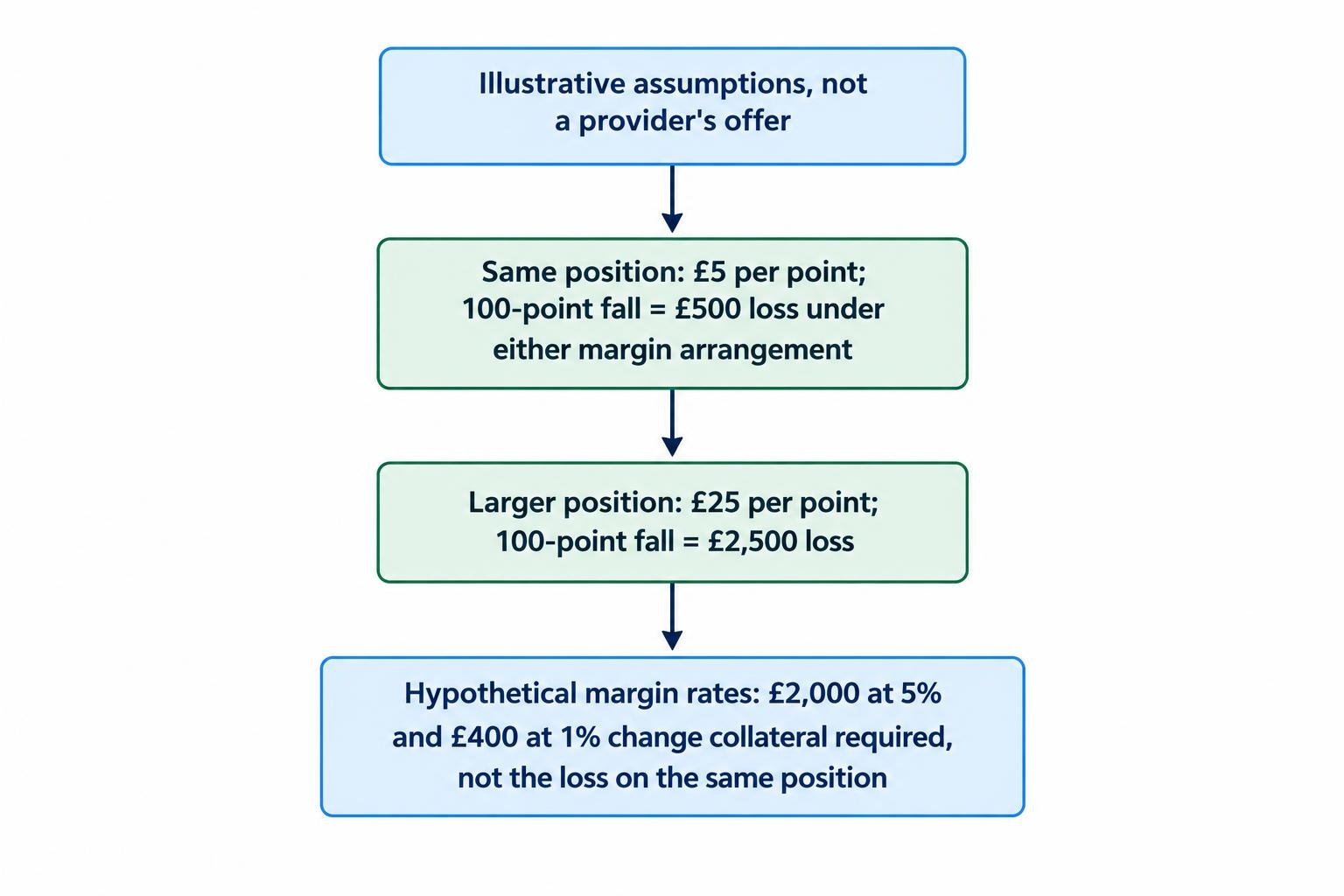
Compare classifications using the same account balance, stake and assumed market movement. Only then assess any change in exposure. Otherwise, the apparent benefit can hide a different trading decision altogether.
Base the stake on an affordable loss and a realistic exit scenario, not the platform’s maximum buying power. The guide to position sizing for spread betting covers that calculation without treating available margin as a spending target.
Negative Balance Protection Deserves Particular Attention
For covered retail accounts, negative balance protection addresses losses beyond the funds dedicated to trading in the account. It does not protect those funds from being lost. The protection forms part of the FCA policy establishing permanent retail CFD safeguards.
A professional client should establish whether any equivalent protection exists in the contract. A voluntary promise from a broker is not the same thing as a protection required by the retail rules. Read its scope, exclusions and conditions.
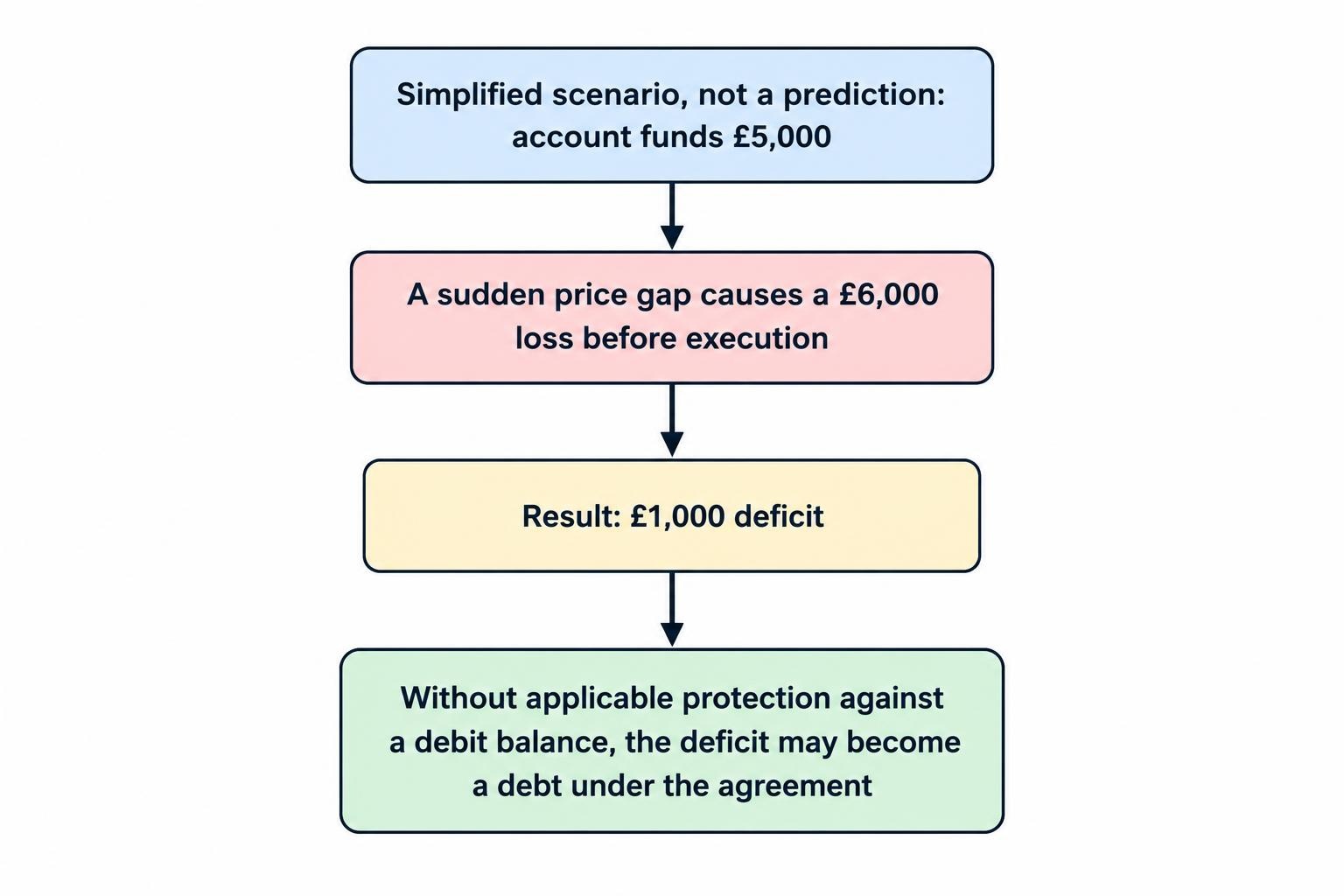
For a simplified stress scenario, assume an account has £5,000 and a sudden price gap produces a £6,000 loss before execution becomes possible. Without applicable protection against a debit balance, the resulting £1,000 deficit may become a debt under the agreement. This is not a prediction of how a particular position would be closed.
Ask a direct question: “Can I owe money beyond the funds in this account, and under what circumstances?” A reassuring discussion about stop orders is not an answer. The negative balance protection guide explains why an account liability cap and an order to exit a trade perform different jobs.
Does Professional Status Remove Every Other Protection?
No. “Professional clients lose all protection” is too broad. Margin safeguards, client money arrangements, compensation eligibility and complaint rights come from different rules. They need separate checks.
It is just as unsafe to assume everything remains unchanged because the broker is regulated. Ask which protections continue, which change and which depend on a separate agreement.
Client Money and Collateral Arrangements
Professional classification does not, by itself, tell you how the broker holds your cash. Check whether it remains client money or whether you are being asked to enter a title transfer collateral arrangement, often shortened to TTCA.
Under the FCA rules on client money and title transfer collateral, firms must not enter into a TTCA over retail client money. Money transferred under a permitted non-retail TTCA does not count as client money. Such arrangements require a written agreement.
The practical question is whether ownership of the cash transfers to the firm as collateral, rather than the firm holding it as client money. Do not accept “your funds are safe” as a substitute for an explanation of the legal arrangement.
Ask whether changing classification also changes the treatment of existing balances, future deposits or particular collateral. Keep the answer with the account agreement. The client money rules guide covers the distinction in more detail.
FSCS Eligibility Is Not Decided by the Label Alone
Elective professional status does not automatically rule out Financial Services Compensation Scheme compensation. In the SVS Securities failure, the FSCS confirmed protection for eligible elective professional clients with FX balances, including eligible individuals and small businesses. The decision depended on the investment and how it was held.
That example is not a promise that every professional spread betting claim qualifies. It does show why blanket statements that all professional clients lose FSCS protection are unreliable.
Separately, the FSCS investment compensation conditions exclude claims for poor investment performance. Compensation may be available for an eligible shortfall when a provider fails, subject to the scheme’s conditions. It is not reimbursement for a losing trading strategy.
Ask about the exact contracting firm, the activity and your circumstances. A brand name alone is not enough to assess protection. The guide to FSCS protection and spread betting separates firm failure risk from ordinary trading losses.
Financial Ombudsman Access Requires a Separate Assessment
It is also inaccurate to say that every professional client automatically loses access to the Financial Ombudsman Service.
The FCA rules on eligible Ombudsman complainants generally exclude professional clients in relation to the firm and activity concerned. However, that exclusion does not apply where the complainant is a consumer in relation to the activity. Other jurisdiction conditions still matter.
An individual trading outside their trade, business or profession therefore needs a different assessment from a business making a business related complaint. Regulatory professional status and consumer status for complaint purposes are not interchangeable labels.
Do not rely on an account comparison table that simply marks Ombudsman access “yes” or “no”. Ask the firm to explain its position, and retain the documents showing the capacity in which you opened and used the account.
The guide to spread betting complaints and the Financial Ombudsman covers the complaint process. Neither access to that process nor an alleged classification error guarantees compensation.
What Changes When You Opt Up?
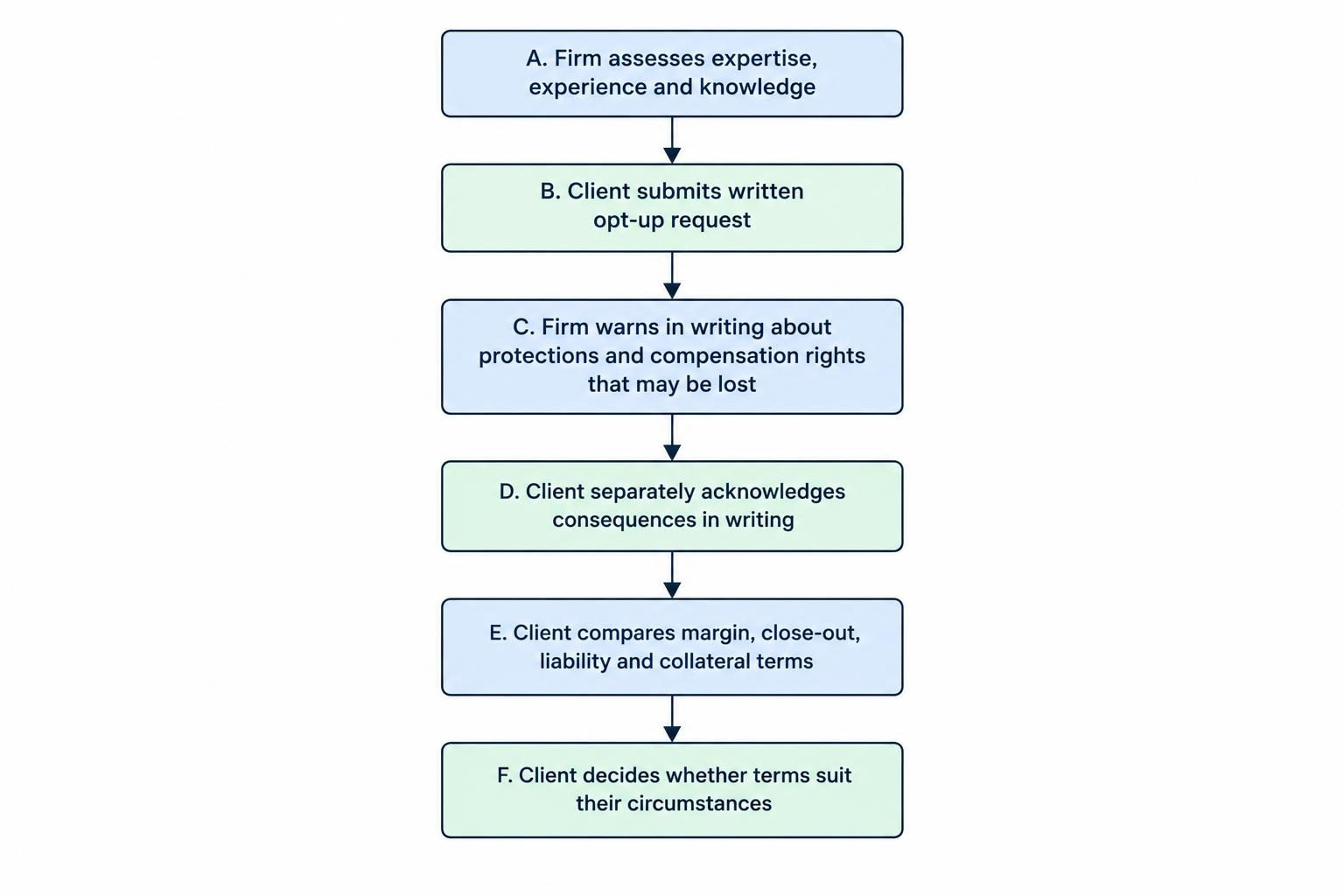
Elective professional classification requires more than choosing an account setting. The firm must assess your expertise, experience and knowledge against the transactions or services envisaged. Applicable eligibility conditions must also be satisfied.
The procedure includes your written request, a clear written warning from the firm about protections and compensation rights you may lose, and a separate written acknowledgement of the consequences. Do not treat that acknowledgement as routine account administration.
Before signing, turn the warning into practical questions. Does “losses may exceed deposits” create a liability you could meet without selling long term assets? Does a different close out policy fit the amount of cash you intend to maintain? Are collateral terms changing at the same time?
Classification disputes are also fact dependent. In Ombudsman decision DRN-5396626 concerning an elective professional spread betting account, the complaint was not upheld despite shortcomings identified in parts of the assessment. The decision considered the trader’s experience, evidence and circumstances; it did not treat a procedural failing as automatic grounds to refund trading losses.
The detailed eligibility criteria and supporting evidence belong in the guide to qualifying for professional client status. Eligibility should be established before comparing commercial benefits, not manufactured to obtain them.
When Might Remaining Retail Make More Sense?
Remaining retail deserves serious consideration when your intended positions already fit comfortably within retail margin requirements. In that situation, professional status may solve a problem you do not have, while changing protections you would prefer to keep.
Consider a trader with a £20,000 account whose planned positions require £3,000 of margin. If the trader intends to keep the same £20,000 available and retain the same exposure, a lower margin requirement does not reduce the cash loss from an adverse move. It changes the allocation between required margin and available funds.
There may be a reason to value that flexibility, but identify it precisely. “More freedom” is not a financial calculation.
Now consider a trader who wants to withdraw cash after obtaining lower margin rates. That decision changes the buffer supporting the positions. Review the effect of a gap, several correlated losses or a sudden increase in required margin before treating the withdrawal as spare capital.
Professional treatment should not be a workaround for an underfunded strategy. If a position only becomes affordable after removing retail safeguards, reconsider the stake and the amount you can afford to lose.
A useful decision test is to remove the word “professional” from the offer. Would you still accept the same liability, collateral and close out terms in return for the stated margin reduction? That is the offer worth assessing.
Can You Return to Retail Classification?
Professional clients must be allowed to request a classification carrying greater protection. Professional clients should also keep the firm informed of changes affecting their categorisation; the firm must take appropriate action if it becomes aware that the original elective professional conditions are no longer met.
However, do not assume that requesting retail treatment changes the account immediately. Ask for written confirmation of the effective date and the products or services covered.
Before a change, establish what happens to open positions, margin requirements, pending orders and any collateral agreement. If retail treatment requires more margin for the same exposure, plan for that requirement before the change takes effect.
Reviewing classification after a change in circumstances is sensible account management. Returning to retail is not a demotion, and remaining professional is not evidence that the original decision still suits your finances.
What to Confirm Before Agreeing to Professional Terms
Request a comparison that names the contracting legal entity and answers these questions:
- Which accounts, products and services will the classification cover?
- What margin rates and close out arrangements will apply?
- Can losses create a debt beyond the account balance?
- Will cash remain client money, or will any title transfer arrangement apply?
- What is the firm’s position on FSCS eligibility and Ombudsman access?
- How can you request retail treatment, and what happens to existing positions?
Confirm the firm’s identity and permissions rather than relying on the trading name shown in an advert. The guide to checking a broker on the FCA Register covers that verification.
Choose the classification by its consequences, not its status. Compare identical positions, test the worst liability you could face and keep the terms in writing. A lower margin requirement is easy to measure. Whether it is worth the protections you give up requires a more careful decision.