Offshore spread betting brokers need more scrutiny than a comparison of spreads, platforms and minimum deposits. For a UK resident, the first question is which legal company will hold the account, followed by whether that company has permission to provide the service and what happens if something goes wrong.
Do not treat an offshore account as a shortcut to higher leverage. Before sending money, establish the contracting entity, regulatory permissions, client money arrangements and complaints route. If those details are unclear, the advertised trading conditions are not enough to justify opening an account.
What does “offshore spread betting broker” mean?
For this guide, an offshore account means an account contracted with an overseas entity rather than the UK entity a customer might expect to use. The term describes the arrangement being investigated; it does not establish the firm’s legal status or the protections attached to the account.
Foreign ownership alone does not make a broker unregulated in the UK. An international group can operate through a UK subsidiary, while an overseas incorporated firm can obtain FCA authorisation and operate through a UK branch. These structures differ, and services provided from overseas offices can have different protection arrangements. The distinction appears in the FCA’s approach to international firms.
Start with the client agreement rather than the logo. Imagine a hypothetical group with a UK company and a separate overseas company using the same trading name. An application begins on the group’s main site, but the agreement names the overseas company. Your review must follow the company named in that agreement, not stop at the group’s UK presence.
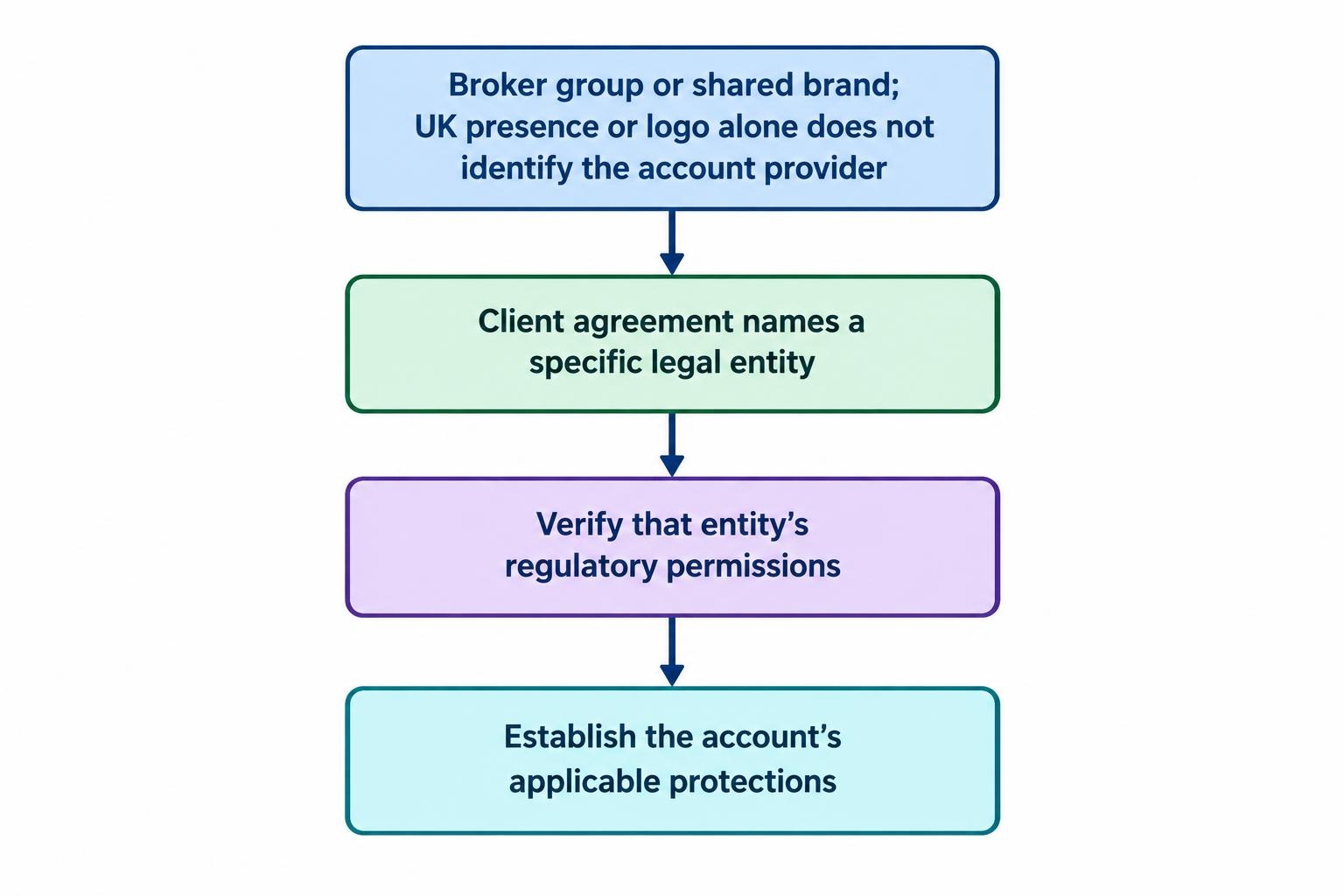
Write down the legal name, registration number, registered address and regulator before comparing trading features. Keep these details beside the account opening documents. This gives you a clear reference point if a later email, payment instruction or revised agreement names a different business.
Can offshore brokers legally serve UK customers?
There is no reliable blanket answer based only on where a company is incorporated. An overseas registration does not, by itself, establish that a firm may provide regulated services to UK customers. Equally, a foreign address does not prove that the firm is operating unlawfully.
The FCA has identified firms redirecting retail customers to associated overseas CFD providers without equivalent consumer protections. Its 2022 CFD portfolio letter on offshore redirection also identified overseas entities illegally providing regulated activities to UK clients outside the Overseas Persons Exclusion. The existence of that exclusion is not a general permission for an offshore broker to accept UK business.
A functioning registration page proves little beyond the fact that the page accepts an application. Ask the firm to identify its regulatory basis for serving a UK resident, then verify the answer independently. Do not accept “internationally regulated” as a substitute for a named entity, an identifiable licence and relevant permissions.
If a sales representative says the account avoids UK restrictions, pause the application. Ask for a written explanation of why the proposed service is lawful and which protections will apply. The wider guide to UK spread betting regulation provides the framework for assessing that answer.
Which retail protections should you compare?
Use the UK retail rules as a benchmark, not as an assumption about an overseas account. The following requirements apply to covered retail business under FCA Handbook COBS 22.5, which includes leveraged spread bets.
| Protection | UK retail benchmark | What to establish for the proposed account |
|---|---|---|
| Leverage restrictions | Margin floors restrict leverage by asset category. | The margin schedule, maximum exposure and margin change terms. |
| Margin close-out | Below 50% of required account margin, positions must be closed as soon as market conditions allow. | The threshold, calculation and liquidation process. |
| Negative balance protection | Liability for covered trades is capped at funds in the account. | Whether protection is contractual or regulatory, and any exclusions. |
| Trading incentives | Monetary and non-monetary incentives are prohibited, subject to the rules’ scope. | Any deposit, turnover or withdrawal conditions. |
| Risk warnings | Prescribed warnings disclose trading risk and, where required, account loss rates. | Whether the warning relates to the actual contracting entity. |
Negative balance protection does not protect the account balance from trading losses. Nor does it cap each trade’s loss at that trade’s opening margin. For the broader framework, see retail client protections for spread betting.
Ask for the relevant contractual clauses rather than a support agent’s summary. If the agreement contradicts the sales explanation, resolve the difference before funding the account.
Higher leverage does not make a position cheaper to lose
A smaller margin requirement can make a position look more affordable without changing its market exposure. Compare the loss from a price movement before comparing the deposit required to open the trade.
Consider a hypothetical position with £20,000 of market exposure. At a 5% margin requirement, opening margin is £1,000. At a 0.2% requirement, it is £40. These figures illustrate two margin schedules; they are not offers from actual firms.
An adverse 1% movement still produces a £200 trading loss in either case, before costs and assuming the position remains open throughout the move. The £960 difference in opening margin is not a saving on that loss. It is money that was not required as opening collateral.
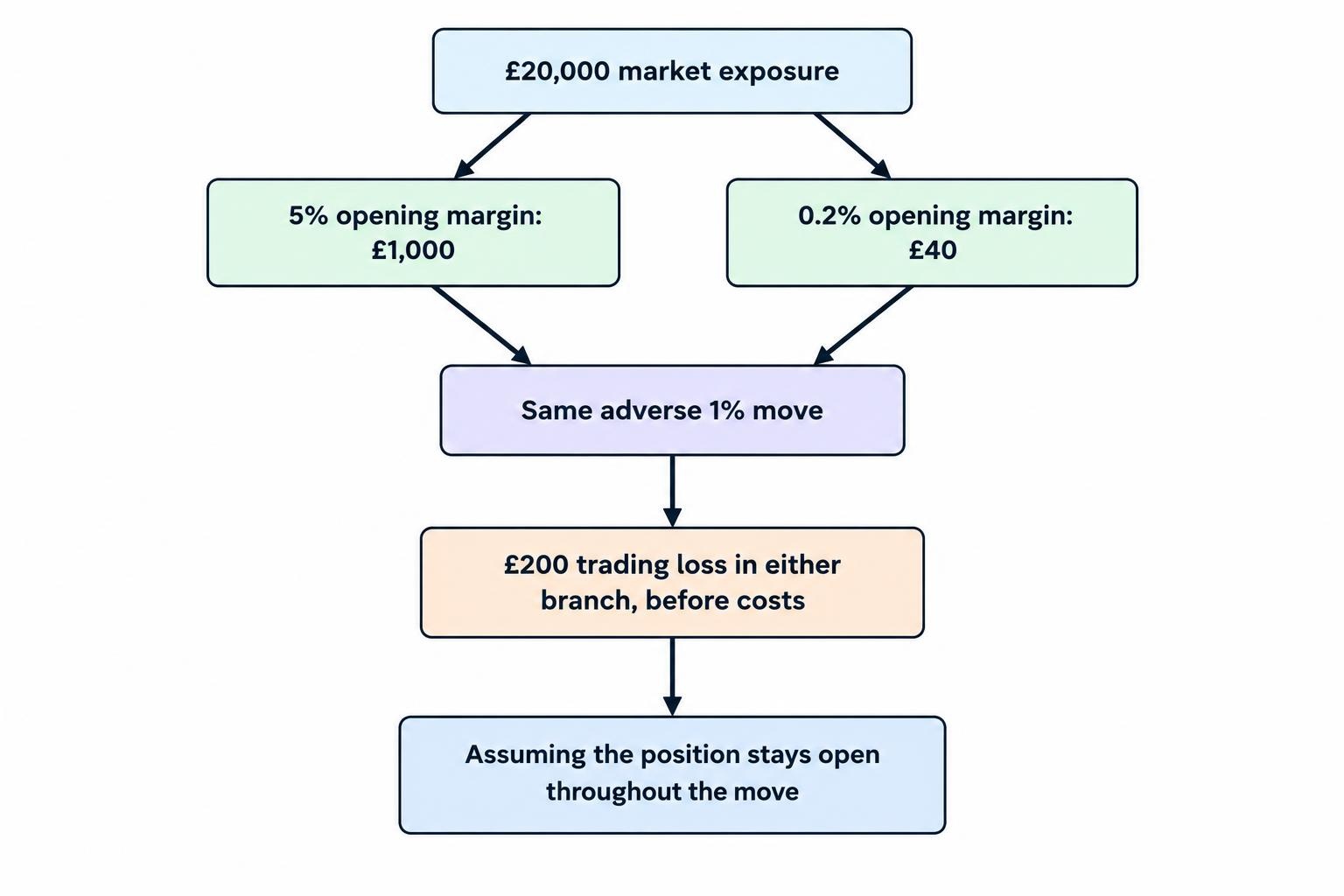
If the account contains £2,000, the £200 loss represents 10% of its starting balance under either schedule. The danger increases if the lower margin encourages a larger position. This is the practical issue covered in the guide to leverage risk.
Decide the loss you can afford, the point at which the trade thesis fails and the stake that connects those two figures. Only then check the margin requirement. The position sizing guide develops that process without treating available borrowing capacity as a trading target.
How to check the broker before opening an account
Verify the entity and its permissions
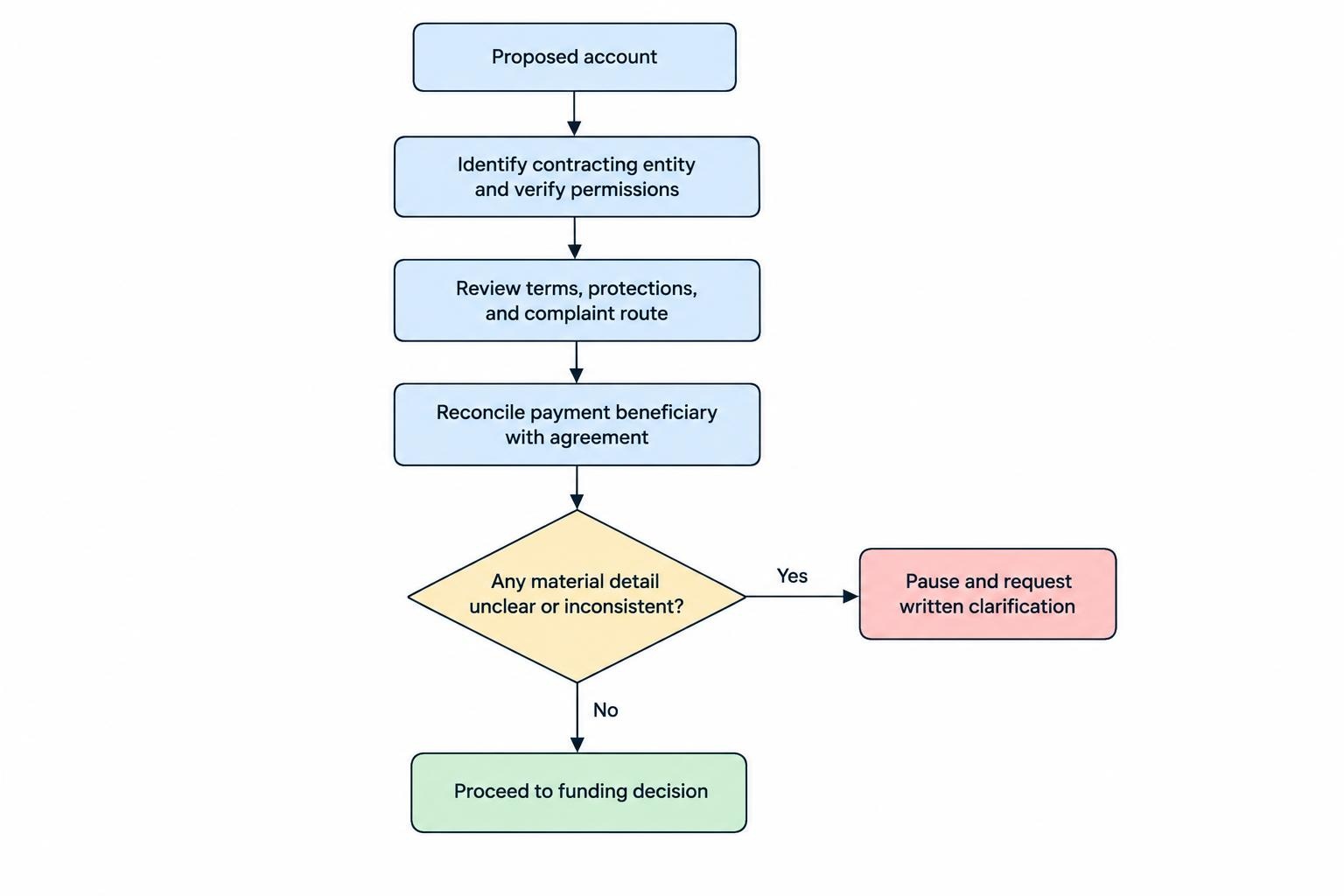
Use the legal name in the proposed client agreement when checking regulatory records. Check the firm’s status and permissions for the service you want. A company registration certificate is not sufficient evidence of permission to provide spread betting.
The FCA’s authorisation checking guidance distinguishes authorisation from registration and explains how to check permissions. It also warns about clone firms impersonating genuine authorised businesses. Match the contact details you have received against the official record rather than relying on a registration number copied into an email.
If an overseas licence is presented, conduct the same exercise through that regulator’s own records. Ask whether the licence covers the proposed activity and client category. Treat any inconsistency between the agreement, regulatory entry and payment instructions as something to resolve, not a minor administrative detail.
For a more detailed checking process, use the guide to checking a broker on the FCA Register.
Read the documents that control the account
Request the client agreement, execution policy, margin schedule, fee schedule and complaints procedure before depositing. Search these documents for the terms that matter during a dispute: pricing errors, trade cancellation, exceptional market conditions, account suspension, withdrawals and termination.
Ask how the firm calculates financing charges, when it can increase margin and whether it can close positions without further instruction. Request worked calculations where a charge is unclear. Comparing a headline spread is easier than comparing a financing formula, but the second task still needs doing.
Keep copies of the documents supplied at account opening. If the firm later proposes new terms, compare the changes rather than assuming the replacement is routine.
Check the payment destination
Before transferring funds, reconcile the beneficiary name with the client agreement. If a payment processor or another group company appears, request a written explanation of its role and how the payment will be credited to your account.
Do not proceed while the destination remains unexplained. This is a decision rule, not a declaration that every payment intermediary is improper. The objective is a traceable payment to an arrangement you have verified, rather than an argument about ownership after the money has left your bank.
Client money claims need more than a reassuring label
Ask exactly what the broker means by “segregated client funds”. Request the governing rules, the legal entity holding the money and an explanation of how a client’s entitlement would be established if the business failed.
Keep the questions practical. Does the arrangement apply to your account category? Where can you find it in the agreement? Who handles a shortfall or an insolvency claim? Which documents would you need to demonstrate your balance?
A statement that funds are held at a well-known bank should prompt further questions rather than end them. Ask whether the protection being described concerns the bank, the broker’s obligations to clients, or both. Do not accept those as interchangeable answers.
The guide to spread betting client money rules provides the UK comparison. For an offshore proposal, require evidence of the actual arrangement rather than assuming that similar wording produces the same outcome.
FSCS protection and complaints access must be checked separately
Compensation if the firm fails
The Financial Services Compensation Scheme can cover eligible investment claims against failed firms, with protection of up to £85,000 per eligible person, per firm. Eligibility requires the relevant authorisation and regulated service or product; FSCS does not compensate for poor investment performance. Its investment compensation requirements distinguish possible claims for money or asset shortfalls from ordinary market losses.
Do not carry a protection claim from one group company across to another without checking it. Ask the proposed contracting entity to identify the applicable compensation scheme, the covered activity and the basis on which your claim would qualify.
If it names an overseas scheme, verify membership and eligibility directly with that scheme. Include residence, product type and account classification in the questions. An answer about “clients” in general is not enough if your account falls outside the category being described.
A route for complaints
UK residence alone does not establish access to the Financial Ombudsman Service. Its jurisdiction depends on factors including the respondent firm, activity, complainant eligibility and territorial scope. These tests are set out in the Financial Ombudsman’s jurisdiction guidance.
Identify the dispute route before opening the account. Ask which independent body can consider a complaint, whether an award binds the firm and what deadlines apply. If the agreement instead points to courts or arbitration, consider the practical cost of using that route.
Keep compensation and complaint questions separate. One concerns an eligible claim when a firm cannot meet its obligations; the other concerns how a dispute can be reviewed. Ask for a clear answer to each.
Offshore accounts and professional status are different decisions
Changing the contracting entity and changing client classification are separate issues. A proposal to do both deserves two separate assessments: one for the overseas arrangement and another for the consequences of professional status.
The FCA has warned about high-pressure attempts to encourage investors to claim professional status, alongside redirection to associated overseas providers without equivalent protections. It has also warned that some clients’ funds may leave segregated client money accounts. These concerns appear in its warning about giving up retail trading protections.
Do not let a request for more borrowing capacity become an automatic acceptance of a new account category. Review what you would lose, what remains contractual and what the firm must establish before reclassification.
The comparison of retail and professional client classification covers that separate decision. If a representative suggests changing answers about your experience or finances, stop the application rather than trying to make the form fit the offer.
Confirm that the product is actually a spread bet
Do not assume that an account described informally as “spread betting” provides the contract you expect. Read the product documents and ask the firm to resolve any mismatch between the advertising, order ticket and agreement.
If the documents identify a CFD, investigate it as a CFD rather than relying on the trading interface’s appearance. The comparison of spread betting and CFDs covers the distinction without treating similar market exposure as proof of an identical contract.
Tax claims need the same care. HMRC’s Capital Gains Manual on financial spread betting states that no chargeable gains or allowable losses arise from spread betting. That is guidance about spread betting, not evidence that every overseas trading product qualifies.
Do not infer a tax result from an offshore address or a “tax free” badge. Establish the product first, then assess your circumstances through the UK spread betting tax guidance or obtain qualified advice where the position is uncertain.
When to stop the application
Set rejection criteria before speaking to a salesperson. This makes it easier to decline an unsuitable arrangement without being distracted by a temporary promotion or an apparently better margin rate.
Pause the process if:
- The firm will not identify the contracting entity or explain its permission to serve you.
- The agreement contradicts statements about protection, withdrawals or account classification.
- You are asked to misstate your residence, finances or trading experience.
- A payment destination remains unexplained, or documents are withheld until after funding.
Require a written, verifiable answer before resuming. If the answer introduces another company or another set of terms, restart the relevant checks. Do not treat the time already spent on an application as a reason to continue.
These checks also fit the broader process for identifying spread betting scams. Avoid trying to decide whether an unfamiliar firm “looks legitimate” from presentation alone; focus on claims you can verify.
What if you have already funded an offshore account?
Begin by collecting the evidence. Download statements, transaction histories, trade records, the signed agreement and relevant correspondence. Record which entity received the money and which entity the agreement names.
Request clarification of any unresolved protection or withdrawal terms in writing. If you want to withdraw, follow the documented process and retain the request, reference number and response. Ask for the contractual basis of any refusal, deduction or additional payment demand.
If fraud is suspected, contact your bank or payment provider promptly and explain what happened. Do not send further money simply because someone says it is necessary to release an existing balance. Seek independent advice before accepting that explanation.
Where a transfer to another entity is proposed, ask what happens to open positions, cash balances, accrued charges, complaints and historical records. Consider those questions before consenting, not after the replacement agreement takes effect. Do not assume that the account number staying the same means the legal arrangement stays the same.
Use verifiable protection as the starting point
For a UK retail trader, the sensible starting point is an identifiable firm with the correct permissions, clear account terms and a usable route for complaints. A comparison of FCA regulated spread betting brokers should still involve checking the contracting entity and permissions before applying.
Assess an offshore proposal on written evidence, not on the attraction of a lower margin requirement. If you cannot establish who owes you the account balance, which rules protect it and how you could pursue a dispute, the review is unfinished. Better trading conditions do not answer those questions.