If a spread betting broker fails, the immediate problem is access: you may not be able to trade, withdraw cash or move your account. The longer term question is how much of your money can be recovered, and through which process. Broker failure does not automatically mean your entire balance has disappeared, but an account balance on a screen is not a promise of immediate repayment.
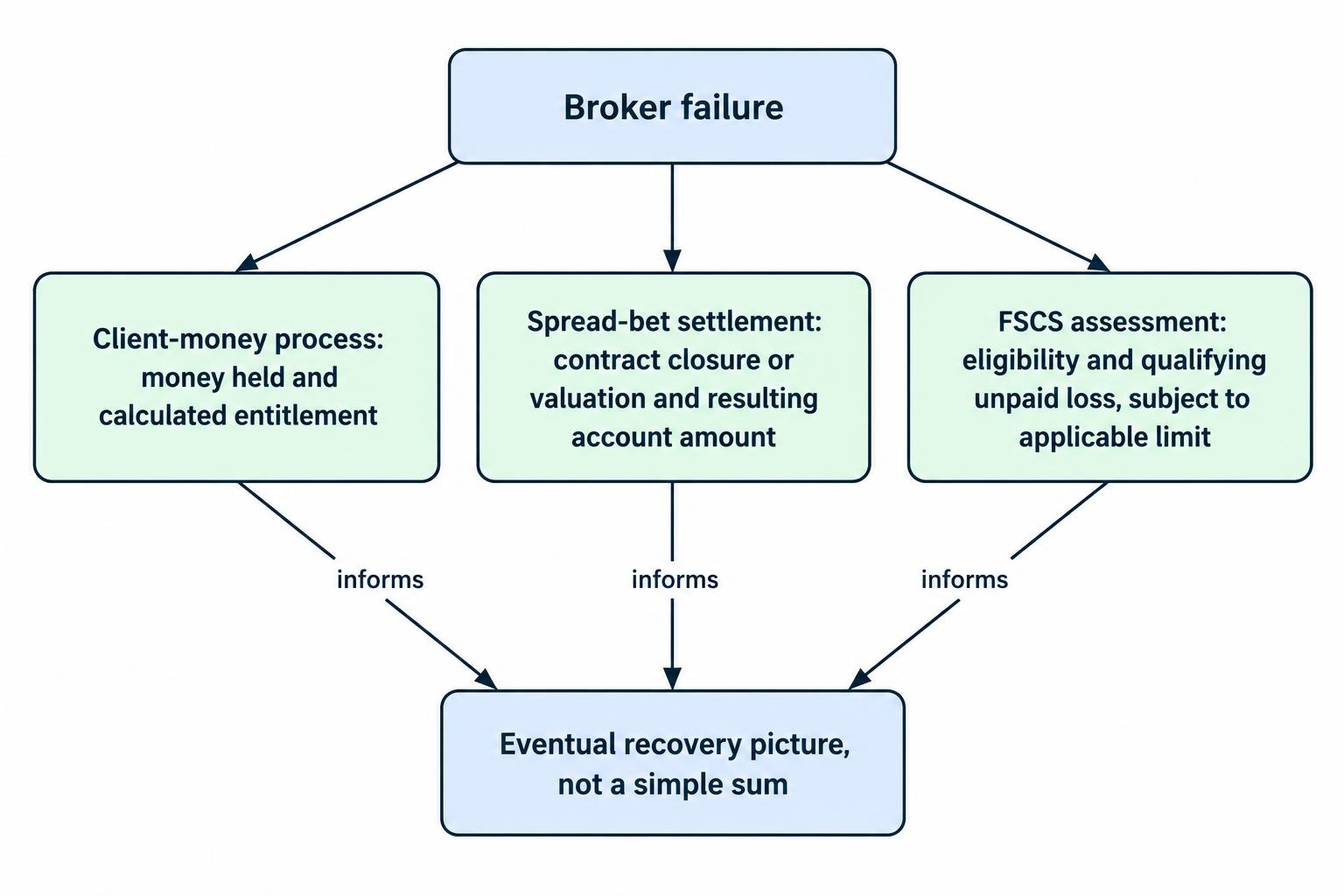
Three separate issues determine the outcome: the treatment of your client money, the settlement of your spread bets and any compensation available for an eligible loss. This article focuses on UK authorised firms. The wider framework is covered in our guide to UK spread betting regulation; an overseas account should not be assumed to carry the same protections.
What Happens Immediately After a Broker Fails?
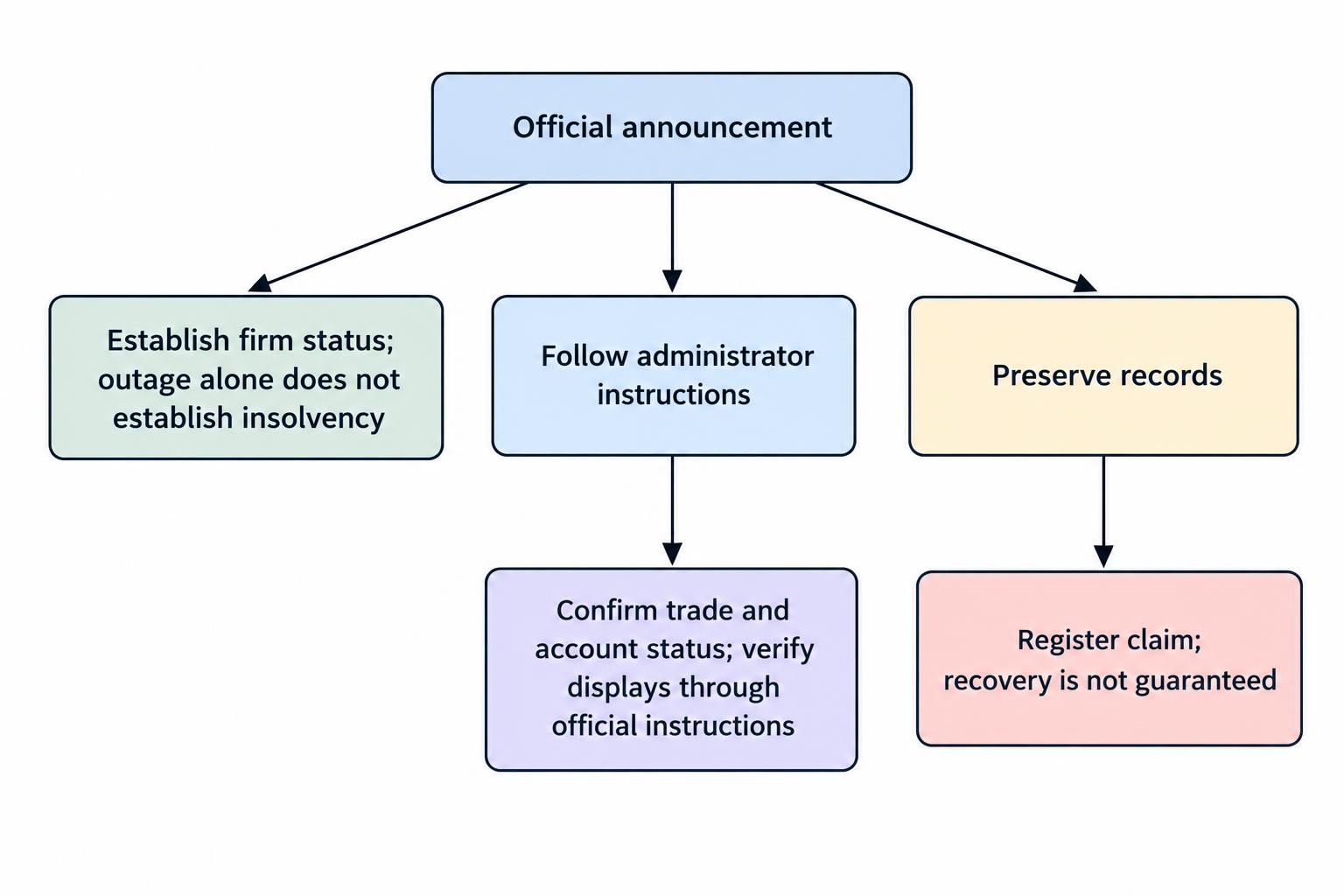
Start with the official announcement rather than the trading platform. Establish whether the firm has stopped trading, entered an insolvency procedure or become subject to restrictions. A platform outage alone does not establish that a broker is insolvent, and a failed withdrawal does not tell you how much money will eventually be recovered.
Where an insolvency practitioner has been appointed, look for instructions covering account access, open positions, claims registration and future updates. Do not assume that an earlier withdrawal request has completed, that a pending order has been cancelled or that a position remains open simply because it still appears on screen. Ask for confirmation and retain the response.
A relevant UK investment firm may enter the investment bank special administration regime. Despite its name, this procedure is not confined to familiar high street investment banks. Its statutory objectives include returning client assets as soon as reasonably practicable, engaging with market infrastructure bodies and authorities, and rescuing the firm or winding it up in creditors’ interests. Those objectives are set out in the Investment Bank Special Administration Regulations 2011.
The practical response is to separate urgent account questions from the eventual recovery calculation. Confirm what has happened to your trades, preserve your records and follow the appointed practitioner’s claims process. Repeatedly refreshing the withdrawal page will not resolve the reconciliation.
What Happens to Segregated Client Money?
Client money segregation separates money held for customers from the firm’s own money. Under the normal approach, client money must generally be received directly into a client bank account rather than first passing through the firm’s operating account. The FCA rules on segregation of client money establish this safeguard. It is a protection against firm failure, not a guarantee that every recorded balance will be available without delay or deduction.
Failure triggers the relevant client money distribution process. Under the applicable rules, money forms a notional pool, and distributions or transfers reflect customers’ calculated entitlements. If that pool cannot meet all the entitlements against it, customers may receive proportionate amounts rather than full repayment. The FCA rules on primary pooling events govern this process, including the calculation and offsetting of relevant balances.
This distinction matters: the obligation to segregate money and the amount actually available after failure are different questions. Ask whether the administrator has confirmed the client money position, whether a shortfall has been identified and whether the quoted recovery estimate includes costs. An early statement that funds appear intact is not the same as a final distribution calculation.
Our guide to spread betting client money rules covers the protection before failure. Once a firm has failed, concentrate on the administrator’s findings about the money actually held and your entitlement to it.
What Happens to Open Spread Bets?
A spread bet is a contract with the provider, not ownership of the shares, index constituents or commodity referenced by the bet. Do not expect an open FTSE 100 spread bet to become a parcel of investments that another provider can simply place in a custody account.
The immediate questions are whether your contracts have been terminated or closed, which valuation method applies, and how the resulting amounts enter your account calculation. Read the insolvency notice alongside the account agreement. Do not assume that the last platform quote is the valuation used for your claim, or that every customer’s contracts receive identical treatment.
Keep cash balance, floating profit or loss and final entitlement separate. As a simple illustration, suppose an account has £12,000 in cash and its positions are subsequently agreed to produce a £2,000 loss. Ignoring charges and other adjustments, the resulting balance is £10,000. The £2,000 trading loss is different from any later failure to return that £10,000.
A disputed valuation needs evidence. Save trade confirmations, order instructions, timestamps and correspondence about attempted closures. Explain the disputed transaction and amount rather than submitting only a screenshot of total equity. Our guide to calculating spread betting profit and loss helps separate the trading calculation from the recovery calculation.
Also avoid automatically recreating every position with another provider. First establish what exposure remains under the original contracts. A replacement trade could add exposure rather than replace it, and it requires a fresh assessment of risk and available capital.
When Can FSCS Compensation Apply?
The Financial Services Compensation Scheme may compensate eligible customers when a failed investment firm cannot return money or assets it owes them. Protection depends on the firm, the regulated activity and the claim meeting the scheme’s requirements. FCA authorisation alone does not establish that every service or loss is covered.
For investment firms that fail after 1 April 2019, the compensation limit is £85,000 per eligible person, per firm. A shortfall in money held for a customer may qualify; poor investment performance does not. These conditions appear in the FSCS investment protection requirements and limits.
Do not combine two different losses in your claim calculation. If trading reduced an account from £15,000 to an agreed entitlement of £9,000 before a return shortfall arose, the original £15,000 deposit is not automatically the amount recoverable through compensation. Identify what the firm owes you, what has been returned and what remains unpaid.
Check eligibility rather than guessing from a platform badge or account description. If the account belongs to a company, trust or another arrangement, ask how that ownership affects the assessment. Our guide to FSCS protection for spread betting accounts addresses the coverage questions in more detail.
The Limit Applies Per Firm, Not Per Account
Opening several accounts with the same legal firm does not create a separate investment compensation allowance for each one. Protected investment claims against the same firm are aggregated. The FCA compensation limit and aggregation rules set the maximum payment for this category of claim.
For example, two eligible shortfall claims of £55,000 and £45,000 against the same firm total £100,000. Splitting them between two account numbers does not turn the £85,000 maximum into £170,000.
Check the legal counterparty in your agreement, not just the brand displayed on the app. Two brands can leave you exposed to the same firm. Conversely, do not assume every company within a corporate group is the same legal counterparty. The useful starting point is our research on broker legal entities, followed by verification of your own agreement.
Worked Example: Returned Money and Compensation
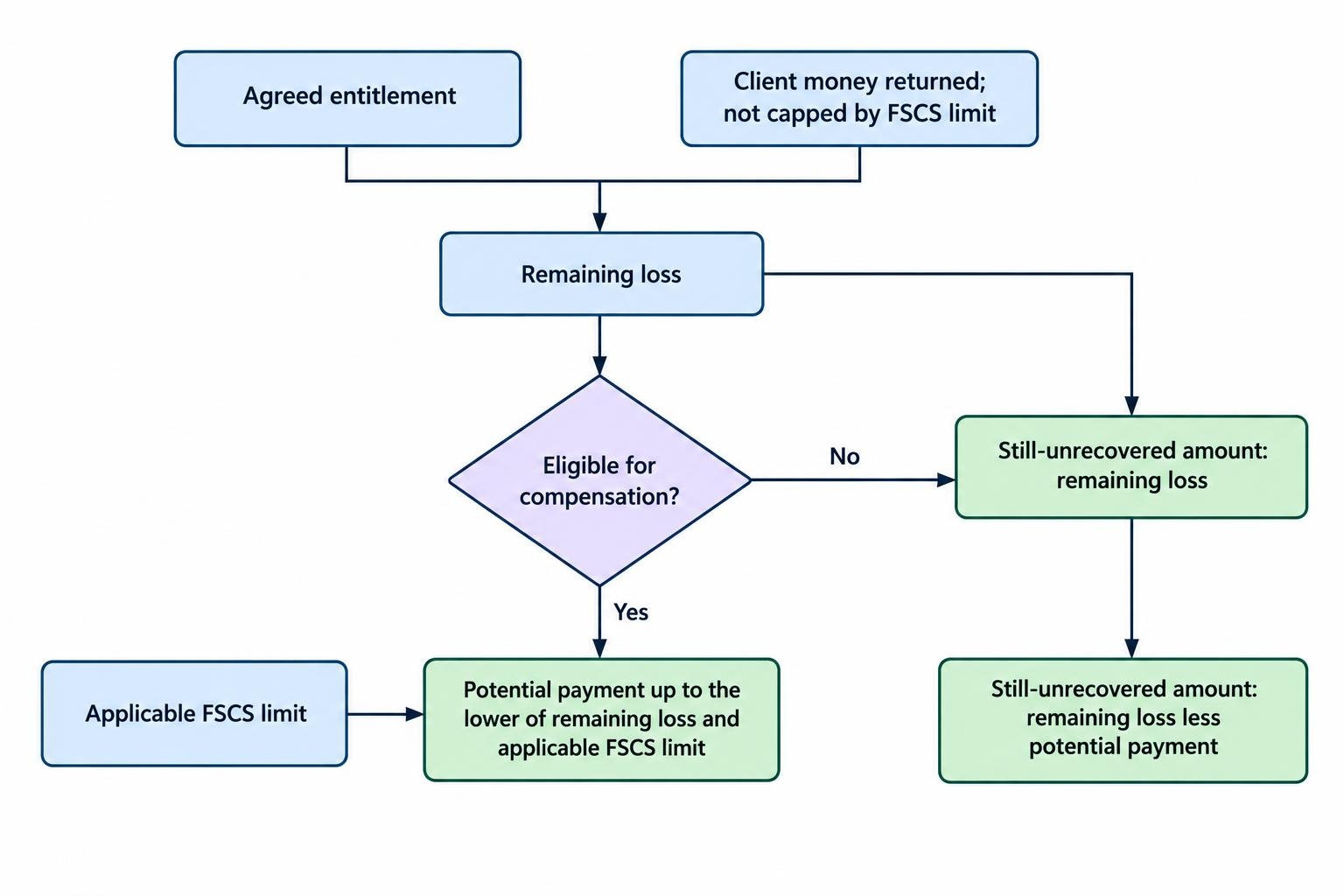
The following figures are hypothetical. Assume both customers qualify for compensation, have no other protected investment claims against the failed firm, and the stated returns already reflect relevant deductions. There are no further recoveries in this illustration.
| Agreed entitlement | Client money returned | Remaining loss | Potential FSCS payment | Still unrecovered |
|---|---|---|---|---|
| £10,000 | £6,000 | £4,000 | £4,000 | £0 |
| £120,000 | £24,000 | £96,000 | £85,000 | £11,000 |
The compensation ceiling is not a ceiling on the amount of client money that can be returned. Someone with a £120,000 entitlement could receive that entire amount from the client money process if sufficient money is available. Equally, a balance below £85,000 does not remove the need to establish eligibility and the actual loss.
Can Administration Costs Reduce the Amount Returned?
Yes. Returning client money and assets requires work, and relevant costs can affect customers’ recoveries under the special administration process. FSCS protection can cover eligible customers’ share of transfer costs and qualifying shortfalls, subject to the combined compensation limit. These are not separate allowances that can each generate an £85,000 payment.
In some cases, FSCS works directly with administrators and makes bulk payments rather than requiring every eligible customer to submit a separate claim afterwards. Its explanation of FSCS involvement in special administrations covers these arrangements and the assignment of customers’ recovery rights when compensation is paid.
Ask whether a published recovery percentage is before or after costs, whether compensation has been included and whether the figure is provisional. Also disclose payments already received. Do not treat an administrator’s distribution estimate and an FSCS estimate as two amounts that can automatically be added together.
How Long Does Getting Money Back Take?
Do not build a household or trading budget around immediate repayment. Historical UK special administrations have involved prolonged waits for client money distributions. A 2025 empirical study of client money returns in special administrations examined cases commencing between 2011 and 2021 and documented substantial delays. Those cases demonstrate the risk of waiting, not a timetable for a future failure.
For your own case, ask which stage has been reached: records reconciliation, agreement of customer entitlements, investigation of a shortfall, compensation assessment or preparation of a distribution. “The administrators are working on it” is less useful than knowing which unresolved issue stands between your claim and payment.
Keep three dates separate: when your entitlement is agreed, when a payment is expected and when the insolvency procedure itself ends. Ask whether an announced payment is an interim distribution or a final settlement. Do not infer from the continued existence of an administration that no money has been returned, or from one payment that nothing further remains to be resolved.
What to Do If Your Spread Betting Broker Fails
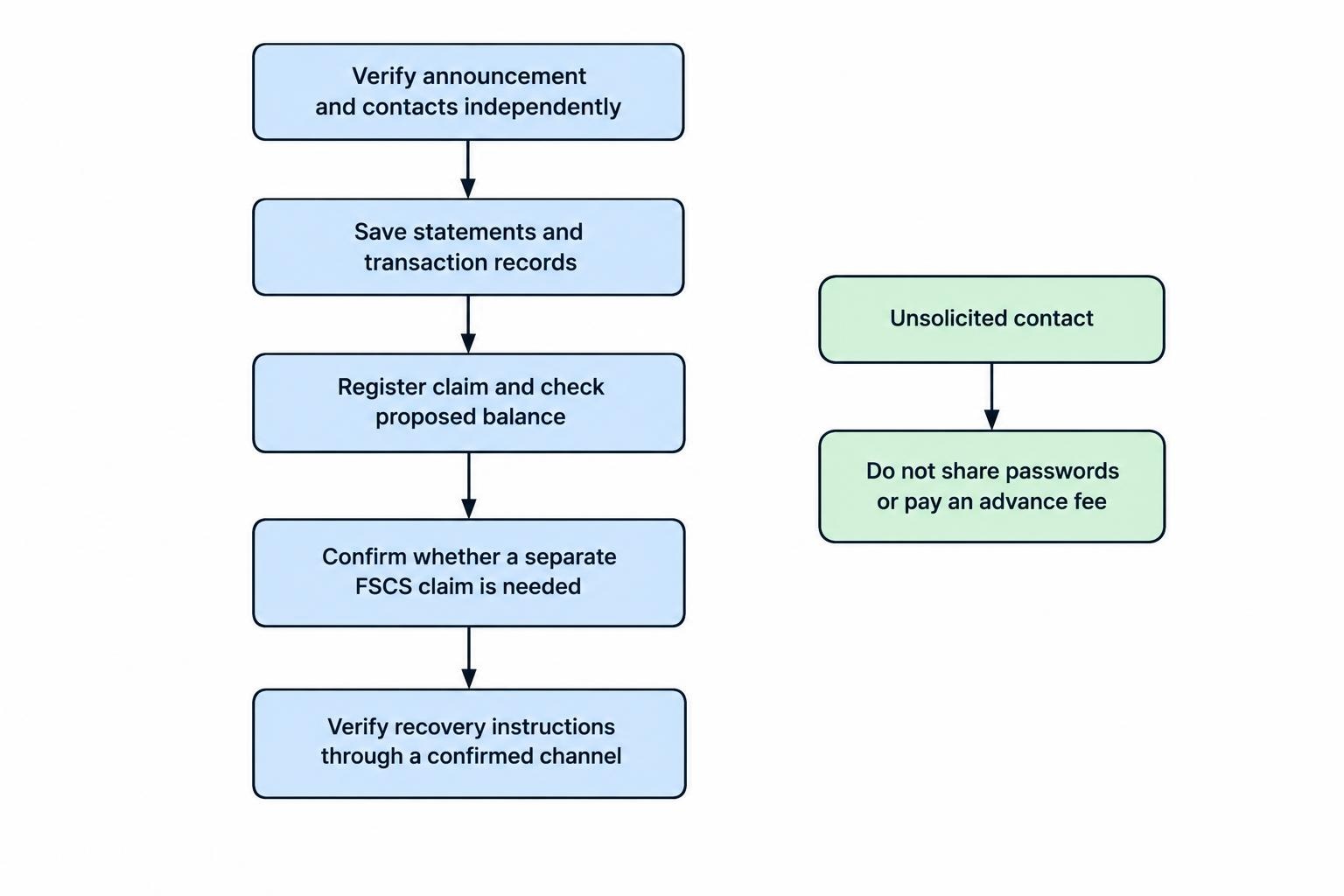
1. Verify the Announcement and the Contact Details
Check the exact company named in your account agreement against the official failure announcement. Confirm the appointed insolvency practitioner and obtain contact details independently. Avoid relying on a forwarded email, a social media account or a telephone number supplied by an unsolicited caller.
Our guide to checking a broker on the FCA Register covers how to identify the regulated firm. Keep a copy of the announcement and note when you accessed it, especially if instructions are being updated.
2. Preserve Records Outside the Platform
If account access remains available, download statements and transaction histories. Retain deposit and withdrawal records, trade confirmations, open position details, account agreements and correspondence about unresolved issues. Keep copies outside the broker’s app or message centre.
Use your records to build a short chronology: money paid in, money withdrawn, disputed transactions and the last balance you can substantiate. Our guide to spread betting account statements helps distinguish cash, equity, margin and charges. A clearly evidenced calculation is more useful than a large folder with no explanation.
3. Register Through the Official Process and Check the Balance
Follow the administrator’s instructions for identifying yourself and registering your entitlement. Before accepting a proposed figure, compare it with your records. If you disagree, identify the exact difference: a missing deposit, an uncompleted withdrawal, a disputed trade valuation or an unexplained charge.
Ask which figures are provisional and how disagreements must be submitted. Keep confirmation that your documents were received. Treat every stated deadline as urgent. If you have already missed one, contact the practitioner promptly and ask how your claim will now be treated rather than assuming it has vanished or remains unaffected.
4. Confirm Whether You Need a Separate FSCS Claim
Read the case instructions before submitting duplicate applications. Ask whether compensation is being arranged through the administrator, whether you need to apply separately and what evidence is still required.
FSCS is free to use, and paying a claims company is not a condition of receiving compensation. The FCA guidance on claiming after a financial firm fails sets out the contact route and explains that claims management companies charge fees. Consider paid help only after establishing what the official process requires and what assistance is already available.
5. Keep Recovery Instructions Secure
Verify any request to change bank details or make a payment through a previously confirmed contact channel. Do not provide a trading password, remote access to your computer or cryptocurrency to someone claiming they can release your balance.
Be particularly cautious about an unsolicited promise of faster recovery in exchange for an advance fee. Our guide to spread betting scams covers warning signs worth checking before responding. Keep suspicious messages, but do not use the contact details inside them to establish whether they are genuine.
Does Negative Balance Protection Help When a Broker Fails?
Negative balance protection addresses a different problem. For accounts covered by the UK retail rule, liability for the relevant speculative investments is capped at the funds dedicated to trading them. The FCA retail trading rules on negative balance protection define that protection. It is not insurance that repays a positive balance when a provider fails.
If an administrator presents a debit balance, request the calculation and check which rules and account classification apply before paying or accepting it. Do not assume that insolvency either establishes the debit as correct or makes the issue disappear.
Our guide to negative balance protection explains the account level distinction. A stop order or guaranteed stop also serves a different purpose from compensation for missing client money. Do not treat a trading risk control as a guarantee of the provider’s financial health.
How to Reduce Your Exposure Before a Failure
Keep emergency savings and money needed for ordinary expenses outside a trading account. Decide how much capital the account actually needs, allowing for planned positions, price movements and withdrawals. Avoid leaving a large surplus there simply because moving it requires an extra step.
Review the contracting company whenever an account is transferred, its terms change or you open another account under a related brand. If considering professional classification, ask for a written explanation of which protections change. Do not make assumptions about insolvency recovery or compensation from the label alone; our guide to retail and professional client classification covers the distinction.
Apply the same scrutiny to an overseas account. Verify its regulator, legal counterparty and any compensation arrangements before depositing. A familiar brand is not a substitute for checking the agreement. The separate guide to offshore spread betting brokers addresses those jurisdiction questions.
Finally, retain records while everything is working normally. Set a routine for downloading statements and reviewing the amount left with each provider. These habits form part of protecting trading capital, alongside controlling losses from the trades themselves.
If a failure occurs, work from the agreed entitlement, verified recovery estimates and the official claims instructions. Keep the trading loss calculation separate from the missing money calculation. That separation makes it easier to challenge errors, assess any compensation and understand what remains at risk.