A broker’s legal entity is the company named in your trading agreement, not necessarily the brand displayed above the login button. For spread betting research, that distinction comes before comparing spreads, platforms or market coverage. You need to establish who provides the account before assessing what that account offers.
The same research must separate corporate identity, regulatory permissions, client classification and potential compensation rights. A familiar name does not answer all four questions. Nor does a company number prove that a business has permission to provide financial services.
This article sets out an evidence based method for recording broker legal entities, with two verified corporate record examples. It forms part of our spread betting research and focuses on identifying the contracting company rather than ranking providers or reproducing a full regulatory guide.
Separate the Broker Brand from the Contracting Company
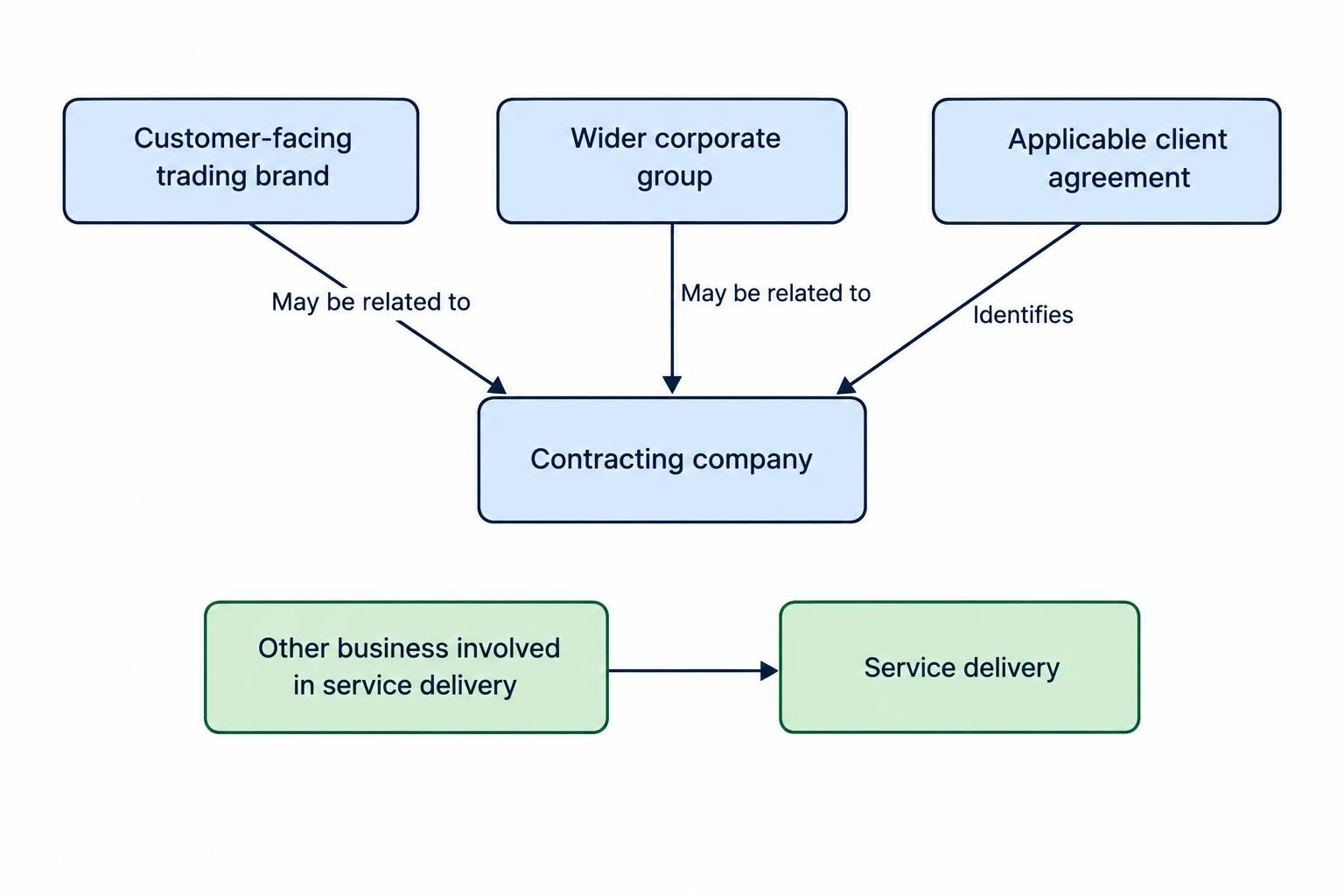
Start with four separate entries in your research notes: the trading brand, the contracting company, the wider corporate group and any other business involved in delivering the service. Do not combine them into a single “broker” field.
A trading name describes a name under which a firm conducts its business. Registering that name does not change another person’s regulatory status or give an unauthorised business permission to carry out regulated activities. The FCA requirements for trading names also distinguish a trading name from an appointed representative, which is a separate legal person.
For an account review, the practical question is straightforward: which company does the agreement identify as the provider of your spread betting service? Record the full name, including “Limited” or “plc”, rather than shortening it to the consumer brand.
Keep the group name in another field. If you want to rely on financial support from a parent company, look for evidence of that support and its terms. Do not use a group logo, consolidated accounts or stock market listing as a substitute for examining the contracting company.
The same discipline applies to platform names. Treat the application, charting package and payment interface as separate research entries until the documents establish their relationship to your account. The logo is useful for finding the app. It is less useful for identifying who owes you what.
Named Legal Entities: What Corporate Records Establish
The following examples use Companies House records checked on 21 October 2026. They illustrate corporate identity only. They are not recommendations, a live account allocation table or confirmation of regulatory permissions.
| Legal entity | Company number | Recorded company type | Recorded status |
|---|---|---|---|
| IG Index Limited corporate record | 01190902 | Private limited company | Active |
| CMC Markets UK plc corporate record | 02448409 | Public limited company | Active |
The records also contain previous company names. IG Index Limited’s record includes I.G. Index Public Limited Company, while CMC Markets UK plc’s record includes Currency Management Corporation plc. This is a useful reminder to record the company number alongside the name when reconciling older documents.
Neither row establishes which company would provide a new account offered to you. That requires the relevant agreement and regulatory checks. An “Active” corporate status should remain in the corporate status column; do not copy it into a column headed “FCA authorised”.
For the same reason, these examples do not assign firm reference numbers or account protections from corporate records alone. Leaving a field unconfirmed is better research than filling it with a plausible guess.
Build an Entity Record for Each Account
Use an account level record rather than a brand level summary. If you are comparing a spread betting account with a CFD account, create two entries even when both appear under the same brand. Merge them only after the evidence supports doing so.
The following structure works for a personal broker shortlist or a published comparison. Its purpose is to make each statement traceable, not to produce a large spreadsheet for its own sake.
| Field | What to record | Evidence to retain |
|---|---|---|
| Brand and product | The advertised brand and the exact account being examined | Account offer and application details |
| Contracting company | Full legal name and jurisdiction of incorporation | Applicable client agreement |
| Corporate identifier | Company number or overseas equivalent | Official corporate record |
| Regulatory identity | Regulator, firm reference number and recorded status | Official regulatory entry |
| Permissions | Relevant activities, restrictions and client money information | Detailed regulatory record |
| Client classification | Retail or professional status for the account | Classification notice and agreement |
| Protection and complaints | Applicable scheme statements and complaint respondent | Account disclosures and official scheme requirements |
| Timing | Document version, effective date and date checked | Dated copies and research notes |
Add a short evidence status beside each field: confirmed, unresolved or historical. Avoid a single green tick covering the whole company. Confirming a company number does not resolve a disagreement about the account provider.
Record the customer circumstances used in the review too. For a UK retail spread betting comparison, state that scope at the top of the record. Do not silently reuse an entry prepared for a different residence, product or client classification.
Match the Agreement, Corporate Record and Regulatory Entry
Start with the applicable agreement
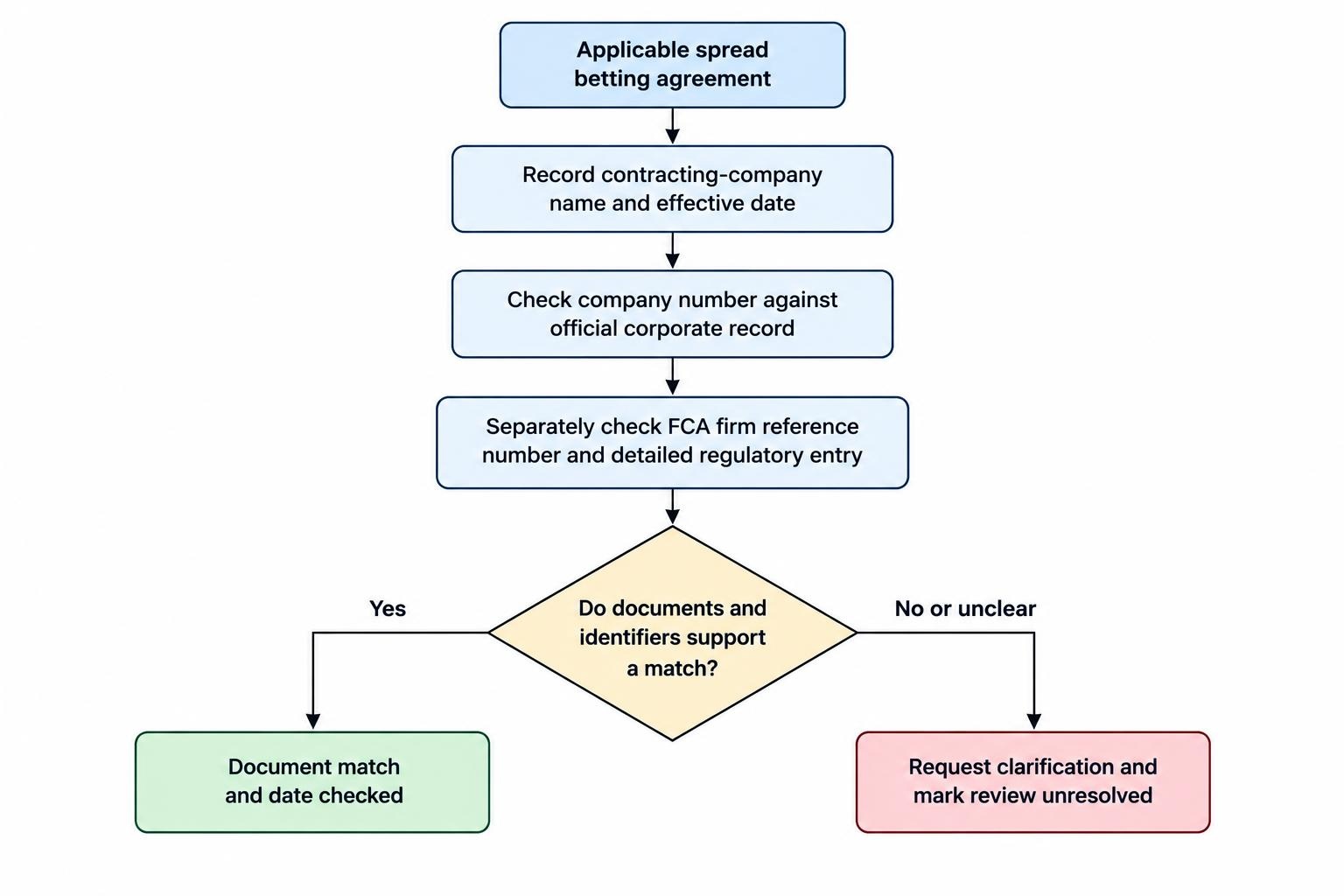
Find the section that identifies the parties and defines terms such as “we”, “us” or “the company”. Record the named provider and the agreement’s effective date. Check that the document applies to spread betting rather than another service advertised on the same site.
For an existing account, retain the accepted agreement and any later notices. A newly downloaded document is useful for comparison, but it should not replace the record of what you accepted without checking when the new terms became applicable.
For a proposed account, examine the documents presented during the application before funding it. Treat a general footer disclosure as a starting point, not the final answer to account allocation.
Use the identifiers for different purposes
Keep the company number and FCA firm reference number in separate columns. Use the corporate identifier to reconcile company records, including previous names. Use the regulatory identifier to locate and examine the relevant regulatory entry.
Do not search only for the shortest version of the brand name and accept the first result. Copy the full legal name from the agreement, then compare the identifiers and other recorded details. Where the documents disagree, preserve the disagreement in your notes.
The procedural checks belong in our guide to checking a broker on the FCA Register. For entity research, the output should be a documented match between the account provider and the regulatory record, not just a screenshot of a search result.
Record permissions separately from identity
Finding the named company is one task. Establishing whether the recorded permissions match the proposed service is another. Add separate fields for status, relevant activities, restrictions and the date of the check.
Read the detailed record rather than reducing it to “regulated: yes”. If a restriction or unfamiliar status affects your interpretation, leave the account review unresolved until you have clarified it. A comparison should not turn uncertainty into reassurance through tidy formatting.
Resolve conflicting documents before depositing
Suppose the application names Company A, the agreement names Company B and an email response refers only to the group. Do not choose whichever answer appears most favourable. Ask which company would enter into the spread betting agreement and request the document that supports the answer.
Keep the reply, but compare it with the formal account documents. A useful response identifies the legal entity, product and applicable terms. “You are covered by our global regulation” does not resolve the mismatch.
Check Jurisdiction and Client Classification Together
An entity record needs both the company’s jurisdiction and your client classification. These are separate questions, and neither should be inferred from the language of the site, the currency displayed or the location of a customer service team.
Overseas firms can use names similar to UK firms or share trading names with them. The account terms should establish the actual contracting entity and where it is incorporated. Moving to professional status or dealing with an overseas entity can also mean losing protections available to UK retail clients. These risks are addressed in the FCA investor information for CFDs and spread betting.
In your research, record the proposed account as a combination: legal entity, product, residence and classification. Do not describe a whole international group as having one protection package.
If an application offers professional classification, compare that proposal with the retail account in a separate record. Our guide to retail and professional client classification covers that decision in more detail.
Apply the same separation to overseas account offers. Before assessing prices or trading conditions, establish which legal entity would provide the service and which protections the documents say apply. The related guide to offshore spread betting brokers covers the broader jurisdiction risks.
Record Client Money and Compensation Evidence Separately
Do not collapse client money arrangements and compensation eligibility into a single “funds protected” statement. Give each its own evidence field and leave room for qualifications.
Client money documentation
Extract the relevant account disclosures rather than relying on a marketing phrase. Note which company provides the account, what the agreement says about handling money and whether any separate firms are identified.
Where the documents mention a bank, distinguish that bank from the broker. Ask what role each business performs and which failure scenario each disclosure addresses. Do not copy a bank protection statement into the broker protection field without examining its relevance.
The purpose here is to map the evidence, not to reproduce the rules governing every arrangement. Our guide to spread betting client money rules covers that subject separately.
FSCS eligibility
FSCS eligibility is not established by a brand name or company registration alone. Its requirements include a failed financial firm, the relevant authorisation and regulated activity, a loss and a legal liability owed to the claimant. Check the FSCS compensation eligibility requirements against the account circumstances rather than treating membership language as an unconditional promise.
Record any account statement about FSCS protection word for word in your private research file, alongside the document date. Then record what remains unconfirmed. This avoids turning a qualified disclosure into an absolute claim when writing a broker comparison.
The investment compensation limit
For investment firms that failed after 1 April 2019, the published limit is up to £85,000 per eligible person, per firm. Coverage depends on the product and claim; FSCS does not compensate for ordinary poor investment performance. These qualifications appear in the FSCS investment protection requirements and compensation limits.
The “per firm” wording matters when comparing brands. As an illustration, two otherwise eligible investment claims of £60,000 and £40,000 against the same failed firm do not create a £170,000 limit because the accounts use different brands. Nor should the illustration be read as a forecast of the amount payable.
For the fuller account protection discussion, use our guide to FSCS protection for spread betting. Keep the entity record focused on identifying the firm and preserving the supporting disclosures.
Identify the Correct Complaint Respondent
Add the complaint respondent to the account record before there is a dispute. Record the company named in the complaints procedure, its contact details and any explanation of another firm’s involvement.
The Financial Ombudsman Service assesses whether the firm and activity fall within its jurisdiction. It also requires the correct respondent to be identified and asks businesses to explain responsibility where another firm or a business transfer is involved. Its jurisdiction requirements for firms, activities and complaint respondents make that distinction explicit.
For your evidence file, preserve the legal entity named on the account statement, the agreement in force and any transfer notices. Do not assume that the current brand owner answers every question about an earlier event.
Keep complaint handling separate from compensation research too. An entity record should identify the possible routes and their supporting documents, not promise that a complaint or claim will be accepted.
Measure Concentration by Entity, Not by Number of Apps
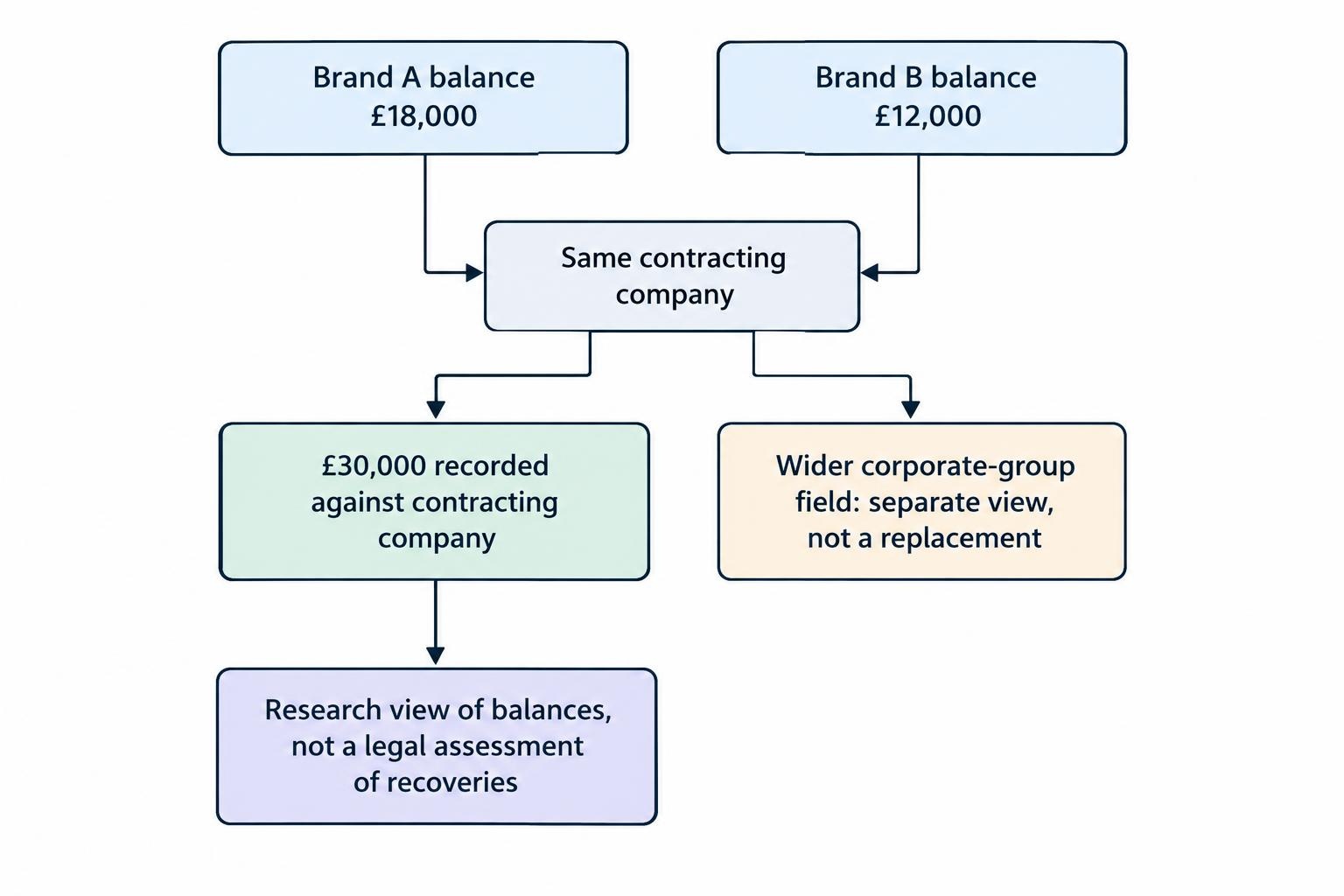
Consider a hypothetical trader with £18,000 at Brand A and £12,000 at Brand B. If the account documents identify the same contracting company, the trader should record £30,000 against that company in an entity exposure schedule. Two passwords are not two counterparties.
This calculation is a research view of balances, not a legal assessment of recoveries. Its purpose is to stop the brand presentation from hiding a shared provider.
Use a separate group column for accounts provided by different companies within the same group. That preserves two useful views: exposure to each contracting entity and exposure associated with the wider group. Do not merge the companies’ legal positions simply because the ownership is connected.
You can also note shared operational dependencies where evidence supports them. Keep those notes separate from legal identity. A platform dependency and a contracting relationship answer different risk questions, even if both matter to protecting trading capital.
Keep Broker Research Attached to the Entity Reviewed
Every broker comparison should state which legal entity and account its observations concern. This is particularly useful when a comparison includes fees, execution information or published risk disclosures.
For cost research, record the entity, product, tariff date and client category beside the price data. Do not combine a spread betting tariff with terms collected for another account and present the result as a single offer. Our framework for comparing total spread betting costs provides the separate cost analysis.
Apply the same rule to execution evidence. An entity name helps define the scope of the evidence, but it does not establish execution quality. Record the account and period covered before drawing comparisons in a broker execution quality review.
For any published loss rate, preserve the disclosure exactly as presented in your research notes, including its scope and date. Avoid relabelling an account disclosure as a figure for every customer across an international group. The broader interpretation belongs in our research on retail client loss rates.
This approach also improves updates. If the contracting company changes, you can identify which comparisons need rechecking rather than assuming every old finding still applies.
Recheck the Record When the Account Changes
Create a new dated entry when you receive a notice about a company name, account provider, classification or contractual change. Preserve the previous entry rather than overwriting it.
Check whether the notice describes a change of name, a different contracting company or another change to the service. Compare company identifiers as well as names, then record the stated effective date and the documents involved. Do not infer the legal effect from the subject line of an email.
Where a transfer is proposed, ask which company would be responsible before and after the stated date. Also ask which agreement would apply and whether the account’s protection disclosures would change. Keep any answer alongside the notice rather than replacing the original evidence.
A useful review trigger is any request to accept new terms, move to another entity or change client classification. Revisit the record before agreeing, not after transferring more money.
Leave Unresolved Entity Questions Unresolved
A broker research record should be clear about what has been established and what has not. “Unconfirmed” is a valid result when the documents do not support a reliable match.
Before treating an account as ready for comparison, check that you can answer these questions:
- Which legal company would enter into the spread betting agreement?
- Do its corporate and regulatory identifiers match the documents being reviewed?
- Does the regulatory record support the proposed service?
- What jurisdiction and client classification apply to this account?
- Which dated documents support the protection and complaints statements?
If the answers conflict, pause the funding decision and request clarification through independently verified contact details. Do not resolve missing evidence by borrowing information from another company in the group.
The finished record should let another reader follow the same evidence to the same company. That is the standard worth meeting before spreads, platform features or a welcome offer enter the discussion.