News trading with financial spread betting means using economic releases, central-bank decisions, company announcements or unexpected events as part of a trading decision. A trader might take a position before an announcement, respond to the first reaction or wait for a clearer opportunity afterwards. These are different approaches with different risks. The central difficulty is that the news, its interpretation and the executable price can change before the trader has finished reading the headline. A correct view of the announcement does not guarantee a profitable entry. This guide explains how news spread betting works, who it may suit, its advantages and disadvantages, and how to evaluate practical setups. All figures and market reactions in the examples are hypothetical rather than forecasts.
What is news trading in financial spread betting?
News trading links a position to information that may change expectations about an asset, a company or the wider economy. It can involve a scheduled release, such as inflation data, or an unexpected development, such as a profit warning or supply disruption. The objective is to benefit from the resulting price movement, but there is no single news-trading strategy. Predicting the announcement, following the reaction and trading a later reversal require different evidence and execution assumptions. Within financial spread betting strategies, news trading describes the catalyst being studied. A complete method still needs rules for the instrument, timing, entry price, position size, exit and conditions in which the event produces no trade at all.
Spread betting provides exposure through a stake per point without buying the underlying asset. A long position opens at the buy price and closes at the sell price; a short opens at the sell price and closes at the buy price. The difference between the executed prices, multiplied by the stake, gives the price profit or loss before separate charges and adjustments. The FCA includes spread betting within its supervision of contracts for difference and related products, which it describes as high risk. Around announcements, a position can lose through an incorrect interpretation, a reversal, a gap or an unfavourable fill. Knowing when information will be published does not establish either its content or the prices available once it arrives.
Why markets react to surprises rather than headlines alone
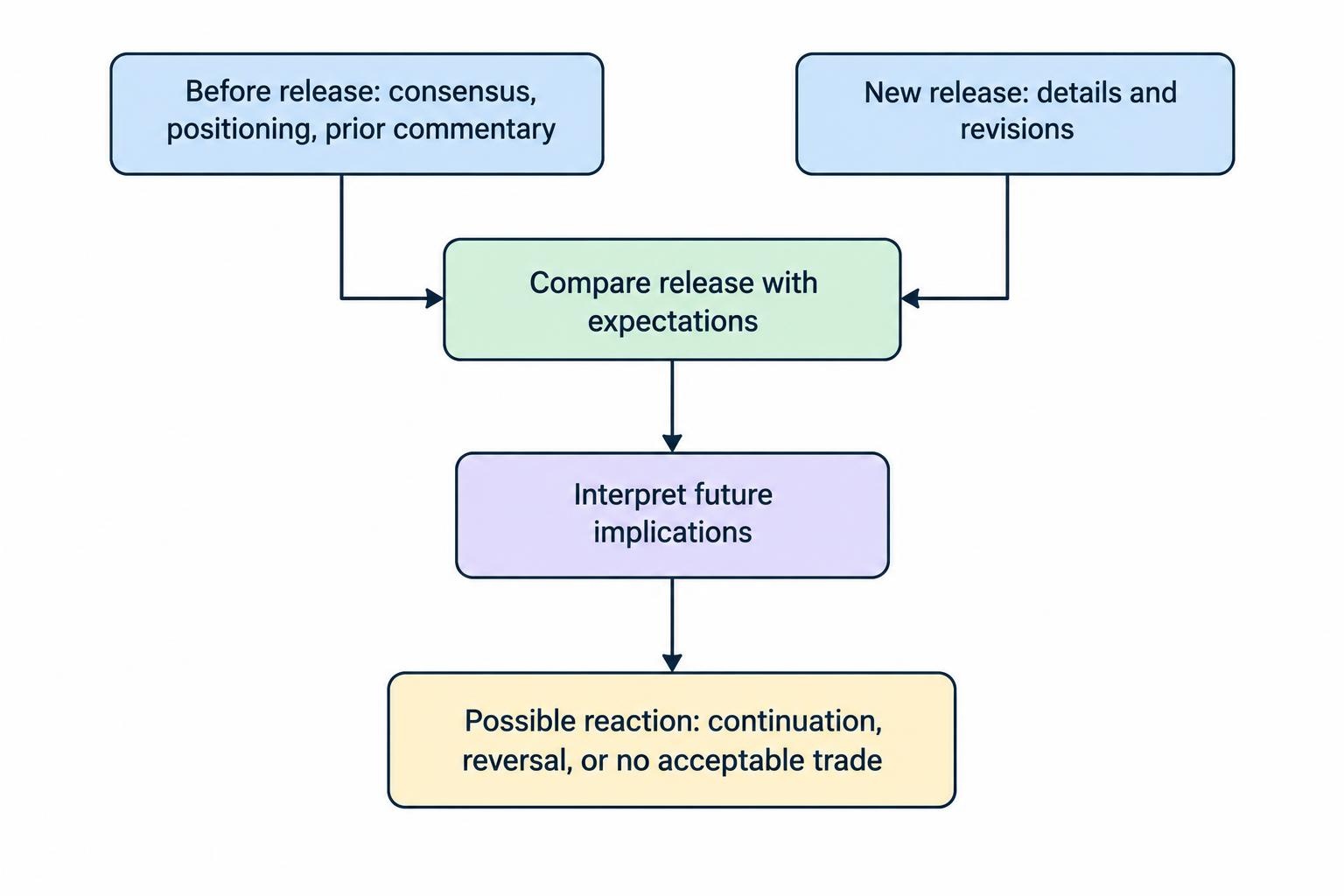
Markets respond to information in relation to what participants expected, what was already reflected in prices and what the release implies for the future. Suppose annual inflation falls from 3.4% to 3.2%, while a survey forecast was 3.0%. Inflation has slowed compared with the previous observation, but the new figure is 0.2 percentage points above that forecast. Describing it only as falling inflation misses the surprise. Even that comparison is incomplete: the composition of the release, revisions and implications for interest rates may matter. A currency could rise if participants infer tighter policy than previously expected, but that is a possible interpretation, not a dependable rule connecting every inflation surprise to a particular currency move.
The consensus figure on an economic calendar is usually a survey estimate assembled by that service or its data supplier, not an official forecast published as part of the statistical release. Different services can show different expectations because their contributors, timing and methods differ. Record the source and the version visible before the event rather than replacing it afterwards with a more convenient number. Expectations also extend beyond a single estimate: positioning, prior commentary and the range of forecasts can affect the reaction. A result matching consensus can still move the market, while an apparent surprise may produce little continuation. The task is to define what information the strategy uses, not assume that subtracting forecast from actual provides a complete trading instruction.
Scheduled announcements and unexpected news
Scheduled releases allow preparation because their intended publication time and subject are known. A trader can review the instrument, establish scenarios and decide whether to hold existing positions before the event. Unexpected news offers less control over timing and often arrives through fragments that require verification. An unscheduled corporate statement, geopolitical development or policy announcement may also occur while an underlying market is closed. The spread betting quote can move before the trader is able to act, and an existing protective order may not execute at its intended level. Keep these cases separate when evaluating a method. A process designed around a known release time should not be assumed to work equally well when an unverified headline interrupts an otherwise ordinary session.
Different events require different reading. A rate decision can be accompanied by a statement, voting details, forecasts and later comments; an earnings release can contain revenue, profit, cash flow and guidance that point in different directions. An employment report can contain revisions and several measures of labour-market conditions. The relevant question is which part changes the outlook for the instrument being traded. A broad index can react differently from one constituent, and a currency pair reflects the relative position of two currencies. There is no universal “good news means buy” rule. Identify the mechanism being proposed and what evidence would weaken it before treating the announcement as a reason to take exposure.
Building a reliable news calendar
Use an economic calendar to organise the session, then verify the event against the original publisher. For UK data, the Office for National Statistics release calendar identifies scheduled publications. The Bank of England’s monetary-policy pages provide policy information and links to announcement dates. US events can be checked through the Federal Reserve’s FOMC calendar and the Bureau of Labor Statistics CPI schedule. Confirm the date, time zone and current schedule rather than relying on a remembered weekly pattern. UK and US daylight-saving changes do not always occur on the same dates, and holidays or revised schedules can alter the timing. Your platform clock may also use a different time zone from the publisher.
| Event type | Original source to check | Information to examine | Example markets to study |
|---|---|---|---|
| UK economic data | ONS release calendar | Actual figures, definitions and revisions | Sterling pairs, UK indices and gilts |
| UK monetary policy | Bank of England | Decision, explanation and accompanying material | Sterling, gilts and UK equities |
| US monetary policy | Federal Reserve FOMC calendar | Statement and other meeting publications | Dollar pairs, US indices and Treasuries |
| US inflation | BLS CPI schedule | Headline and component measures | Dollar pairs, gold and US indices |
| US employment | BLS Employment Situation | Employment measures, wages and revisions. | Dollar pairs and US indices |
| US petroleum data | EIA Weekly Petroleum Status Report | Crude and product stocks, production and related data. | Crude-oil contracts |
| Company results | The issuer’s investor-relations announcements | Results, guidance and subsequent explanations | The company’s shares and related sectors |
The markets in the table are examples to investigate, not predictions of direction or evidence that every event will produce a tradable move. Read the primary announcement where possible and check its publication date before acting on a quotation or screenshot. A genuine old release can circulate as if it were new, while a short headline can omit the qualification that changes its meaning. A fast commentary feed may help organise information but should not become a substitute for knowing what the measure represents. Company reporting also requires checking whether numbers are reported or adjusted and which period they cover. The fundamental analysis guide develops this interpretation work beyond the immediate price reaction.
Who might news trading suit?
News trading may suit someone who can prepare scenarios, interpret information carefully and accept that the right decision may be to remain out of the market. The useful skill is disciplined evaluation under uncertainty, not simply reading headlines quickly. A trader needs to separate an interesting event from an obtainable entry and remain willing to reject a trade if the spread, stop distance or fill makes it unattractive. Scheduled events can help organise a defined trading window, but preparation includes cancellation and loss controls as well as entry rules. Someone who keeps records of what was expected, what was released and what prices were available can assess whether the process adds value rather than relying on memorable occasions when the market moved as anticipated.
It may be a poor fit for someone who finds fast price changes difficult to manage, trades around other interruptions or increases stakes when an event feels especially important. Beginners face the combined challenge of interpreting information and operating orders during unstable conditions. A slower approach after the release can provide more time to assess the situation, although it still needs testing and does not remove gap or reversal risk. A trader who depends on predictable withdrawals should not treat a busy calendar as a schedule of earnings opportunities. Many events will produce no acceptable setup. The ability to watch a large move without joining it is part of the method, especially when the only available entry arrives after the planned opportunity has already passed.
Advantages and disadvantages of news spread betting
A potential advantage is a clearly identified event around which to organise research, scenarios and review. Scheduled announcements let the trader decide in advance which instruments to observe and which conditions would justify action. News can also change expectations sufficiently to create movement beyond an existing range or to sustain a trend across several sessions. Spread betting permits long and short expressions, subject to contract availability and terms. These features can make the process structured and measurable. They do not establish an edge over other participants, and the existence of a catalyst does not guarantee that its effect remains available at an attractive price. The most dramatic part of a move may occur before the trader can reasonably execute.
The disadvantages include uncertain interpretation, rapid repricing, wider spreads and losses beyond intended stops. A release can contain conflicting information, and the first reaction may reverse as further detail appears. A position can also remain exposed to a later press conference or company call after the trader thinks the main announcement is over. Historical charts can make the opportunity look easier than it was by displaying a smooth candle without the intermediate quotes and execution difficulties. Frequent attempts to recover from a wrong first trade add costs and can concentrate exposure around one event. A viable process must therefore address the full sequence, including missed trades and failed reactions, rather than judge itself by the largest visible move after publication.
Three approaches to trading a news event
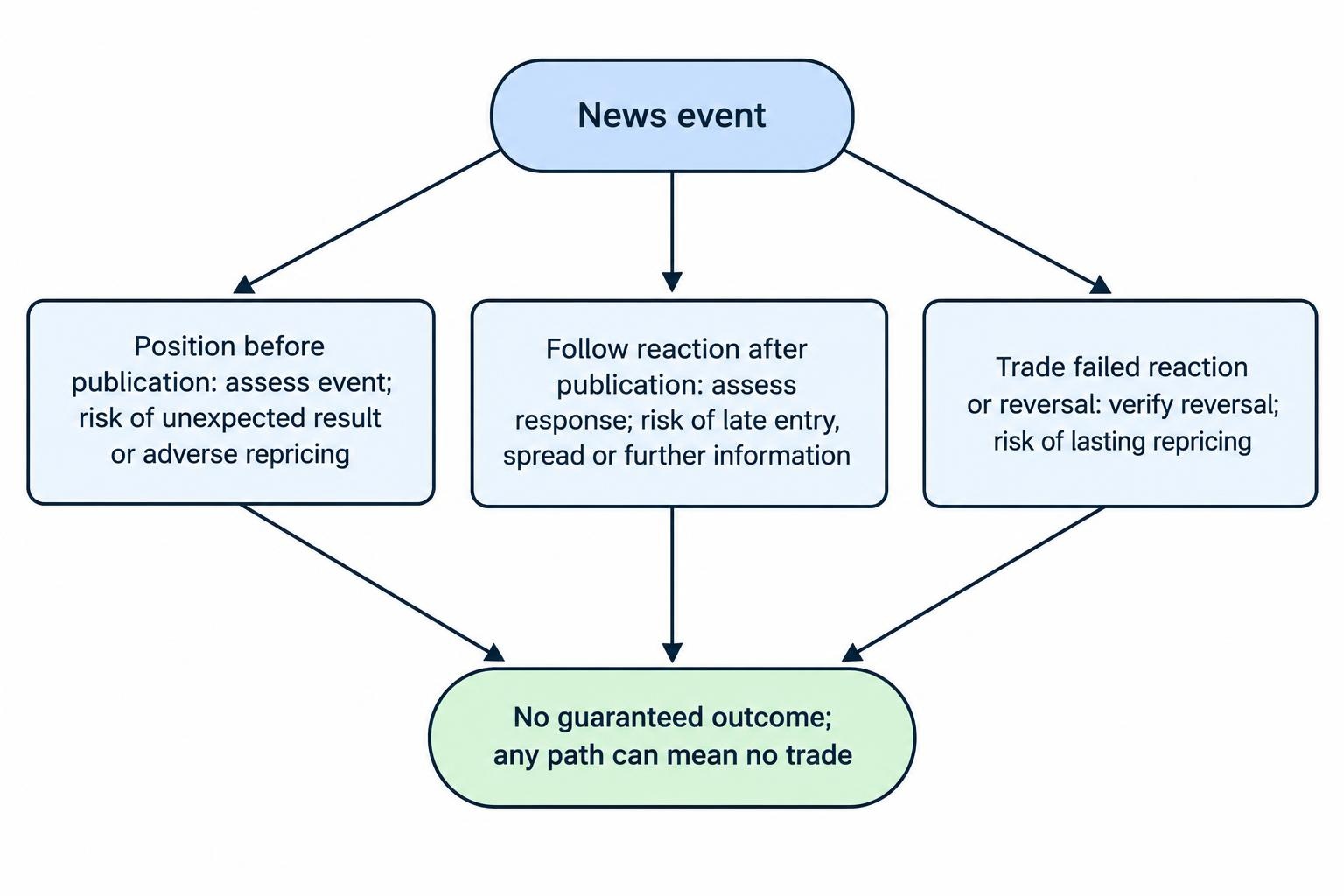
Taking a position before the announcement
A pre-announcement position expresses a view before the new information is public. That view might concern the likely result, the way expectations are priced or an anticipated change in positioning. The advantage is participation if the event moves immediately in the expected direction. The risk is that the release differs from the scenario or that the market reacts differently despite a correct forecast. Stops may execute beyond their intended level if the quote jumps. Define the total event exposure and the circumstances in which the position would be reduced or closed beforehand. An existing swing trade held through a release also becomes an event-risk decision, even if it was originally entered for an unrelated technical reason.
Following the reaction after publication
A post-release continuation method waits for the information and then looks for price behaviour consistent with further movement. It may require a defined period of observation, a consolidation or a renewed break in the reaction’s direction. The purpose is to make the entry conditional on what has actually happened, while recognising that the market may already have travelled a considerable distance. A fixed waiting period is not a guarantee of stable execution. Check the spread, available target distance and whether further information is due. Momentum trading and breakout trading can supply entry frameworks, but their news-event versions need separate evaluation because prices and fills may differ from those observed during ordinary sessions.
Trading a failed reaction or reversal
A reversal method looks for evidence that the initial response has failed, rather than assuming that a large first move must reverse. The trader might require price to return through a pre-defined level after the main details have been reviewed. This can overlap with mean reversion, but a sharp deviation alone does not establish that the old price remains relevant. The announcement may have permanently changed expectations. Define the evidence for failure, the entry and the point where the reversal idea is invalid. Selling merely because the market has risen a long way can mean standing directly against a lasting repricing. A convincing explanation after the event cannot replace a rule that was usable when the decision had to be made.
Practical example: buying sterling after an announcement
Suppose GBP/USD is quoted at 1.2500/1.2502 before a scheduled announcement. In this hypothetical scenario, the released information supports sterling, and the quote jumps to 1.2530/1.2538. The eight-pip spread exceeds the trader’s permitted entry spread, so no order is submitted. Later, the chosen continuation condition appears with a quote of 1.2534/1.2536. The trader buys at 1.2536 for £0.50 per pip, with the contract defining a pip as 0.0001. An intended stop sale at 1.2506 gives 30 pips or £15 of planned price risk. The target is a closing sale at 1.2596, offering 60 pips or £30. This illustrates a conditional entry, not a rule that this announcement must strengthen sterling or that waiting ensures safety.
If the closing sale fills at 1.2596, the price profit is £30. An early exit under a failed-continuation rule at 1.2530 loses six pips, or £3. A stop filled at 1.2506 loses £15, while a gap producing execution at 1.2486 loses 50 pips, or £25. These are alternative outcomes for the same entry. The example assumes closure before the relevant overnight funding cut-off and no separate charges or adjustments. The spread is already included in the actual opening buy and closing sell prices. None of the movement from the pre-announcement quote to the entry belongs to this trade’s profit. That earlier move explains the setup, but it was not captured by the position that actually opened.
| Alternative outcome | Actual closing sell price | Movement from 1.2536 entry | Price profit or loss at £0.50 per pip |
|---|---|---|---|
| Target reached and filled | 1.2596 | +60 pips | +£30 |
| Early exit after continuation fails | 1.2530 | −6 pips | −£3 |
| Stop fills as planned | 1.2506 | −30 pips | −£15 |
| Stop slips during a sharp reversal | 1.2486 | −50 pips | −£25 |
An entry arriving later at 1.2566 would change the same stop-and-target plan considerably. The distance to the 1.2506 stop would be 60 pips, while the remaining distance to the 1.2596 target would be 30 pips. At £0.50 per pip, planned price risk becomes £30 and potential price profit becomes £15. The original relationship has reversed, even though the trader’s interpretation of the announcement has not changed. Reducing the stake lowers the amounts without improving that relationship. Moving the target farther away simply to repair the arithmetic introduces a different expectation. A news strategy needs an explicit response to late entries and missed opportunities. Being correct about the direction is not permission to accept any price.
Practical example: selling a share after company news
Suppose a hypothetical UK share traded near 700p before disappointing company guidance. After the announcement it is quoted at 620p/626p, then later at 618p/620p when the trader’s short-entry conditions are met. The trader sells at 618p for £0.50 per penny, with an intended stop purchase at 648p. That 30-point distance gives £15 of planned price risk. If the decline continues and the position closes at a buy price of 558p, the 60-point gain produces £30. Assume £2 of financing and £1 of borrowing charges apply, with no dividend or other adjustment during this hypothetical holding period. The net profit is £27. The earlier decline from around 700p was not captured by this position.
If later commentary changes the interpretation and the share gaps higher, a closing purchase at 670p produces a 52-point loss, or £26, before carrying costs. This exceeds the planned £15 price risk. Company news can also coincide with trading interruptions, changes in available quotes or restrictions affecting the contract. An out-of-hours spread betting price should not be assumed to offer the same execution conditions as the main underlying session. Check the point value, borrowing terms and stop-trigger reference before trading. A short closes at the buy price, so a sell-price chart touching the target does not establish that the required purchase was available. The actual fills and adjustments determine the result, rather than the distance between two attractive points on the chart.
Why placing orders on both sides is not a guaranteed solution
Placing a buy stop above the market and a sell stop below it is sometimes presented as a way to avoid predicting the announcement. It replaces one uncertainty with others. A fast move can trigger an order beyond the intended price, then reverse through the other side before the trader responds. Two unlinked orders can both execute, while linked orders depend on the platform’s cancellation rules and how rapid price changes are handled. Confirm what an opposite order does to an existing position under the account’s dealing arrangements. It may close exposure or create another position, depending on the setup. This arrangement does not guarantee capturing the winning direction, and an ordinary stop-entry order does not enforce a maximum loss or an exact entry price.
Market and ordinary stop-entry orders seek execution without guaranteeing the displayed or trigger price. Limit and stop-limit orders impose price restrictions but may remain unfilled if the market moves beyond them. Neither type makes a news event predictable. A strategy needs to specify whether missing a trade or accepting execution uncertainty is compatible with its tested behaviour. Read the execution policy, identify the bid or offer used for triggering and understand how attached exits behave after a slipped entry. If a maximum spread is part of the method, establish how it is enforced. An unattended order without that condition can activate during quote widening even when the trader would have rejected the same trade manually.
Stops, gaps and guaranteed exits
An ordinary stop-loss is not an assurance of execution at its stated level during a gap or rapid repricing. The loss may exceed the planned distance between entry and stop. A stop-limit exit adds an execution-price restriction, which can leave the position open when no permitted fill is available. A guaranteed stop, where offered, provides a contractual exit under its terms, but premiums, minimum distances and rules on placing or changing it around events must be checked. The guaranteed stops guide explains the distinction. Choose the order protection and exposure before the event rather than assuming an adjustment can be made in the final seconds. Protection attached to the trade still needs to fit the contract and the method’s cost assumptions.
Planning the whole event, including later information
The event may not end with the first headline. The Federal Reserve’s meeting calendar links statements and other meeting material, while the Bank of England explains its policy announcements and supporting publications. For a trading plan, distinguish the decision itself from later explanation, questions or additional documents. Company results can likewise be followed by commentary that changes the interpretation. Decide whether the position may remain open through each stage and what would cancel the original scenario. A trade based on the first reaction should not silently become a bet on a later communication. Mark other releases due nearby as well, because price movement cannot always be attributed cleanly to the event initially being watched.
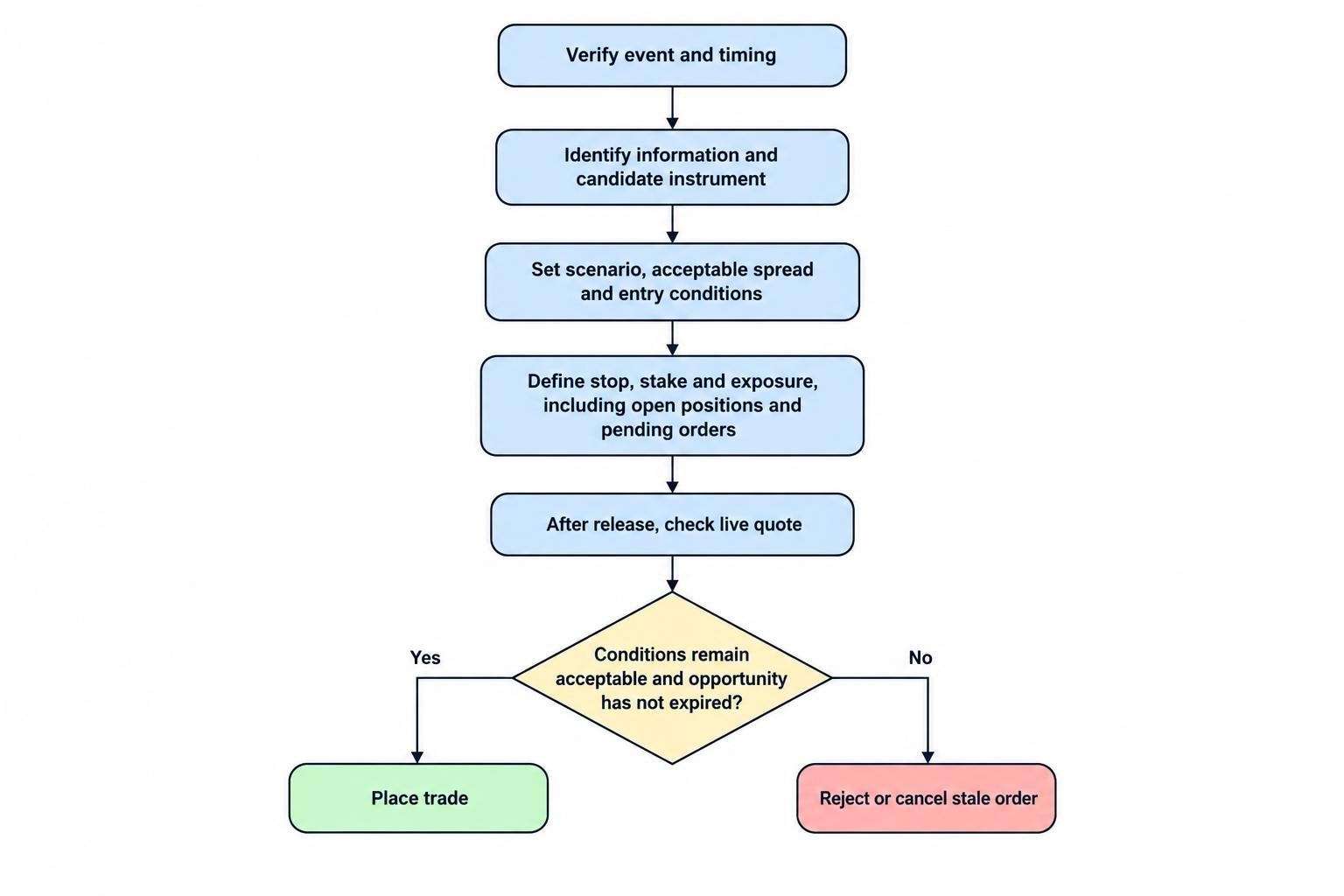
A practical event plan states the information being studied, the candidate instrument, the acceptable spread and entry area, the initial stop and the conditions requiring no trade. It also sets an expiry for the opportunity: a setup intended for the first part of the reaction should not remain active indefinitely. Include a response to lost connectivity and verify which protective orders remain active if the device disconnects. Review existing positions and pending orders, because they may carry the same event exposure even if no new trade is planned. After the announcement, reassess the actual quote rather than applying the pre-event stake automatically. A wider defensible stop or poorer fill can make the original position size inappropriate.
Position sizing, margin and correlated news exposure
Calculate the stake from the planned price-risk allowance and intended stop distance, then examine worse execution scenarios separately. A £20 allowance divided by a 40-pip stop gives £0.50 per pip. If the actual distance becomes 80 pips at the same stake, planned price risk rises to £40. These figures demonstrate sizing arithmetic, not recommended allowances, and neither calculation caps a gap loss. The position sizing guide should be used alongside an assessment of the event’s execution risks. Quiet conditions immediately before publication are not evidence that the same stop distance will remain appropriate afterwards. Historical average volatility also does not establish the maximum movement that the next announcement can produce.
Under FCA retail rules in COBS 22.5, minimum initial margin includes 3.33% for major currency pairs, 5% for major stock indices and 20% for individual shares; firms can require more. In the share example, 618 points multiplied by £0.50 gives approximately £309 of exposure, requiring £61.80 at an assumed 20%. That is separate from the £15 planned price loss. The rules also provide account-level close-out when net equity falls below 50% of required margin, as soon as market conditions allow, and negative balance protection for relevant retail accounts. These protections do not preserve deposited funds or guarantee an individual stop price. Enough margin to open a position does not establish that its event exposure is affordable.
One announcement can affect several open positions simultaneously. Multiple dollar pairs may express the same view on US policy, while equity indices and individual shares can share exposure to one change in risk appetite. Adding another ticket does not necessarily diversify the event. Assess a common adverse scenario and the combined effect of gaps or wider spreads, rather than treating each intended stop as an independent limit. Set a loss allowance for the sequence of attempts around the release as well. Repeated entries after a failed first reaction can turn a small planned trade into much larger event exposure. The risk management guide covers correlation, losing streaks and drawdown at account level, where these effects ultimately appear.
Costs and the decision to hold beyond the session
The cost of a news trade includes more than the advertised minimum spread. Actual entry and exit spreads, slippage and any separate charges affect the result, while positions held beyond the relevant cut-off can accumulate funding. The FCA’s review of CFD providers’ price and value, covering spread bets and related products, examines costs beyond the headline spread and differences in financing practices. Compare daily funded and dated contracts using the intended holding period and expiry arrangements. A forward quote may incorporate financing rather than remove its economic cost. Share positions can also involve borrowing and dividend adjustments. A failed intraday trade should not become an overnight position without reassessing those costs and the additional event exposure.
How to get started with a news-trading process
Begin by observing one type of scheduled event and one market, rather than trying to trade every item marked as important on a calendar. Learn the release’s definitions, accompanying detail and possible revisions, then record how the available quote behaves before and after publication. Write scenarios that include conflicting information and no-trade outcomes. Before choosing an account, follow the FCA’s guidance on checking that a firm is authorised and genuine, including permissions and contact details. Read the contract specification and execution policy, especially order handling around volatile conditions. Authorisation does not establish strategy suitability or profitability. The account must support the intended order controls, position sizes and product requirements before any observed setup can become a practical method.
Use a demonstration environment to practise the whole process, including cancelling stale orders, rejecting expensive entries and closing a trade when the reaction fails. A simulated fill at the trigger price is not evidence that the same execution would be available during a live announcement. Record the signal timestamp, quote observed, instruction submitted and execution received where the platform makes those details available. Simulated losses also do not reproduce the pressure of a real position moving sharply. Progress should depend on understanding these differences and producing an interpretable record, rather than a few profitable practice events. If a live evaluation is appropriate, a suitably small stake can help investigate execution without treating the exercise as a dependable income source.
How to test a news strategy without hindsight
A fair test needs the release as it first appeared, the forecast available beforehand and executable prices at the times when decisions could have been made. Later revised data can change the apparent size or direction of a surprise, so the latest database value may not represent what traders saw on the day. A one-minute candle also cannot establish that an entry and exit were both obtainable in the assumed order. Include publication and observation delays, spread widening, rejected or missed orders and slippage. Separate event types rather than combine unrelated announcements solely to enlarge the sample. Record no-trade decisions as well, because a method that filters difficult events must be assessed on the opportunities it actually permits.
Review results across multiple events and different market conditions, keeping the rules fixed during the evaluation period. Ten trades around one announcement are not ten independent tests of how the method behaves across releases. Examine average net wins and losses, drawdown, losses beyond intended stops and how much the result depends on a few exceptional events. As an illustration, five £30 price winners and five £20 price losers produce £50 before separate costs. If execution problems increase the average loser to £35, the same five winners and five losers produce a £25 loss. These assumptions demonstrate sensitivity, not a typical return. A strategy needs evidence about executable outcomes, rather than just a record of whether the initial market direction matched the forecast.
UK tax treatment of news-trading spread bets
HMRC’s Business Income Manual states that a person placing a spread bet is not normally carrying on a trade, with profits not taxable and losses not relieved under that normal treatment. Its guidance on spread betting exceptions explains that the contract and economic substance matter, including whether winnings arise from carrying on an existing trade. A news-trading label does not itself determine the tax position. Residence, individual circumstances and company arrangements can require separate consideration. Tax treatment should be assessed alongside the product’s costs and risks. It does not make a release easier to interpret or an entry easier to obtain, and the normal absence of loss relief remains relevant when the method loses money.
Building a news strategy around decisions you can execute
A workable news-trading process connects a defined event and interpretation with an entry that can actually be obtained, a suitable stake and an exit that remains relevant when the reaction changes. It also explains when to cancel orders, avoid the first move or stop trading the event altogether. The trader’s task is not to capture every headline-driven candle. It is to determine whether a repeatable set of decisions produces worthwhile results after the costs and uncertainty of execution are included. Keep records of the information available at the time, rather than rewriting the explanation after seeing the outcome. A convincing forecast is useful only when it leads to a trade whose entry, exposure and possible losses still make sense at the prices actually available.