Momentum trading with financial spread betting means taking positions in the direction of an observed price move, expecting further movement before the opportunity fades. A trader might buy an index showing sustained strength, sell a share whose decline is continuing or compare markets to identify stronger and weaker performers. The challenge is that a fast move can be close to exhaustion by the time it attracts attention. A correct observation about recent strength does not guarantee an attractive entry at the current quote. This guide explains how momentum spread betting works, who it may suit, its advantages and disadvantages, and how to develop a practical process. All numerical examples are hypothetical and illustrate mechanics and risks rather than promised returns.
What is momentum trading in financial spread betting?
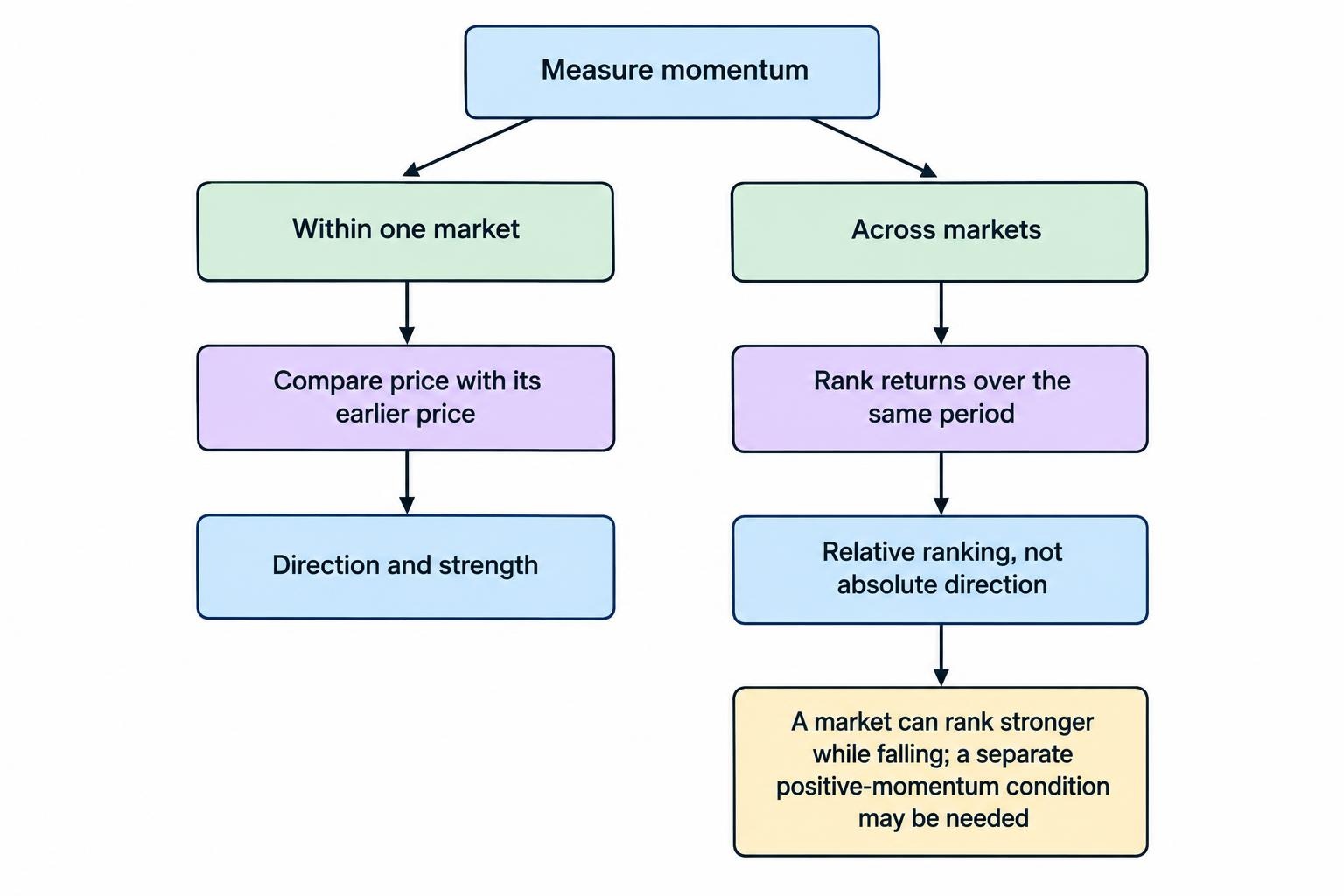
Momentum describes the direction and strength of price change over a defined period. A method may measure an instrument against its own earlier price or compare its performance with other instruments. The trading idea is that the measured behaviour may continue long enough to produce a worthwhile result after costs. It does not require prices to accelerate continuously, and it does not mean buying anything that has just risen sharply. Within [financial spread betting strategies](/spread-betting-strategies/), momentum is a basis for selecting or timing exposure. A complete strategy still needs a market universe, observation period, entry trigger, position size and exit rules. Without those details, two traders describing themselves as momentum traders may be doing very different things.
Spread betting translates the view into a stake per point without ownership of the underlying asset. A long position opens at the buy price and closes at the sell price; a short opens at the sell price and closes at the buy price. The difference between those executed prices, multiplied by the stake, gives the price profit or loss before separate charges and adjustments. The FCA includes spread betting within its supervision of contracts for difference and related products, which it identifies as high risk. Following a strong market does not remove that risk. A reversal, an unfavourable fill, excessive exposure or holding costs can turn an apparently convincing signal into a loss. www.fca.org.uk
Two different ways to measure momentum
Momentum within one market
An instrument’s own price history can provide a simple momentum measure. If an index rises from 10,000 to 10,300 over the chosen observation period, its price return is 3%, calculated as the new price divided by the earlier price, minus one. A method might require that return to exceed a threshold before considering a long position. The period and threshold define the signal: a move over ten minutes is not equivalent to the same percentage change over ten weeks. Stronger momentum also does not require every candle to move in the same direction. Pullbacks can occur while the measure remains positive. Specify the data, calculation and timing so that the rule can be reproduced without selecting a favourable starting point afterwards.
Relative strength across several markets
A relative-strength method ranks instruments over the same observation period and looks for opportunities among stronger or weaker performers. That ranking is different from the Relative Strength Index indicator, despite the similar wording. It also does not establish absolute direction: a market down 3% is stronger than one down 8%, but both have fallen. A strategy that buys the strongest market may therefore need a separate condition requiring positive momentum if it intends to avoid buying declines. Compare consistent percentage returns rather than raw point changes, and account for differences such as dividends, contract adjustments and volatility. The ranking helps select candidates; it does not by itself determine whether their spread betting quotes, stop distances and carrying costs make a trade worthwhile.
Momentum versus trend trading, breakouts and mean reversion
[Trend trading](/spread-betting-strategies/trend-trading/) generally seeks to participate in an established direction, while momentum methods may place more emphasis on the magnitude, persistence or relative strength of recent movement. The categories overlap considerably. A [breakout](/spread-betting-strategies/breakout-trading/) can provide an entry trigger for a momentum position, but a move beyond resistance is not the only way to identify strength. A pullback followed by renewed movement may also qualify. [Mean reversion](/spread-betting-strategies/mean-reversion/) starts from a different expectation, seeking a return towards a reference after a deviation. Neither approach wins simply because its explanation sounds plausible. The relevant question is whether the complete method has produced credible results under the intended market conditions, costs and execution assumptions.
| Approach | Main observation | Possible entry | What can go wrong |
|---|---|---|---|
| Momentum trading | Strong or persistent recent movement | Continuation signal in a stronger or weaker market | Strength fades or entry arrives too late |
| Trend trading | An established directional structure | Pullback or trend-following signal | The trend reverses or becomes choppy |
| Breakout trading | Price crosses a defined boundary | Entry beyond support or resistance | The break fails and price returns |
| Mean reversion | Price has deviated from a reference | Entry expecting a partial return | The deviation persists or the reference changes |
The holding period is a separate decision. Momentum can be used within [day trading](/spread-betting-strategies/day-trading/), where positions close during the session, or [swing trading](/spread-betting-strategies/swing-trading/), where exposure continues across several sessions. A longer-term method may use a slower ranking and less frequent adjustments. The chosen horizon changes the meaning of the signal and the balance between spread costs, financing and event risk. Do not assume that evidence for one horizon applies to another. A daily-chart setup also should not be managed solely through reactions to a one-minute indicator unless that combination forms part of the rules. Otherwise, the trader may repeatedly exit ordinary fluctuations while still believing they are testing a longer-term momentum method.
Who might momentum trading suit?
Momentum trading may suit someone who can act on a prepared rule without needing to buy near a recent low or sell near a recent high. Joining an established move often means accepting a price that already looks expensive or cheap relative to where it was earlier. The trader needs to distinguish that discomfort from a genuine deterioration in the trade’s potential. A useful temperament combines patience while waiting for qualification with willingness to reject an entry that has moved too far. The method also requires acceptance of missed trades. A market can continue without offering an acceptable fill, and that does not establish that the entry limit was wrong. Evaluate the process across a series of opportunities rather than one memorable move.
It may be a poor fit for someone who chases sudden price changes, increases stakes after missing a winner or depends on trading profits for immediate expenses. Fast intraday versions require attention during the intended trading window, while longer versions require monitoring of open exposure, announcements and costs. Beginners may find a rising chart easy to interpret, but the remaining opportunity can be much smaller than the move already visible. A trader must also tolerate ordinary pullbacks without abandoning the plan, while still exiting when the stated condition fails. Those are different judgements. Someone who continually replaces the exit rule with a story about what the market ought to do is unlikely to obtain a useful record of the strategy.
Advantages and disadvantages of momentum spread betting
A potential advantage is that momentum provides a measurable basis for selecting opportunities rather than relying solely on a forecast of fair value. A trader can define the return period, rank candidates and specify the conditions needed before entry. A method can also participate in sustained movement without predicting the event that originally started it. Spread betting permits long and short expressions, subject to the market’s availability and contract terms. The approach can be adapted to different review schedules, from a concentrated intraday session to a slower process. These features make it possible to build clear rules and review decisions against them. They do not establish profitability, and a market’s place at the top of a performance table says nothing about the price at which the trader will execute.
The disadvantages include late entries, rapid reversals and costs that become unusually important during the moments the strategy wants to trade. A fast move can widen spreads or carry the price beyond the planned entry before an order fills. Strong performers can also move together, leaving a supposedly varied set of positions exposed to the same reversal. Waiting for confirmation may reduce some false starts but sacrifice part of the available movement. Frequent ranking changes can encourage expensive turnover, while holding through a fading move can surrender gains. A momentum method therefore needs rules for entry quality, aggregate exposure and exit timing. The presence of movement is only the beginning of the assessment; it does not settle whether a trade is worth taking.
Selecting markets and checking the quality of the move
Indices, currency pairs, shares and commodities can all show momentum, but the market and contract must be considered together. A heavily traded underlying asset does not guarantee a narrow or stable spread in every spread betting session. Compare the quote, trading hours, point value and expected movement during the period when the method will operate. Individual shares can respond sharply to company news, currencies to changing rate expectations and commodities to supply information. A broad index may appear smoother while still carrying substantial exposure to common market factors. Begin with instruments whose behaviour and contract details can be documented. Choosing the largest recent percentage move without checking liquidity and costs can select the most difficult trade rather than the most useful opportunity.
Volume and participation can provide context, but their source matters. Exchange volume, tick activity and data from one trading venue are different measurements. Retail spot forex has no single consolidated exchange volume series representing the whole market, and volume from a futures contract does not describe every transaction underlying a spread betting quote. A share’s turnover should also be compared with a relevant baseline, because activity naturally varies during the session. High volume does not guarantee continuation: substantial trading can occur around reversals as well. Treat these observations as conditions to evaluate, not automatic confirmation. If the strategy uses volume, define the instrument, source, observation window and comparison period so that the signal remains consistent between testing and actual use.
Common entry methods for momentum trading
Entering a continuation breakout
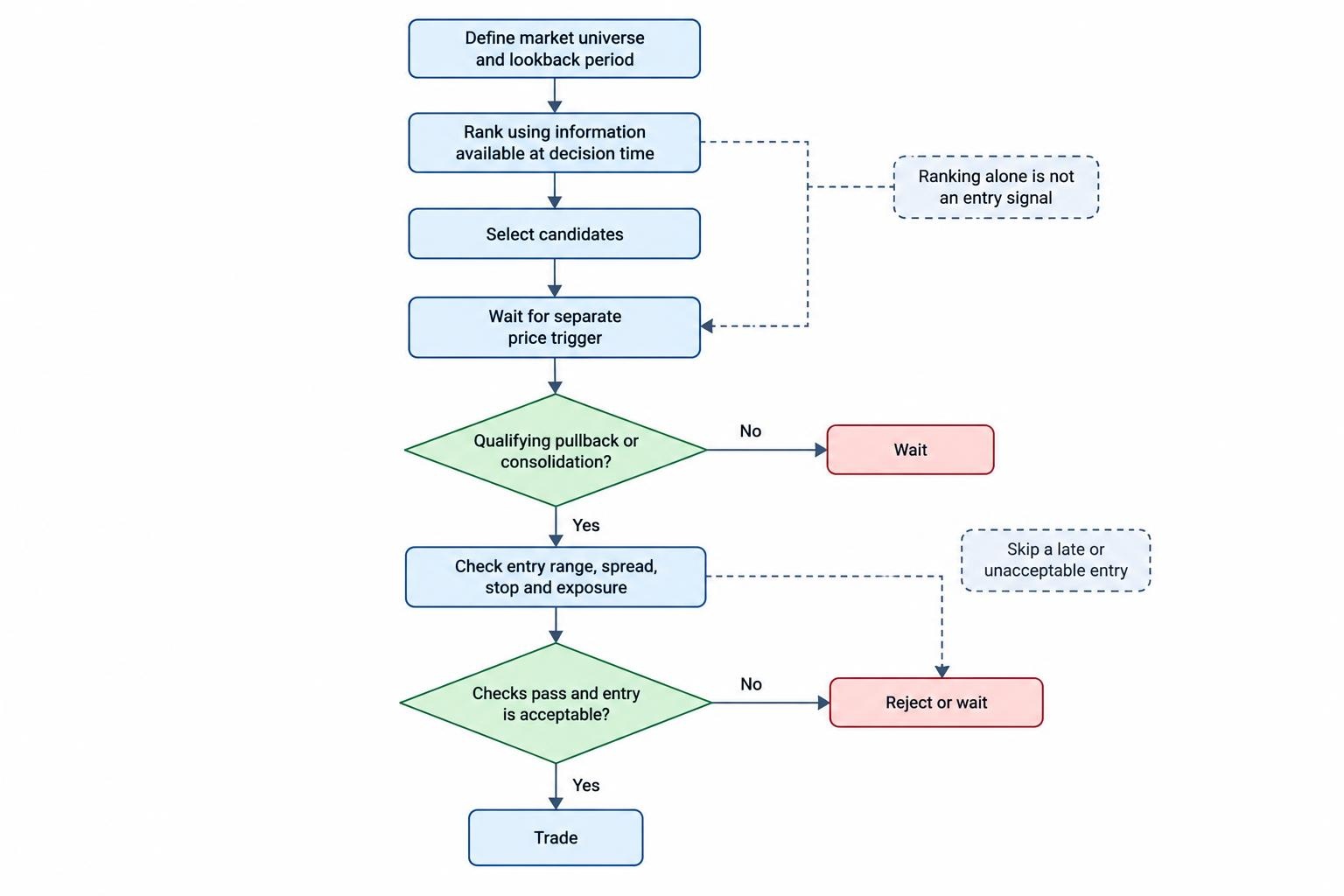
A continuation breakout enters after a pause or consolidation within a directional move. The trader identifies the boundary before the next move and decides whether a temporary breach or a completed close is required. The pause can offer a clearer invalidation area than an entry made during an uninterrupted surge, but the breakout can still fail. A stop-entry order may apply the trigger consistently without guaranteeing the fill price. Specify an acceptable entry range and what happens if the market jumps beyond it. The fact that a setup began with strong momentum does not justify any entry price. A trade with too little distance left to its intended exit can be unattractive even if the direction subsequently proves correct.
Entering after a controlled pullback
A pullback method waits for a temporary movement against the recent direction and then looks for evidence of renewed continuation. A long setup might require the broader momentum measure to remain positive while price retreats and subsequently turns higher. The intended benefit is a potentially closer invalidation point and less chasing. The trade-off is that the pullback may become a reversal, or the market may resume its move before the preferred entry occurs. Define what makes the retreat acceptable, what triggers the entry and what cancels the opportunity. A lower price alone does not make a long trade better if the conditions supporting it have weakened. The entry must fit the method as it exists at that moment.
Combining a ranking with a separate entry trigger
A relative-strength ranking can narrow the watchlist while a separate price rule determines whether and when to trade. For example, a method might consider only instruments in a defined stronger group, then require a qualifying pullback or consolidation before entry. The ranking needs a stated universe, lookback period and refresh schedule. Recalculating it continually can replace a measured selection process with constant switching between whatever has just moved. A longer review interval reduces that activity but can retain exposure after leadership changes. Both choices need evaluation. The ranking and trigger also must use information available at the decision time. It would be misleading to select today’s eventual strongest performer and assume it was identifiable as such earlier in the session.
Practical example: buying an index with positive momentum
Suppose a hypothetical index meets the trader’s momentum condition and has paused after an upward move. When the chosen continuation signal appears, the provider quotes 20,100/20,102. The trader buys at 20,102 for £0.50 per whole index point. The intended stop exit is 20,062, while the planned target is a closing sell price of 20,182. The 40-point stop distance gives £20 of planned price risk, and the 80-point target distance gives £40 of potential price profit. At the unchanged bid, the position would initially show a £1 loss. The example assumes the contract permits the required stake and order distances. These numbers demonstrate the mechanics rather than a recommended risk allowance or a guarantee that the stop will fill exactly.
If the closing sale fills at 20,182, the price profit is £40. If an agreed momentum-failure rule closes at 20,112 instead, the gain is £5. An ordinary stop filled at 20,062 produces a £20 loss; a sharp reversal causing execution at 20,032 produces a £35 loss. These are alternative paths, not successive exits from the same position. The example assumes an intraday close before any applicable funding cut-off and no separate charges or adjustments. Because the calculation uses the actual opening buy and closing sell prices, the spread is already included. The distinction between the intended stop and the worse fill matters: the £20 planned risk does not cap every possible loss from the position.
| Alternative outcome | Actual closing sell price | Calculation at £0.50 per point | Price profit or loss |
|---|---|---|---|
| Target reached and filled | 20,182 | (20,182 − 20,102) × £0.50 | +£40 |
| Early exit under a momentum-failure rule | 20,112 | (20,112 − 20,102) × £0.50 | +£5 |
| Stop fills as planned | 20,062 | (20,062 − 20,102) × £0.50 | −£20 |
| Stop slips during a sharp reversal | 20,032 | (20,032 − 20,102) × £0.50 | −£35 |
Why a late entry changes the trade
Suppose the same index continues higher before the trader acts, and the eventual entry is 20,142. Keeping the original stop at 20,062 and target at 20,182 now leaves 80 points of planned price risk against only 40 points of potential gain. At £0.50 per point, that means risking £40 to seek £20, compared with the original £20 and £40. The market’s direction may still look strong, but the trade is no longer the same proposition. Reducing the stake shrinks both amounts without restoring the original relationship. Moving the target farther away simply to make the arithmetic attractive creates a new forecast. The method needs a rule for missed entries, including when to wait for another setup or take no position.
Practical example: selling a share with negative momentum
Suppose a hypothetical UK share has continued lower after a weak recovery and meets the trader’s short-entry conditions. The provider quotes 980p/982p, and the contract defines one point as one penny. The trader sells at 980p for £0.50 per penny, with an intended stop purchase at 1,010p. The 30-point distance gives £15 of planned price risk. If the quote later falls to 918p/920p and the position closes at the offer of 920p, the 60-point gain produces £30. Assume £2 of financing and £1 of borrowing charges apply, with no dividend or other adjustment during this hypothetical holding period. The resulting profit is £27. The applicable charges and availability of a short position depend on the contract.
If the share instead gaps higher and the closing purchase fills at 1,040p, the 60-point adverse move produces a £30 price loss before carrying costs. That is twice the originally planned £15 price risk. A short position can also be affected by borrowing availability, corporate events and changes in trading conditions. A profitable decline in the underlying chart therefore does not tell the whole story of the spread bet. Check the point value, price used for stop triggering and the treatment of any dividend adjustment. A short position normally closes at the buy price, so a sell-price chart touching the target does not establish that the intended purchase was available. The executed prices and adjustments determine the account result.
Momentum indicators and what they can actually tell you
Rate of change measures a price’s movement over a chosen interval, while [RSI](/spread-betting-strategies/technical-analysis/rsi/) describes recent gains and losses within its calculation. [MACD](/spread-betting-strategies/technical-analysis/macd/) compares moving averages and can help describe changes in their relationship. These tools organise price information; they do not independently establish that a trade will succeed. A high RSI reading is not automatically a reason to sell, because strong movement can keep it elevated. Equally, it is not sufficient evidence to buy without considering entry price and risk. Define the role of each indicator and avoid counting several calculations from the same price history as separate guarantees. A clear rule with known limitations is more useful than a crowded chart whose signals can be interpreted differently after each outcome.
Slowing momentum is not the same as a reversal. A market can continue rising while its rate of increase falls, just as a decline can continue at a slower pace. An indicator turning down may therefore signal reduced strength without establishing that price is about to fall. Divergence, where price makes a new extreme while an indicator does not, can be investigated as a warning condition, but it does not specify an inevitable turn or an exact exit time. Decide whether the strategy exits on a momentum change, a price-level breach, a time limit or a combination. Otherwise, the trader may treat any indicator fluctuation as failure while ignoring the different behaviour the method was originally designed to capture.
Stops, targets and exits when momentum fades
The initial stop should reflect a defined invalidation point or exposure limit, not the amount of money the trader hopes to earn from a small move. A nearby consolidation or swing can provide context, while [ATR](/spread-betting-strategies/technical-analysis/atr/) can describe recent volatility. None of these identifies the largest possible adverse move. An ordinary stop can slip during gaps or rapid reversals. A stop-limit exit adds a price restriction that can leave the position open if a permitted execution is unavailable. A guaranteed stop, where offered, provides a contractual exit under its terms, with premiums and distance restrictions to check. The method must distinguish the intended analytical exit from the practical protection available through the chosen order type.
A fixed target defines a known intended reward but can close the trade before an extended move finishes. A trailing exit can retain participation while surrendering some unrealised profit before it is triggered. A time exit can end exposure when the anticipated continuation has not developed within the expected period. Partial exits combine outcomes but change the average size of winners and must be evaluated as part of the method. None of these choices avoids trade-offs. The exit should also match the entry premise: if a position depended on immediate continuation, prolonged inactivity may matter even without a stop being reached. Extending the holding period whenever momentum fades can turn an intraday idea into an unplanned financed position.
News, exhaustion and execution risk
A catalyst can help explain why a market is moving without proving that the remaining move is tradable. Earnings, interest-rate decisions and economic releases may change expectations abruptly, with the first executable quote already far from the price visible before the announcement. The initial reaction can also reverse as details are interpreted. A strategy should state whether such periods are included, excluded or treated as a separate [news-trading approach](/spread-betting-strategies/news-trading/). Do not assume that a large candle provides both a valid signal and an obtainable entry near its beginning. Historical charts show where prices travelled, while the trader needs evidence about when information became available and what quotes could actually be used afterwards.
Market orders seek execution without guaranteeing the displayed price, while limit orders restrict the acceptable price but can remain unfilled. Stop-entry orders can trigger into a fast move and fill beyond their trigger. A stop-limit entry can enforce a price boundary at the expense of missing the trade. Read the execution policy and check the price reference used to trigger each order. Spread widening can affect both entries and exits, especially when the chart displays a midpoint or a different market from the contract. If the method includes a maximum spread or entry distance, establish how that condition is enforced. A rule written in a journal does not automatically control an unattended order placed without the corresponding platform functionality.
Position sizing, margin and concentrated momentum exposure
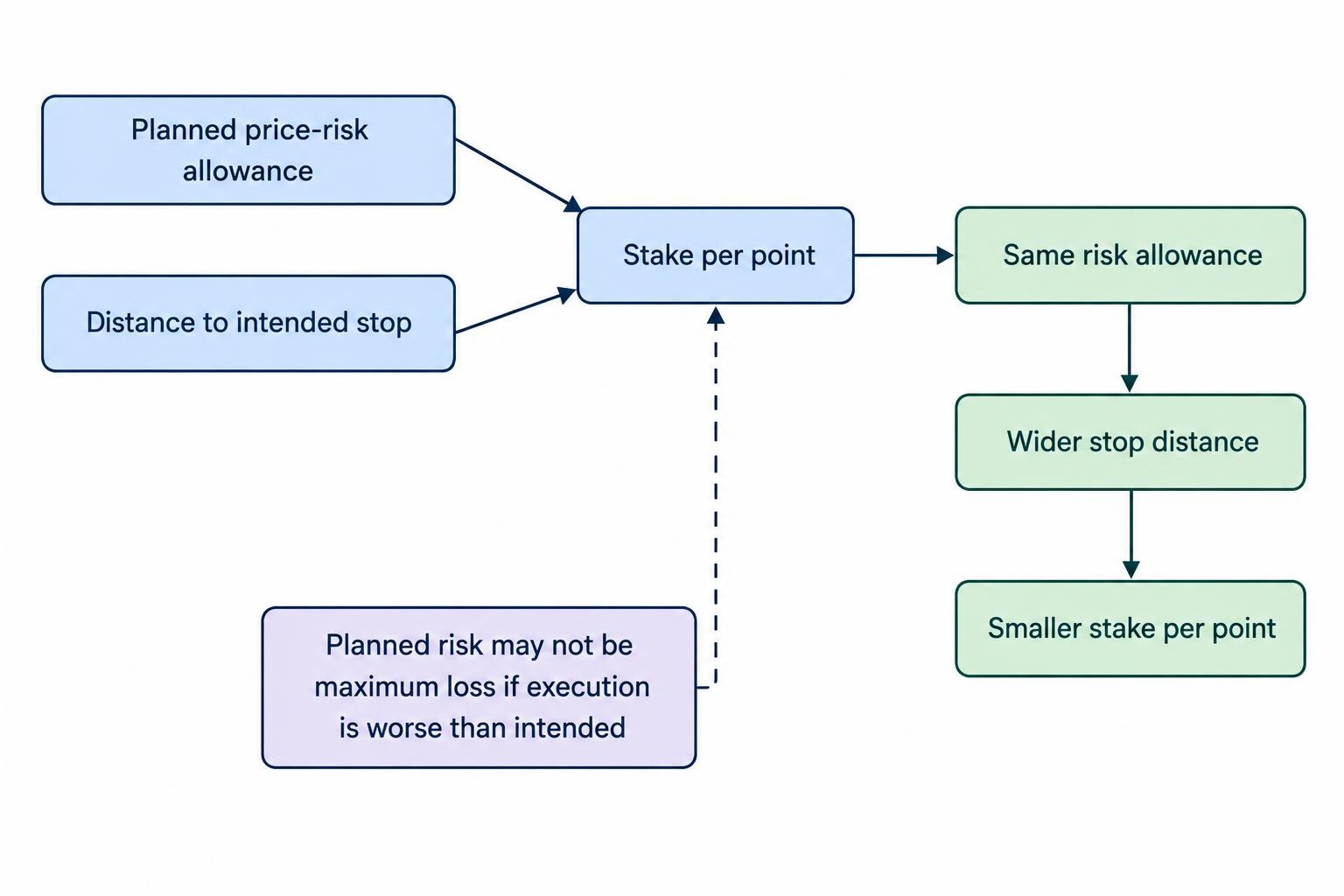
Calculate the stake from a planned price-risk allowance divided by the distance to the intended stop. A £30 allowance and a 60-point distance give £0.50 per point; a 120-point distance reduces the stake to £0.25 for the same allowance, assuming the contract permits it. These are examples, not recommended budgets. Allow for expected charges and examine how worse-than-planned fills would affect the account. A more volatile candidate does not deserve a larger stake simply because its recent return is more impressive. The [position sizing guide](/risk-management-guide/position-sizing/) develops this calculation separately from margin. If a contract’s minimum stake prevents suitable sizing, narrowing the stop solely to make the numbers fit changes the trade rather than solving the exposure problem.
Under FCA retail rules in COBS 22.5, minimum initial margin includes 5% for major stock indices and 20% for individual shares; firms can require more. In the index example, 20,102 multiplied by £0.50 gives approximately £10,051 of exposure, requiring £502.55 at an assumed 5%. That is separate from the £20 planned price loss. The rules also provide account-level close-out when net equity falls below 50% of required margin, as soon as market conditions allow, and negative balance protection for relevant retail accounts. These protections do not preserve funds already in the account or guarantee an individual stop price. The amount available as margin should therefore not determine the stake used for a momentum trade. handbook.fca.org.uk
Strong recent performers can share the same underlying exposure. Several technology shares, related indices or currency positions may all react to one change in expectations. A relative-strength screen can concentrate the account in those exposures even when it lists many instruments. Assess a common adverse scenario rather than treating each ticket’s stop allowance as independent. Adding to a winning position also increases exposure; an existing paper gain is not a separate reserve of risk-free capital. Each addition needs a planned size, an exit and a calculation of the combined outcome if prices reverse. The [risk management guide](/risk-management-guide/) covers correlation, losing streaks and drawdown alongside the risk of each trade. Define account-level limits before several apparently attractive signals arrive together.
Costs and the difference between fast and slow momentum
Short holding periods place greater emphasis on spreads and execution relative to the intended move, while longer positions can accumulate financing and other adjustments. The FCA’s review of CFD providers’ price and value, covering spread bets and related products, examines charges beyond the headline spread and differences in funding practices. Compare daily funded and dated contracts over the intended holding period, including expiry and rollover arrangements. Financing incorporated into a forward quote has not disappeared. Shares can also involve borrowing and dividend adjustments. A ranking method that changes positions frequently needs to account for the cost of each switch, including trades closed at a small loss when the next candidate becomes temporarily stronger. www.fca.org.uk
How to get started with a momentum-trading process
Begin with one instrument or a small, clearly defined comparison group. State how momentum is measured, when the measure is updated, which conditions permit entry and what cancels the setup. Add the maximum acceptable spread, intended stop, sizing rule, exit and treatment of scheduled events. Before opening an account, follow the FCA’s guidance on checking that a firm is authorised and genuine, including permissions and contact details. Read the contract specification and execution policy so that point values, minimum stakes and trigger prices are understood. Authorisation does not establish that a strategy is suitable or profitable. The account must also support the order controls and trade sizes needed to carry out the method as it was evaluated. www.fca.org.uk
Practise the complete process in a demonstration environment, including rejecting late entries and closing a position whose momentum condition has failed. Record the signal and quote as they appeared at the time, rather than reconstructing the opportunity from the finished chart. Test order amendments, cancellations and the behaviour of protective orders when the device disconnects. Demo fills and costs can differ from live conditions, and simulated losses do not recreate the emotional effect of real ones. Progress should depend on an understandable record and knowledge of those differences, rather than a short sequence of successful trades. If a live evaluation is appropriate, a suitably small stake can help assess execution without assuming the method is ready to produce regular income.
What momentum research does and does not establish
The word momentum also appears in academic portfolio research, where its definition may be very different from a retail intraday signal. For example, Kenneth French’s monthly momentum factor methodology forms stock portfolios using prior returns over months two through twelve and calculates a return difference between stronger and weaker groups. That is a defined portfolio construction, not a test of buying a fast index candle through a spread betting account. The practical implication is that research must be matched to the proposed strategy’s universe, timing, instruments and costs. A familiar label does not transfer evidence from one implementation to another. The particular spread betting method still requires its own evaluation rather than an appeal to momentum as a generally recognised idea. mba.tuck.dartmouth.edu
Testing results without selecting the winners afterwards
A fair test includes the instruments and information available at each decision, including candidates that later performed badly or ceased to be tradable. Do not build a historical ranking from today’s surviving winners or use the end-of-session leaderboard to select morning trades. Calculate signals without future observations and model entries after the required information becomes available. Include realistic spreads, missed fills, slippage and carrying costs. Research on the probability of backtest overfitting explains why selecting among many historical rule variations can produce misleading results. Evaluate the chosen rules on data outside their design sample and across different conditions, including rapid reversals and quiet sessions. A method that only looks attractive with one precise setting deserves more scrutiny than its headline return suggests. scholarworks.wmich.edu
Review average net wins and losses, win rate, drawdown, trading frequency and dependence on a few exceptional moves. Suppose a hypothetical method wins 45% of trades with average price gains of £50 and average price losses of £30, calculated from actual bid and offer fills. Its estimated price expectancy is 0.45 × £50 minus 0.55 × £30, or £6 per trade. Additional average charges of £2 reduce that to £4. If late entries reduce the average winner to £40 while other assumptions stay unchanged, the estimate becomes minus £0.50 after those charges. These figures illustrate sensitivity rather than typical performance. They also show why correct direction and a respectable win rate are insufficient: entry quality and the size of actual outcomes determine the result.
UK tax treatment of momentum spread betting
HMRC’s Business Income Manual states that a person placing a spread bet is not normally carrying on a trade, with profits not taxable and losses not relieved under that normal treatment. Its guidance on spread betting exceptions explains that the contract and economic substance matter, including whether winnings arise from carrying on an existing trade. Calling a method momentum trading does not itself determine the tax position. Residence, individual circumstances and company arrangements can require separate consideration. Tax treatment should be assessed alongside the product’s costs and risks. It does not improve the probability of continuation or compensate for a poor entry, and the normal absence of loss relief remains relevant when the method loses money. www.gov.uk
Building a momentum method you can follow
A workable momentum process connects a defined observation of strength or weakness with an obtainable entry, a defensible exit and controlled exposure. It must also explain what happens when the entry is missed, the move slows or several correlated signals appear at once. The trader’s task is not to participate in every fast market. It is to determine whether a repeatable set of decisions remains worthwhile after costs, mistakes and less favourable conditions are included. Keep records that separate rule-compliant losses from execution problems and departures from the plan. Use those records to decide whether the method merits further evaluation, revision or a pause. Recent movement supplies information; the discipline lies in deciding when that information supports a trade at the price actually available.