Swing trading with financial spread betting means holding a position across several trading sessions to capture a market move that takes time to develop. A trade might last a few days or several weeks, depending on the setup and exit rules. The trader uses a stake per point to take a long or short position without owning the underlying asset. Compared with day trading, the approach generally involves fewer entries and less continuous screen time, but positions remain exposed when the trader is away. Financing, overnight gaps and the events scheduled during the holding period therefore become part of the trade from the outset, rather than details to consider after the entry.
The attraction is having time to assess a setup and allow a movement to develop without trying to capture every intraday fluctuation. That slower pace does not make the position inherently safe or profitable. A wider stop can require a smaller stake, a weekend announcement can change the opening price and carrying costs can reduce an otherwise favourable result. The FCA includes financial spread betting within its CFD framework, which it describes as high risk and unsuitable for some retail consumers. This guide explains the mechanics, practical suitability, advantages and disadvantages of swing trading through spread betting, with hypothetical examples showing how price movements, funding and exit conditions affect the account.
What Makes a Trade a Swing Trade?
Swing trading sits between intraday dealing and longer-term position trading, although there is no universal number of days separating the categories. The defining idea is to capture a particular move across multiple sessions, with a reason to enter and a reason to leave. A trader might buy a pullback within a rising trend, sell a failing rally or enter after price breaks out of consolidation. The position remains open because the setup is still valid, not because closing would be inconvenient. A failed day trade left running overnight has not automatically become a swing strategy. Its holding period has changed, but the original risk assessment, financing assumptions and exit rules may no longer fit what the account is actually carrying.
The timeframe used for analysis is another choice rather than a definition of the strategy. Daily charts can help identify the broader structure, while four-hour or hourly charts may help refine an entry. Looking at more timeframes does not necessarily improve the decision, particularly if the trader changes which chart matters whenever the position moves against them. Establish which timeframe defines the setup, which one controls the exit and when a completed candle is required before acting. That makes it possible to distinguish an ordinary fluctuation from a failed signal. The objective is a consistent decision process, not a search for whichever chart currently provides the most reassuring interpretation of an open trade.
How Swing Trading Through Spread Betting Works
A spread betting provider quotes a sell price and a buy price. A long position opens at the available buy price and closes through a sell execution; a short position opens by selling and closes by buying. The movement between those execution prices, expressed in contract points and multiplied by the stake, produces the price profit or loss. Separate funding charges and adjustments then affect the final account result. Holding the position for several days does not change that basic calculation, but it increases the number of charges and events that may need to be included. The spread is already captured by the entry and exit executions, so it should not be deducted again when calculating the result.
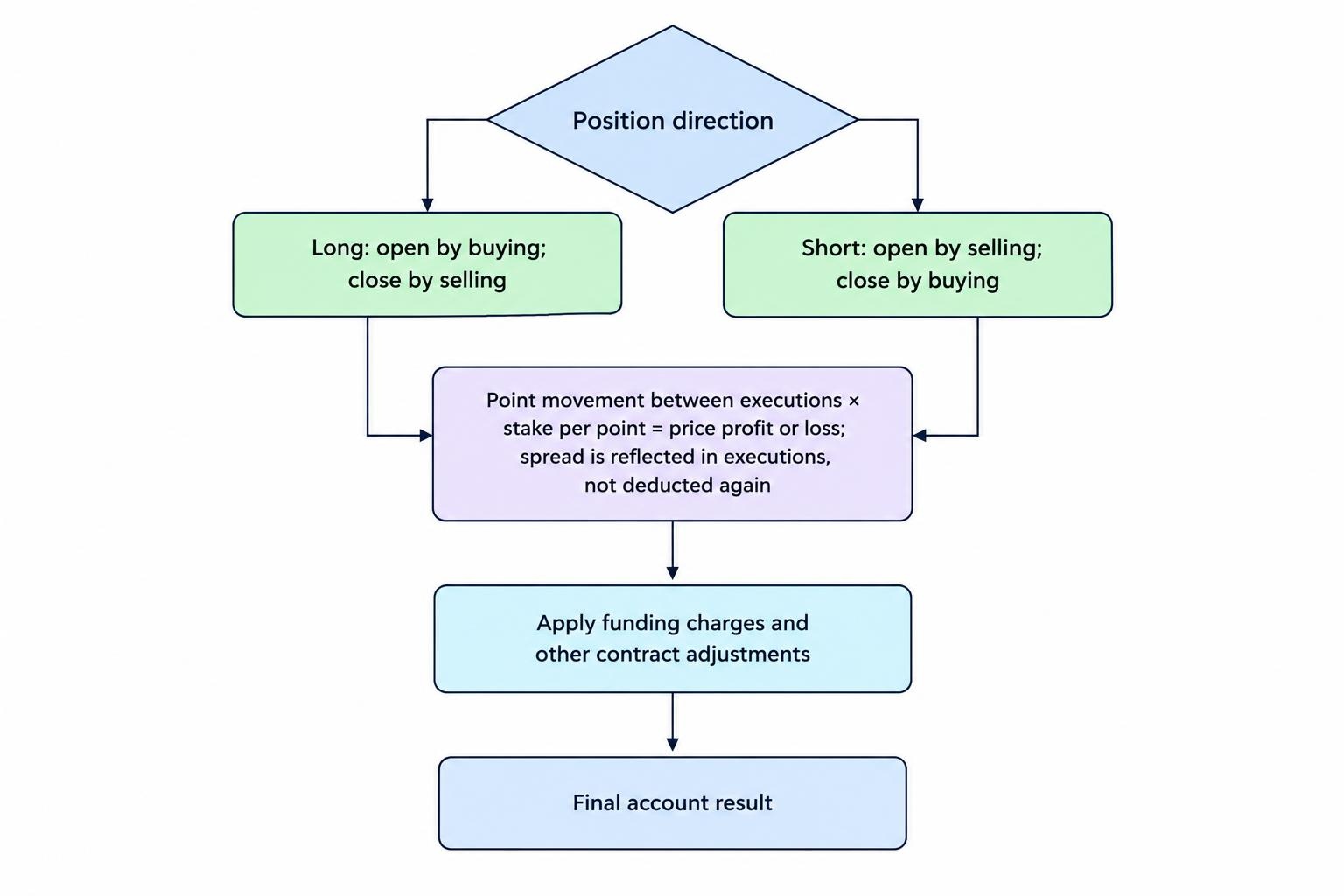
Margin supports the position but does not measure its intended or maximum loss. If a trade has an eighty-point stop distance and a £0.50 stake, its planned price risk is £40 before slippage and separate charges. A provider’s margin requirement might be much larger than £40, yet neither figure guarantees what happens during a gap. The stake still determines the financial effect of each point moved. This is why a swing trader cannot simply use the same stake as on a shorter trade with a much closer stop. The analysis should identify an appropriate invalidation level first; the stake must then fit the distance to that level and the account’s available risk budget.
Who Does Swing Trading Suit?
Swing trading may suit someone who can prepare carefully, review positions at defined times and respond when an event changes the plan, but cannot watch a market continuously. That can make it more compatible with other commitments than a method requiring constant intraday decisions. Compatibility still depends on the instrument and strategy. A position in a company reporting results while you are unavailable needs different arrangements from an index trade with no immediate scheduled catalyst. The useful question is whether the monitoring routine covers the risks that matter. Checking a chart once each evening may be enough for some predefined processes, but it should not be assumed sufficient for every market or every open position.
The approach also requires patience with waiting, uncertainty and temporary adverse movement. A trader who repeatedly intervenes whenever an open profit shrinks may find it difficult to follow a multi-session method, while someone uncomfortable carrying exposure overnight may prefer a different holding period. Conversely, treating swing trading as passive income is a poor starting point. Decisions about earnings, weekends, financing and failed setups remain active responsibilities even when entries are infrequent. Money needed for living expenses should not depend on the next trade working. The practical advantage of a slower pace is more room to make considered decisions, not a dependable payment schedule or permission to ignore the position once the opening order has been filled.
Advantages and Disadvantages of Swing Trading
Swing trading can reduce the need to act on small price fluctuations and may allow a larger intended movement relative to the opening spread. Fewer entries also mean fewer occasions to incur transaction costs or make an order-entry mistake, provided the trader genuinely remains selective. There is more time to examine economic conditions, company information and the structure of a chart before dealing. Long and short spread bets provide flexibility in expressing those views, and a defined monitoring schedule can make the work more manageable. These are process advantages rather than proof of superior returns. A larger target is only useful if the strategy has a credible reason to expect it and a workable response when the market behaves differently.
The disadvantages arise from keeping exposure open while more information arrives. Overnight and weekend gaps can take price beyond an ordinary stop, financing can accumulate and a promising move can reverse before the next scheduled review. Wider stops also require smaller stakes if planned risk is to remain comparable with a shorter-term trade. The account may support several positions at once, making shared exposure harder to see than when trading a single intraday ticket. Patience can become another trap if it is used to justify holding after the setup has failed. The method needs a distinction between allowing time for a valid trade to develop and giving an invalid trade more time because accepting the loss is uncomfortable.
| Feature | Potential benefit | Cost or risk to consider |
|---|---|---|
| Positions held across sessions | Allows time for a broader move to develop | Exposure continues overnight and through intervening events |
| Fewer entries | Can reduce repeated transaction costs | Funding and other holding costs accumulate |
| Larger intended price movement | May make the opening spread less important proportionally | Wider stops require smaller stakes for comparable planned risk |
| Scheduled reviews | Can reduce continuous screen time | Unexpected news may require attention between reviews |
| Long and short positions | Allows views in either market direction | Short positions can have different funding and borrowing costs |
| Several simultaneous trades | Allows more than one opportunity to be considered | Correlation can concentrate losses across the account |
Choosing Markets for a Multi-Session Trade
Indices, major currency pairs, shares and commodities can all be used for swing trading, but their risks differ. An index spreads exposure across companies while retaining broad market and constituent concentration risk. A currency pair expresses a relative view that can change with developments affecting either currency. An individual share adds company-specific announcements, corporate actions and the possibility of a trading suspension. Commodities require attention to the benchmark and, where relevant, the futures month and its changing relationship with other delivery dates. Choose a small set of instruments whose mechanics and main drivers you can follow. Moving between markets because one happens to have an attractive chart is a weak substitute for understanding what could alter that chart overnight.
The planned holding period should shape the calendar review. Before entering, look ahead for earnings, economic releases, central-bank decisions, public holidays and contract expiry. A trade expected to last seven sessions may cross several events that an intraday trader would avoid simply by closing that afternoon. This does not mean every announcement must be avoided, but its treatment should be explicit. The plan might permit holding through routine data while excluding company results, or require a smaller position before a particular event. Check the provider’s trading hours as well. A continuously updating news feed does not mean the contract can be closed continuously, and a displayed indicative price may not represent an executable exit at the required size.
Overnight Funding: Calculate It Before Entering
Daily funded spread bets commonly incur adjustments when held beyond the provider’s funding cut-off. For many cash index and share positions, charges relate to the full exposure, not merely the margin deposited. The FCA’s review of CFD price and value highlighted substantial variation in overnight charges and shortcomings in some disclosures. Ask for the formula applicable to the actual instrument, direction and account. Short positions do not automatically receive interest, and a quoted annual rate may include a provider’s addition to a reference rate. Forex and commodity calculations can differ from a simple share or index funding model, so one generic percentage should not be applied across the platform.
For a purely illustrative calculation, an £8,000 exposure charged at 7.5% annually on a 365-day basis would cost approximately £23.01 over fourteen chargeable days if the exposure and rate stayed constant. Calculating the charge on an assumed £400 margin would badly understate that amount. Actual charges can change with price, rates, direction and the provider’s calendar, including weekend or holiday adjustments collected on a particular day. Estimate the cost over the intended holding period and over a longer period in case the trade develops slowly. Financing does not by itself invalidate a swing strategy, but it raises the amount the trade must earn to achieve the same net result and makes an indefinite holding period economically different from the original plan.
Daily Funded Bets or Dated Contracts?
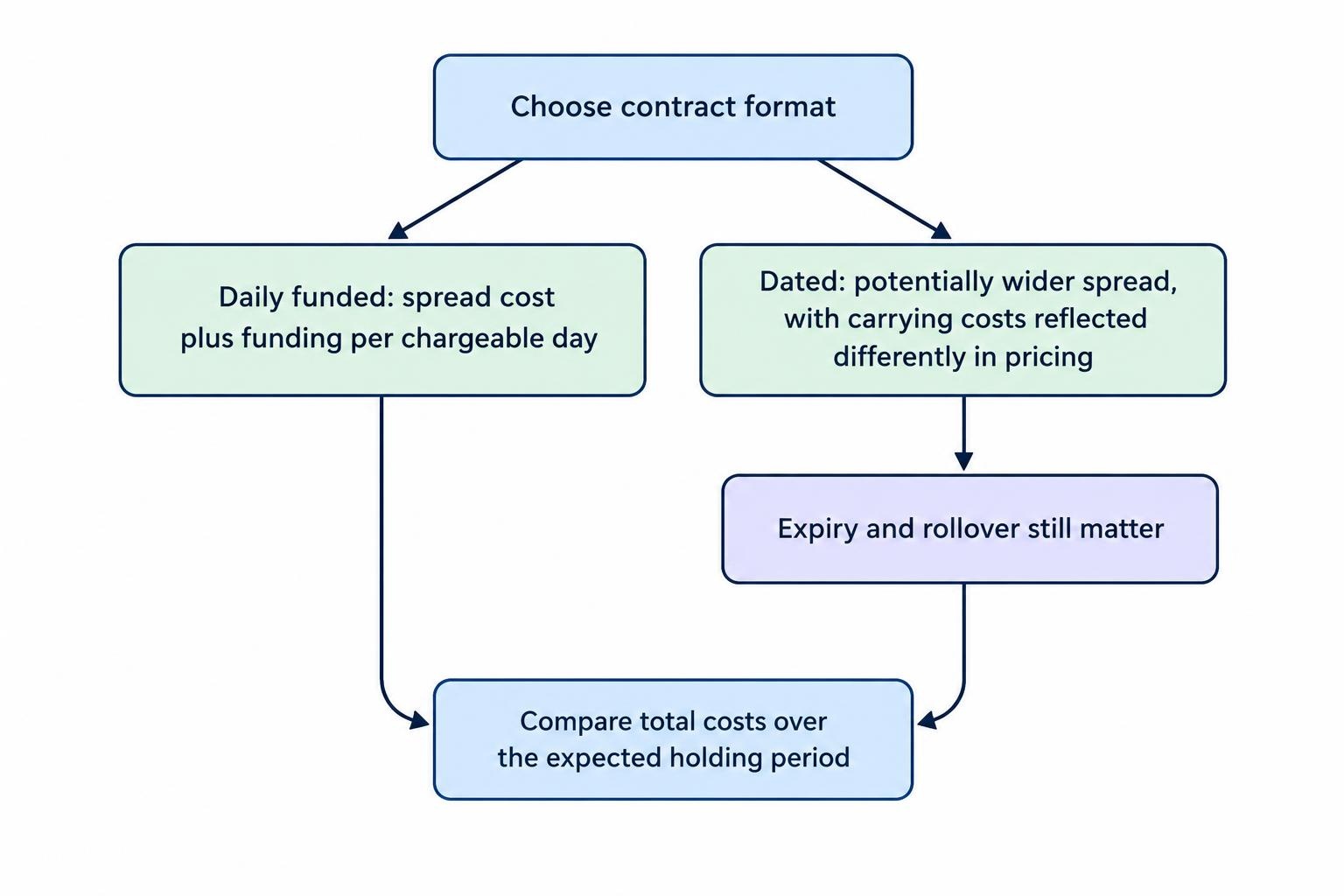
Daily funded contracts often have narrower spreads and no fixed near-term expiry, making their entry cost attractive. Dated futures or forward spread bets can have wider spreads, with carrying costs reflected differently in their pricing instead of the same daily funding charge. That does not make holding a dated contract free. Its expiry, settlement method and any rollover costs still matter, and its quoted level can differ legitimately from the cash market. Compare the two formats over the period you expect to hold the exposure, allowing for how long the trade might remain open if the move is slower than expected. The market name alone does not tell you which contract offers the more economical expression of the idea.
As a simplified cost comparison, suppose one contract costs £2 through its unchanged opening-and-closing spread and £1 for each chargeable day held, while a dated alternative costs £10 through its spread and has no separate daily funding charge. After three chargeable days, the totals would be £5 and £10; after twelve, they would be £14 and £10. This arithmetic assumes the same economic exposure and ignores differences in pricing, expiry and other adjustments. It is not a quotation from a provider. Its purpose is to show why the expected duration belongs in the contract decision. The apparently cheaper entry can become the more expensive position, while a trade extending beyond the dated contract’s expiry introduces a further comparison.
Worked Example: A Long Index Swing Trade
Suppose a hypothetical index has pulled back within a rising trend and then meets the trader’s predefined entry conditions. The quote is 8,100/8,102, and the trader buys at 8,102 for £0.50 per point, assuming that stake is available. The ordinary stop is at 8,022 and the target sell limit is at 8,262. Planned price risk is eighty points multiplied by £0.50, or £40, while the target price profit is £80. For an illustrative £5,000 account, a £50 trade allowance would leave £10 beyond the planned price loss for assumed costs, but would not cap a gap loss. The anticipated holding period is several sessions, with a calendar review and a time-based reassessment if the move fails to develop.
If the position is eventually sold at 8,262, the 160-point gain produces £80 of price profit. With an assumed £6 funding debit and no other separate adjustments, the net result is £74. Alternative exits can produce different losses and different funding totals because the position may be held for a different period. The table illustrates three possible outcomes; it does not describe three trades or predict how often any outcome would occur. The stop’s intended level is not a promise of execution, and the final column shows why price profit alone is an incomplete measure for a multi-session position. The spread is already reflected in the opening buy and closing sell executions used in each calculation.
| Alternative outcome | Closing sell execution | Price profit or loss at £0.50 per point | Assumed funding debit | Net result before any other charges |
|---|---|---|---|---|
| Target reached | 8,262 | +£80 | £6 | +£74 |
| Stop fills at its trigger | 8,022 | −£40 | £4 | −£44 |
| Gap produces a worse exit | 7,970 | −£66 | £2 | −£68 |
Worked Example: A Short Share Position
Now consider a hypothetical share quoted at 500p/502p, with one spread betting point equal to one penny. The trader sells at 500p for £1 per point after a bearish setup, placing an ordinary stop to buy back at 525p. Several sessions later, the quote is 448p/450p and the trader closes at the 450p offer. The fifty-point decline between selling and buying produces £50 of price profit. Assume funding and borrowing charges total £4. The result would be £46 before other adjustments. If the short also incurs an £8 dividend adjustment under the contract’s terms, the result becomes £38. These figures illustrate the accounting; the actual adjustments depend on the provider, instrument and events occurring during the holding period.
A dividend-related fall in the share price should not be mistaken for an automatic windfall on the short position. The contract’s adjustment is intended to account for the event, and the relevant price movement must be considered alongside that debit. Splits, rights issues, takeovers and suspensions can create other changes or restrictions. A swing trader should therefore look beyond the chart and check the company calendar and contract information before entering. The same principle applies to the planned reward-to-risk ratio. A £50 price target against £25 of planned stop risk describes the intended movement, but funding, adjustments, early exits and slippage determine the realised distribution of gains and losses. An attractive ratio alone does not establish that the strategy has an advantage.
Swing Trading Setups Worth Understanding
Pullbacks Within an Established Trend
A pullback strategy seeks an entry after a temporary retreat within a broader directional move. The trader might define the trend through price structure, a moving average or another consistent rule, then require evidence that the pullback has stopped before entering. The important distinction is between a retracement that preserves the original structure and a reversal that invalidates it. Buying solely because the market is below its recent high does not make that distinction. A wider chart perspective can help, but the rules must be decided before the outcome is visible. Identify where the setup fails, estimate how long the expected move should take and size the trade accordingly. Patience is useful only while the original conditions remain relevant.
Breakouts and Retests
A breakout strategy looks for price to leave an established range or consolidation and continue into a new area. Some swing traders enter after a completed candle beyond the boundary; others wait for a retest before considering a position. Waiting can provide more evidence, but can also produce a later entry or no trade at all. The strategy needs a rule for recognising a failed breakout and for avoiding entries when the required stop would be too distant. Check the catalyst behind the move where possible, especially if it coincides with company or economic news. A breakout after a genuine change in expectations and a brief move during thin trading may look similar on a small section of a chart but present different risks.
Ranges and Mean Reversion
A range or mean-reversion approach anticipates movement back towards an established zone or reference after price has moved away from it. It may involve buying near support, selling near resistance or trading a justified relationship between markets. The weakness is assuming that an old relationship must continue. An oversold indicator can remain oversold while price falls further, and a range that worked repeatedly can end after new information. A swing strategy should define both a price limit and a reasonable period for the expected reversion. Adding more exposure whenever the position loses can conceal the absence of either. The trade needs a reason to recover that is stronger than the trader’s desire to return to the original entry price.
Getting Started: Match the Account to the Strategy
Start by identifying the legal entity providing the account and checking its status and relevant permissions using the FCA’s firm-checking guidance and services. Then compare the features needed for the intended holding period: minimum stakes, cash and dated contracts, financing, short-selling costs, guaranteed stops and treatment of corporate actions. A low minimum deposit says little about whether the account can support a sensible swing position. If a strategy needs an eighty-point stop but the minimum stake forces more risk than the budget allows, the account and trade do not fit. Do not move the stop to an analytically meaningless level simply to make the position appear affordable. The risk plan should determine which trades are possible.
Use demo practice to learn the complete process, including maintaining an order across sessions, changing a stop according to a rule and finding funding entries in the account history. Check whether pending orders expire automatically and whether the platform cancels associated instructions when a position is closed. Use a realistic balance and stake, and record trades through their full holding periods rather than restarting after an uncomfortable loss. Demo conditions may differ from live execution and charges, so a favourable simulated result is not sufficient evidence to commit substantial funds. If you decide to proceed to a small live trial, its first purpose is to compare actual execution, funding and behaviour with the assumptions used in the plan.
Managing the Position From Entry to Exit
Before entering, write down the setup, stake, invalidation level, target or trailing-exit rule, anticipated holding period and known events. Estimate costs and identify any condition that would require an early exit, such as a change in the underlying thesis or an approaching announcement the method does not permit holding through. Decide how often the trade will be reviewed and what alerts are needed between reviews. This does not require forecasting every price movement. It creates a clear basis for deciding whether the position still belongs in the account tomorrow. A trade with no time-based reassessment can remain open long after the opportunity it was meant to capture has disappeared, accumulating costs while retaining the original label.
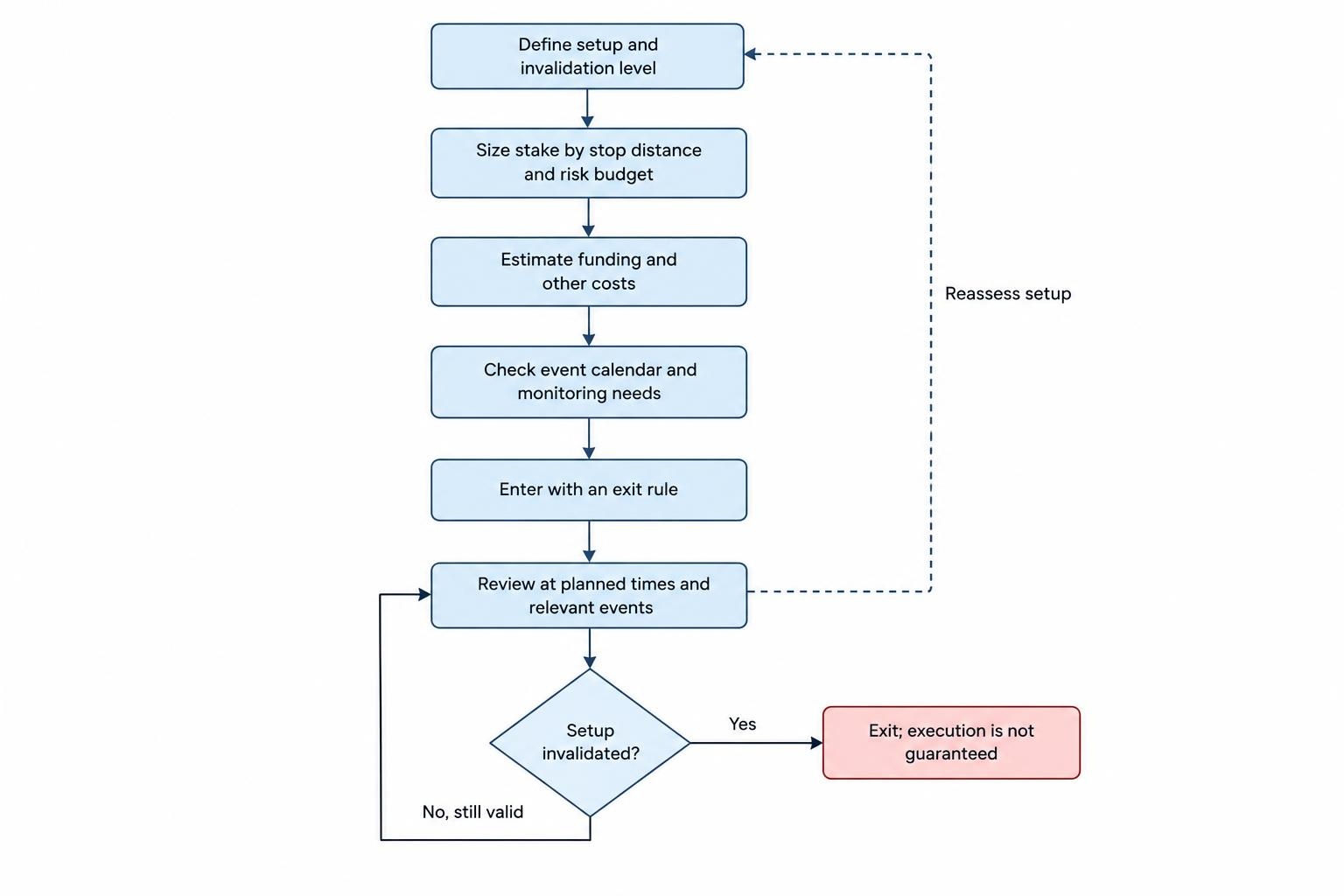
Once the position is open, distinguish management from interference. A trailing stop or partial exit can be sensible if it is part of the tested method, but repeatedly changing the plan in response to ordinary fluctuations makes the results hard to interpret. Moving a stop to the entry price does not automatically make the trade risk free: charges remain, and an ordinary stop can slip. Closing part of a position also changes the average reward and may leave a remainder below a provider’s minimum size. When amending orders, confirm that the change has been accepted and that the remaining instructions match the remaining exposure. Review the whole account as well as the individual trade, because new positions can change the combined risk.
Overnight and Weekend Risk
An ordinary stop cannot guarantee an exit at its trigger when the next executable price is beyond it. That can happen after an overnight announcement, over a weekend or during a sudden move while the market is open. Extended dealing hours may provide more opportunities to act, but they do not guarantee constant liquidity or the same spreads as the main session. Before carrying a position through a closure, ask whether the setup still justifies that exposure, whether a scheduled event changes the risk and whether the stake remains appropriate. Closing before a weekend removes future exposure from that position, but reopening later creates another trading decision and potentially another transaction cost. There is no costless rule that removes every gap risk.
Guaranteed Stops, Margin and Account Protection
A guaranteed stop, where available, provides a specified exit under the provider’s contractual terms. Its usefulness depends on the market, permitted distance, premium and conditions for placing or amending it. Include the applicable charge in the planned trade rather than treating it as an unrelated account expense. An ordinary stop and a guaranteed stop should not be assigned identical worst-case assumptions in a test. A stop-limit order introduces another distinction: the price limit can prevent a poor fill, but can also leave the position open when the market has moved beyond it. Choose the order according to the risk being managed, and read the actual contract conditions. The name of an order is not enough to establish how it behaves in every circumstance.
The FCA’s retail rules require firms to close positions as soon as market conditions allow when account net equity falls below 50% of the applicable margin requirement, and restrict liability for covered products to funds in the relevant account. Those protections do not preserve the money deposited or replace trade-level risk controls. A swing account may have several positions open when an announcement moves them together. Buying an equity index, a technology share and a related sector instrument can concentrate exposure even though three different market names appear on the platform. Leave sufficient margin room and assess plausible combined losses. A longer holding period gives correlated positions more time to encounter the same adverse event.
How to Assess Whether the Method Is Working
Keep a record of the original reason for entry, planned risk, expected holding period, actual executions, funding, adjustments and exit reason. Compare net results rather than chart movements alone. A strategy can show a favourable price return while disappointing after the cost of holding, particularly if losing positions remain open much longer than winners. Review average gains and losses, drawdown, the time spent in trades and how often the original plan was changed. A high win rate is not enough if occasional losses dominate the account. Equally, one stopped trade does not show that the method has failed. The purpose of the record is to distinguish an ordinary losing outcome from poor execution, an invalid assumption or a pattern of discretionary changes.
Historical testing should include realistic funding and events occurring during the holding period, not just an entry and exit marked on a chart. Share data may need appropriate treatment for corporate actions; futures-based instruments need attention to expiry and rollover. Avoid interpreting overlapping positions as independent evidence when all benefited from the same market move. Reserve data for evaluation after developing the rules, and check how results change with higher costs or less favourable execution. Swing strategies may generate observations slowly, so a profitable month can provide little information about performance across different conditions. A small live trial can reveal practical differences from the simulation, but neither a short trial nor a carefully selected historical period establishes that future returns will repeat.
UK Tax Treatment and Longer Holding Periods
Holding a spread bet for several days does not by itself turn it into direct ownership of the underlying investment. HMRC’s general guidance says a person placing spread bets is normally not carrying on a trade, with profits not taxable and losses not relieved under that general treatment. Its guidance on spread-betting exceptions emphasises the contract’s terms and economic substance, including circumstances where winnings arise from an existing trade. The position can differ for companies, business transactions or people subject to another jurisdiction’s rules. Do not let a broad tax-free description replace analysis of the trading costs and risk. An exemption on profits is of little practical benefit to a method that loses money after financing.
Building a Swing Trading Process You Can Maintain
A useful learning approach is to follow a small number of markets, define one setup clearly and practise the complete holding period rather than concentrating only on entries. Work out the stop distance and stake, compare suitable contract formats, review the event calendar and decide how the position will be monitored between entry and exit. Then measure the net result honestly, including the cost of waiting. Swing trading can offer a more deliberate pace than intraday dealing, but it still requires active decisions and capital that can withstand losses. Progress comes from matching the strategy to your availability and risk capacity, and from keeping its assumptions open to review. Leaving an invalid position open for longer is not the same as giving a valid swing trade time to work.