Financial spread betting works by attaching a cash stake to each point of movement in a market. You choose whether to buy or sell, decide your stake per point, and settle the difference between your opening and closing prices. You do not own the underlying shares, currency or commodity.
The basic calculation is straightforward: points gained or lost multiplied by your stake. The part that needs more care is how the provider’s spread, margin requirements, execution prices and holding costs affect that result.
A £2-per-point position can gain £100 from a favourable 50-point move, but an adverse move of the same size produces a £100 loss. The margin needed to open that position is security for the trade, not its maximum possible loss. This guide covers the mechanics in a UK financial spread betting context, using hypothetical prices throughout.
What happens when you open a spread bet?
You enter a contract with a spread betting provider whose price references an underlying financial market. That might be a stock market index, a currency pair, an individual share or a commodity. The contract determines what counts as one point, how prices are quoted, when you can trade and how the position settles.
Buying creates a long position: you benefit if the price rises far enough to cover your costs. Selling creates a short position: you benefit if the price falls far enough. Neither action transfers ownership of the underlying asset to you.
This distinction matters with shares. Buying a spread bet on a company does not make you a shareholder, give you voting rights or place shares in your investment account. The trade provides exposure to price changes instead. The differences between ownership and a derivative position are covered in spread betting versus share dealing.
Your contract is with the provider rather than directly with another trader on a stock exchange. The provider may hedge its exposure elsewhere, but that does not turn your spread bet into ownership of its hedge. Your account records your stake, entry price, open profit or loss, and any charges or adjustments.
How the buy price, sell price and spread work
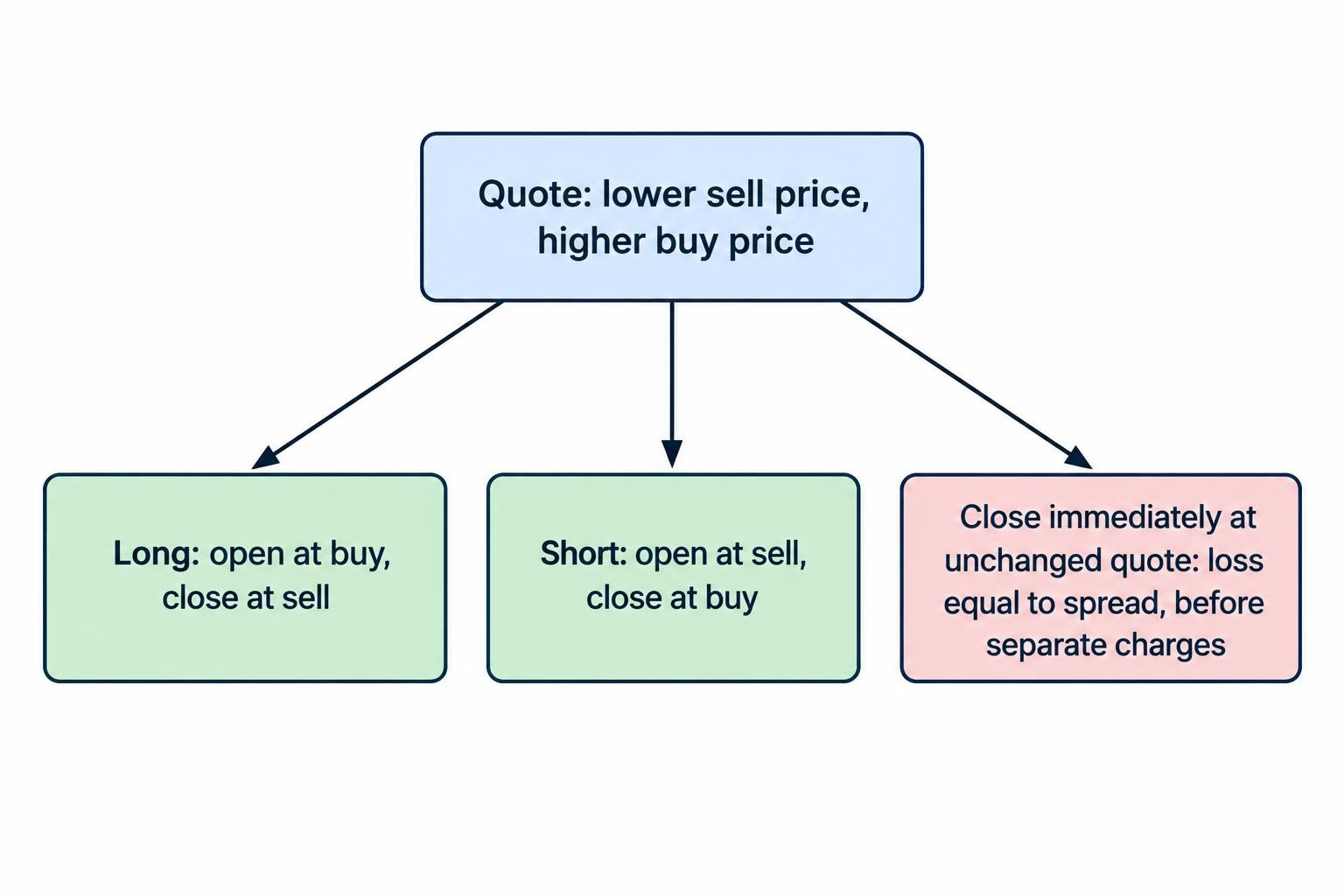
A spread betting quote has two prices. The lower price is the sell price, also called the bid. The higher price is the buy price, also called the ask or offer. The difference between them is the spread.
Suppose a hypothetical index quote is 8,100 sell / 8,102 buy. The spread is two points. If you expect the index to rise, you buy at 8,102. If you expect it to fall, you sell at 8,100.
Closing uses the opposite side of the quote. A long position closes by selling at the available sell price. A short position closes by buying at the available buy price. Comparing your entry with the wrong side of the closing quote will overstate your profit or understate your loss.
If you bought at 8,102 and immediately closed while the quote remained unchanged, you would sell at 8,100. That is a two-point loss before any separate charges. At £2 per point, the loss would be £4.
This is why an open position can show a loss immediately after entry, even though the underlying market has barely moved. The spread between the buy and sell prices is already reflected in the available entry and exit prices.
Spreads are not necessarily constant. They can change with trading conditions, market hours and the provider’s pricing terms. A chart may also display a mid price rather than the price at which you can close. Check which price the chart uses before comparing it with your position.
Your stake determines the cash effect of each point
The stake per point converts price movement into pounds and pence. At £1 per point, a 30-point movement changes the position’s value by £30. At £5 per point, the same movement changes it by £150. Increasing the stake increases both possible gains and possible losses in direct proportion.
The stake is not an entry fee and it is not the total amount placed at risk. A £2-per-point bet does not mean the trade costs £2 or that you can lose only £2. It means each point of adverse movement costs £2 while that stake remains open.
Always check the contract’s definition of a point. One point on an index may be one whole index unit. A share product might use a one-penny movement, while a currency product may use a defined pip-sized movement. The last decimal shown on the screen is not automatically one betting point. The stake per point guide covers these contract differences.
Stake selection should follow the amount of risk you intend to accept, rather than the largest position the platform permits. If your planned exit is 40 points from entry and your stake is £2 per point, the planned price loss is £80, before separate charges and any adverse execution.
That calculation works backwards too. A hypothetical £80 risk budget divided by a 40-point stop distance gives £2 per point. It is a sizing calculation, not a guarantee that the final loss will stay at £80. Position sizing for spread betting develops that distinction.
How spread betting profit and loss are calculated
For a long position, subtract the opening buy price from the closing sell price, then multiply by the stake:
Long profit or loss = (closing sell price − opening buy price) × stake per point
For a short position, subtract the closing buy price from the opening sell price:
Short profit or loss = (opening sell price − closing buy price) × stake per point
The following examples all start from the hypothetical quote of 8,100 sell / 8,102 buy. Each uses £2 per point and represents a separate possible trade, not several positions opened together.
| Position | Opening price | Closing price | Calculation | Trading result |
|---|---|---|---|---|
| Long, market rises | Buy at 8,102 | Sell at 8,150 | 48 points × £2 | £96 profit |
| Long, market falls | Buy at 8,102 | Sell at 8,050 | −52 points × £2 | £104 loss |
| Short, market falls | Sell at 8,100 | Buy at 8,052 | 48 points × £2 | £96 profit |
| Short, market rises | Sell at 8,100 | Buy at 8,152 | −52 points × £2 | £104 loss |
These results already include the effect of the quoted spread because they use executable buy and sell prices. Do not subtract another full spread from the answer. Doing that would count the same cost twice.
The figures exclude separate financing charges, premiums and other account adjustments. A trading profit of £96 is not necessarily a net profit of £96 once those items are included.
Notice that getting the direction right is not enough. If you buy at 8,102 and the closing sell price reaches only 8,101, the position still loses one point. The market must move far enough for your closing price to improve on your entry, then cover any separate costs.
For a longer walkthrough connecting the opening ticket, price movement and settlement, see the spread betting worked example.
How margin and leverage affect the position
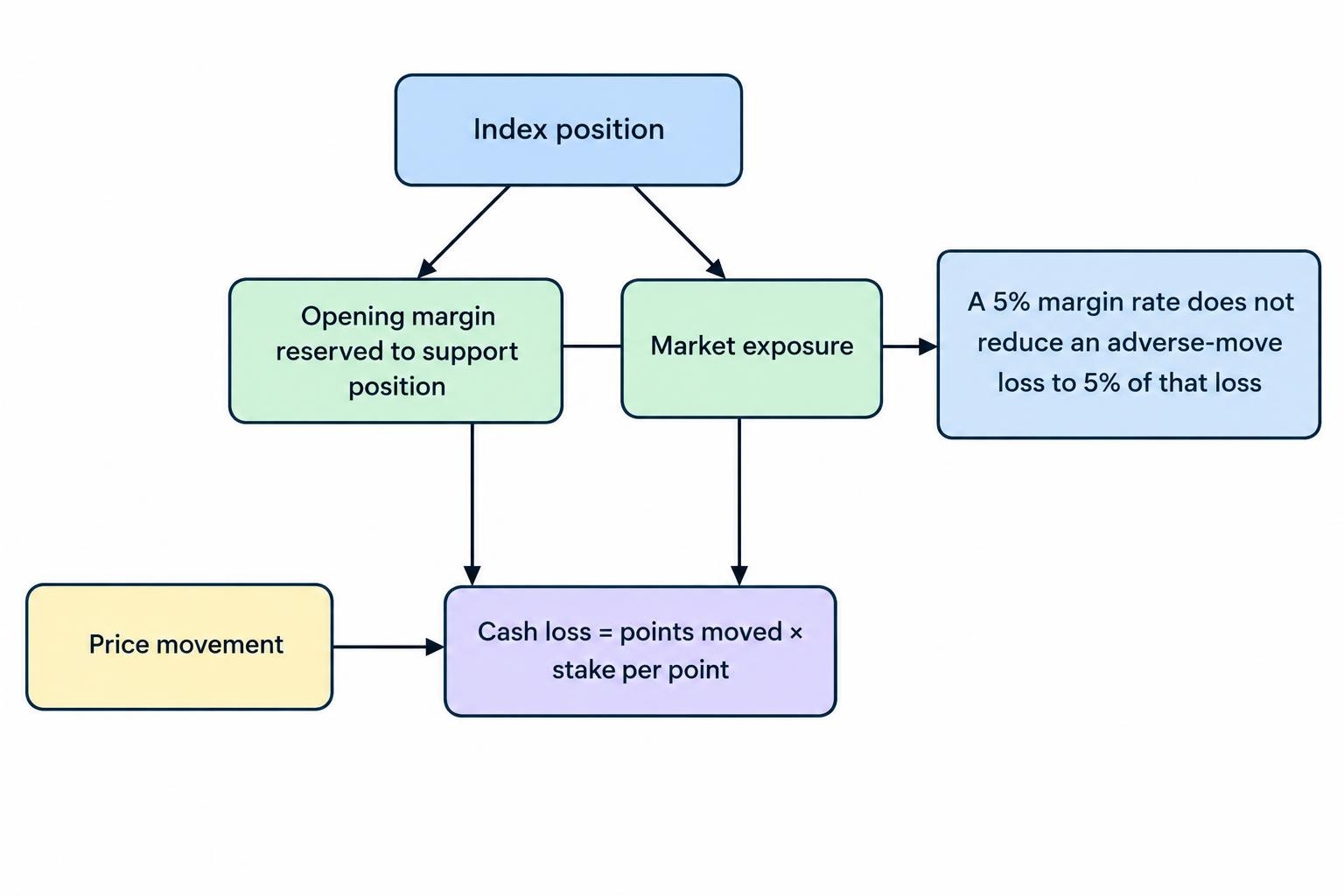
Spread betting uses margin: you commit a portion of the position’s exposure rather than paying its full equivalent value upfront. This creates leverage. The price movement applies to the full position even though the amount reserved as margin is smaller.
For a straightforward index contract where one point means one index unit, an entry level of 8,102 at £2 per point represents approximately £16,204 of market exposure. If the margin rate is 5%, the opening margin would be £810.20.
UK retail rules require opening margin of at least 5% for major stock market indices and 20% for individual shares. Providers can require more than the regulatory minimum. The applicable categories and minimum percentages appear in the FCA’s margin requirements for retail speculative investments.
Using the hypothetical index position, a 100-point adverse move costs £200 at £2 per point. That loss is not reduced to 5% of £200 simply because the margin rate is 5%. Margin changes how much cash is needed to support the exposure; it does not discount the financial effect of price movement.
Nor is margin normally a fee that disappears when you open the trade. It is an amount reserved against the position. When the position closes, that requirement is released, while the realised profit or loss and applicable charges remain in your account.
The provider’s calculation can depend on position size, product terms and account conditions, so use the ticket’s actual requirement rather than assuming every trade follows a simple percentage. The broader spread betting margin guide covers how opening and ongoing requirements differ.
A platform showing enough margin to open a trade has answered an operational question. It has not answered whether the trade is sensibly sized for your account.
What happens to your account while the bet is open?
Once the trade opens, its unrealised profit or loss changes as the available closing price moves. Unrealised means the result has not yet been settled by closing the position. It still affects the resources available to support your trading.
Platforms commonly distinguish between cash balance, equity and available funds. Cash balance generally reflects settled activity. Equity adds open profit or loss to the relevant balance, while available funds account for margin already committed. Labels and treatment of charges can differ, so check the platform’s definitions.
Suppose an account starts with £2,000, has no other positions or charges, and opens the £2-per-point long at 8,102. If the available closing sell price falls to 8,052, the open loss is £100. Account equity is then £1,900, even though the position has not been closed.
Under UK retail rules, positions must be closed as soon as market conditions allow when account equity falls below 50% of the required margin. Providers may use an earlier closure threshold. Negative balance protection restricts liability to funds in the relevant trading account, not the margin assigned to one trade. These are separate safeguards within the FCA’s retail CFD and spread betting protection measures.
For illustration, if the relevant margin requirement were £800 and remained unchanged, 50% would be £400 of account equity. That is not a rule allowing a £400 loss on each position. The calculation concerns the account and its open exposure.
Do not assume a warning gives you a guaranteed period to add funds. Forced closure is not a substitute for your own exit plan. The retail client protections guide explains the scope of these safeguards without treating them as protection against ordinary trading losses.
How orders open and close a spread bet
Entering at the market or waiting for a price
A market order requests execution at the available price. In a moving market, that price can differ from the quote you saw before submitting the order. The difference between an expected price and the execution price is slippage, which can be favourable or adverse.
A pending entry order waits for a price condition instead. A buy limit might seek entry below the current market, while a buy stop might seek entry above it. The order’s trigger rules, execution terms and expiry settings determine what happens next. An unfilled entry order is not an open position.
The spread betting order types guide separates market, limit and stop instructions. Their practical difference is whether you prioritise immediate execution, a price boundary or a trigger condition.
Closing manually or using an exit order
You can close an open position manually at the available closing price. You can also attach an exit instruction, such as a stop loss intended to close after an adverse move or a take-profit limit intended to close after a favourable one.
An ordinary stop loss does not guarantee its requested execution price. If the market jumps over the stop level, the position may close at a worse price. A long opened at 8,102 with a stop at 8,062 has a planned 40-point loss. Execution at 8,040 would instead produce a 62-point loss.
A guaranteed stop-loss order, where offered and accepted under the contract’s terms, provides the agreed stop execution level. Availability, minimum distance and premium arrangements need checking before entry.
Some platforms allow a partial close. Reducing a £2-per-point position by £1 per point settles half the exposure and leaves £1 per point open. Confirm that the instruction reduces the existing position: depending on account settings, an opposite trade could create a separate position instead.
Why the contract’s duration matters
Two spread bets referencing the same market can have different prices and costs because they use different contract structures. The distinction between a daily funded bet and a contract with a fixed expiry affects what happens if you leave the position open.
Daily funded bets
A daily funded bet is generally designed to continue from day to day, subject to the provider’s terms. Holding it beyond the relevant funding cutoff can create a financing charge or credit.
That cutoff matters more than whether you think of the trade as “overnight”. A position held for only a short period can cross a charging boundary. One held for several hours might close before it. Check the product’s funding time, calculation method and treatment of weekends or holidays.
Financing relates to the position’s exposure, not simply the margin reserved against it. A trade supported by £800 of margin can therefore attract funding calculated using a much larger exposure figure. Short positions should not automatically be assumed to earn a credit; rates and product terms determine the outcome.
Futures and forward spread bets
A fixed-expiry spread bet references a dated contract or settlement arrangement. Its price can differ from a cash-style quote, even where both reference the same underlying market. Comparing their headline prices without checking their basis can be misleading.
Funding and carrying costs may be reflected in the quoted price or spread rather than appearing as the same daily charge used for a daily funded bet. No separate daily financing entry does not mean the exposure is cost-free.
If you hold until expiry, the contract settles under its stated rules. A rollover may close the expiring contract and open another, creating a new entry price and potentially further costs. The daily funded bets versus futures comparison examines that choice in more detail.
How costs and adjustments change the final result
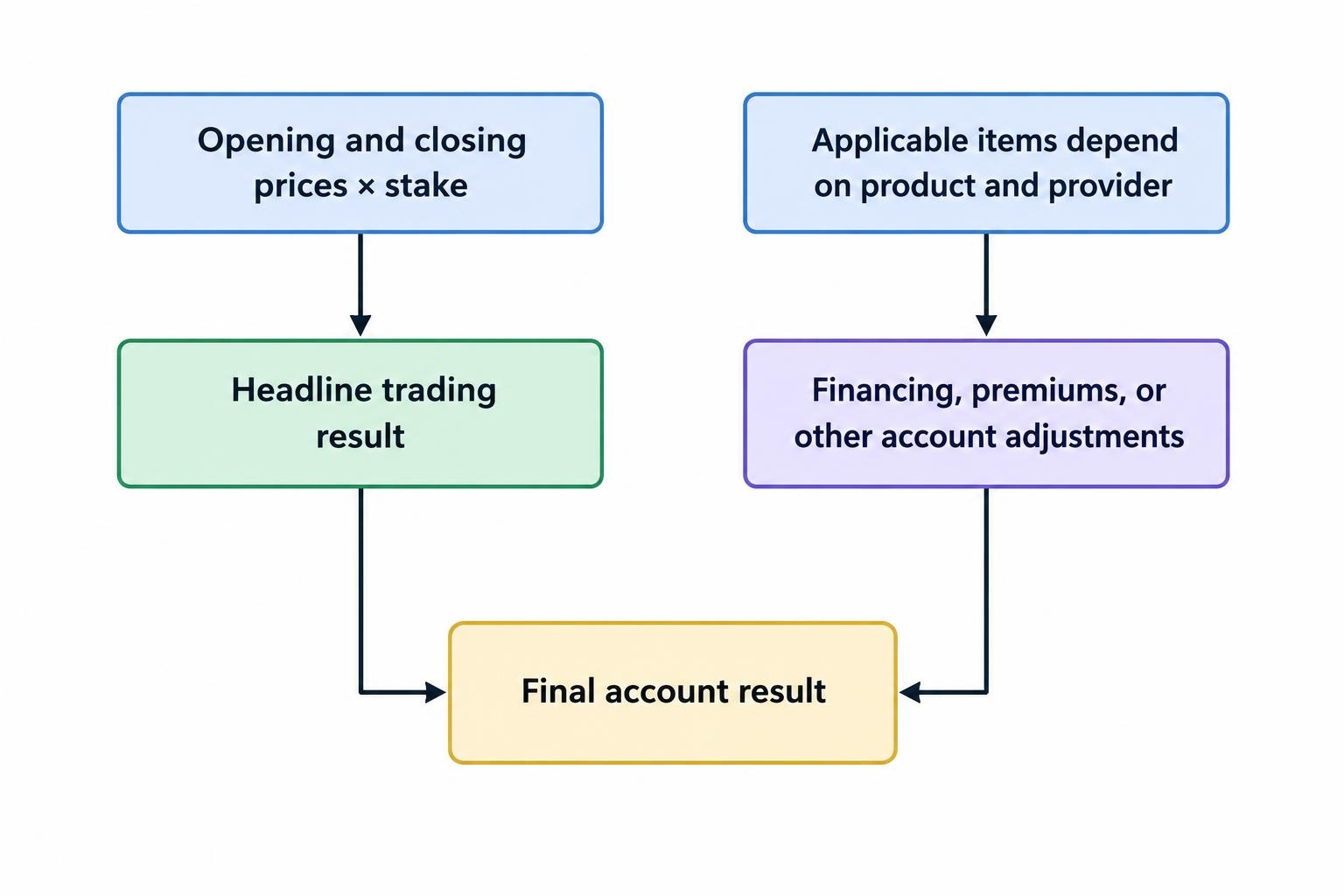
The price calculation gives the trading result. The account result also includes separate charges and adjustments. Those entries can explain why a profitable position contributes less cash than its headline profit suggests.
Suppose a position earns £96 from its entry and exit prices, then incurs £15 of financing during the holding period. Its result after that charge is £81, assuming no other adjustments. The £15 is an illustrative total, not a quoted financing rate.
Other possible costs include a guaranteed stop premium, borrowing charges on certain short share positions, currency conversion charges or account fees. Which items apply depends on the product and provider. A claim of “no commission” does not remove the spread or establish the total cost of holding the trade.
Share and index positions can also receive dividend-related adjustments. These are contract adjustments, not shareholder dividends paid because you own shares. They need to be considered alongside the associated price movement rather than treated as free additional profit.
Corporate actions can affect contract terms too. A share split, for example, may require changes to price levels or position details so that a mechanical change in the underlying share structure does not create an artificial trading gain or loss.
Review the full transaction record after closing: entry, exit, stake changes, financing, premiums and adjustments. The spread betting costs guide provides a broader framework for comparing these items.
Where UK tax treatment fits
Tax treatment is separate from the trade calculation. For an individual placing genuine financial spread bets, gains are outside capital gains tax and losses do not create allowable capital losses. HMRC’s financial spread betting guidance states that no chargeable gains or allowable losses arise.
That does not settle every tax question, establish the treatment of a company’s activity or determine obligations in another country. Read the UK spread betting tax treatment guide before applying a broad “tax-free” description to your circumstances. Tax treatment does not reduce the trading loss itself.
What to check before submitting a trade
A useful final check is to translate the order ticket into cash consequences. You should be able to explain what happens if the market rises, falls, stays near your entry or jumps beyond your planned exit.
- Contract and point size: confirm the exact market, contract duration, trading hours and meaning of one point.
- Direction and stake: check whether you are buying or selling, then calculate the cash effect of a plausible adverse move.
- Margin and account capacity: distinguish the opening requirement from your planned loss and the funds supporting other positions.
- Execution and exit: check the entry order, stop trigger, any guarantee terms and whether opposite orders reduce or create exposure.
- Holding costs and settlement: identify funding cutoffs, possible adjustments, expiry arrangements and how the position will close.
A spread betting demo account can help you practise reading these details without committing cash. It is useful for learning the interface and checking calculations, but simulated execution does not establish what a live order will achieve.
Spread betting works through a small set of connected mechanics: the quote determines your available entry and exit, the stake turns points into money, margin supports the exposure, and costs alter the settled result. Before opening a position, make sure all four agree with the trade you intended to place.