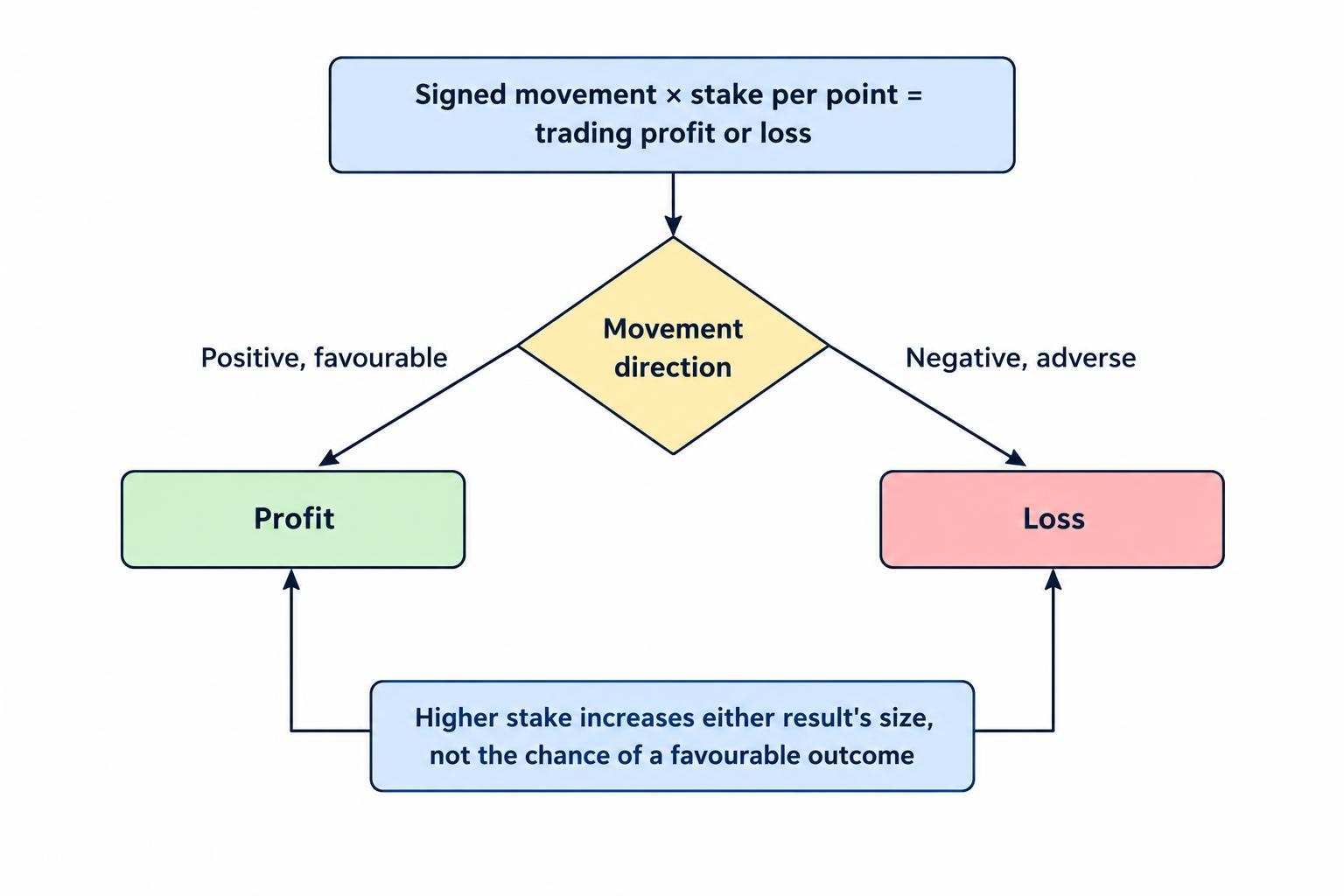
Stake per point is the amount you gain or lose for each point that a spread betting market moves in relation to your opening price. At £2 per point, a 30-point move in your favour produces a £60 trading profit. The same move against you produces a £60 trading loss, before separate charges.
The stake is not a one-off payment or your maximum possible loss. It sets how quickly price movements turn into pounds. Before placing a bet, you need to know both what the platform counts as one point and how much movement your account can withstand.
What Does £1 per Point Mean?
A stake of £1 per point means every full point of movement changes your trading profit or loss by £1. A favourable 10-point move is worth £10; an adverse 100-point move costs £100. Your stake remains £1 per point throughout, unless you change the position size.
This differs from a fixed-stake bet where the amount entered is the amount at risk. Entering “£5” in a spread betting ticket usually means £5 for every point, not £5 for the entire trade. That distinction deserves more attention than the size of the number on screen.
| Stake per point | Profit from 30 favourable points | Loss from 30 adverse points |
|---|---|---|
| £0.50 | £15 | £15 |
| £1 | £30 | £30 |
| £2 | £60 | £60 |
| £5 | £150 | £150 |
Doubling the stake doubles both the profit and the loss for an identical price movement. It does not improve the trade’s chances of success.
What Counts as One Point?
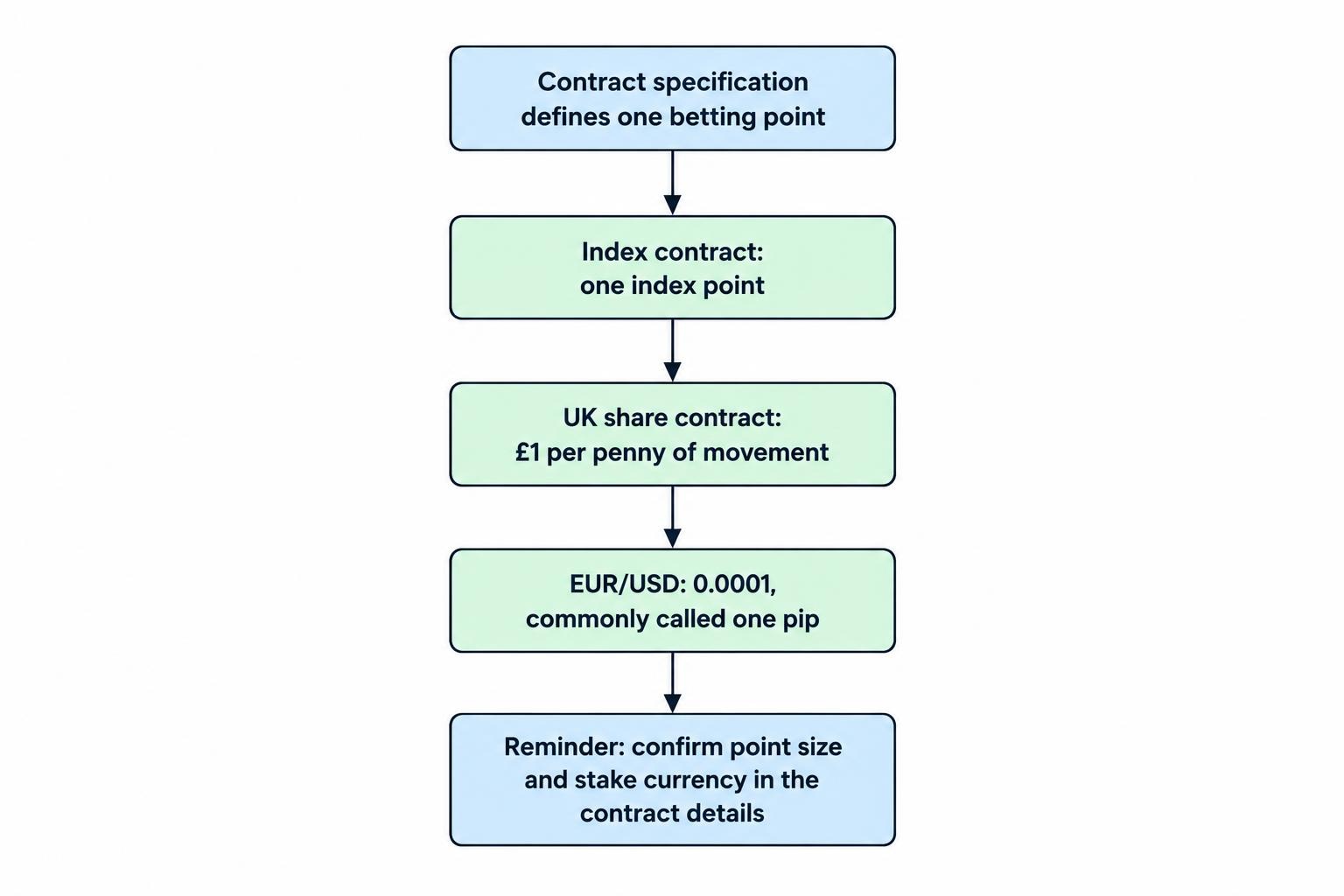
A point is the price unit used to calculate the bet’s result. Its size depends on the market and the provider’s contract specification. Never assume that the last digit displayed on a chart represents one full betting point.
On an index contract where one point equals one index point, a move from 8,000 to 8,025 is 25 points. At £2 per point, that movement is worth £50. A smaller move from 8,000 to 8,000.5 is half a point, worth £1 at the same stake.
For a UK share contract defined as £1 per penny of movement, a rise from 250p to 260p represents 10 betting points. At £3 per point, that produces a £30 profit on a long position, before separate charges.
For EUR/USD, suppose the contract defines one betting point as 0.0001, commonly called one pip. A move from 1.08000 to 1.08250 is then 25 points, not 250. The extra decimal place shows a fraction of a point. Our guide to how forex spread betting works covers currency quotations in more detail.
Check the point size, stake currency and monetary value of a sample move in the contract details. A market quoted in US dollars does not automatically mean your stake is denominated in dollars; use the currency shown on the ticket.
Calculating Profit and Loss from Your Stake
Once the point size is clear, the calculation is straightforward:
Trading profit or loss = signed movement in betting points × stake per point
A favourable movement is positive; an adverse movement is negative. For a long bet, subtract the opening buy price from the closing sell price. For a short bet, subtract the closing buy price from the opening sell price. Convert that price difference into betting points before multiplying.
Long bet example
You buy an index at 8,002 for £2 per point and later sell to close at 8,032. With one betting point equal to one index point, the favourable movement is 30 points:
(8,032 − 8,002) × £2 = £60 profit
If you instead close at 7,972, the result is a £60 loss. These are hypothetical execution prices, not current market quotations.
Short bet example
You sell the same type of index contract at 8,000 for £1.50 per point. You later buy back at 7,960, giving a favourable movement of 40 points:
(8,000 − 7,960) × £1.50 = £60 profit
If the closing buy price were 8,040, the result would be a £60 loss. The arithmetic is the same; the direction changes. See calculating spread betting profit and loss for more examples involving opening and closing prices.
How the spread affects the result
Suppose a market is quoted at 8,000–8,002. You buy at 8,002, but an immediate sale at an unchanged quote would execute at 8,000. At £2 per point, that two-point difference produces an initial £4 loss.
When you calculate the result using actual opening and closing execution prices, the spread is already reflected in those prices. Do not subtract it again. Separate charges, such as applicable overnight financing or stop premiums, still affect the net result. The guide to spread betting spreads explains the difference between the buy and sell quotes.
How to Choose a Stake per Point
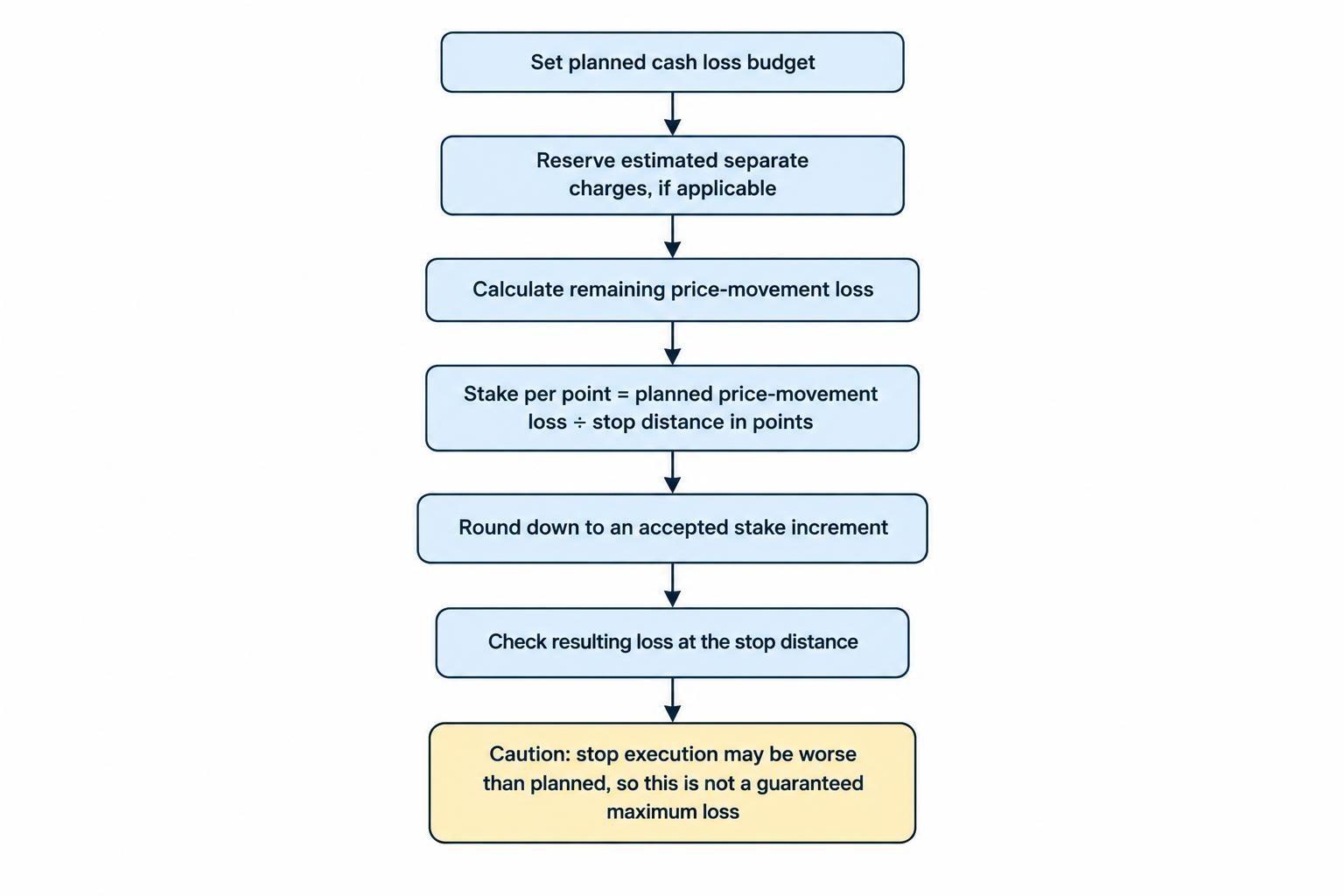
Start with the cash loss your trading plan allows, rather than the largest stake the platform accepts. Then work backwards from the distance between your intended entry and stop level.
Stake per point = planned price-movement loss ÷ stop distance in points
Suppose a hypothetical £5,000 account has a £50 loss budget for one trade. This is an illustration, not a recommended account size or risk percentage. If the intended stop is 30 points from entry, the calculation before separate costs is:
£50 ÷ 30 = approximately £1.67 per point
That figure leaves no allowance for separate charges or a worse execution price. If you reserve £5 of the budget for estimated charges, £45 remains for the planned price movement:
£45 ÷ 30 = £1.50 per point
At £1.50 per point, a 30-point adverse movement costs £45. The £5 reserve is an estimate, not protection against a larger loss.
Use a stake increment the ticket accepts and round down when necessary. If your calculation produces £1.66 but the hypothetical ticket accepts increments of £0.10, £1.60 stays below that calculated amount; £1.70 does not.
A wider stop requires a smaller stake if the cash budget stays unchanged. A 60-point stop at £1 per point carries the same planned price-movement loss as a 30-point stop at £2 per point. Our position sizing guide develops this process across different trades and account exposures.
Stake, Exposure and Margin Are Different Amounts
Three figures can appear around the same trade: the stake per point, the market exposure and the required margin. They answer different questions.
Consider a hypothetical index priced at 8,000, with one betting point equal to one index point. At £2 per point, the position has approximately £16,000 of market exposure: 8,000 × £2.
If the applicable margin rate is 5%, the opening margin is £800. The FCA’s retail margin requirements in COBS 22.5.11 set a minimum opening margin of 5% for major stock market indices; a provider may require more.
A 100-point adverse move on that £2-per-point position creates a £200 trading loss, before separate charges. The loss calculation uses the stake and movement, not the £800 margin figure.
Margin is money required to support the position, not a fixed purchase price or a cap on the trade’s loss. Do not increase your stake simply because the account has enough available margin. The separate guide to spread betting margin explains how that requirement affects available funds.
Why a Small Stake Can Still Produce a Large Loss
A small stake reduces the cash effect of each point. It does not control how far the market can move before you exit. At £0.50 per point, a 400-point adverse movement still costs £200 before separate charges.
An ordinary stop-loss order also does not guarantee the planned exit price. If a stop is 30 points away but the position closes 45 points away after a market gap, a £2-per-point stake produces a £90 price-movement loss rather than £60. The stop distance was a planning assumption, not an assured result.
If guaranteed stops are available for the contract, check their terms and premium before using them in a loss calculation. Our guide to stop-loss orders explains the distinction between a stop level and its execution price.
Check the minimum stake too. If your calculation calls for £0.40 per point but the market requires at least £1, increasing the stake to meet the minimum changes the risk. Skipping the trade is a valid response; forcing the numbers to fit is not.
Check the Stake Before Confirming the Trade
Before placing an order, confirm what one point means, the currency of the stake, and the cash effect of the intended stop distance. Include existing positions in that check: opening another bet can increase the account’s exposure even if its individual stake looks modest.
A useful final question is: “If this position moves 10, 50 or 100 points against me, what does that cost?” If you cannot answer immediately from the contract details and chosen stake, pause before submitting the order. The number entered in the stake box should be the result of a calculation, not a guess.