A margin call is a warning that your spread betting account needs more funds, less exposure, or both to support its open positions. It can follow trading losses, higher margin requirements or a combination of the two. Leave the shortfall unresolved and your provider may close positions.
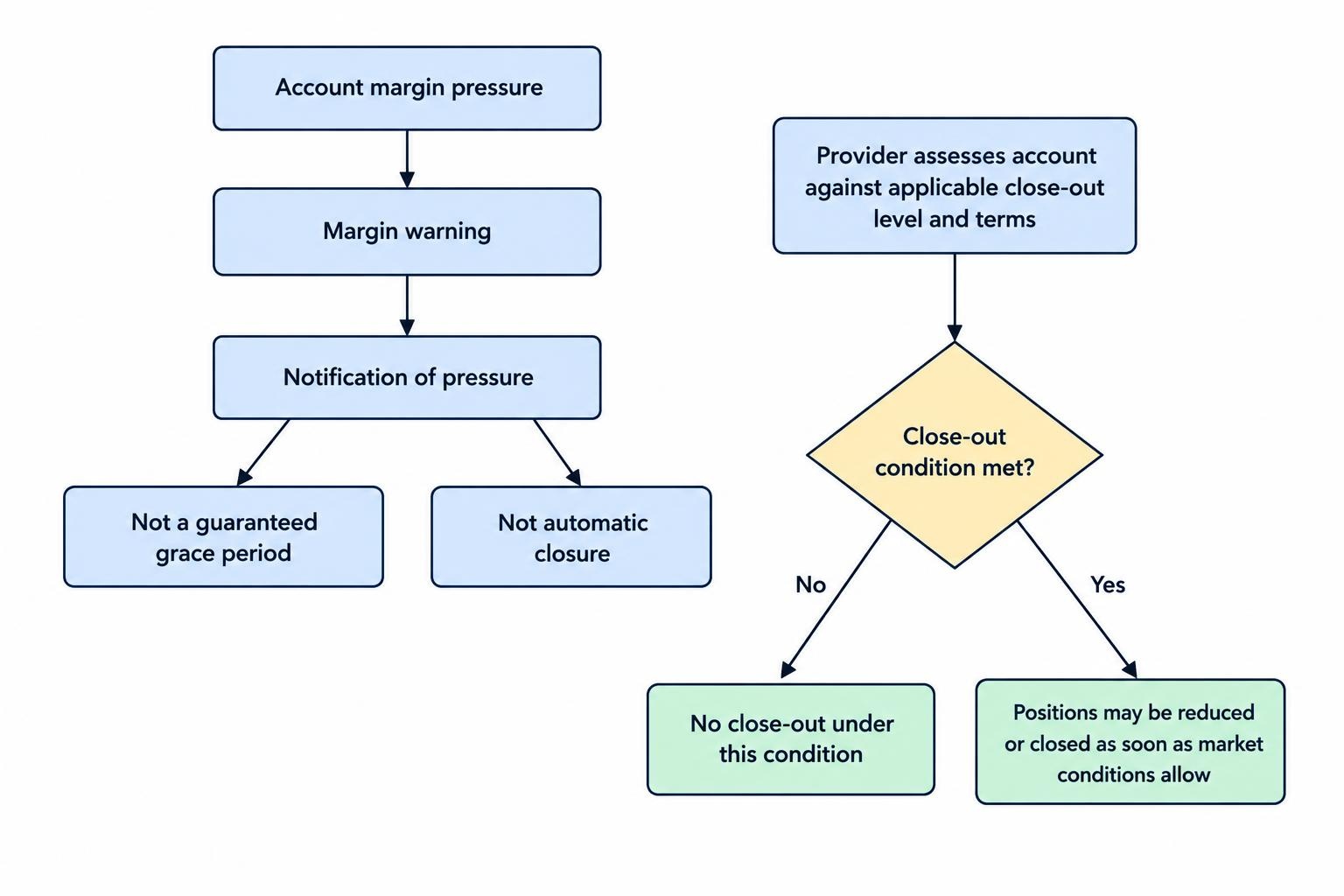
The distinction that matters is between a margin warning and compulsory close-out. A warning tells you the account is under pressure. Close-out means the provider starts reducing your exposure. Do not treat the gap between them as guaranteed thinking time.
What Is a Margin Call in Spread Betting?
When you open a spread bet, the provider reserves part of your account funds as margin. That amount supports the position; it is not a fee or a maximum possible loss. The separate guide to spread betting margin covers how this initial requirement works.
A margin call arises when the funds supporting your positions become insufficient under your provider’s account rules. You may need to deposit money, reduce positions or close them completely. The provider’s terms determine its warning levels and what action it can take.
Despite the name, do not expect an actual telephone call. Check which notifications your account offers, but treat alerts as a backup to monitoring the account yourself. A warning does not freeze prices, protect your remaining funds or promise that a position will stay open.
The Account Figures Behind a Margin Call
Your cash balance alone does not show whether your account can support its positions. Open losses matter before you close the trades.
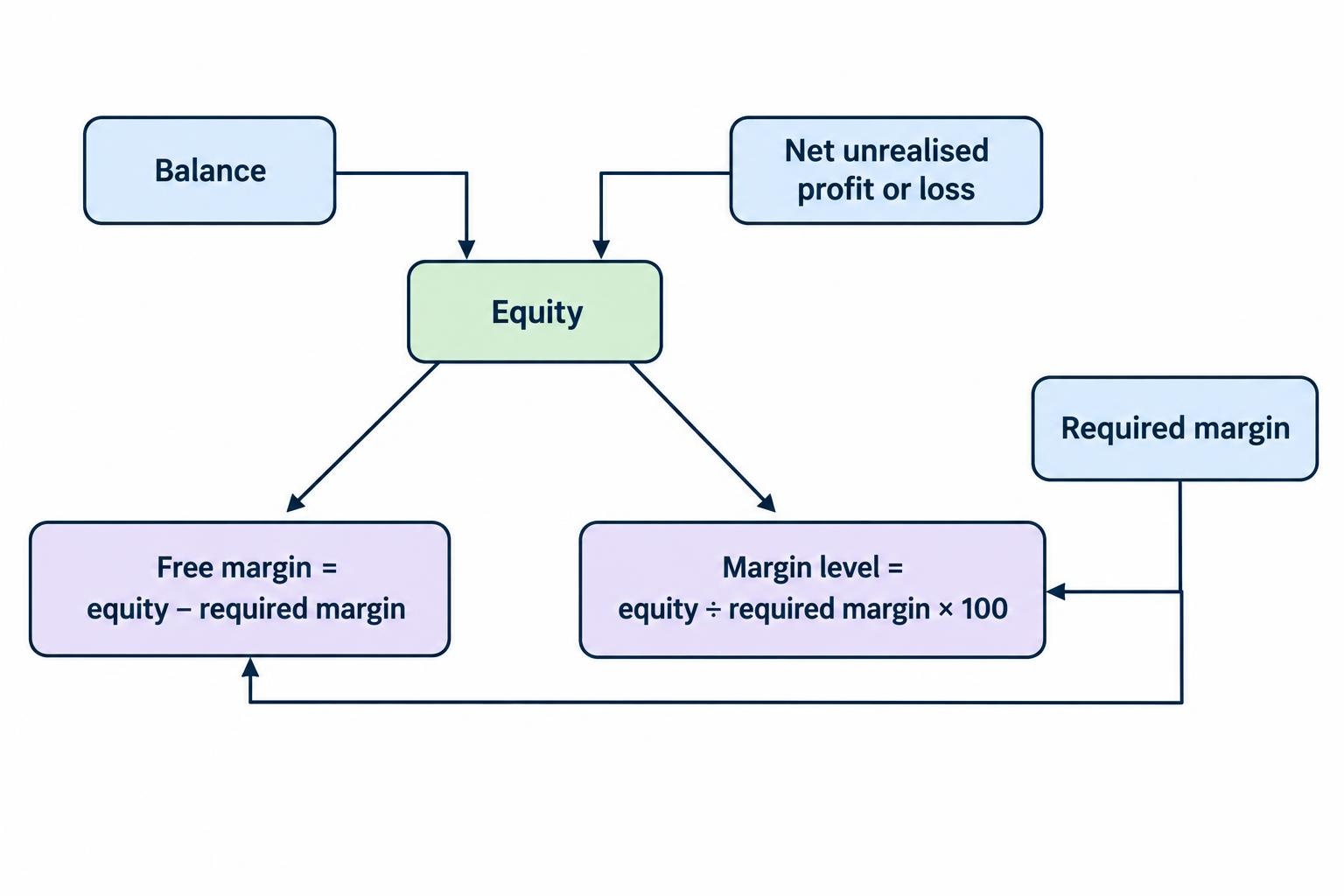
Balance is the account’s recorded cash balance after settled transactions, realised profits and losses, and booked charges. Equity also includes the current profit or loss on open positions. A £3,000 balance with £1,200 of open losses leaves £1,800 of equity, before any other adjustments.
Required margin is the amount needed to support your open positions. Free margin, sometimes displayed as available funds, is generally equity minus required margin. Providers may use different labels or account adjustments, so check the platform’s definitions.
For a simplified account:
Equity = balance + net unrealised profit or loss
Free margin = equity − required margin
Margin level = equity ÷ required margin × 100
Suppose equity is £1,800 and required margin is £2,000. Free margin is minus £200, while the margin level is 90%. That is a margin shortfall, not a negative account balance: the account still has positive equity.
Also check the direction of any percentage displayed. “Margin level” may measure equity against margin, while “margin utilisation” may measure margin against equity. A rising number can mean improving cover on one display and increasing pressure on another.
Margin Calls and the UK Close-Out Rule
For retail spread bets covered by the FCA rules, providers must close open positions when account net equity falls below 50% of the margin requirement, as soon as market conditions allow. This is an account-level test, not a separate allowance for every trade. The same section also provides negative balance protection for covered retail accounts: FCA rules on retail margin close-out and negative balance protection.
The 50% figure is not necessarily your provider’s warning level or its earliest closure point. Providers can use a higher close-out percentage, provided the applicable terms are clear. The FCA policy statement on earlier margin close-outs expressly permits this.
Keep three levels separate: the margin needed to open a position, any warning threshold, and the point at which the provider closes positions. They need not be identical.
Nor does a 50% threshold promise an execution price. Prices can move through it before closure becomes possible. The dedicated guide to the margin close-out rule covers the regulatory mechanism in more detail.
A Worked Margin Call Example
Assume you deposit £2,500 and buy an illustrative index at £5 per point. The position requires £2,000 of margin. To isolate the calculation, assume that requirement stays unchanged and exclude the spread, financing and other charges.
You begin with £500 of free margin. Each point against the position reduces equity by £5.
| Adverse move | Open loss | Account equity | Free margin | Margin level |
|---|---|---|---|---|
| 0 points | £0 | £2,500 | £500 | 125% |
| 100 points | £500 | £2,000 | £0 | 100% |
| 200 points | £1,000 | £1,500 | −£500 | 75% |
| 300 points | £1,500 | £1,000 | −£1,000 | 50% |
At a 100-point loss, the account has no free margin. That does not automatically mean compulsory closure under a 50% threshold, although the provider’s own terms may require action earlier.
At a 300-point loss, equity reaches the illustrative 50% boundary. A further loss would take it below that level. Notice that the account has already lost 60% of its original £2,500 deposit. The close-out percentage refers to the margin requirement, not the percentage of your starting deposit you can lose.
At the 200-point stage, the distance to that boundary is £500 of equity, equivalent to another 100 adverse points at £5 per point. This is only a snapshot. Charges, changing margin requirements and price gaps can alter the result.
The example also shows why opening margin is a poor measure of affordable risk. Your stake and position size determine how quickly market movements consume the remaining funds.
What Can Trigger a Margin Call?
Losses Across Open Positions
A falling market reduces equity on a long position; a rising market does the same on a short position. The account calculation includes net open profits and losses, so pressure can come from several trades rather than one large loss.
Holding several positions does not necessarily spread the risk. Three index bets can respond to the same market shock. Assess correlation between open positions rather than counting trades and assuming that more means safer.
A Higher Margin Requirement
Check whether your provider’s terms allow margin requirements to change on existing positions. If they do, a higher requirement can create a shortfall without a fresh trading loss.
For example, £3,000 of equity against £2,000 of required margin gives a 150% margin level. If required margin rises to £4,000, the level falls to 75%, even though equity is unchanged. Larger positions may also fall into different margin tiers, depending on the provider’s schedule.
Charges and Withdrawals
A charge debited to the account reduces equity. Withdrawing funds reduces the cash cushion too. Neither changes the stake per point on positions that remain open.
Allow for applicable overnight financing costs when projecting how much account headroom remains. A calculation that ignores future charges overstates the room available for adverse price movements.
What to Do When You Receive a Margin Call
Start with the live account figures: equity, required margin, available funds and the applicable close-out level. Establish whether the problem is a loss, a changed requirement or both. Then reassess the exposure, rather than treating a deposit as the automatic response.
Reduce or Close Positions
Reducing a position lowers its sensitivity to further price changes and will normally reduce its margin requirement. Closing it removes that position’s future market exposure, although execution costs still matter.
Return to the example at the 200-point loss. Equity is £1,500, against £2,000 of required margin. If half the position is closed and margin falls proportionately to £1,000, the margin level becomes 150%, ignoring further costs and price changes.
Equity does not jump because part of the loss becomes realised. Roughly speaking, the balance falls by the realised loss while the remaining unrealised loss becomes smaller. The improvement comes from requiring less margin and carrying less exposure, not from making the loss disappear.
If you hold several positions, do not assume the provider will close the one you would choose. Check its liquidation policy before the account reaches that stage.
Add Funds Only Within a Predefined Budget
A deposit can restore margin cover once credited and recognised by the provider. It does not reduce the position’s stake per point or repair the trade’s prospects.
Adding £500 to an account with £1,500 of equity raises equity to £2,000. At £5 per point, every further adverse point still costs £5. More of your money now supports the same exposure.
Do not assume that initiating a transfer resolves the shortfall immediately. Confirm that the provider has credited it. Funds needed for bills, emergency savings or other commitments should not become an improvised trading reserve.
Do Not Depend on a Rebound
A price recovery could improve equity before closure, but it is not an account-management plan. The provider’s close-out process responds to margin conditions, not your view that the market has fallen far enough.
A useful test is whether you would open the same position, at its current size, with the equity now available. If not, keeping it solely to avoid realising a loss deserves scrutiny.
How to Reduce the Risk of Future Margin Calls
Plan the acceptable loss before opening the trade. Set the stake from that loss budget and the intended exit distance, then check the margin requirement separately. A platform accepting an order does not mean the position is affordable.
Keep enough account headroom for the positions you actually hold. There is no universal safe margin percentage: a buffer that tolerates ordinary movement in one market may offer little protection in another.
Use stop-loss orders as part of the exit plan, but distinguish them from margin close-out. A stop targets the risk on a chosen trade. Margin close-out responds to the condition of the account. An ordinary stop also does not guarantee execution at its requested price.
Before opening another position or withdrawing money, recalculate the account with the proposed change included. Consider a combined adverse move across related trades, not just a loss on each trade in isolation.
Check the account before periods when you cannot monitor it, particularly if positions remain open across market closures. An alert can tell you that a problem exists; it cannot supply the funds or reduce the stake for you.
What Margin Protection Does Not Guarantee
Margin close-out is not a promise that you will retain a set proportion of your deposit. A price gap can carry the account past the threshold, and closure depends on executable market conditions. It should not replace a planned exit.
Likewise, negative balance protection concerns the account’s liability, not the preservation of deposited capital. The distinction is between avoiding a debt beyond the protected account funds and avoiding a trading loss. Those are very different outcomes.
This article addresses covered UK retail accounts. Do not assume that a professional or overseas account has identical terms or protections.
If You Think a Margin Closure Was Wrong
Preserve account statements, timestamps, notifications and the terms that applied. Ask the provider to explain the equity calculation, margin requirement, trigger level and execution prices, including which positions it closed and why.
Those records matter when challenging a closure. The Financial Ombudsman’s evidence requirements for derivatives complaints include the account status at the margin call and an explanation of the trades closed.
A later market recovery does not by itself establish an error. The relevant questions concern the account’s condition at the time, the applicable terms and how the provider carried out the closure.