A daily funded bet (DFB) is a spread bet that normally remains open without a fixed expiry date, with a funding adjustment when it is held beyond the provider’s daily cutoff. “Daily” describes the funding arrangement, not a requirement to close the bet each evening (Financial Ombudsman decision on daily funded bet terms).
The practical trade-off is straightforward: you can maintain exposure without choosing a dated contract, but holding costs can accumulate. Before opening a DFB, check the price reference, the funding calculation and how long you expect to keep the position. A narrow dealing spread tells you only part of the cost.
How Daily Funded Bets Work
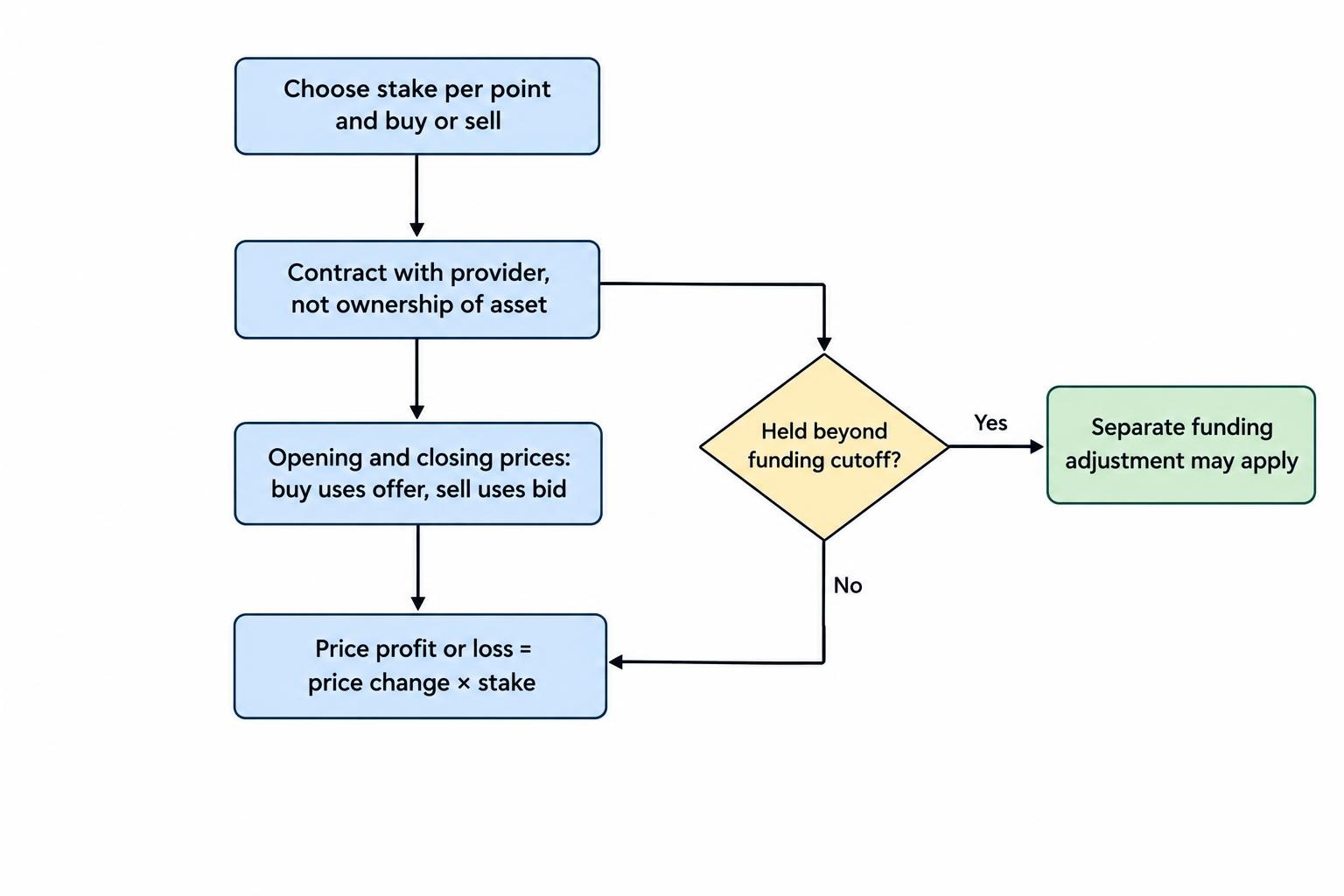
A DFB uses the usual spread betting mechanics. You choose a stake per point, buy if you expect the quoted price to rise or sell if you expect it to fall. Your trading profit or loss depends on the difference between your opening and closing execution prices, multiplied by that stake.
You buy at the offer and sell at the bid. This means a newly opened position usually starts with a loss equal to the spread, assuming prices have not moved. Funding is separate from that initial dealing cost. The guide to how spread betting works covers the underlying transaction mechanics.
DFBs commonly use a cash or spot market reference, or a price constructed to represent an undated market. That does not mean every product labelled “cash”, “rolling daily” or “undated” has identical terms. Check the instrument’s contract details rather than relying on its name.
You do not acquire the underlying asset. A share DFB does not give you shares or voting rights, and an index DFB does not buy the index’s constituent companies. You hold a contract with the spread betting provider.
What the Overnight Funding Charge Covers
Overnight funding is the adjustment associated with maintaining the position beyond its funding cutoff. For conventional cash share and index bets, the calculation commonly combines a reference interest rate with the provider’s administration charge. The applicable rate can depend on the underlying market’s currency, not just the currency of your trading account.
Funding can be calculated on the full notional exposure rather than the margin deposit. Charges vary between providers and assets, and a short position can attract either a debit or a credit. Selling short does not automatically mean receiving interest. These distinctions matter when comparing prices (FCA findings on overnight funding charges and notional exposure).
Keep three amounts separate: the cash deposited in your account, the margin reserved for the trade and the exposure used in the funding calculation. They serve different purposes. Adding spare cash to an account should not be assumed to reduce its funding charges; that depends on the contract’s pricing method.
For a straightforward cash index contract, an illustrative calculation is:
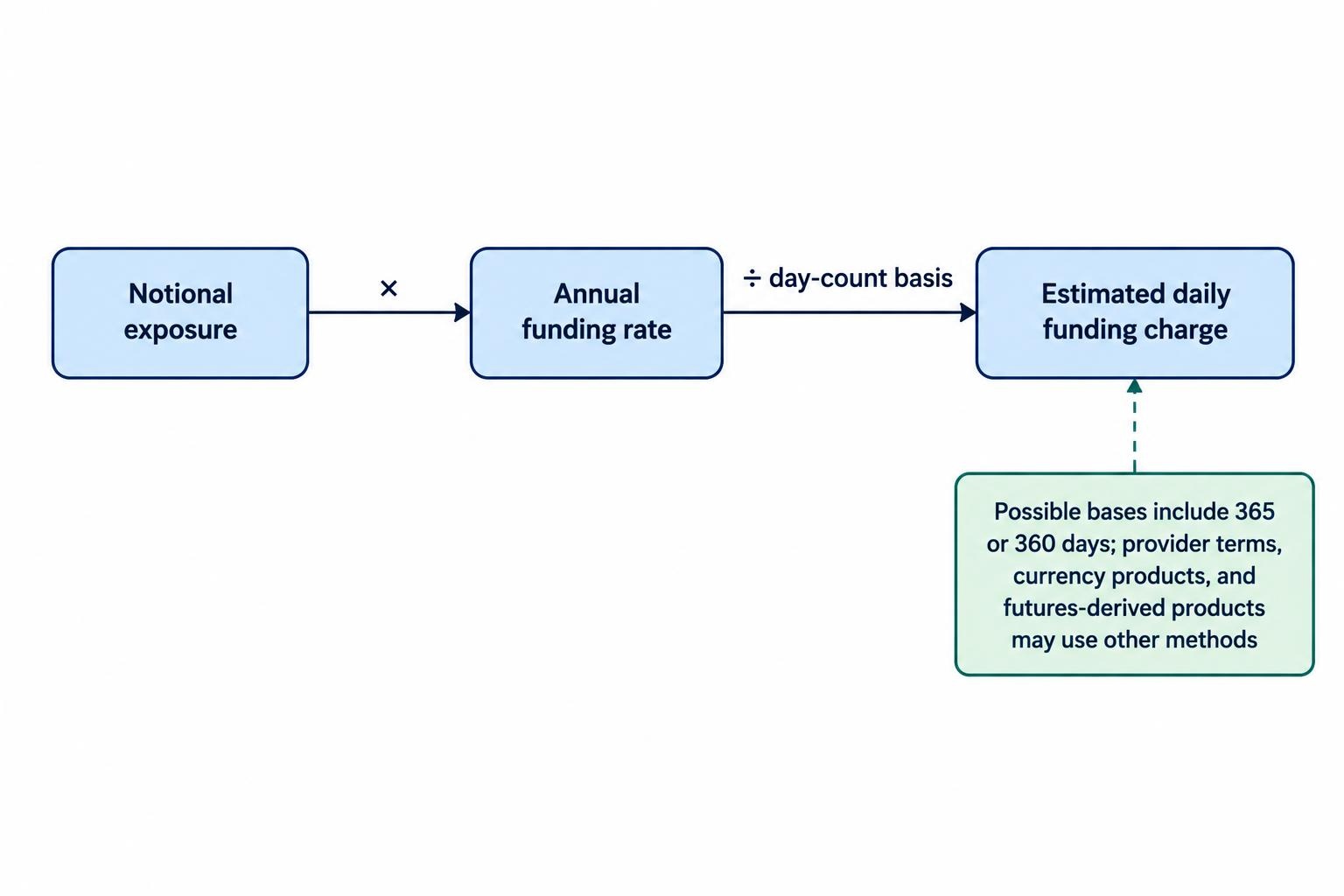
Daily funding charge = notional exposure × annual funding rate ÷ day-count basis
The provider may use a 365-day or 360-day basis. It may also recalculate the reference value each day. Currency and futures-derived products can use other methods, so this formula is not universal. The separate guide to overnight financing costs examines those calculations in more detail.
Funding Cutoffs, Weekends and Holidays
The funding cutoff matters more than the number of hours a position has been open. If a hypothetical contract applies funding at 10pm, opening at 9.50pm and holding until 10.10pm could trigger an adjustment despite a holding period of only 20 minutes. Opening earlier and closing before that cutoff could avoid that funding event.
Check the stated time zone rather than assuming the platform uses your local time. Allow enough time to submit and execute a closing order; pressing the button just before the cutoff is not the same as having a confirmed execution.
Weekend funding can be collected on a weekday, and rates may change while positions remain open. A published Financial Ombudsman decision examined both arrangements in a currency CFD dispute. It is a useful reminder to distinguish the collection date from the period being funded (Financial Ombudsman decision on variable funding and weekend collection).
For your DFB, check how many funding days each adjustment covers, including any holiday treatment. Do not assume every market has the same multiple-day charge date. Closing and reopening solely to avoid funding also needs a cost comparison: another spread and an adverse execution price could outweigh the charge avoided.
Daily Funded Bet Worked Example
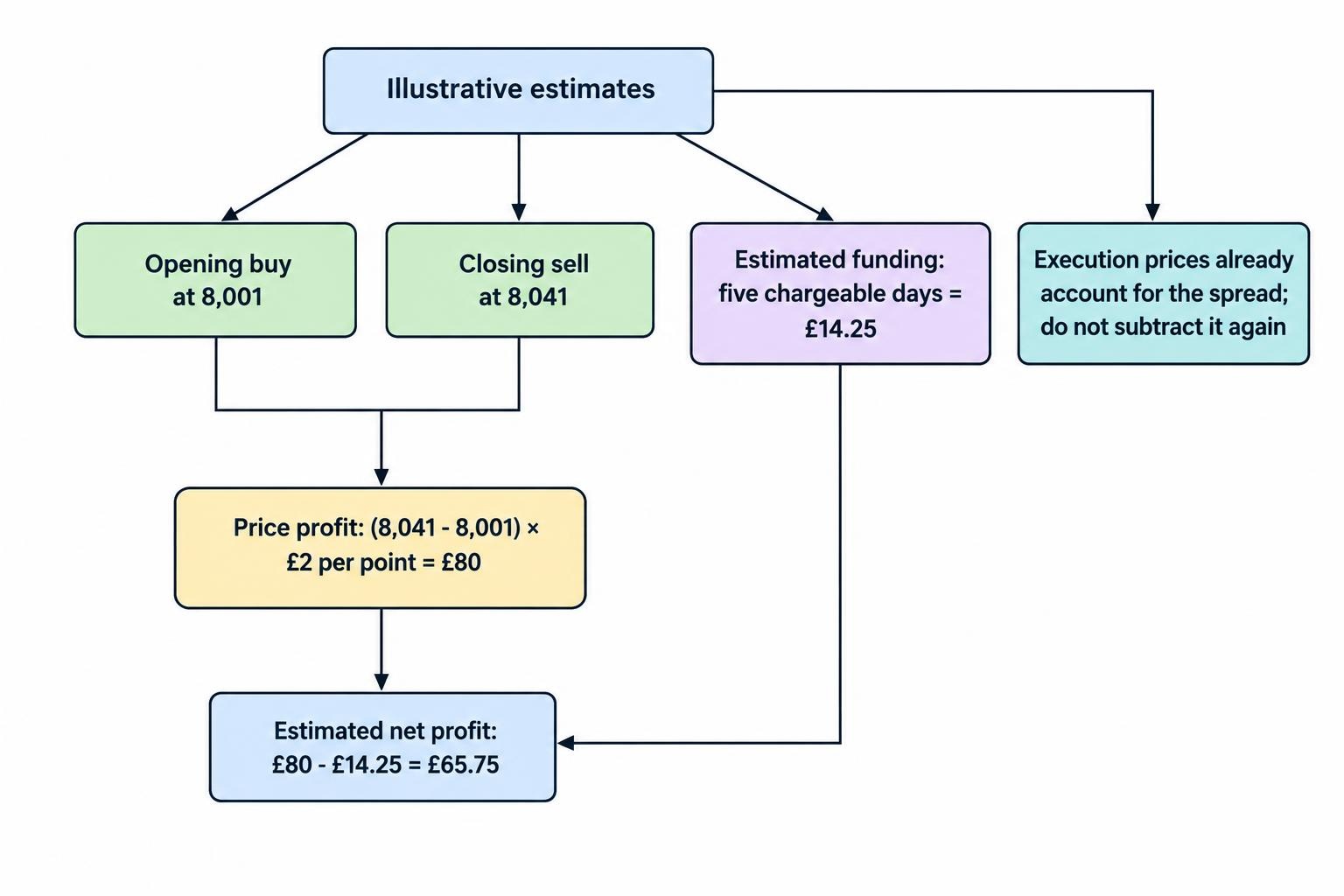
Suppose a hypothetical cash index DFB is quoted at 7,999–8,001. Each index point represents one betting point. You expect the market to rise and buy at 8,001 for £2 per point.
For the funding estimate, assume a reference index level of 8,000 and a total annual funding rate of 6.5%. These are illustrative figures, not a current market quote or provider tariff.
Notional exposure: 8,000 × £2 = £16,000
Estimated daily funding: £16,000 × 6.5% ÷ 365 = £2.85, rounded
You hold through five chargeable funding days, then close when the quote is 8,041–8,043. As a buyer closing a long position, you sell at the bid of 8,041.
| Trade component | Calculation or amount |
|---|---|
| Opening quote | 7,999–8,001 |
| Opening buy price | 8,001 |
| Stake | £2 per point |
| Closing sell price | 8,041 |
| Price profit | (8,041 − 8,001) × £2 = £80 |
| Estimated funding | 5 × £2.85 = £14.25 |
| Estimated net profit | £80 − £14.25 = £65.75 |
The execution prices already account for the spread. Do not subtract it again. Funding is deducted separately because it is not included in the £80 price profit.
This estimate keeps the £16,000 funding reference value and annual rate unchanged. Actual daily charges may differ if the provider reprices the exposure, changes the applicable rate or uses another day-count basis. Dividend adjustments, borrowing charges and other applicable costs are excluded.
Funding also increases losses. If you instead closed at 7,961, the price loss would be £80. Adding the same estimated £14.25 funding charge would produce a £94.25 loss.
Reconcile the trade against your spread betting account statement, not just the position’s headline profit figure. Check whether the platform’s displayed result includes funding already booked elsewhere in the account.
Other Adjustments That Can Affect a DFB
Funding is not the only adjustment to consider. Cash share and equity index DFBs can receive dividend adjustments when the underlying shares go ex-dividend. Long positions generally receive a credit and short positions generally receive a debit, subject to the contract’s terms.
That credit is not a free return. It relates to the dividend effect on the reference price rather than ownership of the underlying shares. The amount and timing should be checked separately from overnight funding; the guide to spread betting dividend adjustments covers that treatment.
Short share positions may also attract borrowing charges. Do not assume a favourable funding adjustment cancels those charges: assess each item independently.
For an undated product derived from futures prices, check whether a quoted overnight adjustment includes a pricing adjustment as well as an administration charge. Applying a standard cash index formula to every instrument can produce a misleading estimate.
Daily Funded Bets Versus Dated Bets
A daily funded bet separates the ongoing funding adjustment from the dealing spread. A futures or forward spread bet has a stated expiry and normally reflects financing in its contract price or quoted terms rather than applying the same separate daily funding charge.
Neither arrangement makes financing disappear. The comparison should cover the same market exposure and intended holding period, including any costs of replacing a dated position at expiry.
For a trade expected to close before the funding cutoff, the DFB spread may be the main direct transaction cost. For a position held across many funding days, the recurring adjustment deserves more attention. There is no universal number of days after which a dated bet becomes cheaper.
Compare both contracts using the provider’s actual terms. The daily funded bets versus futures comparison examines that choice without treating the smallest spread as the deciding factor.
Margin and Risk on Daily Funded Bets
A DFB’s lack of a fixed expiry does not guarantee that you can hold it indefinitely. You still need sufficient account equity, and the provider’s contractual closure and suspension provisions still apply.
Suppose the £16,000 exposure in the example required £800 of initial margin. A 200-point adverse move at £2 per point would create a £400 price loss before funding. The calculation uses the full stake, not a reduced amount because only £800 was reserved.
That is why spread betting margin should be treated as collateral rather than a budget for the trade’s maximum loss. Funding debits also reduce available account equity, leaving less room to absorb adverse price movements.
For covered UK retail accounts, the rules require providers to close open positions as soon as market conditions allow when account net equity falls below 50% of the required margin. Negative balance protection caps liability for covered speculative investments at the funds dedicated to that trading account, not at each trade’s opening margin (FCA COBS 22.5 margin close-out and negative balance rules).
An ordinary stop loss does not guarantee execution at its requested level. A market gap can produce a worse closing price. Use stop-loss orders with an awareness of their execution terms, rather than assuming an open-ended contract gives you time to recover every loss.
Also distinguish “no expiry” from “always tradable”. A suspended underlying market or another exceptional event can affect your ability to close. Check the terms covering suspended positions and whether funding can continue during that period.
What to Check Before Opening a Daily Funded Bet
Start with the intended holding period, then calculate the cost of a longer stay. A trade planned for one afternoon can become a multi-day position if the exit decision is left vague.
- Contract identity: Confirm that the instrument is a DFB or equivalent undated contract, and check what one betting point represents.
- Funding terms: Find the calculation basis, annual rate or adjustment method, administration charge and treatment of long versus short positions.
- Collection schedule: Confirm the cutoff time, time zone, funding days covered and holiday arrangements.
- Other adjustments: Check dividend treatment, short borrowing charges and any futures-derived pricing adjustments.
- Exit and account capacity: Set a planned exit and leave room for adverse price movements and accumulated charges.
Choose the stake through a position sizing calculation, not by asking how much exposure the available margin will permit. Include an estimate of funding in the trade plan, while recognising that execution losses can exceed the planned amount.
A daily funded bet offers a flexible holding arrangement, but flexibility has a running cost. Assess the trade using its expected net result after spread, funding and other adjustments. No fixed expiry is useful; it is not a reason to stop reviewing the position.