A market gap occurs when a price jumps from one level to another without recorded trading through the prices in between. On a chart, it can appear as empty space between the end of one session and the start of the next.
For spread bettors, the practical issue is execution. If a market reopens beyond an ordinary stop loss, the position may close at a worse price than planned. A gap can also increase a profit, trigger an entry order or leave an order unfilled. The direction of the jump matters, but so does the price at which you can actually trade.
How a Market Gap Appears on a Chart
Suppose an index finishes its trading session at 8,000 and opens the next session at 7,880. The opening gap is 120 points down, or 1.5% of the previous close. The chart moves directly between those levels rather than showing a continuous sequence of transactions through them.
An opening gap does not have to sit entirely outside the previous day’s trading range. If that day’s low was 7,850, an opening price of 7,880 would still be inside the range. Traders sometimes distinguish this from a full gap, where the new session opens above the previous session’s high or below its low.
The chart’s session settings matter too. A chart showing only regular exchange hours may display a gap even though related instruments traded during the missing hours. That does not make the chart incorrect. It means the gap describes the data and session being displayed, not necessarily a complete absence of trading elsewhere.
A gap is also different from slippage. The gap describes a discontinuity in price. Slippage describes the difference between an expected or requested execution price and the actual fill. A gap can cause slippage, but slippage can occur without a visible gap.
Why Markets Gap
Prices reflect the orders available at the time. When news changes what buyers will pay or sellers will accept, the next transaction may take place well away from the previous price. There is no requirement for the market to visit every price along the way.
News Arrives While Trading Is Closed
A company can release results after its shares stop trading in the regular session. Political developments, policy announcements and events affecting commodity supplies can also arrive during a closure. When trading resumes, orders reflect the new information rather than the conditions that existed at the previous close.
Opening auctions bring together orders before continuous trading begins. The NYSE’s opening auction procedures include publication of order imbalances before the auction completes. The opening process establishes a tradable price; it does not promise to reproduce the previous closing price.
Weekend closures deserve attention for the same reason. News continues even when a particular dealing service is shut. Check the instrument’s spread betting trading hours, including holiday arrangements and daily breaks, rather than assuming that every market follows the same schedule.
Available Buyers or Sellers Disappear
A market does not need to close overnight to jump. During trading, an announcement or sudden withdrawal of orders can leave very little available at nearby prices. Transactions may then move rapidly to a different level.
Exchange restrictions can also interrupt trading. Under CME Group’s futures price limit arrangements, a contract reaching its permitted price boundary may remain at that boundary, enter a temporary halt or stop trading for the day, depending on the product’s rules. A trading pause should not be mistaken for protection against a further adverse move.
A Worked Spread Betting Gap Example
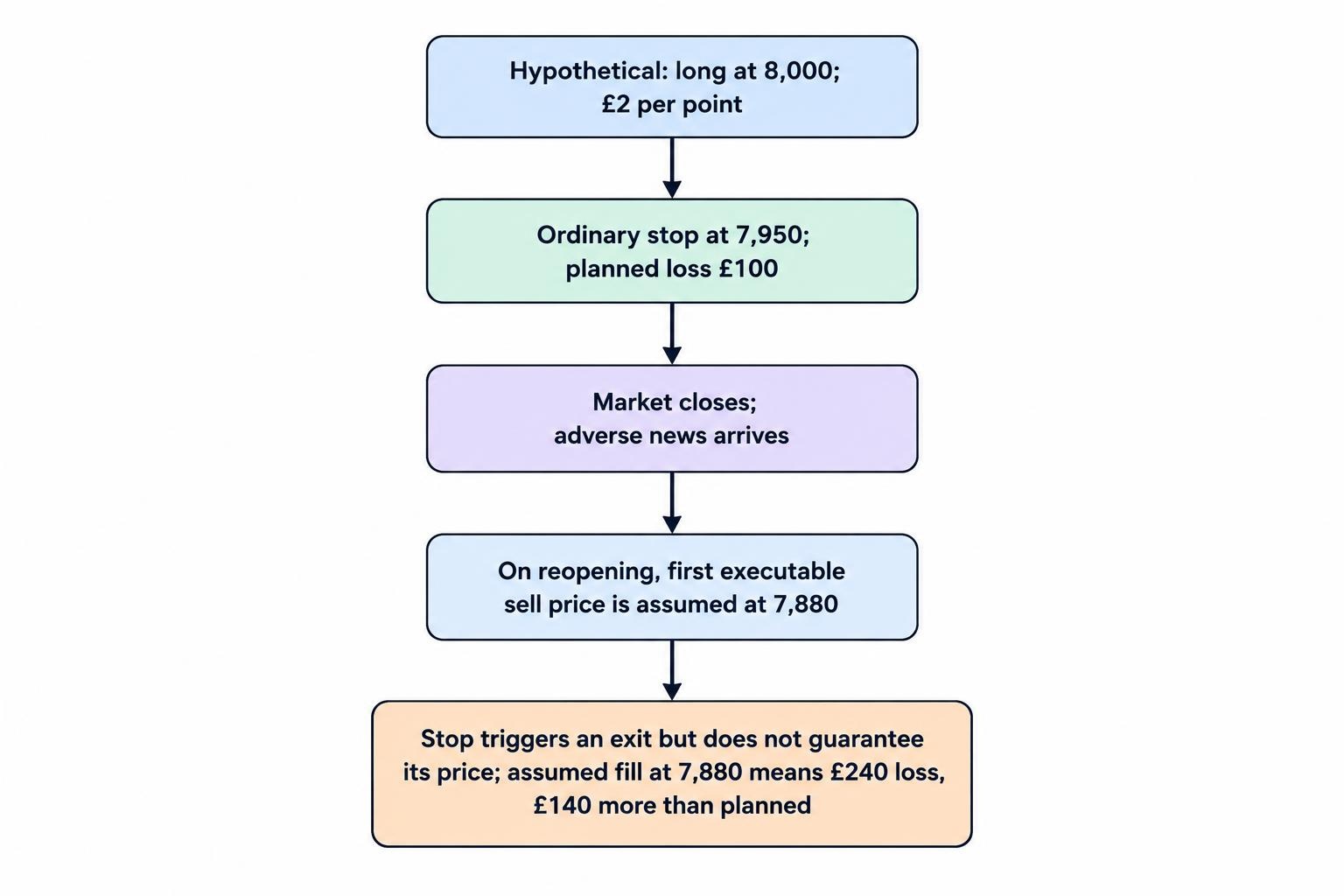
Consider a hypothetical long index spread bet opened at 8,000 for £2 per point. An ordinary stop loss is placed at 7,950, giving a planned price risk of 50 points.
If the position closes at the stop level, the loss is:
50 points × £2 per point = £100.
Now suppose the market closes with the position still open. Following adverse news, the first executable sell price when dealing resumes is 7,880. Assume the stop is filled at that price.
(7,880 − 8,000) × £2 per point = −£240.
The realised loss is £140 larger than planned because execution occurred 70 points below the stop level. The stop triggered an exit, but it did not secure the price.
These figures use assumed entry and exit prices and exclude financing and other account charges. The same spread betting profit and loss calculation applies whether the move happens gradually or through a gap: the point difference is multiplied by the stake per point.
A short position faces the reverse problem. A gap upwards can force an exit above the intended stop. Gaps can also move in a position’s favour, although an unrealised gain still depends on the price available when the position closes.
What Happens to Orders During a Gap?
Ordinary Stop Losses
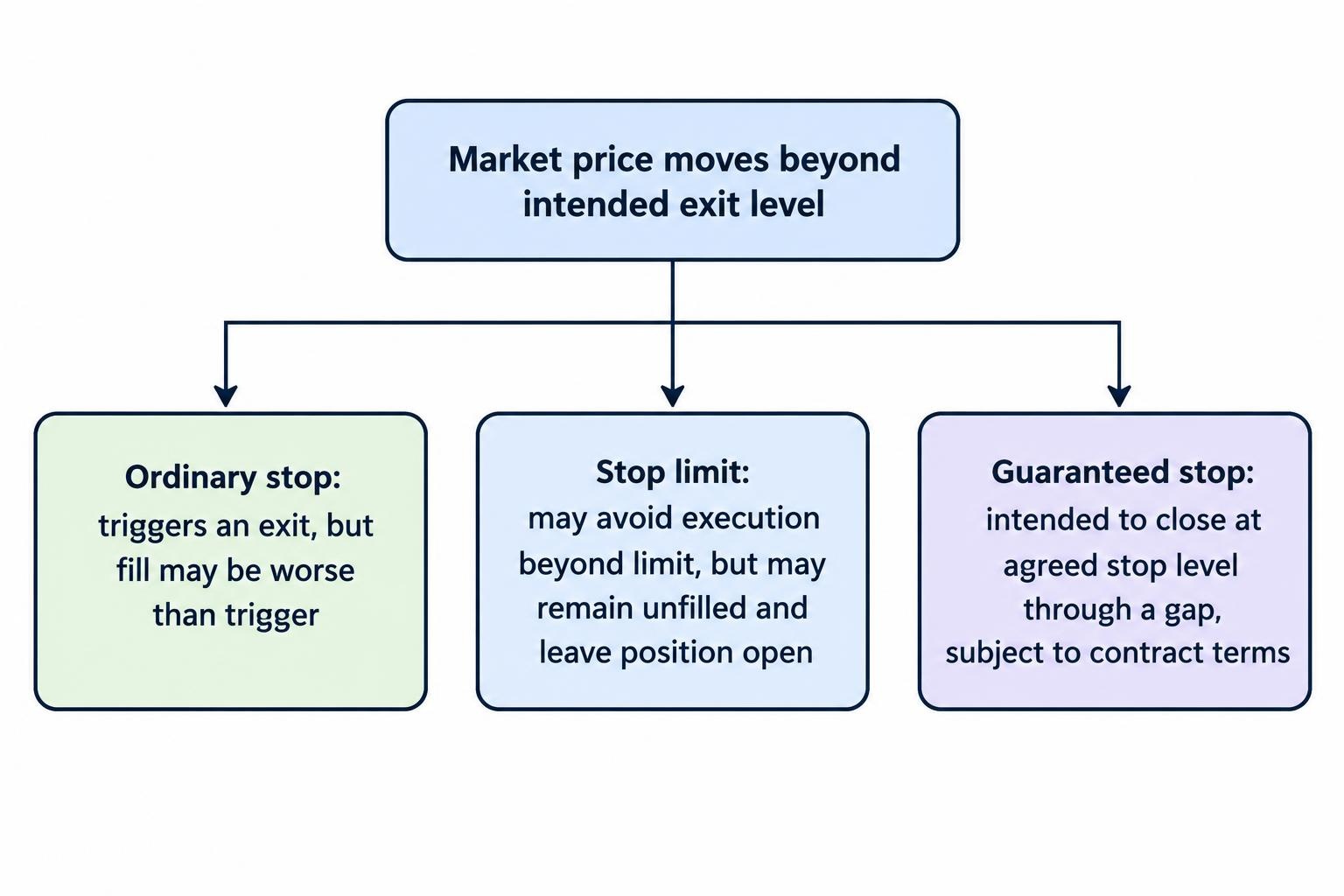
An ordinary stop loss has a trigger level rather than a guaranteed execution price. If the market jumps beyond that level, the resulting exit may occur at a worse available price. The SEC investor bulletin on stop orders makes this distinction for stock orders: reaching the stop price triggers a market order, whose execution price can differ substantially. Spread betting order triggers and execution arrangements must be checked in the provider’s terms.
A trailing stop does not automatically solve this problem. It adjusts its trigger as the market moves favourably, but an ordinary trailing stop remains exposed to execution beyond that trigger.
Stop Limit Orders
Where available, a stop limit order adds a price condition. It may prevent execution at an unacceptable price, but the trade can remain open if no execution is available within the limit. For an exit order, that exchanges price uncertainty for the risk of not closing the position. It is not a guaranteed escape route.
Guaranteed Stops
A guaranteed stop loss is intended to close a position at the agreed stop level even if the market gaps through it, subject to the contract’s terms. Check availability, premiums, minimum distances and any restrictions on changing the order.
Do not assume that a stop becomes guaranteed because it appears on a chart or carries a “stop loss” label. The guarantee must form part of the accepted order.
Entry Orders
Gaps affect pending entries as well as exits. A buy stop placed above the market may trigger after an upward jump and fill above the intended entry level. That can leave less distance to a profit target and more distance to a planned protective stop.
A limit entry offers price control rather than certainty of execution. Whether an order activates, fills or remains pending depends on its conditions and the provider’s dealing rules. Reassess the trade using the actual fill rather than the price originally marked on the chart.
The Main Types of Market Gap
Technical analysis groups gaps by their position within a trading range or trend. These labels help describe price behaviour, but they are not reliable forecasts on their own. Some become much easier to apply after the next move has already happened.
| Gap type | Typical setting | What needs checking |
|---|---|---|
| Common gap | A jump within an established trading range. | Whether price remains inside the range rather than starting a sustained move. |
| Breakaway gap | A jump beyond a range or established chart boundary. | Whether subsequent trading holds beyond the boundary or returns inside it. |
| Continuation gap | A jump in the direction of an existing trend. | Whether the trend continues after the initial repricing. |
| Exhaustion gap | A jump late in an extended move, followed by a reversal. | The reversal itself; the opening jump alone does not establish exhaustion. |
A gap beyond resistance may resemble a breakaway move, then reverse before the session ends. Equally, a jump that looks excessive can continue. Treat the label as a working description, not permission to skip the trade’s entry and exit rules.
Do Market Gaps Always Fill?
No. An opening gap is commonly called “filled” when price returns to the previous session’s closing level. Some traders use a different boundary for gaps between entire trading ranges, so define the reference price before assessing a setup.
A gap might fill during the same session, much later, or not within the period relevant to the trade. A genuine change in a company’s prospects or market expectations may support a lasting repricing. The market has no obligation to tidy up the chart.
Buying every downward gap or selling every upward gap is therefore not a complete strategy. It still needs an entry condition, an exit condition and an explanation of what would invalidate the trade. For gaps beyond established ranges, the separate guide to breakout trading with spread bets covers that decision in more detail.
Be cautious with backtests that assume an exit at the stop price even when the next available observation is beyond it. That assumption can make a strategy appear safer than the execution sequence allows.
Not Every Visible Jump Is the Same
Before treating a chart gap as fresh buying or selling pressure, check the instrument, session and price display. A regular session share chart, an extended session chart and a spread betting quote may not show identical price histories.
Dividends require separate treatment. A share trading without entitlement to its next dividend may show a downward price change, while a spread betting account may receive a corresponding adjustment under the contract’s rules. Assess the price move alongside the spread betting dividend adjustment, not in isolation.
Switching between futures contracts can also create a jump in a continuous chart because the contracts trade at different prices. Chart adjustments may hide or alter that jump. Neither display should be confused automatically with an executable gain or loss on an unchanged position.
Finally, a chart may display a midpoint while orders trigger against the bid or offer. Check which price activates the order before deciding that a stop triggered without the market reaching it.
What to Check Before Holding Through a Closure
The useful question is not simply whether a gap could occur. It is whether the position remains acceptable if the next executable price is materially worse than the planned exit.
- Identify the interruption: check the next closure, reopening time and scheduled announcements.
- Check the order: establish whether the stop is ordinary or guaranteed and which quoted price triggers it.
- Test an adverse reopening: calculate the loss at a price beyond the stop, using the actual stake per point.
- Review connected positions: several trades exposed to the same event can move against the account together.
Use adverse price scenarios as stress tests, not forecasts or maximum possible losses. More cash in the account may help absorb a move, but it does not reduce the pounds lost per point. A smaller stake does.
The wider guide to managing market gap risk covers position decisions in more detail. The central distinction remains straightforward: an ordinary stop can trigger an exit, but only a contractual price guarantee can secure the agreed stop level through a gap.