A spread betting dividend adjustment is a cash credit or debit applied to an eligible open position when the underlying share goes ex-dividend. It commonly affects cash share bets and cash equity index bets, where dividends can reduce the quoted price without representing an ordinary market loss.
The usual treatment is straightforward: an eligible long position receives a credit, while an eligible short position incurs a debit. The adjustment aims to offset the dividend component of the price change. It is not a bonus payment, and it does not remove market risk, trading costs or differences between gross and net dividend amounts.
To check an adjustment properly, you need the contract’s point size, your stake, the dividend amount and the provider’s eligibility rules. The payment date on a company’s dividend calendar is not enough.
Why dividend adjustments happen
A share trading before its ex-dividend date carries entitlement to the forthcoming dividend for an eligible buyer. Once it trades ex-dividend, a new buyer no longer receives that distribution. The price therefore reflects a share without that entitlement.
All else unchanged, removing a 12p dividend from a share priced at 500p gives a theoretical ex-dividend price of 488p. Actual trading rarely keeps everything else unchanged: company news, wider market movements and buying or selling pressure can outweigh the dividend effect. A price fall matching the distribution is possible, not guaranteed; the SEC’s guidance on ex-dividend dates also distinguishes dividend entitlement from the resulting price movement.
Without a corresponding adjustment, a cash spread bet could show a loss for a buyer, or a gain for a seller, caused solely by that loss of dividend entitlement. The cash adjustment addresses this mechanical effect.
You do not become a shareholder by opening the bet. Your entitlement comes from the spread betting contract, rather than ownership of the underlying shares.
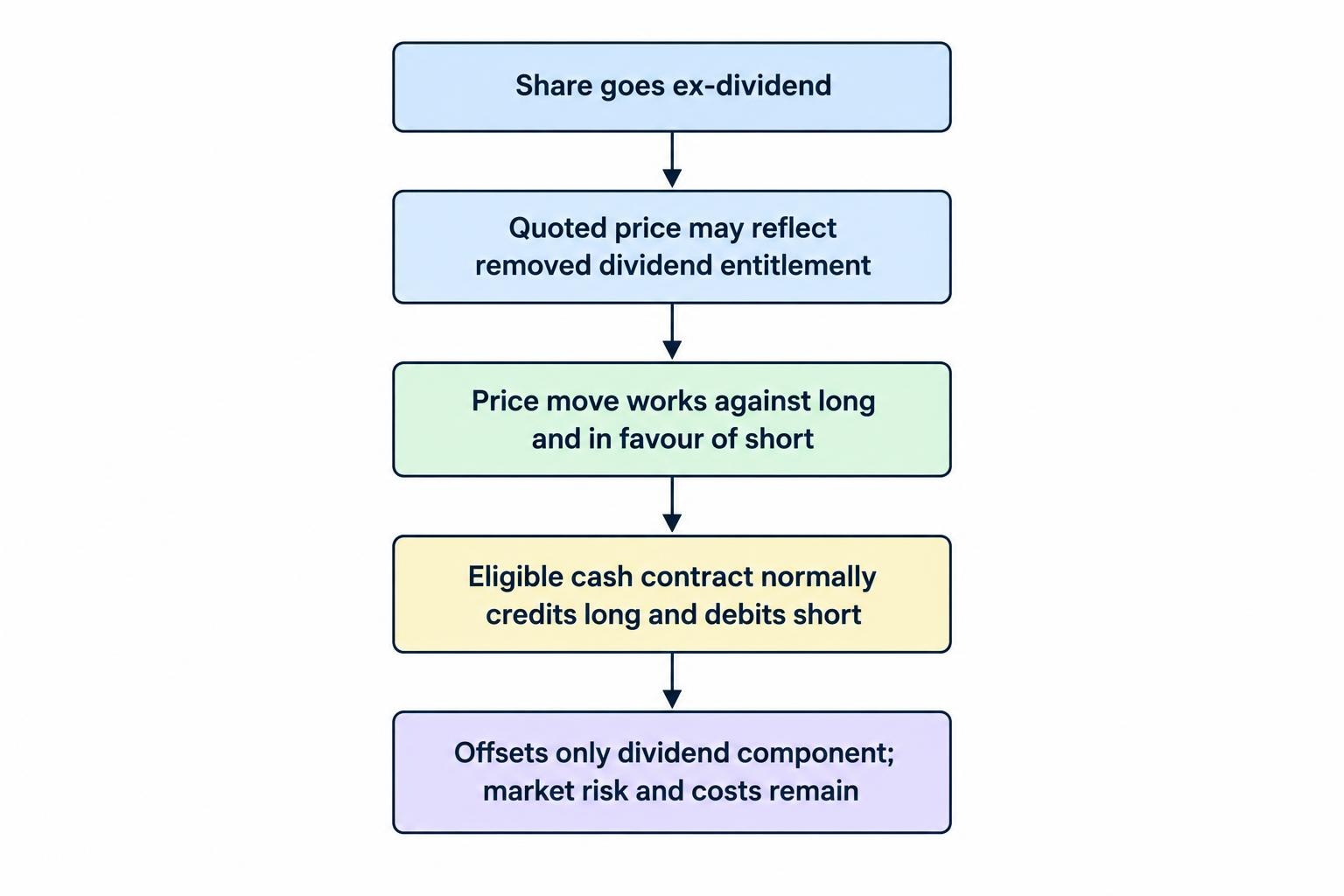
How long and short positions are treated
For an eligible cash position, a long bet normally receives a dividend credit and a short bet incurs a dividend debit. The credit may use a net dividend amount after a withholding related reduction rather than the full declared distribution. These contractual features appear in the Financial Ombudsman decision on spread betting dividend adjustments.
The provider’s current terms determine the calculation. Do not assume that a long credit and a short debit will be equal in every market.
The distinction follows the exposure created by long and short spread bets: a dividend driven price fall works against the buyer and in favour of the seller before the cash adjustment is included.
Which date determines the adjustment?
Dividend calendars contain several dates that serve different purposes. The declaration date announces the distribution. The ex-dividend date marks when the share begins trading without entitlement to it. The record date identifies eligible registered shareholders, while the payment date is when the company pays them.
The London Stock Exchange’s 2026 Dividend Procedure Timetable sets out the UK timetable and requires announcements to include the dividend amount, currency, record date and payment date. Those company dates should not be confused with a spread betting provider’s processing deadline.
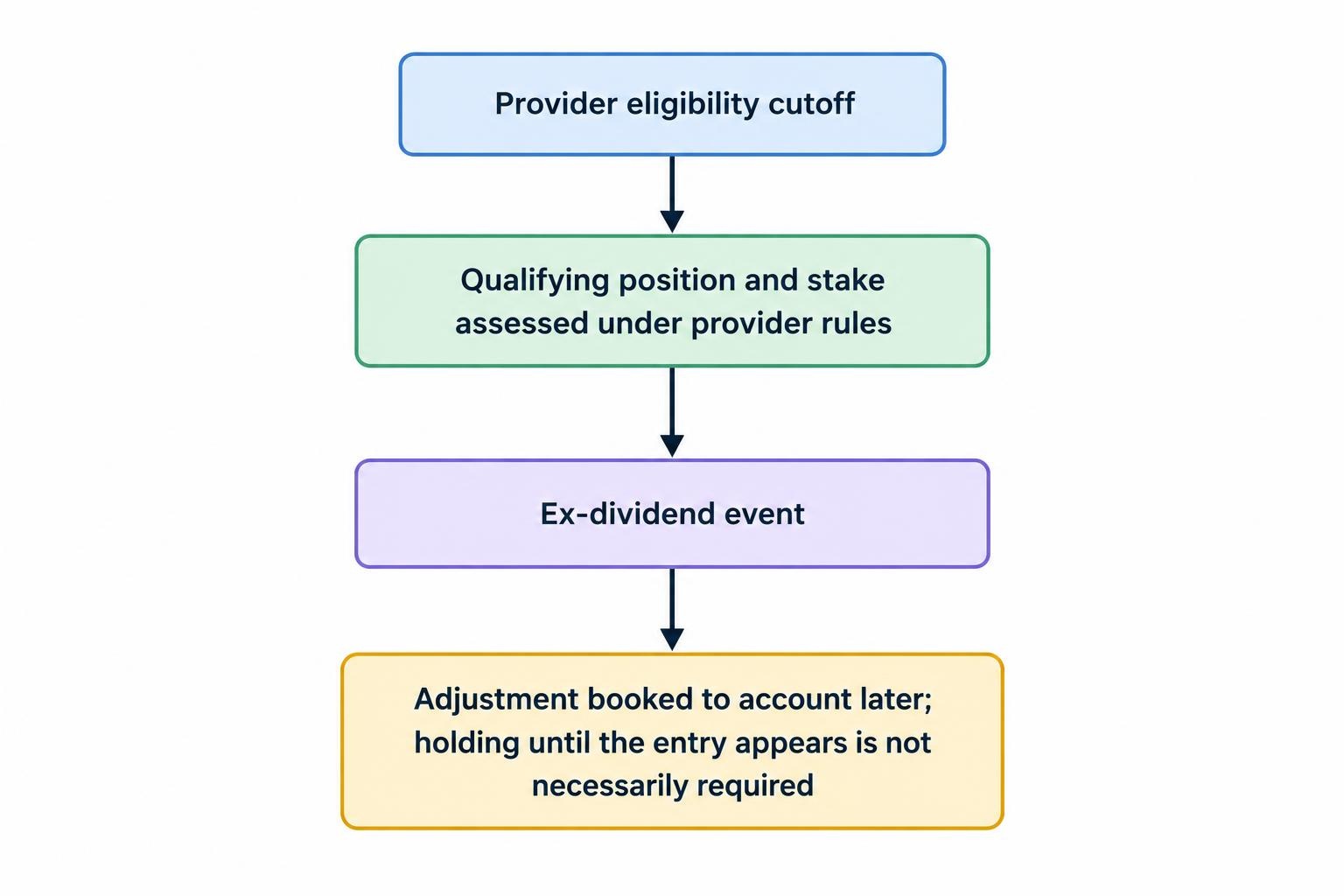
For your bet, establish two separate details: when the position must be open to qualify, and when the adjustment will appear in the account. A provider’s cutoff may fall before the underlying market opens on the ex-dividend date. Do not assume that midnight, the share market’s closing time or the company’s payment date is the relevant deadline.
If you increase, reduce or close a position near that cutoff, confirm which stake qualifies. A £5 per point position reduced to £2 per point before eligibility is assessed should not be budgeted as though the full £5 remains eligible.
Opening a position after the relevant cutoff does not create a retrospective entitlement. Equally, a later statement entry does not necessarily mean you needed to keep the position open until the entry appeared.
Calculating a share dividend adjustment
Start by converting the dividend into the same point units used by the bet. Then multiply by the eligible stake.
Gross adjustment magnitude = dividend expressed in contract points × stake per point.
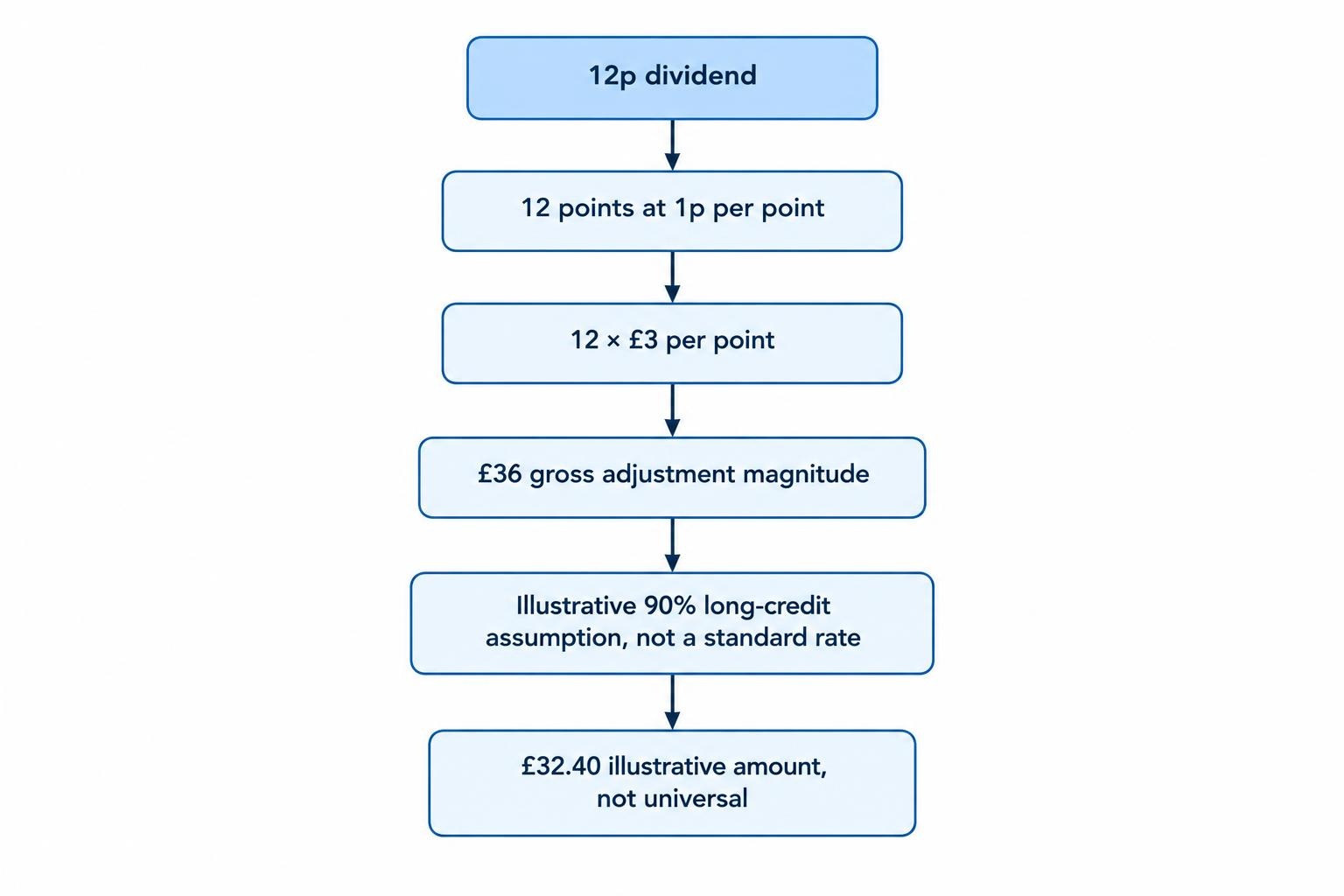
The point definition matters. If one point equals 1p in the share price, a 12p dividend represents 12 points. At £3 per point, the gross adjustment is 12 × £3 = £36. The calculation uses your stake per point, not the margin deposited to open the position.
Worked example: long and short share bets
Suppose a hypothetical share has a reference price of 500p before going ex-dividend with a 12p cash dividend. You hold an eligible position at £3 per point, with each point equal to 1p. Assume the price falls to 488p solely because of the dividend, and the contract applies the full gross adjustment.
| Position | Price movement result | Cash adjustment | Combined effect |
|---|---|---|---|
| Long at £3 per point | −12 points × £3 = −£36 | +£36 | £0 |
| Short at £3 per point | +12 points × £3 = +£36 | −£36 | £0 |
These are changes in position value, not executable opening and closing quotes. A real trade also has a spread and may incur holding costs.
Now assume, purely for illustration, that the contract credits the long position with 90% of the gross amount. The credit becomes £32.40, leaving a £3.60 shortfall against the £36 price loss before other costs. The 90% figure is an assumption, not a standard rate.
For individual share contracts, the guide to dividends and share spread bets covers the share market details. The calculation here provides the starting point for checking the cash entry.
How index dividend adjustments work
An equity index can contain many companies going ex-dividend on the same day. Their distributions must be translated into index points; adding the dividend amounts per share does not produce a usable adjustment.
For the FTSE 100, the dividend points calculation uses the market value of constituent dividends divided by the index divisor. The FTSE 100 Cumulative Dividend Points Index methodology expresses declared ordinary cash dividends in index points and calculates the ex-dividend contribution on the relevant date.
That index calculation is not itself a promise about your account credit. Your spread betting contract determines which dividend figure it uses and whether any reductions apply.
Worked example: a cash index bet
Assume a provider publishes an applicable dividend adjustment of 12.6 points for a hypothetical cash index. Your eligible stake is £5 per point.
Adjustment magnitude = 12.6 × £5 = £63.
Under a full adjustment arrangement, the long position receives £63 and the short position is debited £63. If the index falls from 8,400 to 8,387.4 solely because of those dividends, the long position’s £63 price loss is offset by its £63 credit.
But suppose unrelated market buying adds 30 points during the same period. After subtracting the 12.6 dividend points, the quoted index rises by 17.4 points. The long position gains £87 from the price movement and receives £63 in cash, giving £150 before costs: the value of the separate 30 point market rise.
This is why the adjustment should be checked against the published dividend figure, not against the index’s entire daily move. A falling index does not prove the dividend calculation was wrong, and a rising index does not make the credit free money.
Cash bets versus futures and forward bets
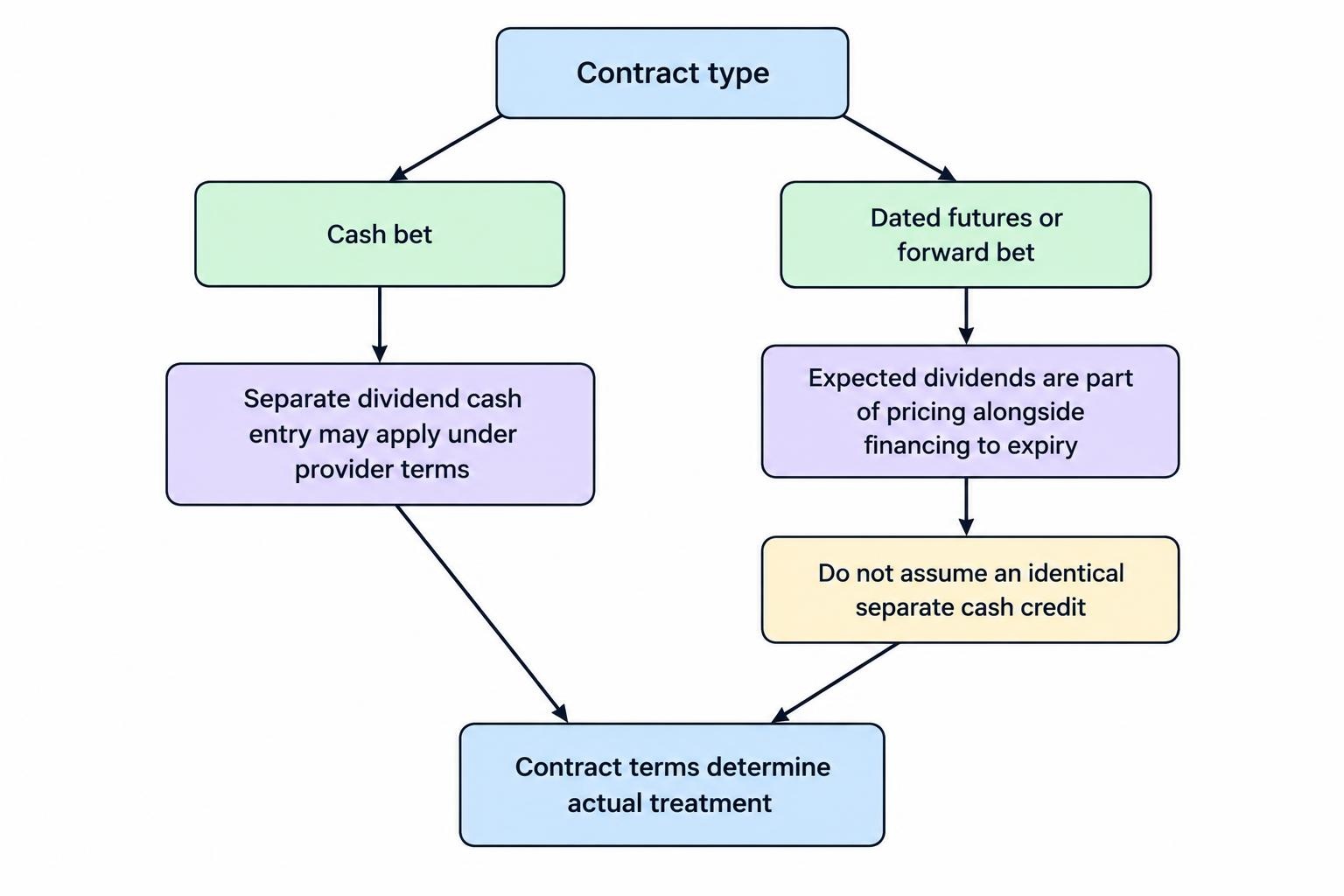
Explicit dividend cash entries are commonly associated with cash contracts, including daily funded bets. A dated equity futures price treats expected dividends differently because they form part of the pricing relationship between the cash market and the future.
A simplified equity index futures relationship is: cash index plus financing to expiry, minus expected dividends before expiry. The CME Group explanation of equity index futures fair value includes dividends, interest rates and time to expiration in that calculation.
That creates a different starting point from a cash bet with a separate dividend entry. Do not assume that a futures based spread bet should receive the same cash credit simply because the underlying companies pay dividends.
Check the settlement and adjustment rules for futures and forward spread bets. A dated contract does not make dividends irrelevant; their treatment may already sit within its price rather than a separate account transaction.
When comparing contracts, assess the quoted price, spread, financing method and dividend treatment together. Counting an expected dividend credit without checking how the contract is priced risks counting the same economic benefit twice.
Special dividends need a separate check
Do not automatically apply an ordinary dividend calculation to a special distribution. Before trading through one, establish whether the event will produce a cash adjustment, a change to the contract or order levels, or another treatment under the provider’s terms.
The announcement should also be checked for related events, such as a share consolidation or return of capital. A large distribution accompanied by a change in the share structure needs more attention than multiplying a headline amount by your stake.
Keep this separate from the routine dividend process. The guide to corporate actions and spread bets covers events that can change the position itself. If the provider’s notice is unclear, obtain written confirmation before the eligibility deadline.
Stops, margin and processing risk
A credit expected to offset a price fall is not a substitute for spare account equity. Check what happens if the price change appears before the cash adjustment has been processed.
Processing delays can have real consequences. In a CFD complaint, a delayed dividend credit led to a margin closeout that would not have occurred had the adjustment been applied on time. The Financial Ombudsman decision on a delayed dividend adjustment upheld the complaint. It concerned a CFD account, rather than a spread betting account, but illustrates the operational risk in relying on an expected credit.
Ask how your provider treats attached orders across the event. Will a stop or limit remain at its existing price, move with the dividend adjustment, or receive different treatment depending on the contract?
For a guaranteed stop-loss order, confirm whether the event changes the stop level, required margin or protected loss amount. Do not assume the word “guaranteed” answers those separate questions.
Keep a margin buffer rather than planning to operate right against the account threshold. The arithmetic may balance in a simplified example, but your account still has to withstand other price movements and the provider’s processing sequence.
Checking the adjustment on your statement
Reconcile the dividend entry separately from trading profit or loss. Begin with the market name and contract type, then match the eligible stake and event date against your position history.
Next, check the units. Was the dividend quoted in pence, another currency or index points? Does one contract point represent a penny, a cent or a different price increment? A correct dividend amount applied to the wrong point definition will still produce the wrong answer.
Use the transaction history alongside your spread betting account statement. Record the adjustment amount and booking time, any stated reduction, and any associated changes to orders or position details.
Do not treat the cash entry as the trade’s complete result. Combine the price movement with the dividend credit or debit, then account for spreads and applicable charges. In particular, overnight financing costs remain a separate part of the calculation.
If the figures do not reconcile, ask the provider for the dividend points used, the qualifying stake, the gross or net basis and the processing timestamp. Those details give the query a clear starting point. “The balance looks wrong” leaves rather more room for a long email exchange.
Before holding a position across an ex-dividend date
A short check before the event is more useful than trying to reconstruct the calculation afterwards:
- Confirm the contract type, ex-dividend event and provider’s eligibility cutoff.
- Convert the dividend into contract points and calculate the expected credit or debit.
- Check whether the calculation uses a gross or net amount.
- Confirm the treatment of attached orders and retain spare account equity.
- Save the event notice and reconcile the booked adjustment afterwards.
Buying immediately before the cutoff to collect a credit, or shorting to capture the expected price fall, does not create a dependable dividend profit. Both approaches must account for the adjustment on the other side of the price move, as well as costs and market risk.
The useful habit is to assess the position and its cash adjustment together. A dividend credit can accompany a price loss; a dividend debit can accompany a price gain. Neither entry tells you whether the trade made money on its own.