Corporate actions can change a spread bet’s opening level, stake per point, cash balance or even the market on which the position is based. A share price falling after a split, rights issue or demerger does not automatically mean a long position has lost that amount, or that a short position has made it.
The practical task is to separate the company’s restructuring from genuine market movement. Then check how your provider will reflect that restructuring in your contract. Corporate action adjustments are part of how spread betting works, rather than an exception to its profit and loss mechanics.
What Corporate Actions Change in a Spread Bet
A corporate action changes a company’s shares, capital structure or distributions to shareholders. Examples include share splits, consolidations, rights issues, special dividends, demergers and takeovers.
With a spread bet, you hold a derivative contract with your provider, not the underlying shares. You do not acquire shareholder voting rights or a direct entitlement to subscribe for shares. Any participation or economic adjustment comes through the spread betting agreement. Financial spread betting sits within the FCA’s framework for high risk CFD products; an adjustment does not remove the trading risk.
Depending on the event and contract terms, the treatment may involve a revised opening price, a different stake, a cash entry, a replacement position or closure of the existing bet. Do not assume every provider uses the same method, or that treatment for a daily funded bet matches an expiry dated contract.
These events matter most directly in share spread betting. A company restructuring can also affect an index, but an index bet does not turn into separate bets on each company involved.
The adjustment and the market reaction are different things. An adjustment can preserve the economic position through a change in share structure. It cannot protect you from investors deciding that the company is worth less after the announcement.
The Dates That Matter
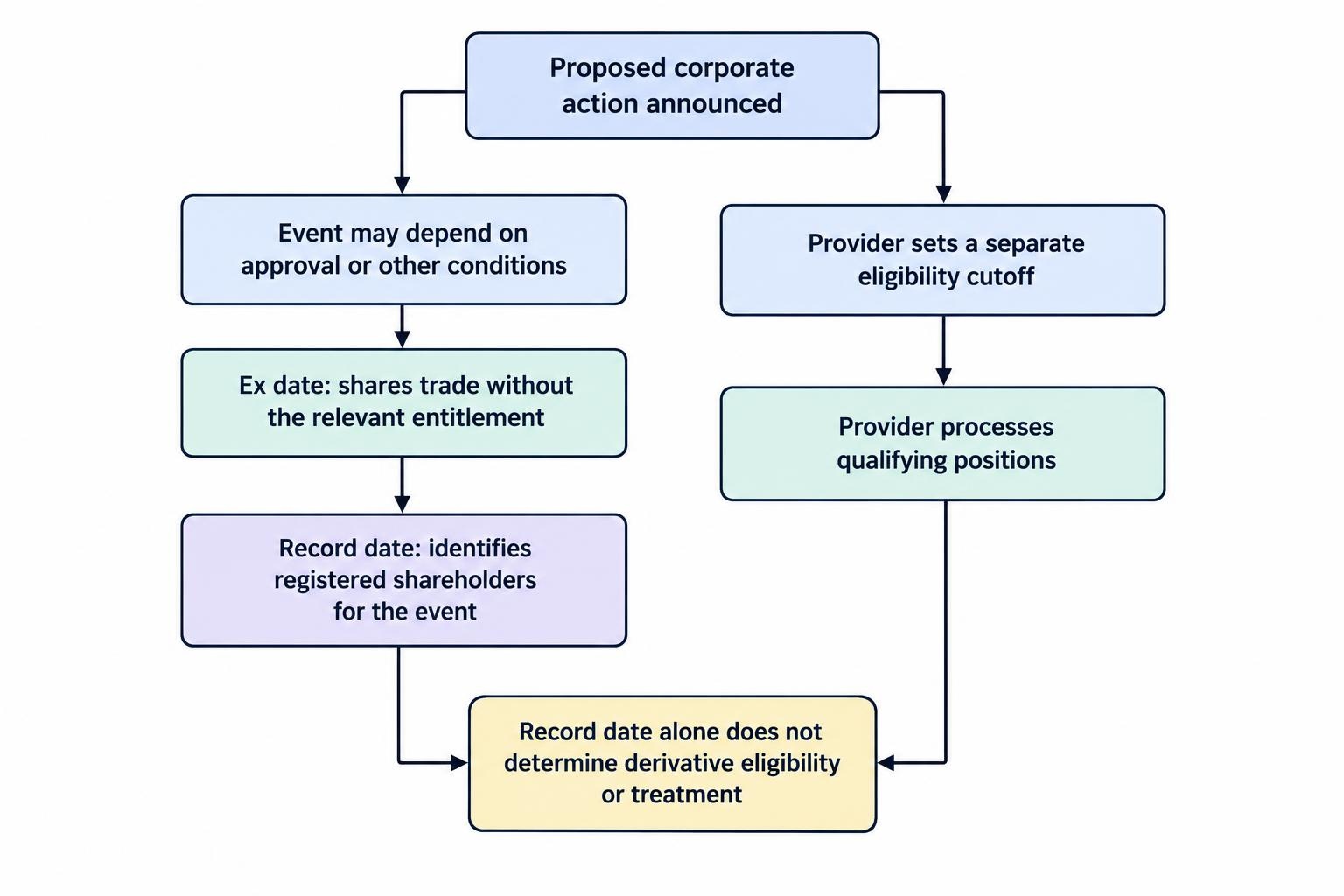
The announcement date tells you what the company proposes. It is not necessarily the date your position changes. An event may still depend on shareholder approval, regulatory clearance or other conditions.
The ex date marks the point at which shares trade without the relevant entitlement. The record date identifies registered shareholders for the event. Those dates serve different purposes; the London Stock Exchange’s corporate action markers and entitlement rules distinguish trading before the ex date from trading on or after it.
For a spread bet, check the provider’s eligibility cutoff as well as the company timetable. Establish which open positions qualify, whether pending orders are affected and when adjustments will appear. A shareholder record date alone does not tell you how the derivative will be processed.
Voluntary events can also have an election deadline. If your provider offers a choice, use its stated deadline, not an assumption based on the company’s final subscription date. Ask what happens if you give no instruction. Silence may have a financial consequence.
Share Splits: A Lower Price Does Not Mean a Trading Loss
A share split increases the number of shares while reducing the price represented by each share. A two for one split turns one old share into two new shares. The split itself does not dilute an existing shareholder’s ownership percentage, as set out in the SEC’s stock split definition.
For a spread bet, adjusting only the displayed price would distort the position. If the price scale halves while the point definition stays unchanged, doubling the stake per point preserves the same exposure to an equivalent percentage move.
The following hypothetical example assumes a UK share quoted in pence, one point equal to 1p, and a provider that adjusts the existing position proportionally. It excludes spreads, financing and other charges.
| Position detail | Before the split | After proportional adjustment |
|---|---|---|
| Opening level | 1,200p | 600p |
| Current valuation level | 1,250p | 625p |
| Stake per point | £2 | £4 |
| Unrealised profit | 50 points × £2 = £100 | 25 points × £4 = £100 |
| Illustrative stop level | 1,140p | 570p |
| Distance from entry to stop | 60 points | 30 points |
| Planned entry to stop loss | 60 × £2 = £120 | 30 × £4 = £120 |
The stake doubles, but the economic position does not. At the illustrated valuation, price multiplied by stake remains £2,500 on either scale. The number beside “£ per point” has changed because each point now represents a different percentage movement.
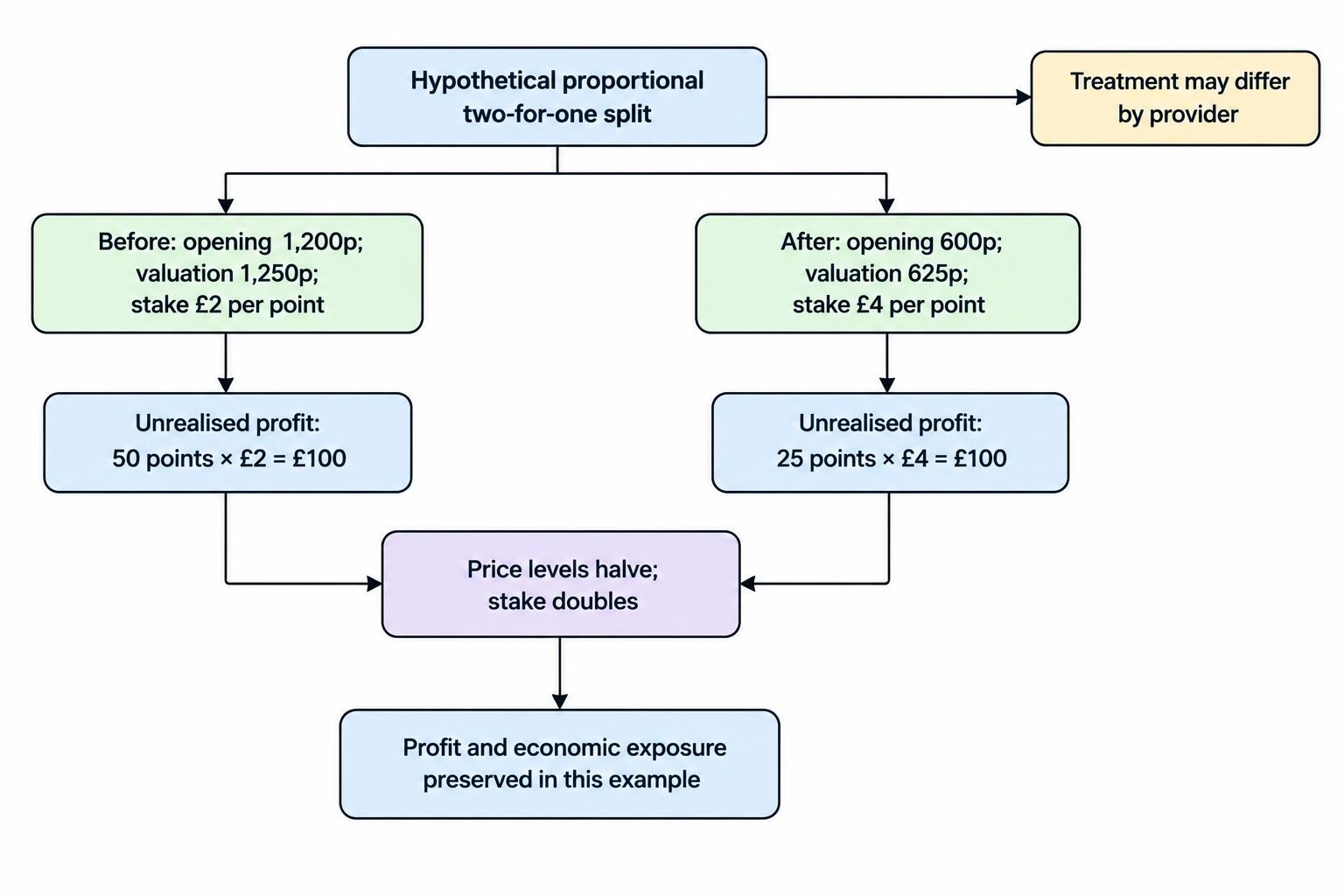
This is why stake per point needs to be assessed alongside the quotation, not in isolation. Reducing the adjusted £4 stake back to £2 would halve the exposure in this example.
The table describes a proportional adjustment, not a promise about platform administration. Confirm whether the provider amends the original trade or closes and rebooks it. If it rebooks, reconcile realised profit, the replacement opening level and any cash entries together.
Use the same approach when calculating spread betting profit and loss: compare the complete position before and after processing. One changed entry price is not enough to establish whether an adjustment is correct.
Consolidations and Bonus Issues
A consolidation, or reverse split, works in the opposite direction. In a one for ten consolidation, ten old shares become one new share. Ignoring market movement, a 50p quotation becomes 500p. A proportionally adjusted spread bet could move from £10 per point to £1 per point, provided the point definition stays the same.
A bonus issue adds shares without requiring shareholders to pay a subscription price. A one for four bonus issue means four old shares become five shares in total. Its price and exposure adjustment therefore differs from a four for one split. Read the ratio carefully: “one additional share for every four held” is not the same as “four shares for every one held”.
Where an adjustment creates an awkward stake fraction, ask about rounding and any cash balancing entry. A small rounding difference should still be explainable.
Rights Issues: Account for the Entitlement, Not Just the Price Drop
A rights issue offers eligible shareholders the opportunity to buy additional shares at a subscription price. Unlike a split, it raises new capital if subscribed. The entitlement attached to the old shares helps explain why the price can fall when those shares start trading ex rights.
For a straightforward discounted issue, a theoretical ex rights price combines the value of the existing shares with the subscription money. The calculation appears in the FTSE Russell methodology for rights offerings. That index calculation helps explain the economics; it does not dictate your provider’s contract treatment.
A Worked Rights Issue Example
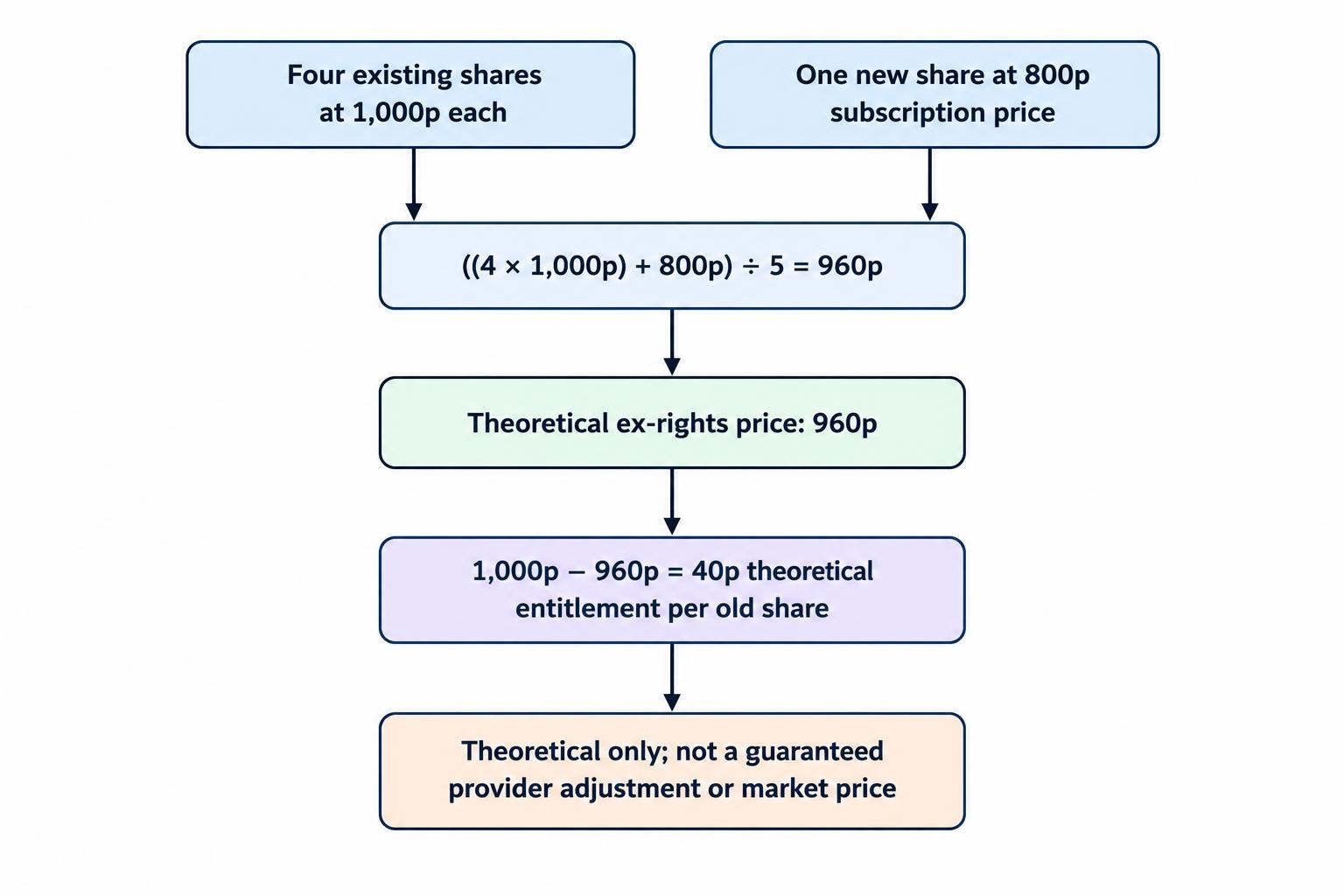
Suppose a company offers one new share at 800p for every four existing shares. Immediately before the adjustment, the existing shares trade at 1,000p.
Theoretical ex rights price = ((4 × 1,000p) + 800p) ÷ 5 = 960p.
Each old share’s attached entitlement has a theoretical value of 40p: the difference between 1,000p and 960p. Four such entitlements have a combined value of 160p, matching the difference between the new share’s theoretical 960p value and its 800p subscription price.
Now consider a long spread bet at £3 per point, with one point equal to 1p. A mechanical fall from 1,000p to 960p produces a £120 loss on the price component. Under a hypothetical cash adjustment method, a £120 entitlement credit would offset that component. For a short position, the £120 price gain would be offset by a corresponding debit.
That example explains economic neutrality, not an amount you can assume will appear in your account. Actual rights can trade away from their theoretical value, and the provider’s valuation method may differ.
Before holding through a rights issue, establish whether the provider will use cash, create a separate rights position or offer an election that increases your exposure. Ask how additional exposure would affect margin, what happens to a short position and what the default treatment will be.
Do not treat the subscription discount as a bargain detached from the rest of the transaction. The company receives new money, the share count changes and the business can still perform badly. A rights issue is not a split with an invoice attached.
Demergers and Spin Offs
A demerger separates part of a business from its parent. Shareholders may receive shares in another company, leaving value distributed between the continuing parent and the separated business.
The parent’s lower quotation therefore needs to be assessed alongside the value distributed. Comparing its price before and after the event, without that second component, can produce a misleading result.
For a spread bet, establish whether the provider will create exposure to the new company, apply cash or use another contractual adjustment. Do not assume that receiving an additional position means you will immediately be able to trade it.
Ask how any new position will be valued, when dealing will become available and whether it will require margin or incur financing. If the new company is not yet trading, request the basis for any provisional valuation and the circumstances in which it can be revised.
Your original trading idea also deserves another look. A bet on a combined business is not economically identical to a bet on the remaining parent after a division leaves. Correct administration does not mean the old investment case still applies.
Takeovers, Mergers and Changes of Security
A takeover can involve cash, shares in the acquiring company, or a mixture of both. For an open spread bet, the practical questions concern settlement: when the existing contract ends, which valuation applies and whether any replacement exposure will be created.
Do not assume an announced offer price is the price at which your bet will close. Read the treatment notice and distinguish a proposed transaction from one that has completed. Conditions, revisions and competing offers can change the outcome.
Consider a hypothetical 600p cash offer while the target trades at 580p. A long position has 20 points of potential movement to the offer price, but the downside is not restricted to those 20 points if the transaction fails. The earlier, unaffected share price may be much lower.
That makes market gap risk relevant even where the offer looks straightforward. A corporate action adjustment is not insurance against a failed deal.
A change of company name or ticker is a different matter. Check that the position, orders and historical records have moved to the correct identifier, but do not infer an economic gain or loss from a new label alone.
Dividends and Capital Repayments
Ordinary dividends need separate treatment from splits and rights issues. Relevant cash share spread bets commonly use dividend related credits for long positions and debits for shorts, subject to the contract’s terms. The mechanics, timing and differences between products are covered in spread betting dividend adjustments.
Special dividends and capital repayments deserve closer attention where they form part of a larger restructuring. Read the full event notice rather than applying an ordinary dividend assumption to one line of it.
If a cash distribution accompanies a consolidation, reconcile the cash, adjusted price and revised stake as one package. Looking at them separately can make a neutral adjustment appear profitable or harmful.
Check Orders and Margin After Processing
Stops and Limits Must Match the Revised Price Scale
An adjusted position needs compatible orders. In the split example above, a stop at 1,140p becomes 570p under the same proportional method. Leaving the old number unchanged would not preserve the intended risk.
Check attached stops, profit targets and pending entry orders. Their treatment may differ. Confirm whether each order will be amended, cancelled or require a fresh instruction; the available spread betting order types do not all perform the same job.
Administrative errors can affect trading outcomes. In one case, an incorrect price following a split adjustment triggered short position closures and credited profits that were later reversed. The Financial Ombudsman decision on a split related pricing error accepted the provider’s correction under the terms applicable to that complaint. It was a case about those facts, not a blanket permission to reverse any disputed trade.
Check alerts and chart annotations too. They are easy to overlook because they may not sit inside the position ticket.
If you use a guaranteed stop loss order, ask how its level and terms will carry through the event. A guarantee should not be read as a promise that the original numerical level survives a change of price scale unchanged.
Recalculate Exposure Before Adding Funds or Changing Size
A larger stake after a split does not, by itself, show that you have increased risk. Start with the adjusted quotation, point value and position size. Then check the provider’s margin calculation.
For a pure proportional split, unchanged economic exposure would imply unchanged margin if the margin rate and calculation method also remain unchanged. Those assumptions need checking. The event notice may contain separate changes to dealing or account requirements.
Review spread betting margin alongside available funds, rather than treating a preserved unrealised profit figure as proof that everything else is unchanged.
Short Positions Need the Same Reconciliation
A mechanical drop in the share quotation is not automatically a short seller’s profit. Rights, distributions and changes in stake must be included in the calculation.
When short selling shares through spread betting, ask about any resulting debit or additional short position. Do not assume the long side’s treatment simply disappears because you sold rather than bought.
Suspensions and Delistings Can Delay the Outcome
A restructuring may involve a trading suspension or delisting. Neither should be interpreted as an automatic instruction to settle every spread bet immediately at zero.
A published dispute involved a short spread bet that remained unresolved after the underlying shares delisted. The Financial Ombudsman decision on a delisted share spread bet examined the provider’s distinction between delisting and the completion of the company’s liquidation process. The contractual procedure mattered to when the position could be removed.
Before an expected suspension, ask whether you will still be able to close, how the position will be valued and whether financing or margin requirements continue. A price that has stopped updating does not establish that the contract has stopped creating obligations.
Also distinguish failure or restructuring of the underlying company from failure of your spread betting provider. They are different risks with different consequences.
How Corporate Actions Affect Index Spread Bets
An index provider processes constituent events through its methodology. Depending on the event, this can involve changes to constituent shares, prices, membership or the index divisor. The FTSE Russell corporate actions and events guide sets out these treatments for index series to which that guide applies.
An index spread bettor should therefore assess the index contract, not copy a single share adjustment onto the bet. A constituent split does not mean your index stake should double.
For index spread betting, keep benchmark maintenance, ordinary dividend adjustments and genuine changes in constituent values separate. They can occur around the same time without being the same process.
A Practical Corporate Action Check
Before holding a position through an event, get answers to five questions:
- What qualifies? Confirm the affected contract, direction, size and eligibility cutoff.
- What changes? Establish the treatment of opening levels, stakes, cash, replacement positions and orders.
- What requires a decision? Identify any election deadline and the outcome if you give no instruction.
- What can you trade? Check restrictions before, during and after processing.
- What must the account support? Confirm margin, financing and any cash debit or subscription related exposure.
After processing, compare the complete account position with the treatment notice. Retain the original trade details, event announcement, provider messages and relevant screenshots. Use your spread betting account statement to reconcile entries rather than relying on a chart that may have been adjusted retrospectively.
If the numbers do not reconcile, request a written calculation showing the ratio, valuation, point definition, stake change and cash entries. Identify whether the disagreement concerns the arithmetic, the chosen treatment or a genuine market move. That makes a complaint easier to investigate.
Where an issue remains unresolved, the guide to spread betting complaints and the Financial Ombudsman covers the escalation process.
A well processed corporate action can preserve the intended economics through a restructuring. It cannot preserve the company’s value, guarantee an exit or keep an outdated trading plan sensible. Check the adjustment, then reassess the position that remains.