The lowest-cost spread betting broker is the one that charges least for the trades you actually place, after spreads, overnight financing, execution and account fees. A narrow advertised spread helps, but it cannot settle the comparison on its own.
Pepperstone, Spreadex, CMC Markets and Trade Nation are worth comparing for different reasons: intraday pricing, spread-led dealing, volume discounts and fixed spreads. They form a research shortlist, not a claim that one firm is cheapest across every market and holding period.
This guide focuses on choosing between those cost structures. For the wider selection process, including platforms, market access and account features, use our spread betting broker comparison. Spread betting puts capital at risk; reducing charges does not remove trading losses.
Which Spread Betting Brokers Should You Compare on Cost?
Start with the account and product, not the broker’s cheapest number. A firm may offer spread betting, standard CFDs and a commission-based forex account under the same brand. Their prices are not interchangeable.
The following shortlist gives each comparison a purpose. It does not assign an absolute price ranking, because the available pricing evidence does not provide a controlled, like-for-like total-cost comparison across all four firms.
| Broker | Why include it? | What should decide the comparison? |
|---|---|---|
| Pepperstone | Candidate for an active intraday trading comparison | The spread betting quote, execution and holding charges, rather than Razor CFD pricing |
| Spreadex | Candidate for spread-led pricing on liquid markets | Observed spreads during your session and the cost of less liquid shares |
| CMC Markets | Candidate when comparing several markets and eligible spread discounts | The applicable discount tier, financing and account charges |
| Trade Nation | Candidate for comparing fixed with variable spreads | The platform’s pricing schedule and actual execution, not spread certainty alone |
Pepperstone: an intraday comparison candidate
Pepperstone belongs on a cost shortlist for active spread bettors. Its spread betting offering has been identified as low cost in BrokerListings’ spread betting broker assessment, which also highlights the importance of checking additional account and transfer charges.
The practical task is to isolate its spread betting prices. Do not copy a zero-spread Razor CFD headline into a spread betting calculation, or add a CFD commission schedule to a different account.
Compare two or three instruments at your usual trading times, then inspect the holding charge separately. An attractive intraday quote does not establish that the same broker will be cheapest for a position held over several nights. Treat it as a candidate to price, not a reason to skip the arithmetic.
Spreadex: compare liquid markets with less liquid shares
Spreadex offers a useful benchmark for spread-led dealing. An EUR/USD spread around 0.6 pips in calm conditions appears in DayTrading.com’s live Spreadex fee checks. Those checks also recorded wider pricing in busier conditions and more difficult trading economics in smaller shares.
That distinction matters. A competitive quote on a major currency pair says little about the cost of entering and exiting an AIM share.
For a shortlist comparison, record the spread on your intended market rather than relying on the broker’s strongest instrument. If you trade selectively, check recurring account charges too. Paying slightly more on an occasional trade can still work out cheaper than maintaining an account with charges you incur between trades.
CMC Markets: assess discounts without changing your trading behaviour
CMC Markets is worth including when the comparison covers several asset classes or eligible volume-based spread discounts. Its pricing programmes, account differences and guaranteed stop arrangements are covered in BrokerListings’ CMC Markets fee and account review.
Calculate any discount using your existing trading volume. A higher tier is not a saving if reaching it requires extra trades that you would otherwise avoid.
Also separate spread betting charges from CFD charges. The brand’s account range makes that distinction worth checking before using any published number. For longer holds, compare the full funding calculation as carefully as the spread. A discount at entry can be outweighed by a small daily difference applied to a much larger exposure.
Trade Nation: compare price certainty with price level
Trade Nation offers a different comparison through fixed-spread pricing on TN Trader, while its MT4 pricing is variable. That platform distinction, and the fact that fixed spreads do not guarantee the execution price, are covered in DayTrading.com’s Trade Nation pricing and execution assessment.
Fixed pricing can make a cost estimate easier to prepare, subject to the instrument’s published session schedule. It does not automatically make the trade cheaper.
Compare the scheduled spread during the hours you trade with the variable quotes available elsewhere. Then check slippage, financing and the exact spread betting account terms. A predictable spread is useful; a predictable spread combined with an unfavourable fill can still produce an expensive trade.
What “Lowest Cost” Should Include
A useful broker comparison separates the cost of entering and exiting a position from the cost of maintaining the account. The first depends heavily on your markets, stake and holding period. The second can apply even when you hardly trade.
Use this working calculation:
Estimated total cost = spread cost + explicit dealing fees + net financing charges + applicable account and service charges + net execution shortfall.
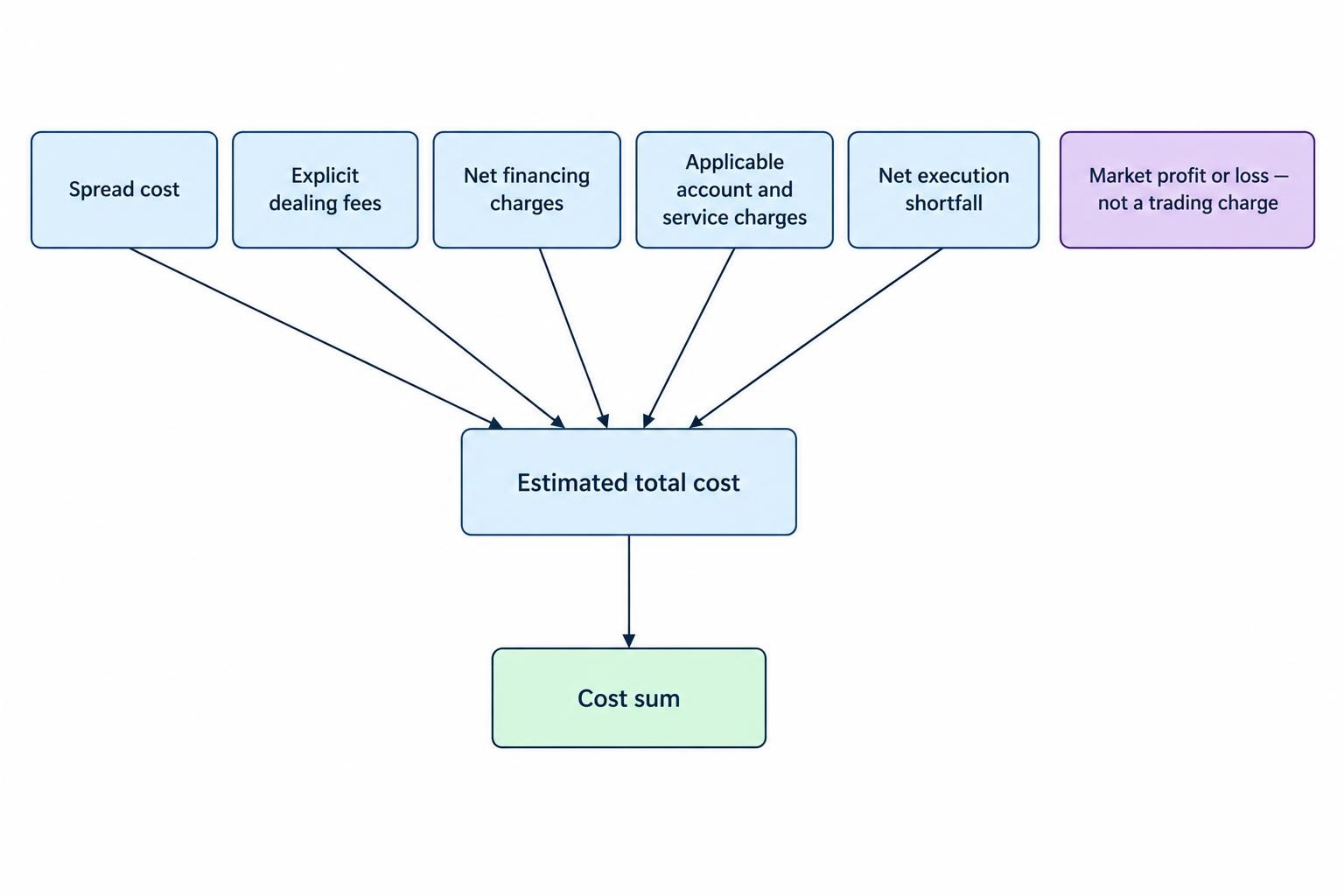
Net execution shortfall means adverse slippage less any price improvement. It is not necessarily a separate broker fee, but it affects the money left in your account just the same.
Keep market profit or loss separate. If a market moves against your position, that movement is not a trading charge. Mixing the two makes it difficult to tell whether you chose an expensive provider or made a losing trade.
Build the comparison around a realistic month: your usual instruments, number of completed trades, stakes and nights held. Our guide to comparing total spread betting costs covers the wider calculation. Here, the purpose is to turn it into a broker selection decision.
The cheapest provider for a trader making 100 intraday index trades may differ from the cheapest provider for someone holding two share positions for three weeks. Neither result contradicts the other.
Compare Like-for-Like Quotes Before Ranking Brokers
Minimum spreads are not average costs
A spread advertised “from” a certain number is a starting price, not a promise that every order receives it. An average needs context too: the account, instrument, period and hours included in the calculation.
Do not rank one broker’s minimum against another broker’s average. That comparison can make the more informative disclosure look worse.
For a spread-only shortlist, our separate guide to brokers with the lowest spreads keeps the focus on bid and offer pricing. For total cost, carry the actual spread observed during your trading session into the calculation.
Take observations at comparable times across several sessions. Include the periods when you normally enter and exit, rather than selecting the calmest five minutes available. A trader who deals around economic announcements needs different observations from someone who trades midway through a quiet session.
Check the point definition and exposure
The same displayed spread can represent different cash costs if the contracts use different point sizes. This is particularly easy to miss when comparing commodity quotes or a full index point with a fractional price movement.
Confirm how much profit or loss a one-unit price move creates on each ticket. Then match the economic exposure before comparing charges.
The stake per point calculation is the bridge between a quote and its cash cost. Comparing £1 per point with £5 per point tells you more about position size than broker pricing.
Use the same contract type and direction
Compare cash with cash, or a dated contract with the equivalent dated contract. Do not treat a cash index and a forward index bet as identical simply because they reference the same market.
Match the direction as well. Funding on a long position can differ from funding on a short position. For shares, a short position may also involve a borrowing charge.
Record the legal entity, retail account status, platform and full instrument name alongside the price. It is a small amount of administrative work that prevents a surprisingly large number of false bargains.
Worked Example: A Narrower Spread Can Lose Its Advantage
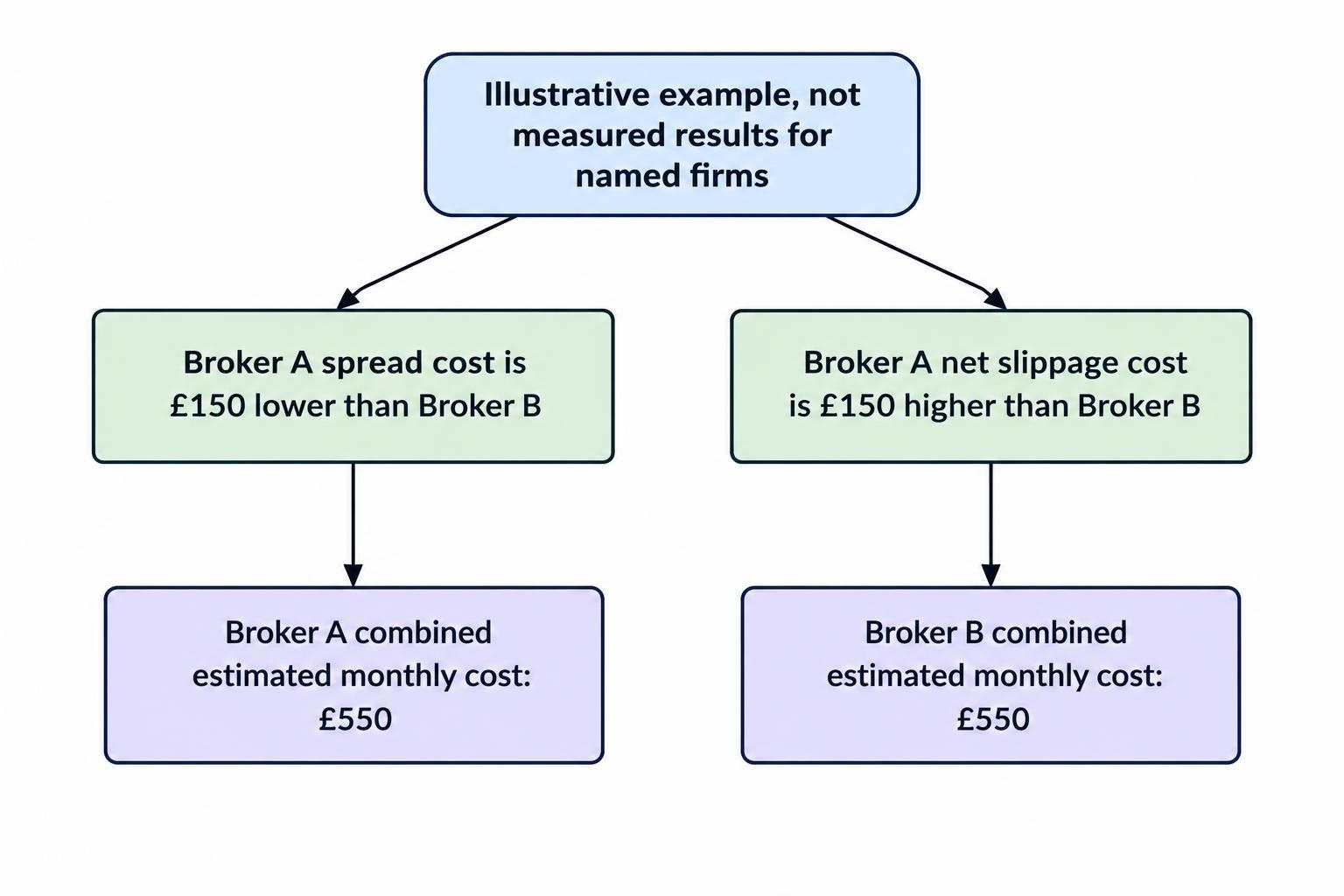
Consider two hypothetical brokers offering the same index contract. You complete 100 trades in a month at £5 per point, with no overnight holds or explicit commissions.
| Cost measure | Broker A | Broker B |
|---|---|---|
| Assumed spread | 0.7 points | 1.0 point |
| Spread cost per completed trade | £3.50 | £5.00 |
| Spread cost across 100 trades | £350 | £500 |
| Assumed net adverse slippage per completed trade | 0.4 points | 0.1 points |
| Monthly slippage cost | £200 | £50 |
| Combined estimated cost | £550 | £550 |
Broker A saves £150 on spreads. Under these assumptions, its worse execution consumes the entire saving. These are invented inputs for the calculation, not measured results for any named firm.
The spread calculation assumes unchanged spreads and uses one full spread per completed trade. Do not automatically charge a full spread at entry and another full spread at exit. Where the opening and closing spreads differ, their two half-spread costs provide a better approximation relative to the market midpoint.
Slippage must be measured against the executable quote for the order’s direction. Comparing a buy fill with the midpoint would count part of the spread again.
Use a repeatable sample before drawing conclusions about broker execution quality. One excellent fill or one poor stop execution is not enough to establish a reliable cost advantage.
Overnight Financing Can Reverse the Ranking
For positions held beyond the funding cut-off, the spread becomes only part of the bill. Financing can accumulate on the position’s notional exposure rather than the smaller amount posted as margin. Check the precise calculation for the instrument.
This deserves more attention than a footnote. The FCA’s 15 October 2026 findings on CFD and spread betting charges identify continuing concerns about overnight funding levels and disclosure, including opaque mark-ups and charges on matched long and short positions.
Request the applicable buy or sell rate, the broker’s adjustment, the calculation base and the number of days charged. A daily amount is useful, but an annualised rate makes comparisons easier where the products use comparable methods.
A funding example using the same exposure
Assume an index stands at 8,000 and a £5 stake represents £5 for each whole index point. The notional exposure is £40,000. Keep that exposure unchanged for this simplified example.
Broker A has a 0.7-point spread and an assumed all-in annual funding charge of 8%. Broker B has a 1.0-point spread and an assumed annual charge of 6%. Both use a 365-day calculation.
| Cost measure | Broker A | Broker B |
|---|---|---|
| Spread cost | £3.50 | £5.00 |
| Financing for one charged day | £8.77 | £6.58 |
| Spread plus ten charged days | £91.17 | £70.75 |
Broker A starts £1.50 cheaper. Broker B becomes cheaper after the first full day of financing under these assumptions. Over ten charged days, the difference reaches £20.42 before slippage or other charges.
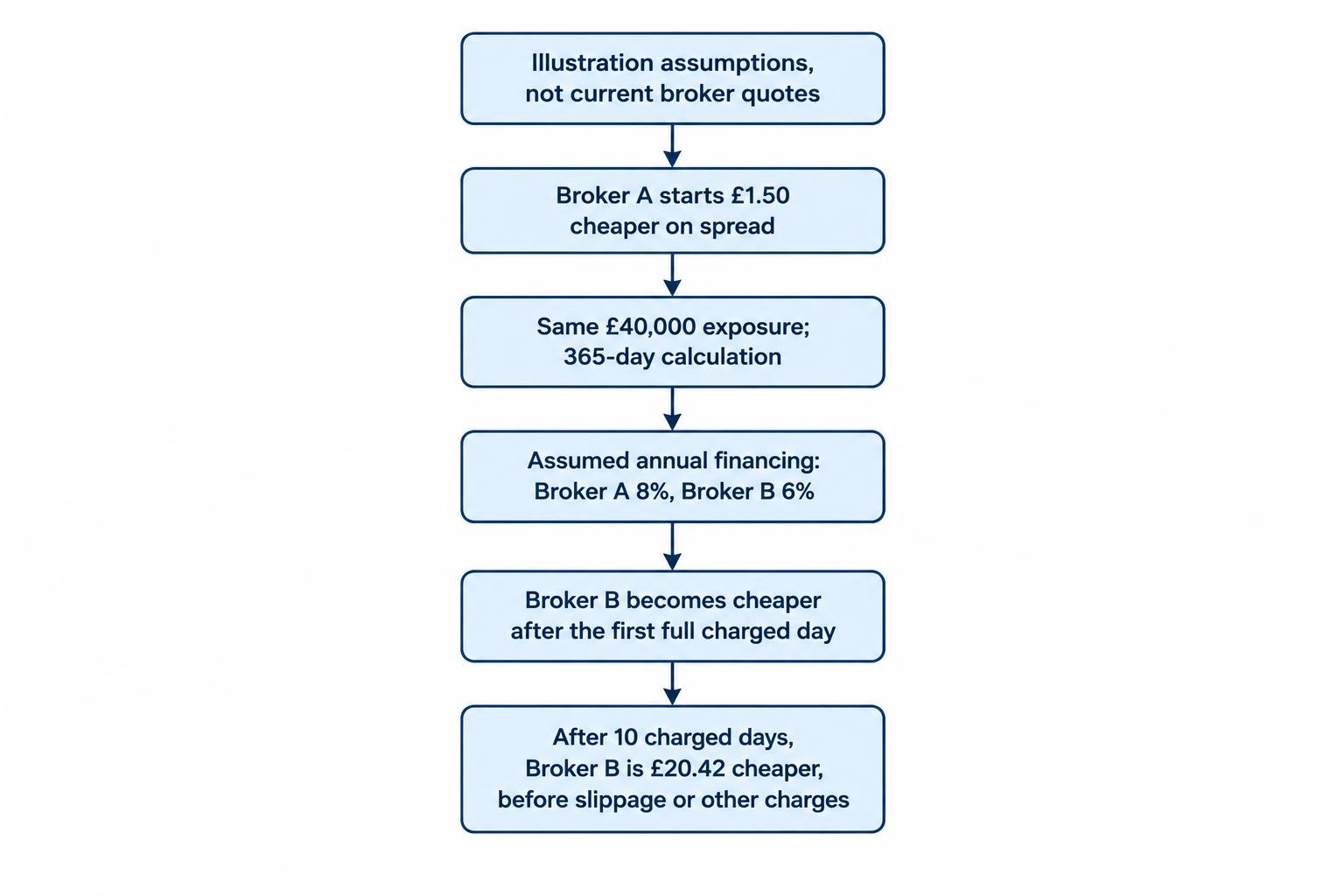
Actual calculations may use changing prices, different day-count conventions or market-based adjustments. The example shows why overnight financing costs should be compared in cash terms, not dismissed because the percentage difference looks small.
Check weekend and holiday treatment too. The number of calendar nights you hold a position need not match the number of financing days posted on each statement date. Avoiding one cut-off also does not guarantee a cheaper strategy if closing and reopening creates another spread cost.
Could a dated spread bet cost less?
A dated contract may reflect financing and other carrying costs in its price and spread rather than applying the same daily charge as a cash contract. No separate daily funding debit does not mean the financing is free.
Compare the wider entry and exit cost against the cash contract’s expected holding charges. Include expiry, settlement and any rollover if your intended holding period extends beyond the contract’s life.
The comparison between daily funded bets and futures-style spread bets is particularly relevant for longer holds. Compare equivalent exposure and dates; do not treat the difference between their quoted prices as an automatic gain or loss.
Other Charges That Can Change the Cheapest Broker
Share pricing and borrowing charges
For share spread bets, establish how the broker adds its charge to the underlying market spread. It may use a percentage-based adjustment or another quoted dealing spread. Check whether the stated amount applies on each side.
A percentage that looks small can become material when applied to a large position or repeated frequently. Match the underlying share, exposure and trading session before comparing the cash amount.
For short positions, ask about stock borrowing charges and whether the rate can change while the trade remains open. Our guide to share spread betting costs covers these product-level differences.
Keep dividend and corporate action adjustments separate from ordinary dealing fees. An account debit is not automatically a broker charge; its purpose and matching price adjustment matter.
Guaranteed stop premiums
A guaranteed stop can change both the cost and the risk of a trade. Compare its premium, minimum distance, availability and charging conditions. Some arrangements charge when the stop triggers; others may reserve or debit an amount earlier, subject to their terms.
Compare equivalent protection. A broker without the order you require is not necessarily better value because its ordinary spread is narrower.
Use the guaranteed stop premium guide to distinguish the protection charge from the trading spread. Include the relevant premium in your estimate rather than assuming it will never apply.
Currency conversion and payment costs
A sterling stake on an overseas market does not, by itself, prove that an account will incur a currency conversion fee. Check which amounts are settled in the account currency and which transactions require conversion.
The same caution applies to deposits and withdrawals. A broker’s zero charge does not establish that your bank, card issuer or payment service charges nothing.
Compare the actual payment route you plan to use. Our explanation of currency conversion costs helps separate a trading account charge from an exchange-rate adjustment elsewhere in the payment chain.
Inactivity, data and platform subscriptions
Recurring charges matter most when trading activity is low. Check when an inactivity fee starts, what resets the clock and whether a zero balance changes its application.
For market data or platform subscriptions, check any waiver conditions. A service may be free only after a trading threshold, and the threshold may apply separately to different exchanges or tools.
Do not create extra trades simply to avoid a modest subscription. Compare the subscription with the additional spread, execution cost and market risk those trades would create.
Minimum stakes
A low spread does not compensate for a minimum stake that pushes your position above its planned size. If one broker requires twice the stake, it also creates twice the cash exposure to each point of movement.
Compare brokers offering smaller stakes when position size is the binding constraint. Spending less on the spread while accepting more risk is not a clean cost saving.
Which Cost Structure Fits Your Trading Pattern?
Frequent intraday trading
Prioritise the spread during your actual session, cash slippage and any explicit transaction charge. With frequent turnover, a small difference per completed trade can accumulate quickly.
Measure the cost relative to your usual target as well. A one-point dealing cost consumes a much larger share of a five-point target than a fifty-point target. That does not make the wider target better; it shows how sensitive the shorter trade is to friction.
Keep financing in the comparison if you sometimes carry positions beyond the cut-off. “Usually flat overnight” is not the same as never paying funding.
Positions held for several days
Give greater weight to the complete holding charge, direction, weekend treatment and contract choice. A spread saving occurs around entry and exit; financing can recur throughout the hold.
Prepare more than one holding-period estimate. A trade planned for three days may last ten, and a broker that wins the shorter comparison may lose the longer one.
Do not alter a sound exit decision just to reduce a charge. Costs belong in the plan before entry, not as an excuse to keep a losing position open.
Occasional and small-account trading
Recurring fees, minimum stakes and payment charges can outweigh small spread differences when turnover is low. Compare annual account maintenance alongside the cost of a normal trade.
Also distinguish a deposit requirement from a fee. Money deposited remains account capital until affected by trading, charges or withdrawals. A low opening deposit is an access feature, not proof of low dealing costs.
The broker’s margin requirement is collateral rather than an entry charge. It affects capital use and close-out risk, but should not be added to the spread as though it were money paid away.
How to Compare Two Brokers Before Committing Capital
A useful comparison does not require a complicated scoring system. It requires consistent inputs and a clear record of what each number represents.
- Define a representative trading month. Write down your usual markets, directions, stakes, completed trades and charged holding days. Use your existing behaviour rather than an idealised version with perfect exits.
- Match the products. Record the account, entity, platform, point definition, cash or dated contract, and retail status. Resolve any mismatch before comparing prices.
- Collect comparable quotes. Observe both providers during the same trading windows over several sessions. Record spreads separately for ordinary conditions and the busier periods you actually trade.
- Add the full holding and account charges. Calculate financing for your expected duration and a longer alternative. Include the subscriptions, premiums and payment costs that apply to you.
- Reconcile the estimate with actual records. Check fills and statements if you later trade live. Investigate differences rather than assuming every unexplained debit is already included in the spread.
Use spread betting demo accounts, where available, to confirm ticket behaviour, point values and platform controls. A demo can help identify mistakes before money is at risk.
It cannot establish future live execution quality. Simulated fills do not prove how an account will behave during a fast market, with a larger order or around a gap. There is no need to place risky trades merely to test a provider.
When reviewing live results, compare the same order types. A market order prioritises execution; a limit order imposes a price condition and may not fill. Comparing one broker’s market-order slippage with another’s unfilled limit orders produces a misleading answer.
Retain the calculation and its assumptions. Your spread betting account statements can then show whether the estimated funding days, premiums and other charges match what happened.
Recalculate when your trading pattern changes. Moving from intraday indices to multiweek share positions can change the cheapest account without either broker changing its prices.
Do Not Trade Away Protection for a Lower Headline Price
Compare costs within an appropriate regulatory and client-protection framework. The FCA’s retail CFD and spread betting requirements include asset-dependent leverage restrictions, account-level margin close-out rules and negative balance protection. The FCA also warns that moving to professional status or an overseas provider can remove protections.
Negative balance protection does not prevent the loss of the funds in the trading account. Nor does authorisation make a trading strategy profitable.
Before funding, follow the steps for checking a broker on the FCA Register. Match the legal entity and contact details rather than relying on the brand name shown in an advertisement.
Do not select professional classification simply to obtain different pricing or higher borrowing capacity. Compare the consequences of retail and professional client status separately from the fee calculation. A cheaper quote is not compensation for a protection you still need.
Questions About Low-Cost Spread Betting Brokers
Which broker is cheapest for every spread bet?
No universal winner is established by this comparison. Pepperstone, Spreadex, CMC Markets and Trade Nation provide useful starting points for different cost questions, but the result depends on the instrument, session, exposure, execution and holding period. Rank them using a representative set of your own trades.
Does commission-free spread betting mean free trading?
No. A spread can contain the dealing charge even where the ticket shows no separate commission. Financing, protection premiums and account charges may apply too. “Commission-free” describes one part of the pricing model, not the complete cost.
Should I use different brokers for different markets?
Possibly, if the cash saving justifies the extra administration and capital split. Calculate the benefit after recurring fees and payment costs. Separate accounts also require separate margin management; money available at one provider does not automatically support an open position at another.
Are fixed spreads always cheaper?
No. Fixed spreads can make costs more predictable within the published schedule. Variable spreads may be narrower at some times and wider at others. Compare the sessions you trade, then include execution. A fixed spread does not mean every order receives the price displayed when you click.
Should I switch for a small spread saving?
Calculate the annual cash difference first. Then subtract any added financing, subscriptions, payment charges and switching costs. If the remaining saving is small, platform suitability and reliable account administration may matter more. If it is substantial across your normal turnover, a closer comparison is worthwhile.
Choosing the Lowest-Cost Account
Start with two candidates, match their spread betting contracts and price a realistic month. Add holding charges before making a decision, and keep execution separate so the spread is not counted twice.
Choose the account that offers the lowest credible total cost for your intended activity while meeting your risk and operational requirements. The smallest number in an advertisement is a starting point. The amount charged for using the account is the answer.