The best spread betting broker for small stakes is one that lets you size a trade around an affordable potential loss, rather than forcing you to trade more than planned. A low opening deposit helps with access. A low minimum stake helps with position sizing. They are not the same thing.
For eligible UK retail clients, the checks that matter are the minimum stake on the intended market, the value of each point, the margin required and the cost of holding the position. This guide focuses on those checks, with two broker examples rather than a broader ranking of spread betting brokers.
Small stakes reduce the cash gained or lost per point. They do not make a leveraged product low risk. Even a penny per point can produce an uncomfortable loss if the market moves far enough.
What Counts as a Small Spread Betting Stake?
A small stake usually means a fraction of £1 per point: perhaps 1p, 10p, 20p or 50p. The useful comparison is not the number alone, but what that stake means for the market and stop distance you intend to trade.
At 10p per point, a 40-point adverse move produces a £4 trading loss before any separate charges. At £1 per point, the same move costs £40. Neither figure tells you the margin required to open the position, or whether an ordinary stop will execute at its requested price.
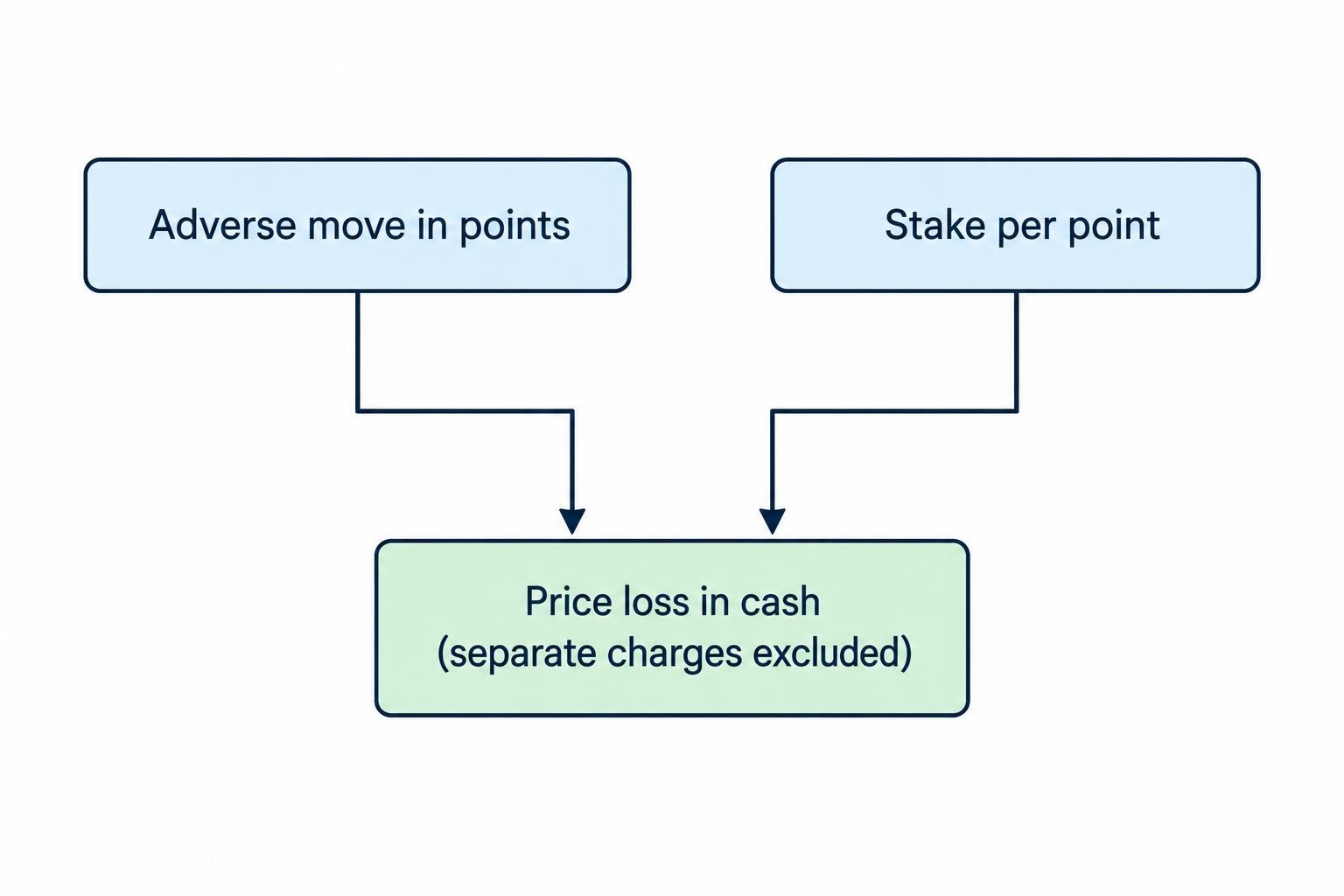
Check the contract’s point definition before comparing platforms. An index point, a forex pip and the smallest displayed price change need not represent the same movement. The stake per point explanation covers how to translate the ticket into pounds of exposure.
Spread Betting Brokers to Check for Smaller Stakes
Two relevant examples are Spread Co and Spreadex. Their published small-stake options provide a starting point, but the deal ticket for your chosen instrument remains the final check. The figures below reflect information retrieved in October 2026, not a promise that every contract or account will have identical terms.
Spread Co: Stakes Starting at 1p per Point
Spread Co offers spread betting stakes from £0.01 per point. That gives traders a smaller starting increment than a platform requiring 50p or £1 per point, and can make it easier to fit a position to a modest cash risk budget. The Spread Co minimum-stake comparison records the penny-per-point offering.
The practical attraction is sizing flexibility. If a planned stop sits 80 points from entry, a 1p stake corresponds to an 80p price loss at that stop level, before separate charges and assuming execution there. A 10p minimum would make the equivalent figure £8.
That does not establish Spread Co as the cheapest choice. Compare the spread, financing terms and point definition on the actual contract. A smaller minimum answers “can I size this trade?” It does not answer “is this trade good value?”
Spreadex: 10p Trading on Selected Financial Markets
Spreadex is another option to check for fractional-pound stakes. Its UK 100 Daily market information lists a 10p minimum, while DayTrading.com’s live-account review of Spreadex reports using 10p stakes on the FTSE and EUR/GBP. The review also records the absence of a full demo account on the core platform.
A 10p stake may suit a trader whose planned stop distances produce affordable losses at that size. It may still be too large for a very small account or a trade requiring a wide stop.
The missing demo matters if you are learning the platform itself. Trading small with real money is not the same as practising without financial exposure. Do not place a live position just to find out which button closes it.
Minimum Stake and Minimum Deposit Are Different Tests
A broker can have a low funding threshold but a minimum stake that is too large for your intended trade. Conversely, a broker with penny stakes may still require more cash than expected to cover margin and leave room for price movements.
Separate three questions: how much must you transfer, what is the smallest permitted position, and how much could that position lose under your exit plan?
The first question concerns account funding. The second concerns the contract. The third concerns your risk. A comparison of brokers with no minimum deposit addresses the funding question, but it should not replace checking minimum trade sizes.
Also ask whether a reduced minimum is permanent or introductory. If it expires after an initial period, assess the account using the stake you would have to trade afterwards.
Choose the Cash Risk Before the Stake
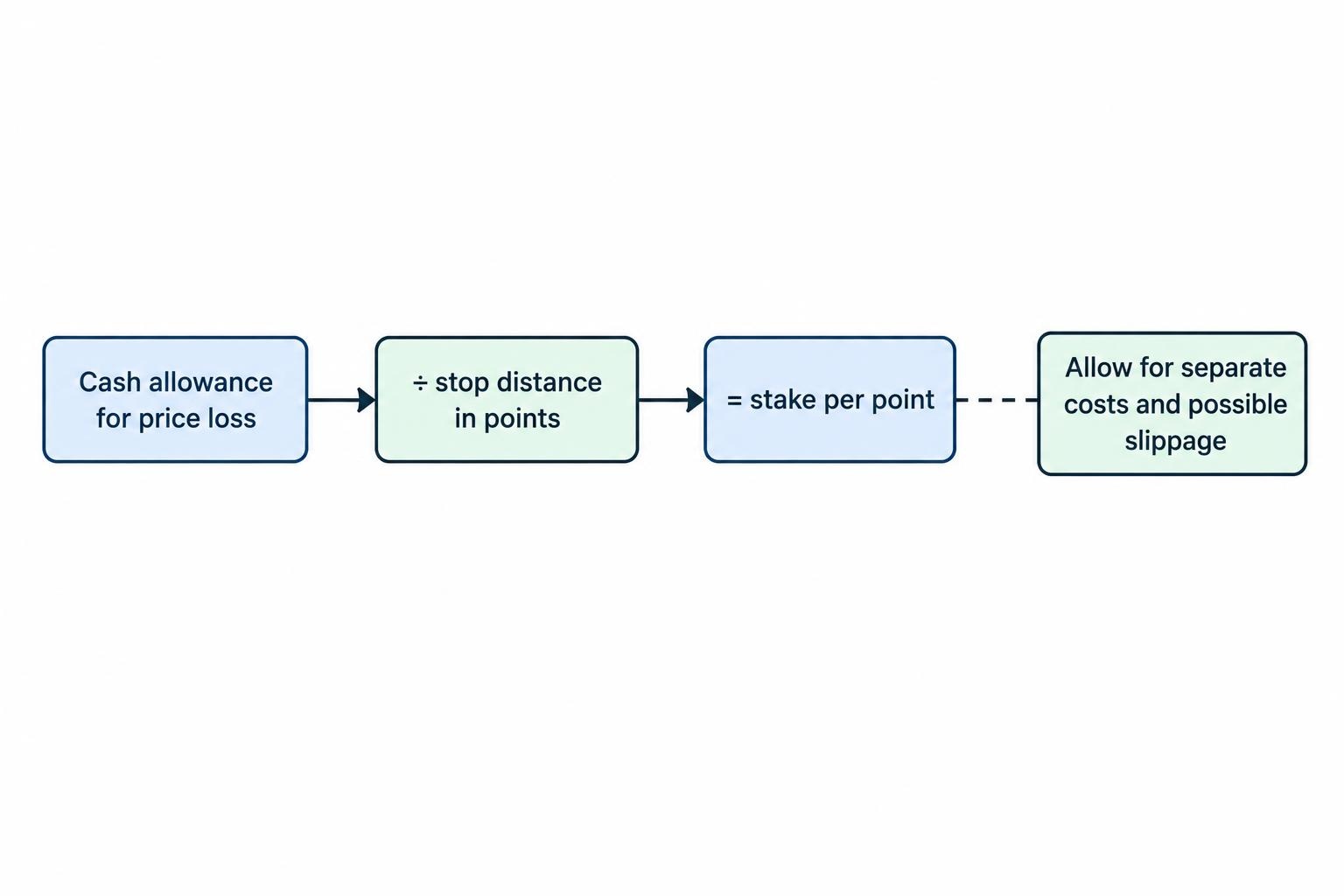
A useful broker comparison starts with a hypothetical trade, not an account-opening form. Decide where the trade would be invalidated, measure the distance from entry to that exit, then calculate the stake that fits your cash risk allowance.
Stake per point = cash allowance for the price loss ÷ stop distance in points.
This calculation assumes execution at the planned stop and excludes separate charges. Leave room for costs, and recognise that an ordinary stop can suffer slippage. The broader position sizing guide covers those adjustments.
| Stake per point | Loss over 30 points | Loss over 100 points |
|---|---|---|
| 1p | £0.30 | £1 |
| 10p | £3 | £10 |
| 50p | £15 | £50 |
| £1 | £30 | £100 |
These are arithmetic examples, not forecasts or maximum-loss guarantees. They exclude financing and other separate charges.
Suppose an illustrative £500 account has a £5 total allowance for one trade. With a 40-point stop, the stake ceiling before allowing for separate costs is £5 ÷ 40, or 12.5p per point. A broker permitting 10p could accommodate a smaller position. A broker requiring 50p could not accommodate that trade within the allowance.
Do not pull the stop closer simply to make the broker’s minimum stake fit. That changes the trade rather than solving the sizing problem. If the minimum is too large, use a smaller permitted stake elsewhere, practise on a demo, or skip the position.
Check Margin Without Mistaking It for Risk
Margin is the amount required to support a position. It is not the amount you have agreed to lose.
For an illustrative index quoted at 8,000, a stake of 10p per whole index point represents £800 of notional exposure. At an assumed 5% margin rate, the opening margin would be £40. A 100-point adverse move would still produce a £10 price loss.
Those figures answer different questions. The £40 concerns opening the trade; the £10 concerns that particular price movement. Neither means that funding the account with exactly £40 is sensible.
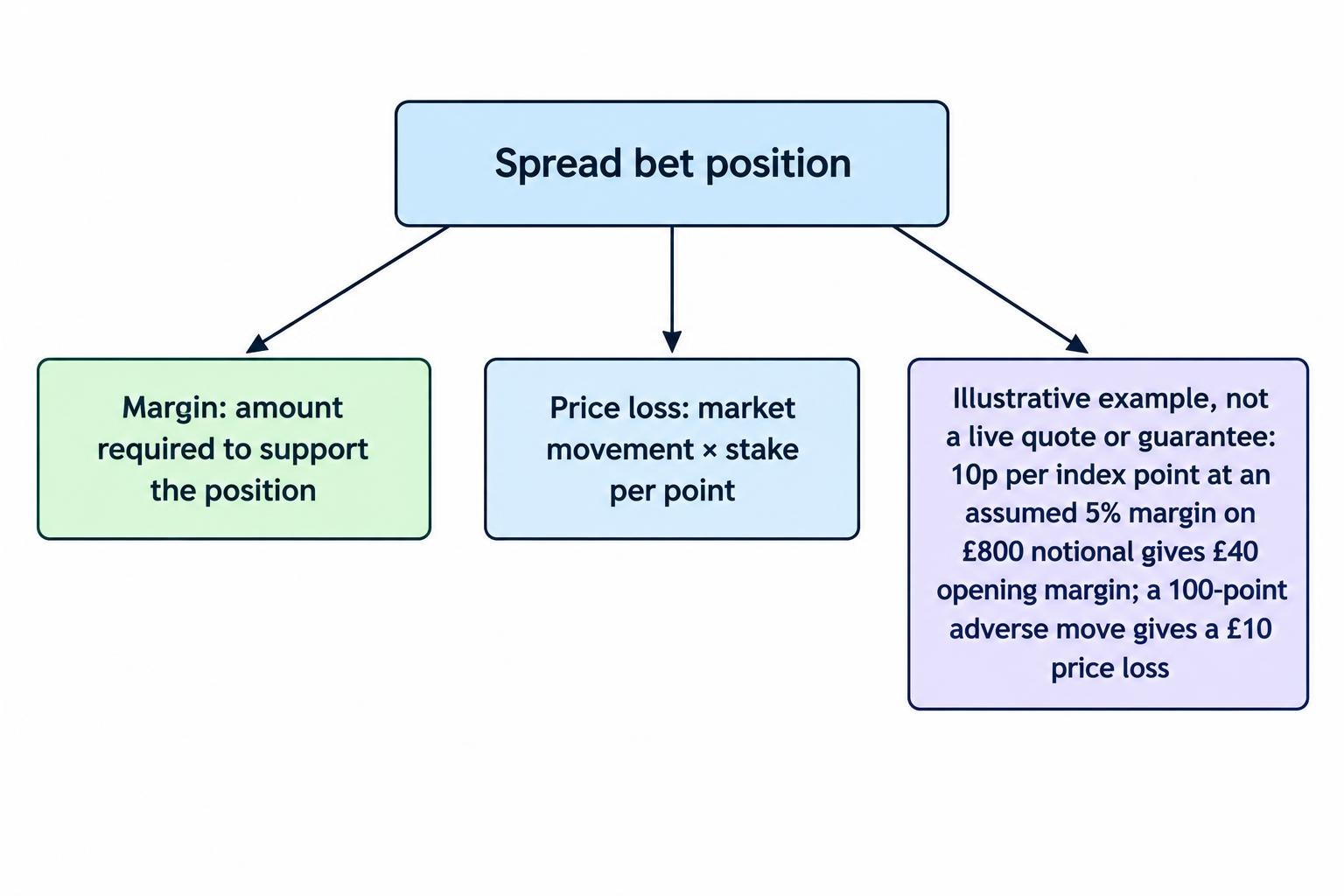
Leave room for trading losses, charges and other open positions. A broker’s margin calculation may also differ from a simple percentage example because of its contract terms, position size or additional requirements. Check the ticket rather than treating a general spread betting margin calculation as a live quote.
Compare Costs at the Stake You Will Actually Trade
Spread Cost
If the quoted spread is two points and the stake is 10p per point, its cash value is 20p. At a 1p stake, it is 2p. Use the same market, contract type and trading session when comparing brokers.
The spread cost is reflected in entry and exit prices. Do not subtract it again from a profit-and-loss calculation that already uses the executed opening and closing prices.
Compare the cost with your intended price target too. A two-point spread against a ten-point target represents a much larger hurdle than the same spread against a hundred-point target. Small pound amounts can still be expensive relative to the trade.
Overnight Financing
For positions held overnight, check the funding calculation rather than assuming a small margin deposit means a small financing bill. Funding can be based on the position’s notional exposure. The FCA review of derivative charges and overnight funding, which covers spread betting providers, identifies concerns about both the level of charges and how firms communicate them.
Request a cash estimate for your intended stake and holding period. A rate expressed annually is easier to assess once converted into an approximate daily charge for the position.
Fixed Charges and Optional Extras
Check for minimum dealing charges, paid market data, inactivity fees and stop premiums before funding. Where a charge is fixed rather than proportional to position size, it can consume a larger share of a small account.
A hypothetical £5 monthly charge equals 1% of a £500 balance before any trading result. That is why comparing total spread betting costs is more useful than choosing solely by the smallest advertised stake.
Test the Platform’s Small-Trade Controls
A low minimum is useful only if the platform makes the position clear. Before submitting an order, check that it displays the cash value per point, required margin and intended stop level without ambiguity.
Pay attention to stake increments as well as the starting minimum. A platform might accept your initial position but restrict how much you can reduce it later. Ask whether you can partially close a small trade, and what minimum position must remain afterwards.
Check saved defaults too. If the ticket reopens at £1 per point when you intended 10p, a routine click can create ten times the planned exposure. Disable instant dealing while learning the controls.
Where available, use spread betting demo accounts to practise order entry, amendments and closing positions with a realistic practice balance. A demo is useful for platform familiarity, not proof that live execution or trading results will match.
Keep Retail Protections in the Comparison
Do not accept weaker account protection simply to obtain a smaller minimum stake. Check the legal entity that would hold your account, its permissions and its contact details. The guide to checking a broker on the FCA Register explains the verification process.
For covered UK retail accounts, the rules require position close-out when account equity falls below 50% of the required margin, as soon as market conditions allow. Negative balance protection limits liability for the covered trading account to its funds. These are account-level protections, not a guarantee that each trade stops at your chosen loss, under the FCA rules for retail speculative investments.
Compensation protection is separate again. FSCS may cover an eligible claim involving a failed authorised firm and a shortfall, subject to its conditions. It does not reimburse poor investment performance. Check the FSCS investment protection requirements rather than assuming that a small account is automatically covered.
How to Make the Final Choice
Compare brokers using one intended market and one realistic trade. Record the minimum stake, permitted increments, cash value per point, margin, spread and expected holding charges. Then check whether the position fits your loss allowance without changing the trading plan to accommodate the broker.
Spread Co’s penny stakes warrant attention where finer sizing is the priority. Spreadex’s 10p options warrant checking where that size fits the intended market and stop distance. Neither should win the comparison on its minimum alone.
The right small-stake account lets you keep exposure proportionate, see the costs and operate the platform reliably. If the smallest available position is still too large, not trading is the better fit.