A spread betting broker for swing trading needs more than a tight headline spread. Positions held for several days or weeks bring overnight financing, weekend gaps, contract expiry and account margin into the buying decision. A small saving at entry can disappear before the trade reaches its planned exit.
The strongest fit is a broker that offers affordable stakes, clear holding costs and position controls that work when you are away from the screen. Start with the available spread betting brokers, then compare their terms against the markets, holding periods and risk limits you actually use.
This guide focuses on choosing and assessing the account rather than trading signals. All numerical broker comparisons below are hypothetical, not live quotes or provider rankings. Spread betting is a leveraged product, and holding a position longer does not make it safer.
What Makes a Broker Suitable for Swing Trading?
Swing trading aims to capture a price move across multiple trading sessions. That changes the broker requirements. Entry speed still matters, but the cost and control of an open position deserve at least as much attention.
For a practical shortlist, concentrate on five areas:
- Holding costs: understandable financing rates, charging dates and any extra costs for short positions.
- Contract choice: daily funded and dated contracts where relevant to your markets.
- Position sizing: minimum stakes and stake increments that fit a wider stop distance.
- Order protection: clear stop execution rules, order duration and guaranteed stop terms where offered.
- Account management: visible margin figures, useful alerts, accessible support and downloadable records.
The weighting depends on your approach. Someone holding an index position for three sessions has different needs from someone holding several share positions through company results. The broker should fit that routine, rather than encourage a different one because its platform happens to look convenient.
Keep the account decision separate from the strategy decision. The guide to swing trading with financial spread betting covers trade selection and management; here, the question is whether the broker can support those trades at an acceptable cost and risk.
Check the Legal Entity Before Comparing Features
For a UK retail account, establish which legal entity will hold the account and provide the spread betting service. Do not stop at the trading brand or a regulatory badge. Check its authorisation, relevant permissions and contact details through the process set out in the FCA guidance on checking an authorised firm. Match those details against the account agreement and the business you are contacting.
Then check your client classification. UK retail rules for these products include minimum opening margins that vary by underlying asset, account-level margin close-out and negative balance protection. When account equity falls below 50% of the required margin, positions must be closed as soon as market conditions allow. Negative balance protection restricts liability to the funds dedicated to the relevant trading account; it does not protect individual deposits or trades from losses. These requirements appear in FCA COBS 22.5 on retail speculative investments.
For swing traders, the practical point is simple: assess the whole account, not just each trade. Several positions can consume margin at once, and a losing position can put pressure on otherwise unrelated trades.
Do not treat higher available exposure as an account upgrade. Before changing classification or accepting a different contracting entity, review the retail client protections that apply to the account you would actually receive.
Compare Costs Over the Expected Holding Period
The relevant cost is the amount paid from opening to closing, including the days between them. A quoted minimum spread tells you only part of that story.
For each shortlisted broker, obtain a cost estimate for the same market, direction, stake and holding period. Include the spread, financing, any separate commission, applicable borrowing charges, guaranteed stop premiums and currency conversion costs. Check which charges apply rather than assuming every broker uses the same structure.
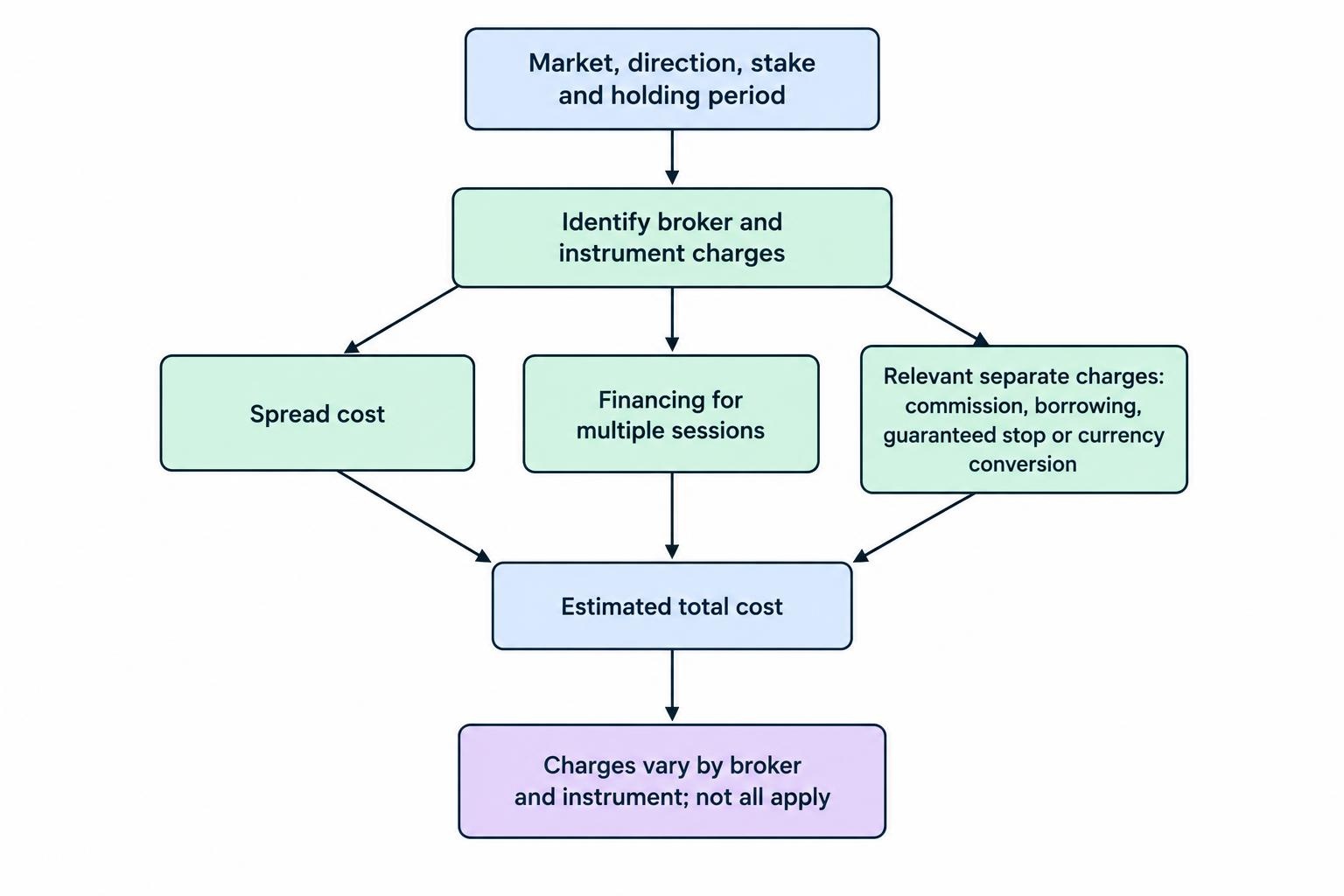
Calculate Financing on Exposure, Not the Deposit
For a straightforward hypothetical long index bet, a useful estimate is:
Financing cost = notional exposure × annual financing rate × chargeable days ÷ annual day count.
Suppose an index trades at 8,000 and the stake is £2 per index point. The notional exposure is £16,000. At an assumed total annual financing rate of 6%, seven chargeable calendar days on a 365-day basis would cost about £18.41.
That calculation uses the £16,000 exposure, not the smaller margin deposit. The actual calculation can change with the instrument, reference price, rate, trade direction and charging convention. Use the broker’s contract terms to establish those inputs; the guide to overnight financing costs covers the mechanics in more detail.
A Hypothetical Broker Cost Comparison
The following comparison assumes the same £16,000 long exposure, a constant reference price and a 365-day calculation. Broker A has a £2 round-trip spread allowance and 6% annual financing. Broker B has a £6 spread allowance and 5% annual financing.
| Chargeable holding period | Broker A: lower spread | Broker B: lower financing |
|---|---|---|
| 2 calendar days | £7.26 | £10.38 |
| 7 calendar days | £20.41 | £21.34 |
| 14 calendar days | £38.82 | £36.68 |
Broker A is cheaper for the shorter holds. Broker B becomes cheaper between the ninth and tenth chargeable days. Neither wins for every holding period.
The example excludes price movement, changing spreads, dividends, slippage and other charges. Its purpose is to show why “lowest spread” and “lowest cost for my swing trades” are different questions.
Check weekend and holiday treatment too. A financing entry covering several calendar days is not necessarily several separate fees. Establish how many days each booking represents so that you neither omit weekend costs nor count them twice.
Daily Funded Bets or Dated Contracts?
A broker offering both daily funded bets and dated spread bets gives you another comparison to make. Look at the actual contract economics rather than choosing solely by the product label.
With a daily funded bet, examine the ongoing financing schedule. For a dated contract, check the quoted spread, expiry, settlement process and any rollover arrangements. If the dated product has no separate daily financing debit, that does not mean carrying the exposure is free.
Equity index futures pricing reflects the cash index, interest rates, expected dividends and time to expiry. The relationship is set out in the CME Group calculation of stock index futures fair value. This matters when assessing a spread bet whose price references a futures contract: a different price from the cash market is not automatically an extra broker fee.
Ask what happens if your trade remains open near expiry. Does it settle automatically? Can it be rolled into another contract, and at what cost? What happens to attached stops and targets? A trade planned for two weeks should not acquire an unexpected deadline because the wrong contract month was selected.
Use the daily funded bets versus futures comparison for the wider product differences. For broker selection, the useful test is whether the available contracts suit your likely holding period without awkward expiry or rollover terms.
Minimum Stakes Matter More With Wider Stops
A broker can have attractive pricing and still be unsuitable if its minimum stake forces you to take too much risk.
Suppose a trade has a planned stop 180 points from entry and a price-loss budget of £75 before charges and slippage. The calculated stake is approximately £0.42 per point:
£75 ÷ 180 points = £0.4167 per point.
If the broker only accepts £1 per point, the planned price loss becomes £180. At a 50p minimum, it becomes £90. Neither fits the original budget. Tightening the stop purely to accommodate the broker’s minimum changes the trade, not just the order ticket.
Check minimum stakes on the exact instruments you intend to trade. Also check the permitted increments: a low minimum is less useful if the next available stake is a large jump. The brokers for small stakes category is relevant where account size makes this a deciding factor.
Separate Trade Risk From Margin
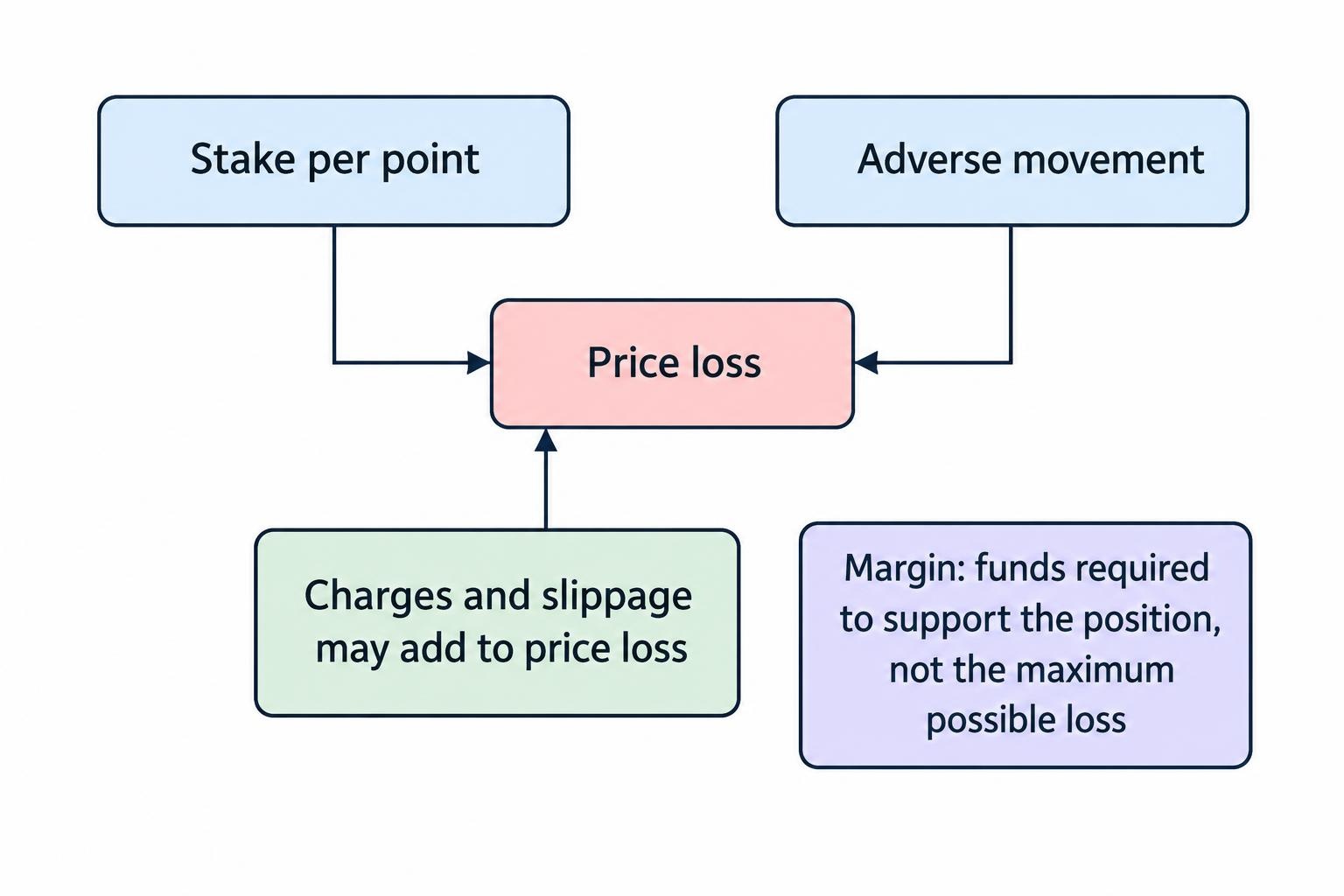
Margin determines the funds required to support a position. It is not the position’s maximum possible loss. A broker requiring a smaller deposit does not reduce the pounds lost for each adverse point at the same stake.
Compare how clearly each platform displays used margin, available funds and the effect of another order. Ask about margin changes, position-size tiers and the broker’s rights to reduce exposure. Keep room for financing charges and adverse movement rather than funding the account to the opening requirement alone.
The calculations belong in a repeatable spread betting position-sizing process. Broker selection should make that process possible, not force exceptions whenever a setup appears.
Assess Stops, Gaps and Overnight Execution
A swing position remains exposed while you are asleep, working or waiting for the market to reopen. The order policy therefore deserves a proper read.
An ordinary stop is not a promise to exit at its trigger price. Gaps and fast markets can produce a worse fill, including at the opening after news. The Financial Ombudsman guidance on spread betting stop-order disputes identifies both market conditions and the broker’s execution disclosures as relevant considerations.
Before opening an account, establish which price triggers a stop: the broker’s bid, offer or another reference. Check whether the chart displays that same price. A chart showing one price series may not provide the full explanation for an order triggered on another.
Read Guaranteed Stop Conditions Carefully
Where a guaranteed stop is offered, check its availability for the intended market, direction and stake. Establish the premium, when it is charged, minimum stop distance and whether amendments are allowed outside normal market hours.
A guarantee on one instrument does not establish the terms on another. Nor should you assume that every contract available through a platform supports it. Compare spread betting brokers offering guaranteed stops using the markets you actually intend to hold overnight.
Also check how attached orders interact. If the target closes the position, is the protective stop cancelled automatically? If you close half the stake, does the stop resize? If the position closes, could an unattached order remain active and open a new trade later?
These are mundane questions until an unwanted position appears. A polished order ticket is not a substitute for clear answers.
Compare Market Coverage at Contract Level
A large advertised market count is less useful than dependable access to the few markets you trade. Build the comparison around a short watchlist rather than the broker’s total catalogue.
Indices and Forex
For index positions, compare the cash and dated contracts, point definition, minimum stake and trading sessions. Check spreads at your intended entry and exit times, not only during the busiest part of the day.
For forex, obtain both long and short holding rates for the pairs on your watchlist. Do not assume that selling a pair produces a financing credit, or that one pair’s charging schedule represents another’s. Ask how the quoted rate changes and where you can inspect the daily adjustment.
Shares and Commodities
For share swing trades, investigate short availability, borrowing charges, company announcements and corporate-action treatment. Ask what happens if a share is suspended or the broker withdraws the ability to open or maintain a short position.
For commodities, identify the price reference and contract expiry. A cash-style quote and a dated oil contract should not be treated as interchangeable because their names look similar.
Check the spread betting trading hours for each contract and confirm when orders operate. A market displayed on a watchlist is not necessarily available for execution at every hour, and an alert does not create liquidity.
Choose a Platform for Managing Positions, Not Watching Them
A useful swing trading platform should make account checks quick and deliberate. You should be able to identify the position, its attached orders, current margin use and accumulated charges without searching through several menus.
Test daily and weekly charts, saved layouts, watchlists and price alerts. Confirm that contract names are unambiguous, particularly where cash and dated versions sit beside each other. Buying the wrong expiry is an expensive way to learn the naming convention.
Mobile access matters even if most analysis happens on a desktop. Check whether the app lets you inspect orders, amend protection, reduce a position and review account funds. Compare the practical controls in mobile spread betting apps, rather than choosing on appearance alone.
Ask which instructions remain active when you log out or lose your connection. Do not assume that every trailing stop, alert or third-party platform feature runs on the broker’s servers. Establish what requires a device or application to remain connected.
Support and Records Are Part of the Product
Check support hours against the markets you hold, including access to dealing assistance during a platform problem. Ask how telephone instructions are authenticated and whether additional dealing charges apply.
Keep records of orders, amendments, fills and financing entries. Terms, communications and trading evidence can all matter in a dispute, as set out in the Financial Ombudsman approach to spread betting complaints. Prefer an account that makes those records easy to retrieve.
How to Compare Two or Three Brokers in Practice
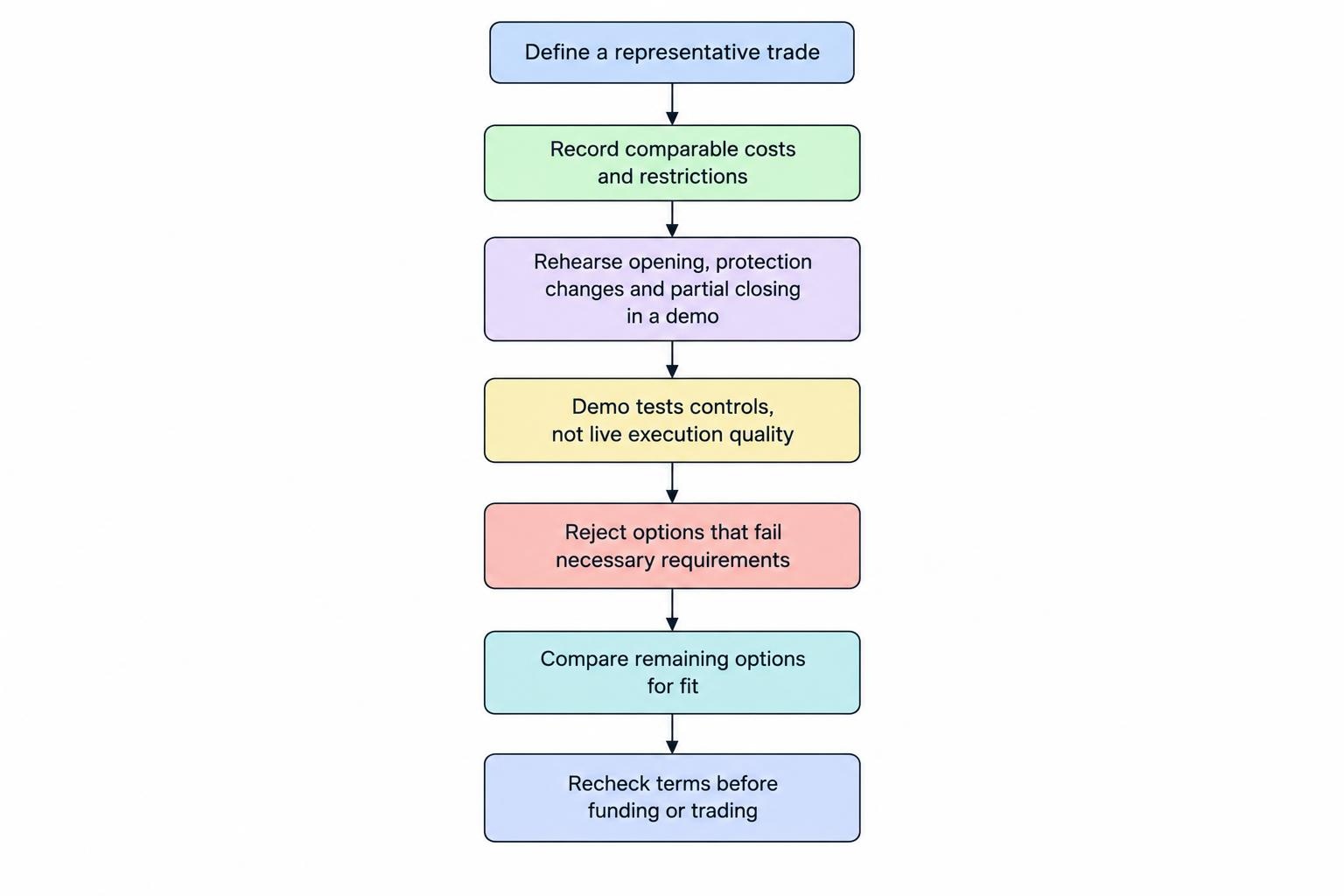
Use a repeatable comparison exercise. Testing everything at once produces a long list of impressions and very little that can guide a decision.
1. Define a Representative Trade
Choose one market you regularly follow. Specify the contract, direction, stake, entry window, stop distance and likely holding period. Include a longer holding scenario in case the move develops more slowly than expected.
Use the same assumptions for every broker. Comparing one provider’s cash index bet with another’s dated contract without accounting for the product difference will not produce a useful cost ranking.
2. Record the Costs and Restrictions
Write down the spread at comparable times, financing inputs, minimum stake, order distances, margin requirement and expiry terms. Record when each figure was checked. Separate published minimum prices from the prices available during your observation window.
Where a charge remains unclear, ask support to explain it using your example. Request an answer covering the trade direction and the intended holding dates, including the weekend. “Financing applies” is not enough detail to estimate a bill.
3. Rehearse the Full Position Lifecycle
Use spread betting demo accounts to practise opening a position, attaching protection, changing an order and closing part of the stake. Leave the demonstration position open across several sessions and inspect the records available afterwards.
A demo can reveal workflow problems. It cannot establish that live fills, slippage or market access will behave identically. Treat it as a rehearsal for the controls, not proof of execution quality.
4. Choose on Fit, Then Recheck the Terms
Reject accounts that fail a non-negotiable requirement, such as an affordable stake or the necessary contract. Among the remaining options, compare the estimated cost and ease of managing the position.
Keep the calculations in a simple worksheet. The method for comparing total spread betting costs helps separate a genuine saving from a cheaper-looking entry spread. Recheck the terms before funding or trading; a saved comparison is a record, not a permanent price promise.
Choosing the Right Broker for Your Swing Trading Routine
For shorter holds, spread and order handling may carry more weight. For longer holds, financing and contract choice deserve closer attention. For smaller accounts, minimum stakes can decide the matter before pricing does.
If you hold through weekends or scheduled announcements, spend more time on gap exposure and protection terms. If you manage several positions, prioritise clear account margin information and records that show the cost of each holding.
The right spread betting broker for swing trading is not necessarily the one with the most markets, the smallest advertised spread or the most indicators. It is the account that lets you express your planned trade at an affordable size, understand the cost of keeping it open and manage the exit without avoidable surprises.