Spread betting brokers with guaranteed stops let you fix an exit price before a trade moves against you. Unlike an ordinary stop loss, an accepted guaranteed stop protects that exit level even if the market gaps past it. The protection comes with conditions, usually including a premium and a minimum distance from the market price.
The useful comparison is not simply which broker offers the feature. It is whether the guarantee covers your chosen market, fits your planned stop distance and remains affordable at your stake size. A guaranteed stop that sits much further away than your trading plan allows is not much help.
This guide focuses on UK financial spread betting accounts. Use it alongside the broader comparison of spread betting brokers, rather than choosing a provider on one order type alone. Spread betting remains a high risk product: a guaranteed exit price does not prevent trading losses.
Spread Betting Brokers to Consider for Guaranteed Stops
IG, CMC Markets and Spreadex offer guaranteed stop functionality. They provide a starting shortlist, not an exhaustive ranking. Availability can differ between instruments, account types and platforms, so confirm the terms for the actual spread bet you intend to place.
| Broker | Guaranteed stop arrangement | What to compare |
|---|---|---|
| IG | Offers guaranteed stops across several market categories, with a premium charged when the guaranteed stop triggers. | Instrument eligibility, premium at your stake size, minimum distance and the platform available for your spread betting account. |
| CMC Markets | Offers optional guaranteed stops on eligible trades. Its GSLO fee is refunded if the stop is not triggered. | The initial cash requirement, refund conditions, minimum distance and any change to position margin. |
| Spreadex | Provides guaranteed stops through its financial trading platform. | The chosen market’s premium schedule, placement rules, minimum distance and restrictions on later amendments. |
Do not treat a broker’s total market count as its guaranteed stop market count. A provider may offer thousands of spread betting instruments without making the guarantee available on every contract. Cash and futures versions of a market also need separate checks.
For IG, the practical cost question is what the triggered premium adds to a stopped trade. For CMC Markets, compare both the eventual cost and the money committed before any refund. For Spreadex, inspect the individual market terms rather than assuming that one instrument’s rules apply across the platform.
There is no defensible universal winner without specifying the market, stake, holding period and required stop distance. A broker that suits an overnight index position may be a poor fit for a short duration currency trade.
What the Guarantee Actually Covers
A guaranteed stop loss order, often shortened to GSLO, is a contractual commitment to close the covered position at the agreed stop level when its trigger conditions are met. An ordinary stop instead instructs the broker to close the position once the trigger is reached, but the available execution price can be worse.
That difference matters during gaps. A market can move from one price to another without offering an executable price at every point between them. An ordinary stop cannot manufacture the missing prices.
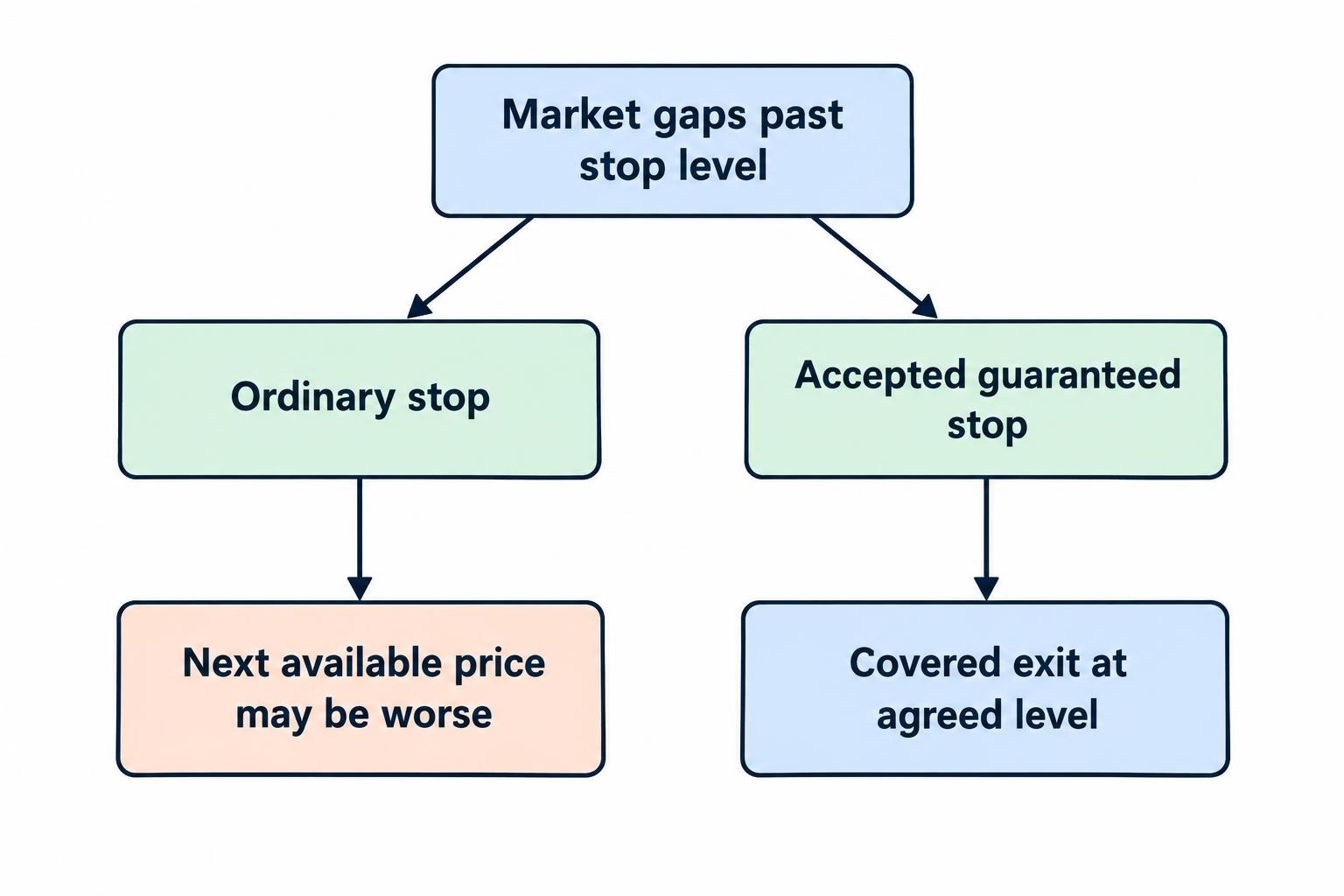
A standard stop does not become guaranteed because the same broker also sells GSLOs. That distinction was upheld in Financial Ombudsman decision DRN-3970117, involving a spread betting stop executed during extreme volatility.
The guarantee concerns the covered exit, not the quality of your entry or the profitability of your trade. It does not normally turn a pending entry order into a guaranteed fill, remove financing charges or protect unrelated positions. The detailed mechanics belong in the guide to guaranteed stop loss orders; the broker comparison should focus on the terms attached to that promise.
Compare Premiums in Pounds, Not Just Points
Guaranteed stop premiums can look small when displayed as points. Convert them into the cash amount payable for your intended position before comparing providers.
Where a premium is quoted per point of stake, the calculation is straightforward:
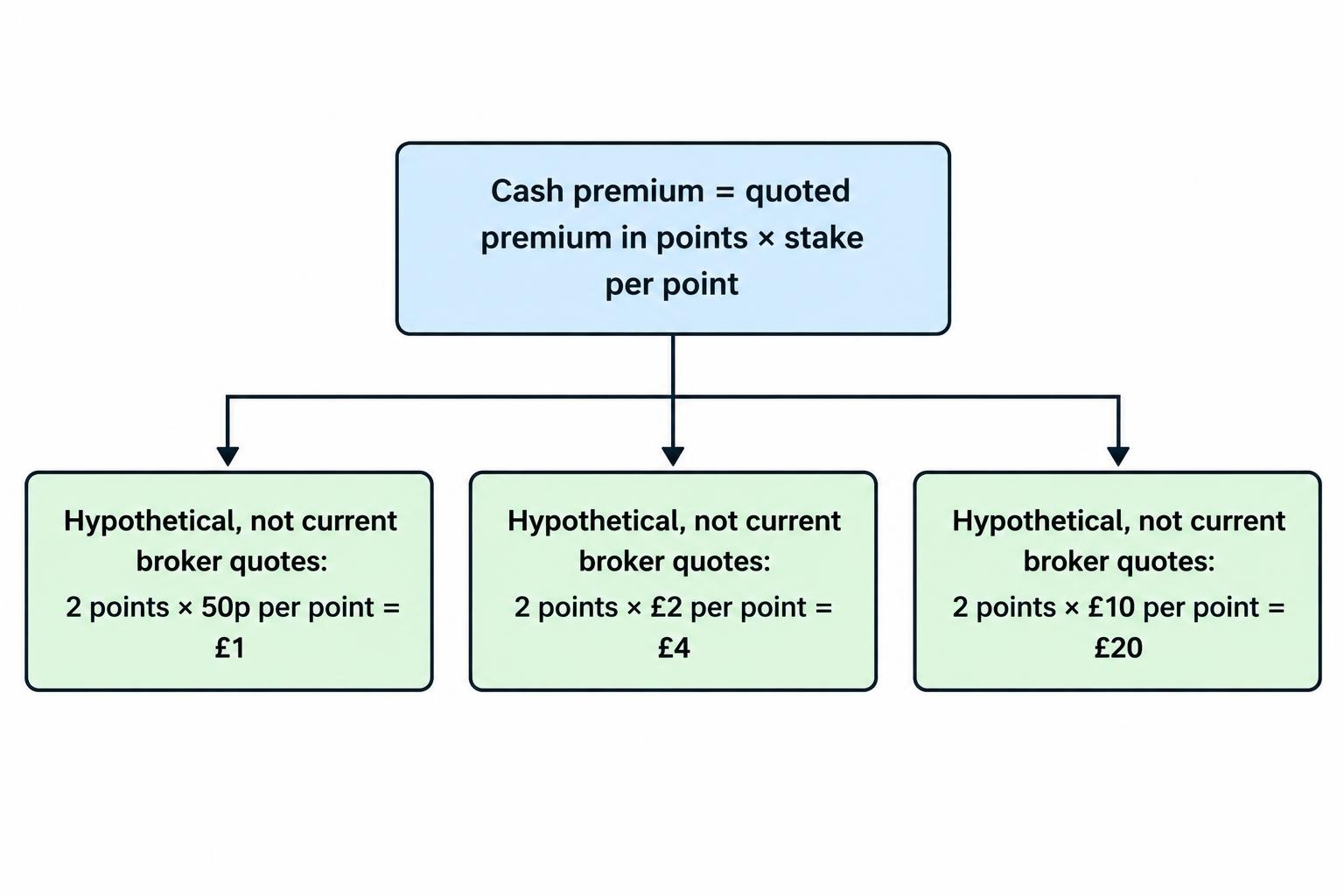
Cash premium = quoted premium in points × stake per point
A hypothetical two point premium costs £1 at 50p per point, £4 at £2 per point and £20 at £10 per point. These are illustrations, not current broker quotes. Some instruments use a different charging basis, so use the dealing ticket’s cash figure when available.
Check when the money leaves your available balance. A charge collected only when the stop triggers and an upfront charge refunded when unused can produce the same eventual fee, but they do not necessarily have the same effect on available funds while the position is open.
Read the refund conditions too. Ask what happens if you close manually, take profit, reduce the position or replace the guaranteed stop with another order type. The guide to guaranteed stop premiums covers the different charging structures in more detail.
Include the rest of the trading bill
A cheap guarantee does not automatically make a cheap trade. Compare the spread during your trading hours, any overnight financing, relevant borrowing charges and other account costs.
For a position held over several nights, financing can matter more than a small difference in the stop premium. For frequent intraday trading, the spread and the number of stopped trades may carry more weight.
Use the same market, stake and holding period for each quote. Comparing one broker’s minimum advertised spread with another broker’s live spread during a volatile session is not a useful contest. The approach in comparing total spread betting costs helps keep the comparison consistent.
A Worked Comparison: Ordinary Stop Versus Guaranteed Stop
Suppose you buy a hypothetical index spread bet at an executed price of 8,002, stake £2 per point and place your stop at 7,952. The distance between entry and stop is 50 points.
Your planned price loss is therefore 50 × £2 = £100.
The market then gaps lower. Assume the next available selling price is 7,882 and an ordinary stop executes there. The price loss becomes (8,002 − 7,882) × £2 = £240.
With an accepted guaranteed stop at 7,952, the covered exit remains at that level. If the hypothetical premium is two points, the stopped trade costs £100 in price movement plus a £4 premium: £104 before financing or other applicable charges.
In this example, the guarantee prevents £140 of additional price loss and costs £4. That does not mean every guaranteed stop will deliver that benefit. If the market trades smoothly through the stop, an ordinary stop might execute at the same level without the guarantee premium.
The calculation uses the actual entry price and closing price, so the spread already affects the price result. Do not add it a second time. Also keep trading margin separate: the deposit required to open this position is not the same number as its planned loss.
Minimum Stop Distance Can Matter More Than the Fee
Every shortlist should include the minimum permitted distance for a guaranteed stop. Compare it on the instrument you trade, not a convenient example elsewhere on the broker’s platform.
Suppose one provider accepts a guaranteed stop 20 points away, while another requires 60 points. At £2 per point, those distances represent £40 and £120 of price risk before premiums. The second provider’s lower fee would not compensate for that difference if your plan requires a much closer exit.
A wider required distance does not automatically make the broker unsuitable. You may be able to reduce the stake and keep the cash risk within your budget. But that changes the position, and it must still fit the trading setup.
Check whether the quoted minimum distance can change around market events or outside normal hours. Ask separately how any change affects an already accepted guarantee and a new request to move it. Those are different questions.
Size the position after checking the stop rules
For an illustration with a £60 loss budget, a 40 point stop and a two point premium, the stake before allowing for other costs is:
£60 ÷ (40 + 2) = approximately £1.43 per point
If the broker permits 10p increments, rounding down to £1.40 produces a £56 price loss plus a £2.80 premium when triggered. That leaves very little room for other charges, so a tighter total budget would require a smaller stake or a separate cost allowance.
Check the broker’s minimum stake before assuming the calculation works. If the smallest permitted position exceeds your budget, the appropriate response is to reject the trade, not stretch the budget. The fuller method is covered in position sizing for spread betting.
Check Coverage, Placement and Amendment Rules
Market and contract coverage
Record the precise instrument name, whether it is a daily funded or dated contract, its trading hours and whether guaranteed stops are available. “Gold” or “UK index” is not a detailed enough comparison.
If your concern is an overnight or weekend gap, check the contractual treatment of that event. The feature should address the exposure you actually intend to carry. The explanation of market gap risk helps separate gaps from ordinary price fluctuations.
Adding protection after entry
Before opening an unprotected trade, establish whether a guaranteed stop can be added later. Check whether placement is restricted to trading hours and whether sufficient available funds are required at that moment.
Do not build a plan around adding protection just before a news release unless the broker’s terms and current ticket allow it. An intended guarantee is not an accepted guarantee.
Moving, reducing or replacing the order
Ask whether you can move the stop closer, move it further away, increase the stake or partially close the position. Check whether each action changes the premium, available margin or protected quantity.
Separate amendments to an existing accepted stop from placement of a new one. A platform may treat those requests differently. After any change, inspect the confirmation rather than assuming the previous protection carries across unchanged.
Expiry and rollover
For dated spread bets, establish what happens when the contract expires or rolls into another contract. Do not assume a guarantee attached to one position automatically protects its replacement.
For daily funded positions, include the cost of carrying the trade in your decision. A guaranteed stop controls one part of the exposure; holding spread bets overnight also introduces funding and operational considerations.
Check the Trigger Price, Not Just the Chart
For a long position, the selling price normally determines the exit; for a short position the buying price normally matters. Confirm the broker’s trigger rules and which price your chart displays. A midpoint or last traded chart can tell a different story from the relevant bid or offer.
A widening spread can bring the relevant closing price to a stop even when another chart appears not to have touched it. The guarantee protects the agreed execution level; it does not mean the stop can trigger only when your preferred external chart reaches that number.
In Financial Ombudsman decision DRN-2419606 on a guaranteed stop pricing dispute, the assessment considered chart evidence, internal tick data, underlying market prices and contractual pricing terms. The complaint was not upheld. It illustrates why the relevant price records matter more than a single chart screenshot.
When assessing a broker, look for accessible order history, clear timestamps and confirmations showing whether the stop is guaranteed. If an execution is disputed, retain those records and request the relevant price data through the broker’s complaint process.
Guaranteed Stops Are Not Negative Balance Protection
These protections operate at different levels. A guaranteed stop addresses the exit price of a covered position. Negative balance protection addresses liability across the relevant retail trading account. Margin close out concerns when positions must be closed because account equity has fallen too far.
Under FCA COBS 22.5 retail trading protections, a firm must close open positions as soon as market conditions allow when net equity falls below 50% of the required margin. The rules also restrict a retail client’s liability for the covered investments to the funds in that account.
That does not make the account balance a sensible risk budget for every trade. An account level backstop is not a substitute for choosing an affordable position size. The distinction is covered further in the guide to negative balance protection.
Nor should you assume a guaranteed stop reserves a position until its stop level is reached regardless of everything else happening in the account. Check the broker’s close out terms and funding requirements. Other positions, charges and withdrawals can affect available funds.
Verify the Firm Behind the Guarantee
The broker’s trading name is not enough. Identify the legal entity that will hold your spread betting account and check its authorisation, permissions and contact details before funding it.
The FCA’s instructions for checking an authorised firm distinguish the consumer Firm Checker from the fuller historical information available on the Financial Services Register. Match the contact details too, because clone firms can copy the name and reference number of a genuine business.
Keep a copy of the customer agreement and the guaranteed stop terms applicable to your account. A contractual price guarantee is not a promise that a broker cannot fail, and it should not be treated as protection against every form of counterparty risk.
If you need help identifying the relevant record, follow the steps for checking a broker on the FCA Register. Avoid assuming that a licence held by another company in the same group covers your account.
Test the Order Process Before Committing Funds
A practice account, where available, is useful for learning the ticket and checking how the platform displays protection. It cannot prove how the broker will perform during a future live market gap.
Run through the same task on desktop and mobile if you expect to use both. Check that the guaranteed setting remains visible after submission and that you can find the confirmation without hunting through several menus.
Use this short acceptance check before placing a protected trade:
- Confirm the correct spread betting instrument, direction and stake.
- Select a guaranteed stop, not an ordinary stop or price alert.
- Check the accepted level, premium, margin requirement and cash loss estimate.
- Review the placement and amendment restrictions.
- Save the confirmation showing the protected position and quantity.
Use the guide to spread betting demo accounts to assess practice facilities. Where a broker does not provide a suitable simulation, request a clear explanation of the order process before using real money to learn it.
Choosing the Right Broker for Your Trading Plan
Choose from the trade backwards. Start with the instrument, intended holding period, affordable cash risk and required exit level. Then compare which broker can accept that arrangement and at what total cost.
For an overnight position, contractual gap coverage may justify a premium. For a strategy requiring very close exits, the minimum guaranteed distance may rule a provider out. For a small account, stake increments and upfront cash requirements can be decisive.
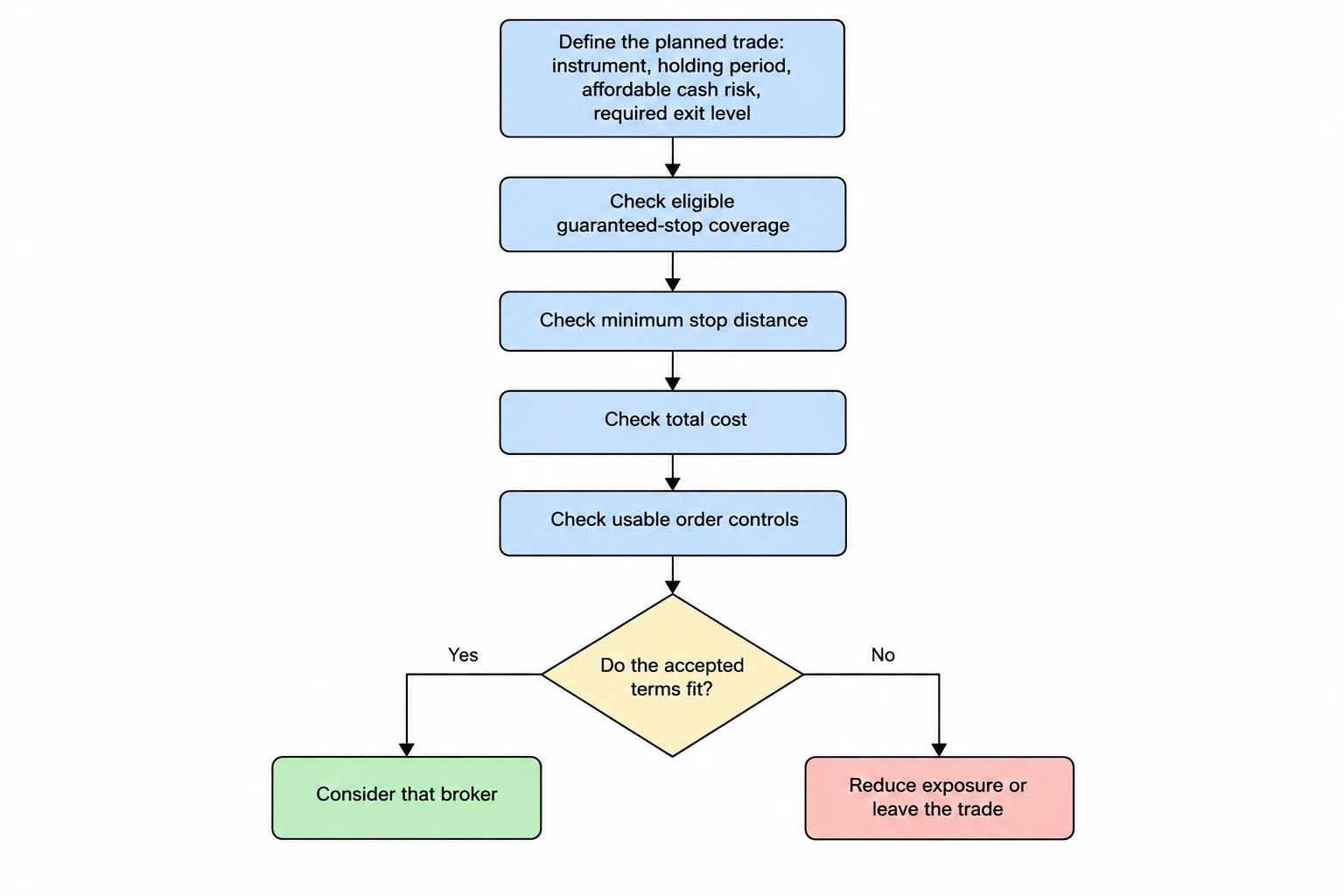
The strongest choice is the broker whose accepted guarantee fits the position you planned, with clear costs and usable order controls. If none of the available terms fit, reduce the exposure or leave the trade alone. Paying for certainty at the exit is useful; paying for permission to take too much risk is not.