Spread betting and futures can provide exposure to the same market, but they are not interchangeable contracts. Spread betting lets you choose a cash stake per point through a provider. Exchange traded futures use standardised contracts with fixed point values, expiry dates and clearing arrangements.
For a UK individual, the choice usually comes down to position sizing, execution, total costs, account protections and tax treatment. A small stake may fit a spread betting account better. A strategy built around exchange prices and order book execution may favour futures. Neither makes a weak trading strategy profitable.
This comparison covers financial spread betting versus conventional exchange traded futures. It does not treat a broker’s “futures spread bet” as an exchange contract, or assume that the smallest opening deposit represents the amount at risk.
Spread betting vs futures: the main differences
| Feature | Spread betting | Exchange traded futures |
|---|---|---|
| Contract | A bet with the spread betting provider | A standardised exchange contract accessed through an intermediary |
| Position size | Cash stake per point, within the provider’s minimums and increments | Number of contracts multiplied by each contract’s point value |
| Price and execution | The provider’s dealing quote and execution terms | Exchange prices and order matching rules |
| Trading costs | Spread, possible financing and other product or account charges | Bid–ask spread, commissions, exchange and clearing charges, plus possible data costs |
| Holding period | Rolling or dated products, depending on the contract | Defined maturity; continued exposure may require a rollover |
| Margin | Provider requirements subject to applicable retail rules | Exchange or clearing requirements plus the intermediary’s requirements |
| Settlement | Cash profit or loss under the betting contract | Cash settlement or physical delivery, depending on the product |
| Currency | Profit and loss can be expressed in the chosen stake currency | Contract profit and loss follows its settlement currency |
| UK capital gains treatment | Genuine private spread bets normally produce no chargeable gains or allowable capital losses | Non-trading transactions in qualifying futures normally fall within capital gains rules |
These differences need checking against the actual contract. Two tickets labelled “S&P 500” can have different point values, financing arrangements and settlement dates. The market name is not enough to make them equivalent.
What are you actually trading?
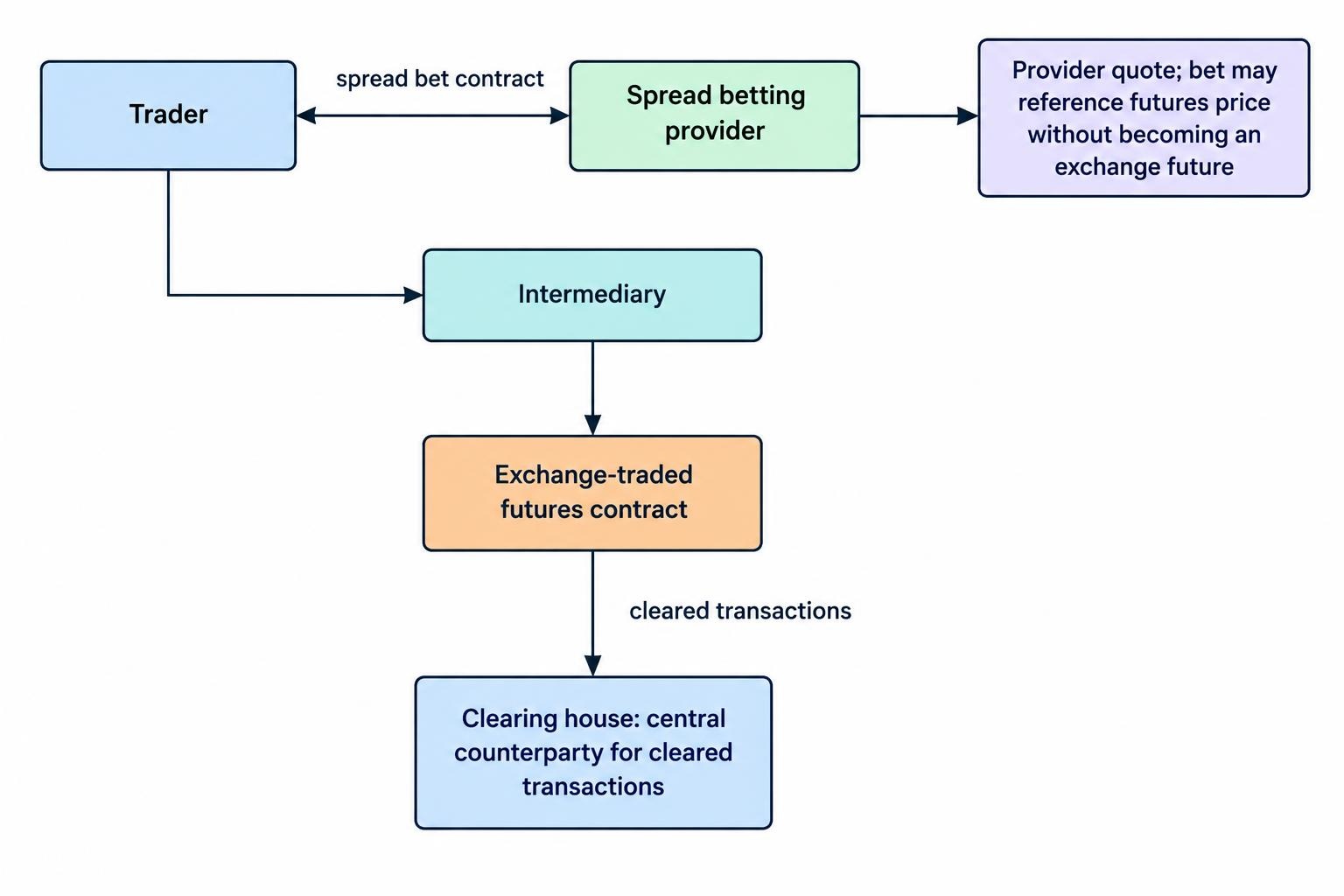
Spread betting is a contract with the provider
A financial spread bet pays out according to the movement between your opening and closing prices, multiplied by your stake per point. You are not buying the referenced shares, index constituents or commodity.
The provider supplies the dealing quote and is your contractual counterparty, even if it hedges its exposure elsewhere. The FCA’s supervisory letter covering CFDs and spread bets identifies providers trading as principal to their clients as the main business model in that market.
This distinction matters when comparing execution policies, trading interruptions and the treatment of disputed prices. Your agreement with the provider governs the spread bet; the underlying exchange’s rules do not simply become your betting contract.
Futures use standardised exchange contracts
With exchange traded futures, the contract specification fixes matters such as the multiplier, minimum price movement and maturity. Exchange trading brings buyers and sellers into a shared market, while a clearing house acts as the central counterparty to cleared transactions. That structure is set out in ICE’s explanation of exchange trading and central clearing.
You still depend on your intermediary for account access, order transmission and the handling of your funds. Central clearing changes how counterparty obligations are managed; it does not remove operational risk or protect a position from market losses.
Be careful with product labels. A spread betting provider may offer a dated bet whose price references a futures contract. You still hold a spread bet, not that exchange future. The distinction is covered further in our guide to futures and forward spread bets.
Position sizing: cash per point versus fixed contracts
Spread betting expresses size directly as a stake: £0.50, £2 or £10 per point, subject to the market’s dealing terms. Futures express size through whole contracts, each with a fixed multiplier. This creates different constraints when fitting a trade to a cash risk budget.
With a spread bet, the calculation is straightforward:
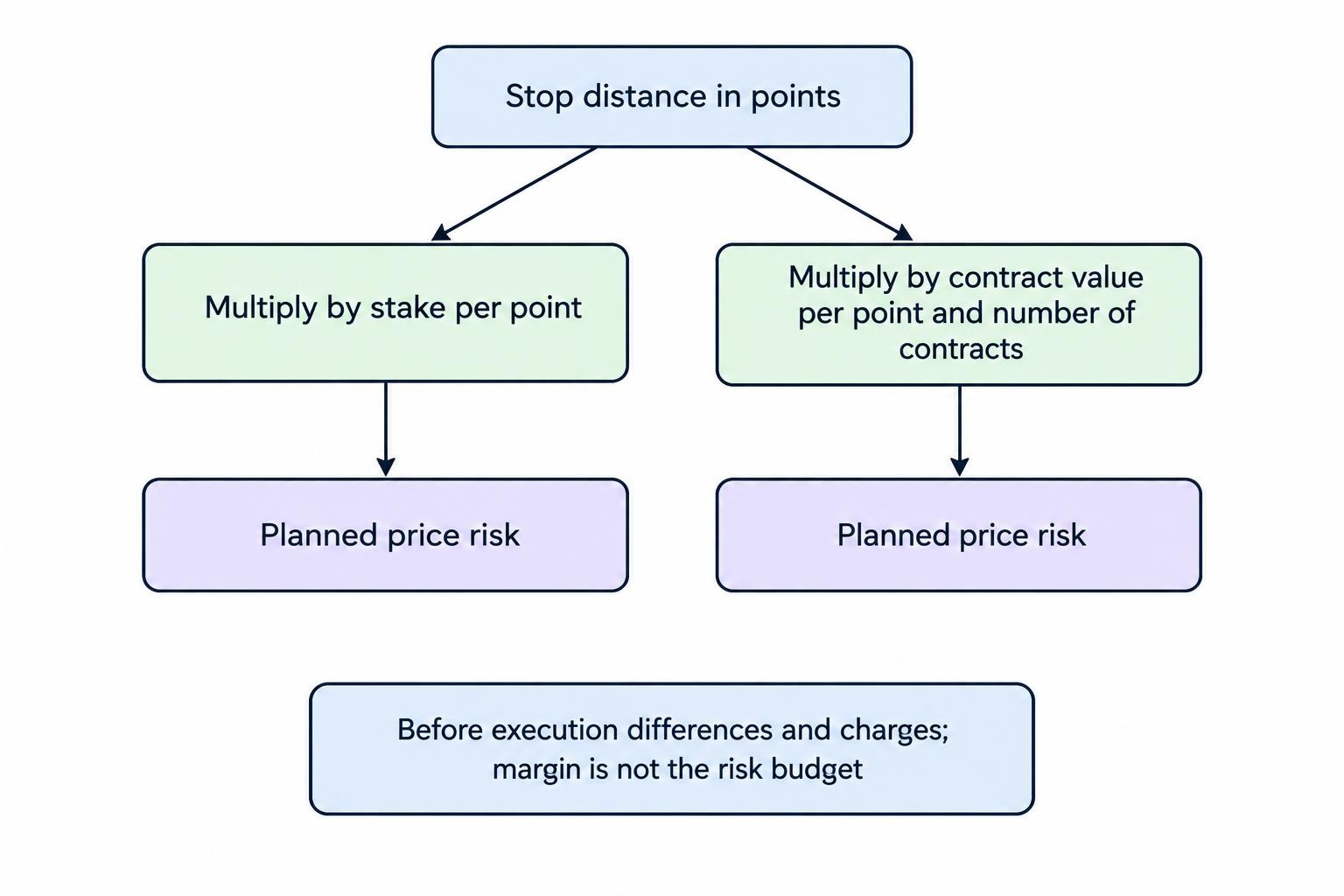
Planned price risk = stop distance in points × stake per point.
A 40-point stop at £1 per point gives £40 of planned price risk before execution differences and charges. Our explanation of stake per point covers how the point definition affects that calculation.
For futures, multiply the stop distance by the contract’s value per point and the number of contracts. CME’s Micro E-mini S&P 500 future, for example, has a $5 multiplier per index point. Its outright minimum tick is 0.25 index points, worth $1.25 per contract, as shown in the CME Micro E-mini contract specifications.
A matched exposure example
Assume, purely for illustration, that £1 equals $1.25 and remains unchanged throughout the trade. One $5-per-point futures contract then provides approximately £4 per point of price exposure.
A 20-point favourable move produces $100, equivalent to £80 at that assumed exchange rate. A spread bet at £4 per point also produces £80 from a 20-point favourable movement between its opening and closing dealing prices. A 20-point adverse movement produces the corresponding loss before other costs.
This is a comparison of price sensitivity, not a promise of identical results. The two products may have different opening prices, spreads, expiry dates and charges. Currency movements can also change the sterling value of the futures result.
Now reduce the planned risk budget to £10 with the same 20-point stop. A spread bet at £0.50 per point would fit that price risk budget, if available. The futures contract in this example would not: one contract creates approximately £80 of planned price risk.
Do not shorten a sensible stop simply to squeeze a contract into an undersized account. The correct response may be another contract size, another product or no trade. The method in our position sizing guide starts with the risk budget rather than the maximum position an account can open.
Costs: compare the complete trade, not the headline spread
Spread betting and futures package their charges differently. That can make one appear cheaper before you have matched the exposure or counted both entry and exit.
For spread betting, check the dealing spread, financing where applicable, guaranteed stop charges, currency charges and any account fees. For futures, check commissions on both sides, exchange and clearing charges, the traded spread, market data subscriptions and any platform costs.
Ask whether a quoted futures commission is “per side” or a complete round trip, and whether exchange charges are included. The NFA’s investor account guidance recommends checking commissions, services and account terms before committing funds. An attractive headline rate is not a complete cost calculation.
An illustrative intraday cost comparison
Use the matched exposure above: a £4-per-point spread bet versus one $5-per-point future, with the exchange rate fixed at £1 to $1.25.
Suppose the spread bet has a one-point dealing spread. If the market does not move and the quote remains unchanged, buying and immediately closing creates a £4 spread cost.
Now assume the future has a 0.25-point bid–ask spread and total explicit charges of $1.20 per side. Crossing that spread costs $1.25, while opening and closing charges total $2.40. The combined $3.65 equals £2.92 at the assumed exchange rate.
Under those invented prices and charges, the futures trade costs £1.08 less. That is not a market-wide finding. Different quotes, contract sizes, execution results or fee schedules can reverse it.
Fixed charges also matter. Fifty such round trips would produce £54 of illustrative savings before subscriptions. A hypothetical £20 monthly data bill would reduce that to £34. At a much lower trading frequency, the same subscription could absorb the saving altogether.
Use a repeatable worksheet rather than comparing one unusually tight quote. Our guide to comparing total spread betting costs provides a framework for counting charges across the whole position.
Overnight holding changes the comparison
A rolling spread bet may carry a separate daily financing adjustment. A dated spread bet may instead incorporate its carrying cost in the quote. Check the product schedule rather than assuming all spread bets use one charging model.
For a hypothetical long rolling position with £24,000 of chargeable exposure, an assumed annual financing rate of 8% and a 365-day calculation basis, ten days would cost approximately £52.60. That is an illustration, not a current provider rate. The actual basis, reference rate, adjustment and charging days need checking in the overnight financing calculation.
Conventional futures do not normally present the same daily provider financing debit. That does not make carrying exposure free. Futures pricing reflects the economics of holding the underlying asset; for equity exposure, financing and expected dividend income matter. The ASX definitions of cost of carry and fair value describe that relationship.
Do not compare the rolling bet’s financing debit with zero and stop there. Compare both positions over the intended holding period, including differences in price basis and any rollover transactions. The narrower comparison of daily funded bets versus futures deals with that product choice in more detail.
Margin: the opening requirement is not the risk budget
Both products allow exposure larger than the cash committed as margin. That magnifies the effect of market movements relative to the money supporting the position.
Futures margin is a performance deposit, not a down payment on ownership of the underlying asset. Initial margin opens the position; maintenance margin sets the minimum required account support. Requirements can change, and an intermediary may demand more than the exchange minimum. These distinctions are covered in CME’s explanation of futures initial and maintenance margin.
A lower opening requirement does not reduce the contract’s point value. If a position gains or loses £4 per point, it still does so whether the required margin is £500 or £1,500. A 100-point adverse move remains a £400 price loss before charges.
Budget for three separate amounts: the margin requirement, the loss you intend to tolerate and cash available to absorb adverse movements or increased requirements. Counting the same £500 as all three is optimistic accounting.
Do not assume a margin warning gives you time to transfer money. Read the liquidation terms and funding deadlines before opening the position. Our guide to margin calls explains why an account can be closed out before a trader’s preferred exit level.
Execution: provider quotes versus exchange orders
Spread betting gives you a dealing price from the provider. Futures trading gives you access, through an intermediary, to orders and transactions in the relevant exchange contract. The distinction matters most when your strategy depends on small price changes or how orders interact.
With futures, examine the contract month, available order types and the quantity available around your intended entry. A visible best price is not a promise that your entire order can trade there. With spread betting, examine the quoted spread, order size restrictions and the provider’s execution policy.
Neither route removes execution uncertainty. A market order prioritises execution rather than a fixed price. A limit order controls the acceptable price but may remain unfilled. An ordinary stop can execute worse than its trigger during a gap or a fast move. Our guide to slippage explains how this affects realised results.
Compare fills against the market and timestamp relevant to each contract. An expiring future, the next futures month and a rolling cash-style spread bet need not display the same price. Treating every difference as poor execution can lead to the wrong diagnosis.
A useful test is whether the strategy needs exchange order book information to make decisions. If it does, confirm that the account provides the required data and order access. If it does not, avoid paying for features that have no role in the trading plan.
Expiry and settlement require different attention
Rolling spread bets and dated contracts create different administrative tasks. A rolling product may continue subject to its terms and financing adjustments. A dated bet needs a plan for closure or rollover around its expiry.
Conventional futures have defined maturities. Some settle in cash; others involve physical delivery. Before trading, identify the last trading day, settlement method and any earlier deadline imposed by your intermediary. The ICE description of standardised futures terms identifies maturity and settlement method among the contract details that distinguish these products.
Continuing exposure usually means closing one maturity and opening another. The price difference between those months is not automatically an extra trading loss: they represent exposure over different periods. However, the rollover transactions can create spreads, fees and execution risk.
Keep expiry management separate from the market forecast. Being right about direction does not excuse missing an account deadline. For spread bets, our guide to expiry dates explains the terms worth recording before entry.
Retail protections are not the same
For covered spread bets sold to UK retail clients, FCA rules impose minimum margin requirements, an account margin close-out rule and negative balance protection. A major stock index generally requires at least 5% margin, equivalent to a maximum opening exposure of 20 times that margin.
The close-out threshold is tied to account equity falling below 50% of the required margin, with positions closed as soon as market conditions allow. Liability for covered products is capped at the funds dedicated to that trading account. These requirements appear in FCA Handbook COBS 22.5.
That protection operates at account level, not at the margin assigned to one bet. If you dedicate £2,000 to an account and open a position requiring £250 margin, the £250 is not a contractual maximum loss on that position. Our explanation of negative balance protection separates the account safeguard from trade-level risk controls.
Do not assume an exchange futures account receives the same protections because its intermediary is regulated. Futures losses can exceed the amount initially deposited, a risk highlighted in the CFTC’s futures risk guidance. Check the account agreement and applicable jurisdiction rather than assuming a zero balance will end your liability.
Neither regulation nor clearing prevents an adverse price move. Nor should you assume that professional classification or an offshore account preserves the protections attached to a UK retail spread betting account. Verify the legal entity and classification before comparing terms.
UK tax: gains and losses are treated differently
Tax can materially affect the comparison for a UK individual, but the treatment must follow the actual contract and circumstances.
Genuine private financial spread bets normally produce no chargeable capital gains and no allowable capital losses. That means losses cannot be treated as capital losses simply because the bet referenced a share or futures market. The position is set out in HMRC’s guidance on financial spread betting.
Futures are different. Non-trading transactions in commodity and financial futures dealt on a recognised futures exchange normally fall within the capital gains framework. Whether transactions amount to a trade is a question of fact, and other arrangements can have different treatment. The relevant distinctions appear in HMRC’s guidance on the capital gains treatment of futures.
Do not reduce this to “spread betting wins are better because they are tax-free”. Compare the expected result after trading costs, execution differences and applicable tax. A tax advantage cannot compensate for persistent trading losses. Our guide to whether spread betting is tax-free covers the qualifications behind that phrase.
This summary is not a blanket answer for companies, business transactions or people with tax obligations outside the UK. If the purpose is to offset another investment or commercial exposure, check the tax treatment of hedging with spread bets before treating the two sides as equivalent.
Which product fits different trading plans?
Smaller risk budgets
Spread betting may fit better when the available stake increments allow a position to match a modest cash risk budget. The advantage is sizing flexibility, not permission to trade with inadequate capital.
Futures can still be unsuitable for a particular account even where a smaller contract exists. Test its point value against a realistic stop distance, then add the margin and cash buffer requirements. If the smallest suitable position is too large, the account is too small for that trade.
Frequent intraday trading
Futures may fit a strategy that needs exchange order interaction or produces enough turnover for tighter execution costs to outweigh commissions and subscriptions. Spread betting may fit a less frequent approach where flexible sizing and simpler charging matter more.
For either route, estimate costs as a share of the strategy’s expected gross profit. A few pounds per round trip can consume a small trading edge. Our guide to day trading with spread bets covers the effect of repeated dealing costs.
Positions held for several days or weeks
The comparison shifts from entry costs to carrying exposure. Examine financing, futures price basis, expiry dates and the possibility of a rollover during the trade.
A dated spread bet is worth including alongside a rolling bet and an exchange future. Choosing only between a rolling product and futures can exclude a relevant alternative. For swing trading, use the expected holding period rather than a one-day cost snapshot.
Portfolio hedging
Start with the exposure being offset: its size, currency, market sensitivity and intended duration. Then assess how closely each contract matches it. An exact-looking cash amount does not guarantee a good hedge if the reference market behaves differently from the portfolio.
Also plan how the hedge will be funded during adverse movements. A position intended to reduce portfolio risk can still create a cash demand in the trading account. The hedge needs to survive long enough to perform its intended role.
How to make a fair comparison before opening an account
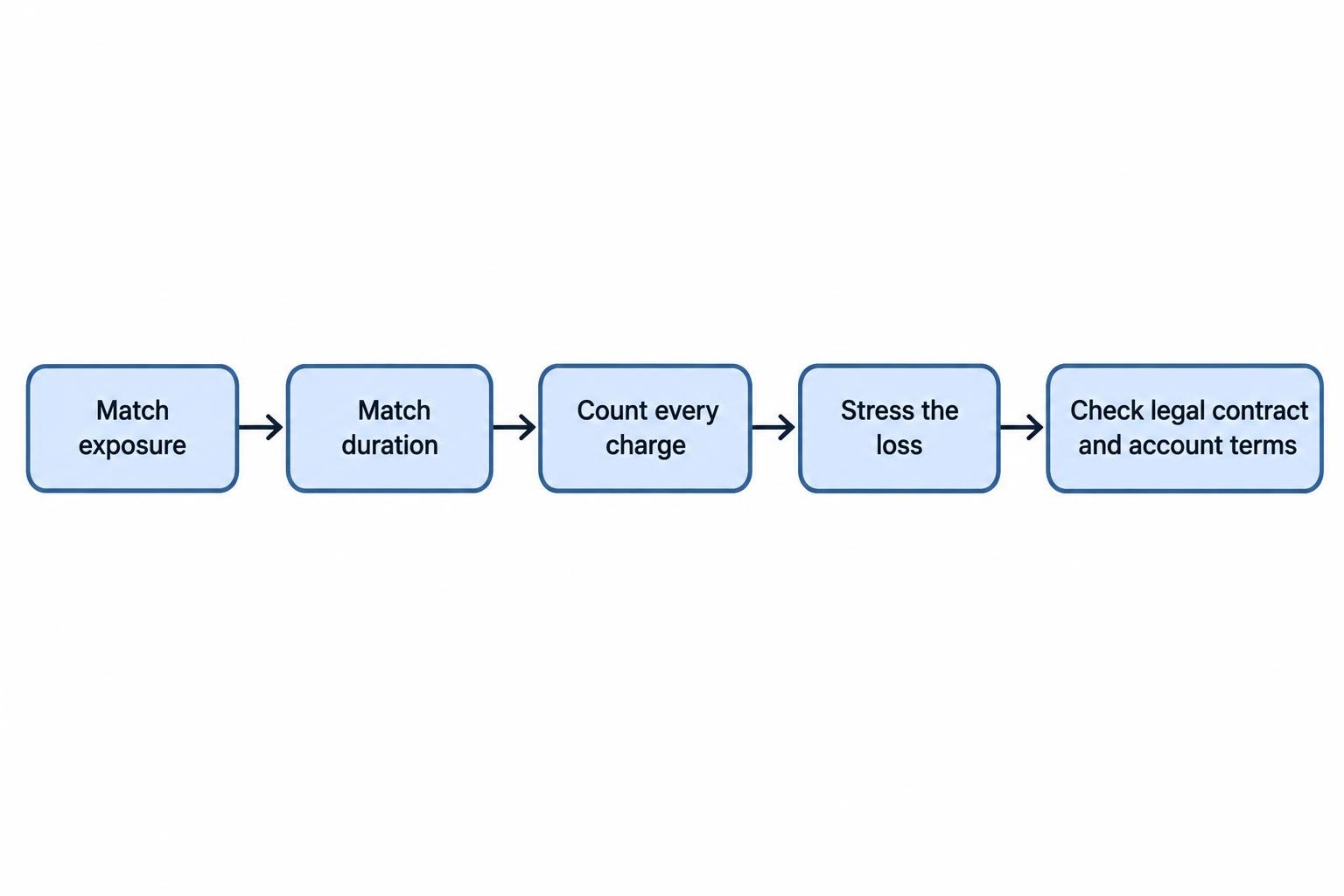
Build the comparison around one representative trade, not a provider’s smallest spread or an intermediary’s lowest advertised margin.
- Match the exposure. Use the same reference market and convert both positions into cash gained or lost per point.
- Match the duration. Include financing, expiry and rollover effects over the planned holding period.
- Count every charge. Include entry, exit, data, platform and currency costs where applicable.
- Stress the loss. Model a move beyond the intended stop and check the account’s liquidation terms.
- Check the legal contract. Confirm the entity, client classification, settlement method and relevant tax treatment.
A spread betting demo account can help check ticket mechanics and position calculations, but simulated results should not be treated as proof of live execution quality. Record the assumptions you still need to verify.
The better choice is the contract that fits the strategy’s size, execution needs, holding period and risk controls at an acceptable total cost. If neither fits the available capital, choosing neither is a valid trading decision.