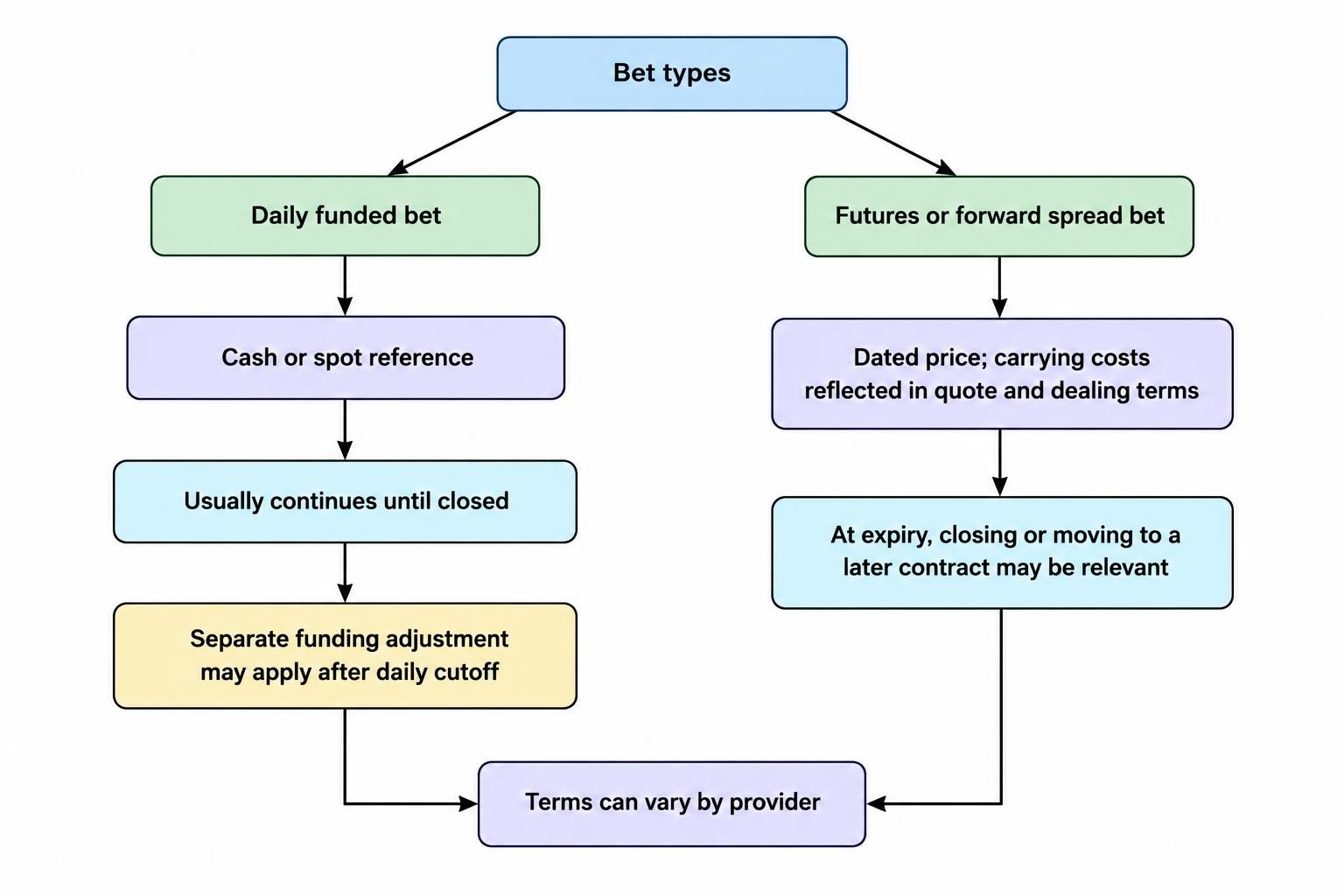
Daily funded bets and futures spread bets can express the same view on a market, but they handle financing and expiry differently. A daily funded bet usually applies a separate funding adjustment when you hold it beyond the provider’s daily cutoff. A futures or forward spread bet has a stated expiry, with carrying costs reflected in its price and dealing terms rather than a separate daily funding charge.
The practical choice depends on how long you expect to hold the position, what each contract costs and whether you might need to roll it into another expiry. A narrower spread does not guarantee a cheaper trade. Equally, the absence of an overnight debit does not mean financing has vanished.
What Are You Comparing?
A daily funded bet, often shortened to DFB, normally follows a cash or spot market reference, or a constructed equivalent. It generally continues until you close it, subject to the provider’s contract terms. “Daily” refers to its funding arrangements, not an instruction to close the trade every evening.
A futures or forward spread bet follows a dated market price and has an expiry or settlement date. You can normally close it before that date. To maintain exposure beyond expiry, you must move into a later contract, whether manually or through an available rollover arrangement.
Here, “futures” means a futures-style spread bet offered by a spread betting provider. You are not buying an exchange-traded futures contract. The distinction affects contract sizes, execution, settlement and your relationship with the provider; those differences belong in the separate comparison of spread betting and exchange-traded futures.
| Feature | Daily funded bet | Futures or forward spread bet |
|---|---|---|
| Usual price reference | Cash or spot price, or a constructed equivalent | A dated futures price or calculated forward price |
| Duration | Usually continues until closed, subject to terms | Has a stated expiry or settlement date |
| Funding treatment | Separate adjustments after the daily cutoff | Carrying costs reflected in the quote and dealing terms |
| Dealing spread | May be narrower on comparable markets | May be wider; check the actual contract |
| Main ongoing task | Monitor funding charges and account equity | Monitor expiry, settlement and rollover arrangements |
| Potential use | Intraday trades or positions with uncertain exit dates | Positions intended to run for longer, where the cost comparison supports it |
These are product patterns, not universal specifications. Check the actual instrument rather than assuming that every provider uses the same label in the same way.
How Funding Changes the Comparison
Daily funded bets: a separate adjustment
A DFB normally incurs a funding adjustment if it remains open beyond the applicable cutoff. That adjustment can be a debit or a credit, depending on the market, direction and pricing terms. Dated bets commonly bundle financing into their dealing terms instead. This distinction appears in the Financial Ombudsman decision examining daily funded bet charges, although the rates and contractual wording in that case should not be treated as current quotations.
For a straightforward cash index position, a useful estimate is the exposure multiplied by the annual funding rate, divided by the provider’s day-count basis. The actual calculation may use a daily closing price, different rates for long and short positions, and adjustments for weekends or holidays.
Funding often applies to the full notional exposure rather than just the margin deposit. Do not assume that depositing more cash reduces the charge. Short positions also do not automatically receive interest: provider charges can turn a potential credit into a debit. The FCA review of CFD pricing and overnight funding identifies both the importance of full-exposure calculations and differences between firms’ treatment of short positions.
A position opened and closed before the relevant cutoff generally avoids that night’s funding adjustment. But “same day” is not precise enough for planning. A trade lasting twenty minutes can cross the cutoff, while a longer trade earlier in the session may not. Check the charging time, its time zone and any daylight-saving changes.
The detailed calculation also depends on the asset. Cash indices, shares, currencies and constructed commodity markets need not use the same approach. Use the instrument’s disclosed terms alongside the guide to overnight financing costs, rather than applying one interest formula to everything on the platform.
Dated bets: carrying costs inside the price
A futures spread bet can have no separate overnight financing debit and still carry an economic financing cost. Two different components matter: the market’s futures price relative to cash, and the provider’s dealing spread or other disclosed charges.
For equity indices, a simplified futures relationship is cash value plus financing to expiry, less expected dividends. The resulting difference between cash and futures prices is called the basis. Actual prices can move away from that theoretical relationship as supply and demand change, as set out in CME Group’s equity index fair-value calculation.
The basis is not the bid–ask spread. A futures market might trade 30 points above cash while having a four-point dealing spread. The 30-point difference and the four-point spread do different jobs. Treating them as one charge makes the comparison unreliable.
Dividend treatment matters too. A cash index bet may receive a separate adjustment when constituent shares go ex dividend, while expected dividends are normally reflected in the dated price. Compare the combined price movement and cash adjustments, not either part alone. The guide to spread betting dividend adjustments covers that mechanism.
A Worked Cost Comparison
The following example isolates trading costs by assuming that the underlying cash index does not move. Every price and rate is hypothetical. They are calculation inputs, not live quotes or suggested provider terms.
Assume a cash index at 10,000 and a long position of £2 per index point. That gives approximately £20,000 of cash-equivalent exposure. Both products use the same definition of a point.
The DFB has a one-point dealing spread and an annual funding debit of 7.3%, calculated on a 365-day basis. The dated bet has a four-point spread. Its price starts 30 points above cash with 30 days remaining, and that basis falls by one point per day. Assume no dividends, rate changes, slippage, rollover or other charges.
Daily funded bet calculation
With a one-point spread, an unchanged market produces a £2 dealing loss when the position is opened and then closed:
Spread cost: 1 point × £2 = £2.
The daily funding charge is:
£20,000 × 7.3% ÷ 365 = £4 per funding day.
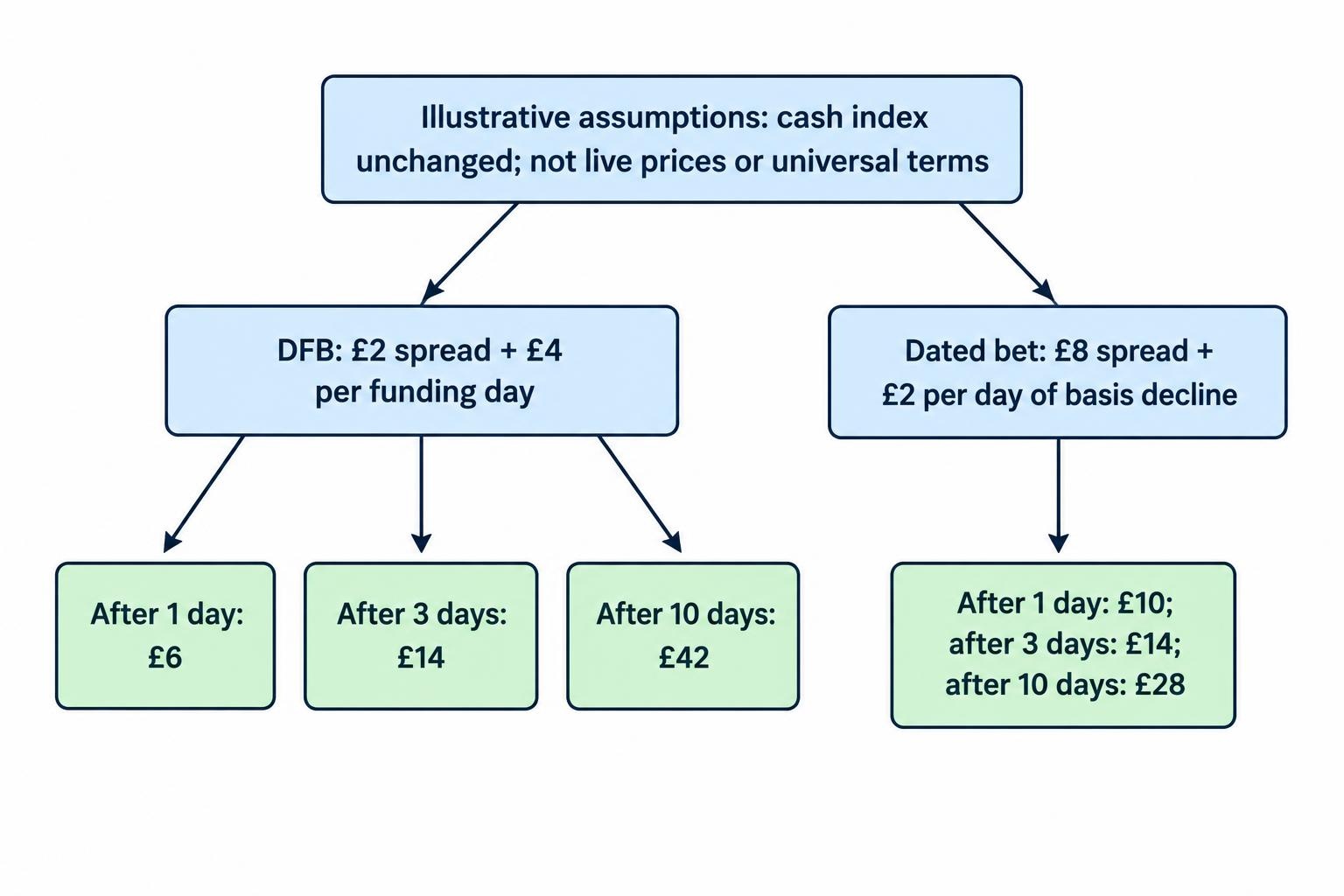
After ten funding days, the cost is therefore £2 in spread plus £40 in funding, giving £42. Because the cash index stays unchanged in this example, the notional value and daily charge also remain unchanged.
Futures spread bet calculation
The four-point spread costs £8 at the same £2 stake. The declining futures basis creates a further one-point adverse movement per day for the long position, even though the cash index remains at 10,000.
At £2 per point, that basis movement costs £2 per day. After ten days, the dated bet’s total economic cost is £8 in dealing spread plus £20 from the declining basis: £28.
There is no separate daily funding debit in this model. The carrying cost appears through the price movement instead. It still affects the result.
| Funding days held | DFB: £2 spread + £4 per day | Dated bet: £8 spread + £2 per day of basis decline |
|---|---|---|
| 1 | £6 | £10 |
| 3 | £14 | £14 |
| 10 | £42 | £28 |
Under these assumptions, the DFB’s smaller spread wins over the shortest holding period. The dated bet catches up after three funding days and becomes cheaper beyond that point.
Notice that the entire initial 30-point futures premium is not charged as an entry fee. If you close before expiry, the remaining basis is still present in the exit price. What matters is how the basis changes while you hold the trade, alongside the spread and any other charges.
Finding an indicative crossover point
In this example, the dated bet costs £6 more to enter and exit, but its daily carrying drag is £2 lower. Dividing £6 by £2 gives a three-day crossover.
This shortcut only works when both daily carrying effects can be estimated on a comparable basis. It fails if you compare a DFB’s funding debit with a dated bet’s spread while ignoring the latter’s embedded carry. Real futures basis movements are not guaranteed to follow a neat daily schedule either.
For an actual trade, repeat the calculation using the intended direction, stake and holding dates. Include plausible early and late exits, not just your preferred outcome. A broader total spread betting cost comparison should also account for execution and any other applicable charges.
Expiry and Rollover Can Change the Result
A DFB removes the routine need to select another dated contract. That can be convenient when an exit depends on a price signal rather than a calendar date. It does not make the position permanent or exempt it from suspension, closure or other contractual provisions.
A dated spread bet adds a deadline. Before opening it, establish the last dealing time, settlement method and what happens if you take no action. The displayed month is not a substitute for reading the contract details.
At the underlying futures-market level, rolling means closing the expiring contract and opening a later one. CME Group’s explanation of expiration and contract rolls sets out that process. A spread betting provider may offer its own rollover procedure, so check how it translates that process into your account.
Do not assume an automatic roll is free or that every order transfers unchanged. Establish the spread or rollover charge, the new opening level, and how stops and limits are handled. Closing the old bet may also crystallise its profit or loss even though your market exposure continues through a new position.
A price difference between contract months is not automatically an extra dealing fee. Different expiries can have different fair values. Separate that market difference from the provider’s charge, then assess how the new contract behaves during the next holding period.
If a trade might run for six weeks, choosing a contract that expires in two weeks creates an avoidable decision point. Compare a later expiry at the outset, or include the planned roll in your estimate. The guide to spread betting expiry dates covers the checks needed before settlement.
The Market Matters as Much as the Product Label
The index example is useful because it makes the financing trade-off visible. It is not a universal pricing model.
In currencies, carrying costs depend partly on the relationship between the two currencies and the provider’s adjustment. Direction matters: the long and short calculations are not interchangeable. A cost estimate made for buying a currency pair cannot simply be reused for selling it.
For commodities, a rolling cash quote may be constructed from futures prices rather than taken from a single continuously tradable spot market. Its adjustments can therefore reflect changes in the futures curve as well as provider charges. The dated alternative also exposes you to a particular contract month, not an abstract version of “oil” or “gas”.
This matters when comparing commodity spread bets. Check which reference each product follows, how that reference changes and what adjustment accompanies the change. Otherwise, two trades that appear equivalent may respond differently over the same holding period.
Charts require the same care. A cash chart, an individual futures contract and a continuous futures chart can show different price levels. Place orders using the contract you will actually trade, rather than copying a numerical level from a related chart without adjustment.
Which Format Fits the Planned Holding Period?
Intraday positions
If the trade will close before the funding cutoff, compare executable spreads and order conditions first. A DFB with a narrower spread can have a clear cost advantage because no overnight adjustment enters that trade’s calculation.
That is a conditional advantage, not a reason to ignore the dated quote. Check both at the time you expect to trade. For day trading with spread bets, a quoted minimum spread is less useful than the spread available during your actual session.
Positions lasting several days or weeks
Once overnight exposure becomes part of the plan, include funding from the start. A dated bet may justify a wider spread if its combined carrying and dealing costs are lower over the expected holding period.
For swing trading positions, calculate at least a short, expected and extended holding scenario. A setup intended to resolve in four sessions can remain open for considerably longer. The extra time should be a cost you have considered, not an unwelcome discovery on the statement.
Uncertain exits and longer hedges
A DFB offers administrative simplicity when the exit date is uncertain, but that convenience comes with continuing funding exposure. A dated bet offers a defined contract period, but you must manage expiry if the position outlasts it.
For a hedge, also compare how closely each product tracks the exposure being hedged. Saving a few pounds in financing is not useful if the chosen contract introduces a price mismatch that makes the hedge less effective.
Neither Format Removes Margin or Execution Risk
Choosing a futures spread bet does not turn the trade into an unleveraged investment. Choosing a DFB does not mean the daily funding charge is the largest possible loss. Market movement remains the main source of risk in both formats.
Set the stake from the loss you can tolerate and the distance to your planned exit, rather than from the margin available. The position sizing guide provides the calculation. When comparing products, match monetary exposure and confirm that their point definitions agree.
For covered UK retail accounts, FCA rules require firms to close positions as soon as market conditions allow when account net equity falls below 50% of the relevant margin requirement. They also restrict liability for covered investments to funds in the account. These are account-level protections, not a guaranteed exit price or a cap equal to one trade’s initial margin; see the FCA retail margin close-out and negative balance rules.
Funding debits can reduce the equity available to support open positions. Expiry and rollover can create different operational pressures. Leave room for both market losses and expected charges instead of using every available pound as margin.
Ordinary stops can execute beyond their intended level when prices gap or liquidity deteriorates. Compare stop availability, minimum distances and any guarantee terms for each contract. The mechanics are covered in the stop-loss order guide.
What to Check Before Placing the Bet
Use the actual trade ticket, contract information and cost disclosure. A general product description will not tell you what your intended position will cost.
- Match the exposure: confirm direction, stake, point definition and price reference.
- Price the intended holding dates: include the funding cutoff, weekends, holidays and a possible delayed exit.
- Separate the components: distinguish the dealing spread, explicit funding, embedded carry and other adjustments.
- Check the deadline: record expiry, last dealing time, settlement and rollover instructions for dated bets.
- Check the exit: compare available orders, stop conditions and the consequences of market disruption.
After closing, reconcile the result against the estimate. Separate dealing profit or loss from funding, dividends and other adjustments rather than treating the final cash balance as one unexplained number. The guide to spread betting account statements helps identify those entries.
The better choice is the contract with the more suitable total cost and operating terms for the trade you have planned. DFBs can work well for short holds where their spread advantage matters. Dated bets can be more economical over longer periods, but only after allowing for embedded carry, expiry and possible rolls. Compare those features at the same exposure, then make the decision before opening the position.