Forex spread betting works by attaching a cash stake to each point of movement in a currency pair. You buy if you expect the exchange rate to rise, or sell if you expect it to fall. Your profit or loss depends on the distance between your opening and closing prices, multiplied by your stake per point.
The arithmetic is straightforward. The details that need care are the size of a point, which side of the quote applies, the margin required and any costs charged while the position remains open.
This guide covers those mechanics using sterling stakes and UK retail account rules. For the broader market overview, see our guide to forex spread betting. All prices and trade outcomes below are hypothetical, not live quotes or trading recommendations.
What happens when you place a forex spread bet?
A forex spread bet is a contract with your provider based on changes in an exchange rate. You choose the currency pair, direction and amount to win or lose for each point of movement. The provider quotes a buying price and a selling price, then calculates the cash outcome when the bet closes.
You do not acquire the currencies themselves. Buying GBP/USD through a spread betting account does not put pounds in one bank account and borrowed dollars in another. No underlying assets change ownership when you place a financial spread bet, a distinction covered in HMRC’s guidance on financial spread betting.
Your account instead records the open contract and its changing value. A favourable price movement creates an unrealised profit; an unfavourable movement creates an unrealised loss. Closing the position turns that price result into a realised account entry.
The stake is not an upfront ticket price or a maximum loss. A £2 per point bet can gain or lose £100 over 50 points. That difference matters far more than the apparently small number entered in the stake box.
Reading a currency pair and its two prices
A currency pair expresses the value of the first currency in units of the second. The first is the base currency; the second is the quote currency.
With EUR/USD at 1.0850, one euro is worth 1.0850 US dollars. If the rate rises to 1.0900, the euro has strengthened against the dollar. That does not necessarily mean the euro has strengthened against every other currency.
Spread betting platforms show two prices rather than a single exchange rate:
| Price | Example | How you use it |
|---|---|---|
| Sell price, or bid | 1.2700 | Open a short position or close a long position |
| Buy price, or offer | 1.2702 | Open a long position or close a short position |
| Spread | 0.0002 | The difference between the buy and sell prices |
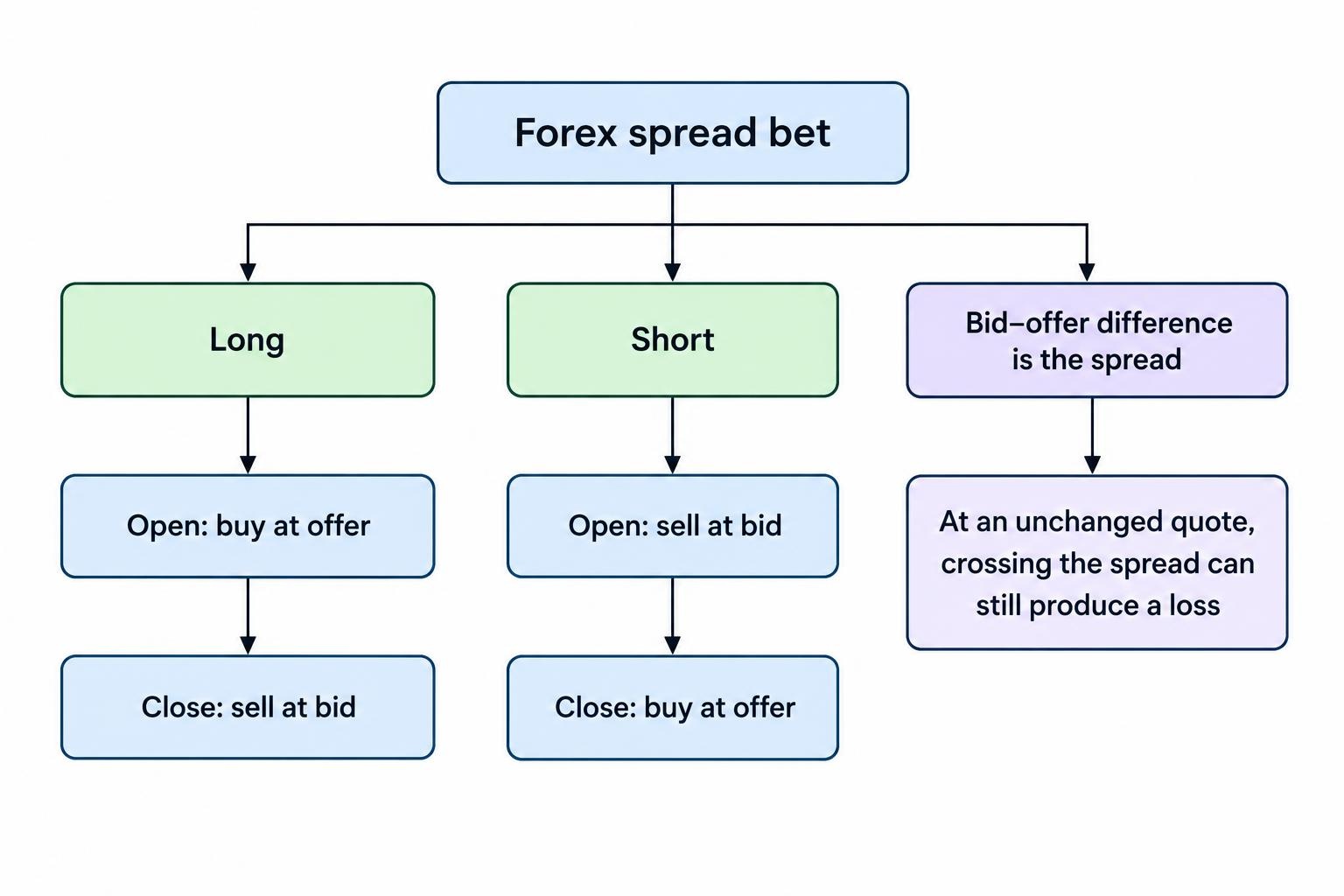
You cannot normally buy at the lower price and immediately sell at the higher price. The arrangement runs the other way: you buy at the offer and sell at the bid.
If you buy at 1.2702 and close immediately at an unchanged bid of 1.2700, you lose two conventional pips. At £2 per pip, that is £4. The market has not moved, but crossing the spread has created a cost.
What counts as one point in forex spread betting?
A conventional pip is usually a movement of 0.0001 in pairs such as GBP/USD and EUR/USD. A change from 1.2700 to 1.2701 is therefore one pip; a change to 1.2750 is 50 pips.
For pairs quoted in Japanese yen, a conventional pip is usually 0.01. A move in USD/JPY from 158.40 to 158.41 is one pip, while a move to 158.90 is 50 pips.
However, a spread betting “point” is the contract’s defined betting increment. Do not assume that every platform uses the word in exactly the same way. The deal ticket or market information should tell you how much price movement your stake applies to.
Some displays also include fractional pips. GBP/USD might appear as 1.27025 rather than 1.2702. The final digit adds precision; it does not automatically mean that a £2 stake applies to every change in that digit.
Other displays scale the exchange rate into a larger number. GBP/USD at 1.2702 might appear as 12702, with one displayed point representing 0.0001 in the exchange rate.
Before trading, check the monetary result of a small example movement. If the contract defines one point as 0.0001, a £2 per point stake should gain or lose £20 over a 0.0010 movement, before costs. If the platform’s preview says otherwise, resolve the difference before placing the order. A misplaced decimal is not much of a trading strategy.
Buying and selling express a relative currency view
Buying a pair means taking a long position in its quoted exchange rate. Buying GBP/USD expresses the view that sterling will rise relative to the US dollar. You profit if the eventual closing sell price is above your opening buy price.
Selling a pair means taking a short position. Selling GBP/USD expresses the view that sterling will fall relative to the dollar. You profit if the eventual closing buy price is below your opening sell price.
The order of the currencies matters. A bullish view on the dollar could lead to selling GBP/USD but buying USD/JPY. “Buy dollars” does not translate into pressing the buy button on every pair containing USD.
A currency can also strengthen while your chosen pair falls. Sterling might rise against the euro but fall against an even stronger dollar. The position follows the relationship between its two currencies, not the strength of either currency in isolation.
Calculating forex spread betting profit and loss
The calculation uses the actual opening and closing execution prices, expressed in the contract’s point size. For the examples below, one point equals one conventional pip.
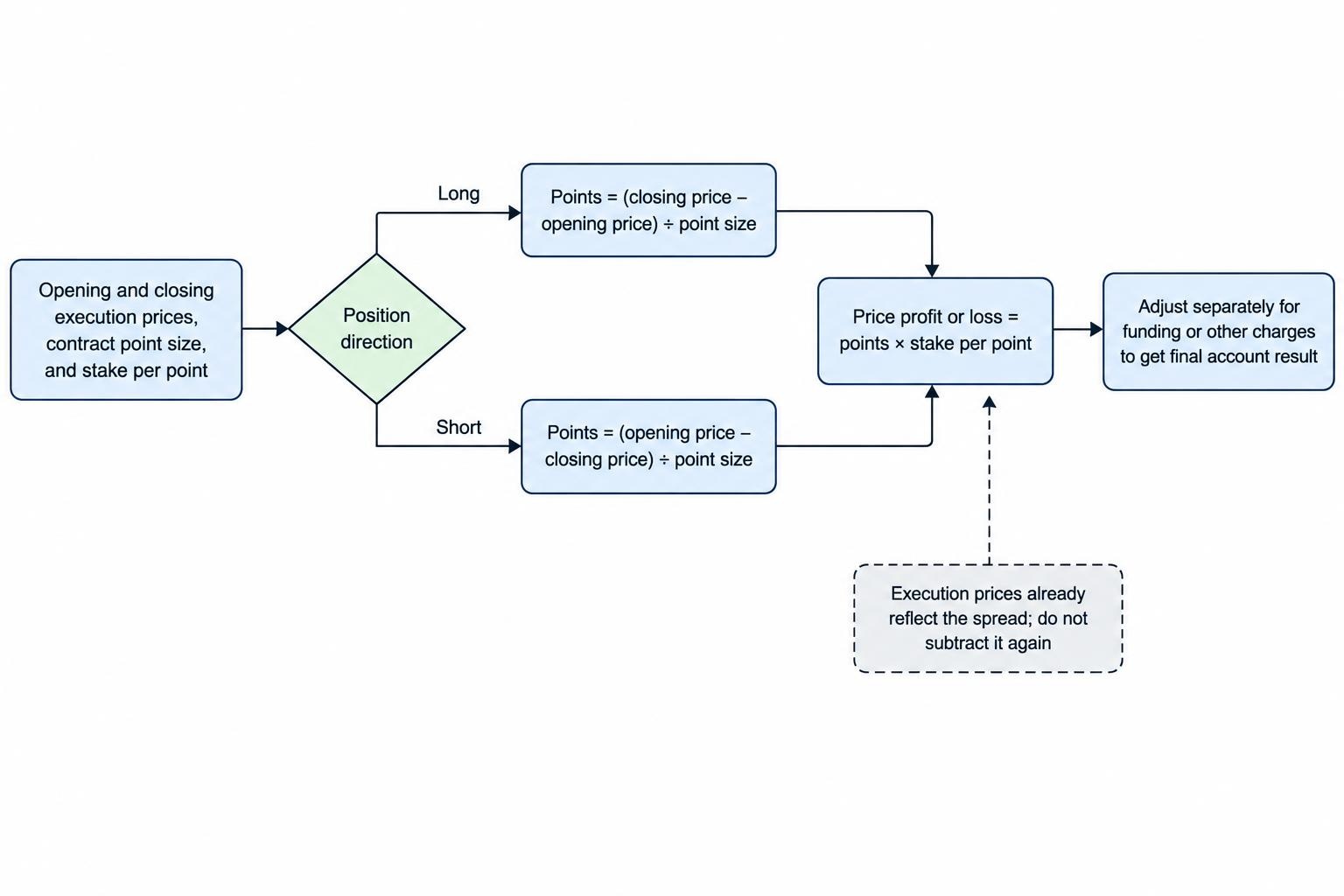
Long position result = (closing sell price − opening buy price) ÷ point size × stake.
Short position result = (opening sell price − closing buy price) ÷ point size × stake.
A positive answer is a profit; a negative answer is a loss. These calculations include the effect of the quoted spread because they use the appropriate buying and selling prices. Separately posted funding charges or other fees still need to be included.
Example: buying GBP/USD
Suppose GBP/USD is quoted at 1.2700/1.2702. You buy at 1.2702 with a stake of £2 per point. Later, the quote rises to 1.2750/1.2752 and you close at the sell price of 1.2750.
| Opening buy price | 1.2702 |
|---|---|
| Closing sell price | 1.2750 |
| Movement in your favour | (1.2750 − 1.2702) ÷ 0.0001 = 48 points |
| Stake | £2 per point |
| Price profit before separate charges | 48 × £2 = £96 |
The bid rose by 50 pips, from 1.2700 to 1.2750, but your trade earned 48 points because you entered at the higher offer price.
If the closing quote had instead fallen to 1.2670/1.2672, you would sell at 1.2670. That is 32 points below your 1.2702 entry, producing a £64 loss before separate charges.
Example: selling EUR/USD
Now suppose EUR/USD is quoted at 1.0850/1.0852. You sell at 1.0850 for £3 per point. The quote later falls to 1.0810/1.0812, and you close by buying at 1.0812.
Your favourable movement is 38 points: (1.0850 − 1.0812) ÷ 0.0001. Multiplied by £3, that produces a £114 price profit before separate charges.
If the closing buy price had risen to 1.0882 instead, the trade would lose 32 points, or £96. Selling does not change the calculation into a fixed payout; losses continue to change with the exchange rate until the position closes.
Our guide to calculating spread betting profit and loss covers the same process across other market types.
Choosing the stake: cash risk comes before margin
Your stake determines how much each point changes the position’s value. At £1 per point, a 40 point adverse movement costs £40. At £5 per point, the same movement costs £200. The market move has not become larger, only your exposure has.
A useful starting calculation works backwards from a planned cash risk and exit distance:
Stake per point = planned price risk ÷ stop distance in points.
Suppose you allocate £50 to the price movement between entry and a planned stop, with a distance of 25 points. The resulting stake is £2 per point. Our explanation of stake per point covers how changing that figure affects the cash outcome.
In the GBP/USD example, an entry at 1.2702 and an intended stop exit at 1.2677 are 25 pips apart. At £2 per pip, the planned price loss is £50. That assumes execution at the intended price and excludes separate charges.
An ordinary stop does not guarantee that result. If execution occurs farther away, the loss grows. A risk budget should leave room for costs and possible slippage rather than allocating every penny to the entry to stop distance.
Minimum stake sizes can also make a proposed trade unsuitable for an account. If your calculation calls for £0.40 per point but the contract minimum is £1, rounding up changes the risk. The answer may be to skip the trade, not squeeze the stop closer. See position sizing for spread betting for the wider sizing process.
How leverage and margin work on a forex bet
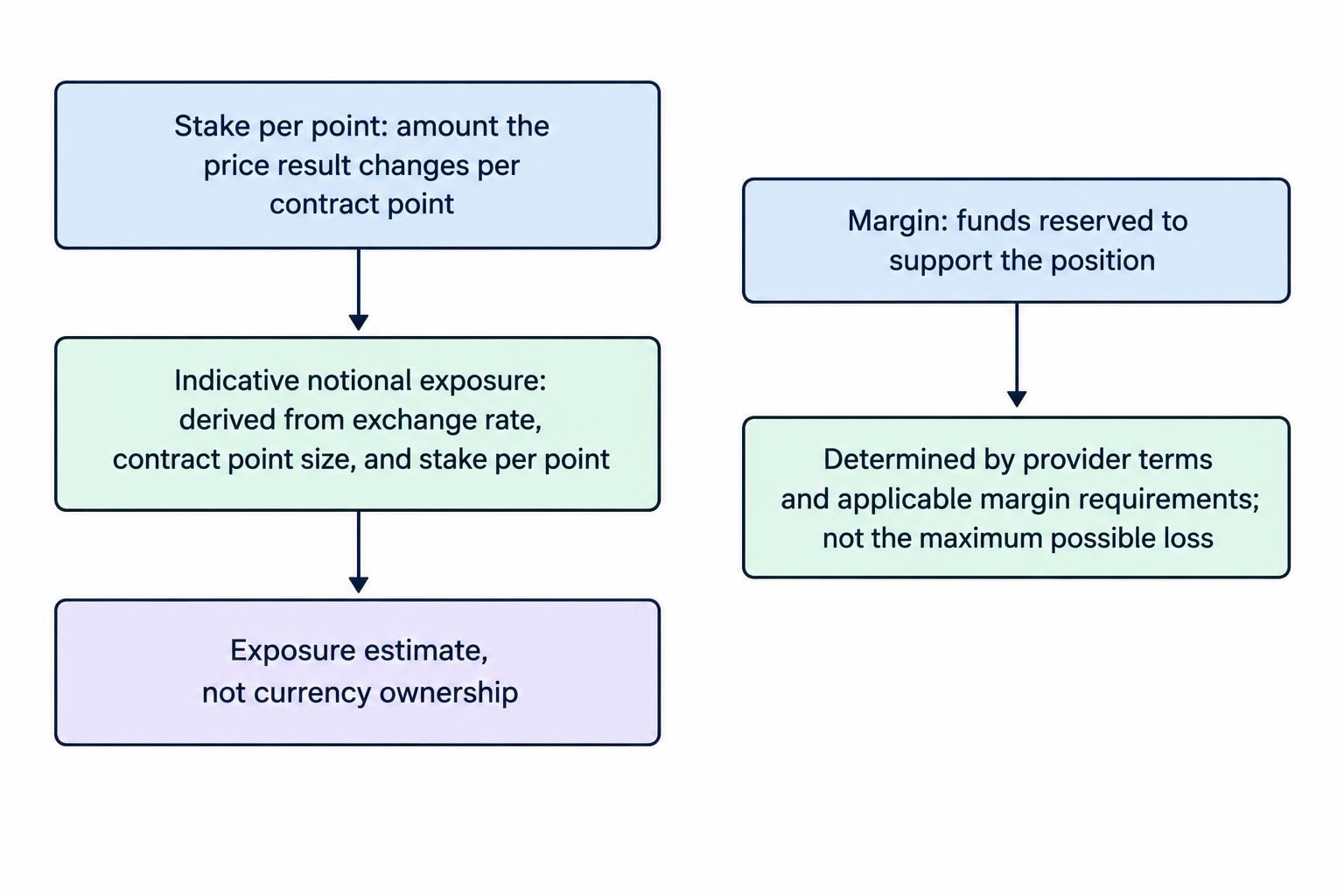
Margin is the money required to support the position. It is not the amount you are betting per point, a transaction fee or a reliable measure of the maximum loss.
The distinction becomes clearer when you compare three figures: the stake, the full notional exposure and the margin reserved against that exposure. A small stake can represent a much larger position than its appearance suggests.
Estimating notional exposure
For a straightforward price based contract, an indicative exposure calculation is:
Notional exposure = exchange rate ÷ contract point size × stake per point.
At GBP/USD 1.2700, with one point defined as 0.0001 and a £2 stake, the calculation is 1.2700 ÷ 0.0001 × £2 = £25,400.
Applying an illustrative 3.33% margin rate gives a requirement of about £846. This is an estimate: the provider’s ticket determines the actual requirement, including its pricing, rounding and any higher margin rate.
You have not paid £25,400 to buy currency. You have opened a contract with that indicative exposure while committing a smaller amount as support. The separate guide to spread betting margin explains how reserved margin affects the funds available in an account.
UK retail limits and account protections
For covered UK retail business, FCA rules require minimum opening margin of 3.33% for major currency pairs and 5% for other currency pairs, broadly corresponding to maximum leverage of 30:1 and 20:1. Providers can require more margin.
The rules also require position closure as soon as market conditions allow when account net equity falls below 50% of the margin requirement. Negative balance protection caps liability for covered speculative investments at the funds dedicated to that trading account. These requirements appear in FCA COBS 22.5 on retail speculative investments.
Negative balance protection does not cap each trade’s loss at its opening margin. Money elsewhere in the same trading account can be exposed to losses. Nor does account level protection make an ordinary stop price guaranteed.
Do not build a trading plan around waiting for compulsory closure. An account supporting several positions can lose its margin buffer through their combined movements, even if no single trade looks disastrous. Our guide to retail client protections separates these safeguards from the trader’s own risk controls.
Costs that change the final result
The spread
The spread is built into the difference between the entry and exit prices available to you. A wider spread means a larger initial unrealised loss and a greater favourable movement needed to reach breakeven.
Do not subtract the spread again after calculating a result from actual opening and closing fills. In the long GBP/USD example, the £96 result already reflects buying at the offer and selling at the bid.
Nor should you automatically count two full spreads for an unchanged round trip. Buying at 1.2702 and selling at 1.2700 loses two pips, not four. Separate commissions, if the account charges them, are a different matter.
Overnight funding
A rolling forex position may attract a funding debit or credit when held through the provider’s daily cutoff. The amount depends on the contract, direction, funding calculation and provider charges. Selling a pair does not automatically mean receiving interest.
Funding rates and treatment differ between providers. The FCA review of CFD providers’ pricing and overnight funding, which included spread bets and rolling spot forex, found substantial differences in charges and weaknesses in their disclosure.
Check the published long and short funding amounts, the cutoff time and how weekends or holidays affect posting. Do not assume that every account applies the same adjustment on the same weekday.
Suppose the £96 winning trade incurs four separate funding debits of £0.60. Those charges reduce its result to £93.60 before any other fees. The example is deliberately simple; actual postings need not be identical. See overnight financing costs for the charging mechanics.
Contract type matters too. A rolling or daily funded bet should not be treated as interchangeable with a dated contract. Check the charging method and any expiry terms rather than choosing from the market name alone.
Other charges and execution effects
Check whether the account adds commissions, conversion charges or premiums for optional order features. A sterling stake stated as £2 per point already expresses the price result in pounds; you should not automatically convert that result from the pair’s quote currency a second time.
Slippage also changes the outcome, but it appears through the execution price rather than necessarily as a separate fee. Use the confirmed fill in your calculation, not the price visible when you first clicked.
Opening, protecting and closing the position
A market order requests execution at the available price. It does not reserve the quote you saw a moment earlier. A limit order sets a price boundary, but the market may never reach a level at which the order can execute.
A stop entry order opens a position after its trigger conditions are met. A stop loss serves a different purpose: it seeks to close an existing position after an adverse movement. Similar names, different jobs.
For an open long position, the sell quote matters when assessing the closing value. For an open short position, the buy quote matters. Check which price the provider uses to trigger an order, particularly if the chart displays only the bid or a midpoint.
An ordinary stop can execute beyond its intended level during a fast move or a price gap. Our guide to slippage explains why the trigger price and final execution price can differ.
A guaranteed stop, where available and subject to its terms, provides contractual protection at the agreed stop level. It can involve a premium, minimum distance or other restrictions. Compare those terms before treating it as a substitute for sensible sizing; see guaranteed stop loss orders.
To exit manually, use the platform’s close position function and verify the remaining exposure afterwards. Entering an opposite order may close or reduce the existing bet, but an account with a hedging mode could instead retain two separate positions.
A partial close reduces the stake still exposed to future movements. If you close half of a £2 per point bet, the remaining position is £1 per point. The realised result on the closed portion and unrealised result on the remainder should be reviewed separately.
Trading hours affect execution, not just convenience
Forex trading generally runs through the working week, but your spread betting contract follows the provider’s dealing schedule. A visible chart does not necessarily mean the contract is currently available to trade.
Check opening and closing times, daily maintenance breaks and holiday arrangements. Also confirm the time zone used by the platform. UK and overseas daylight saving changes can alter the relationship between local times during parts of the year.
A position held while dealing is closed remains exposed to the next available price. If that price differs sharply from the previous quote, an ordinary stop may not close the bet at its intended level.
Available liquidity and spreads can vary through the trading day too. A narrow spread observed during an active session is not a promise that the same dealing conditions will apply around a rollover or major announcement. Our forex trading hours guide covers the timing considerations in more detail.
A practical check before placing the bet
Work through the contract from price to cash before submitting an order. The following checks address the mechanics rather than whether the market view itself is sound:
- Confirm the pair and direction. State which currency you expect to strengthen relative to the other.
- Confirm the point size. Translate a small exchange rate movement into points and pounds.
- Check both quoted prices. Identify your opening side and the side needed to close.
- Calculate the stake from the planned risk. Include room for costs and possible execution differences.
- Check margin and spare account equity. Consider existing positions, not just the new bet.
- Read the holding and exit terms. Check funding, dealing hours, stop behaviour and any expiry.
After execution, inspect the confirmation. Verify the fill price, stake and attached orders rather than assuming every setting carried across correctly. If the platform rejects a stop or changes the available margin, resolve that before leaving the position unattended.
A spread betting demo account can help you practise reading quotes and checking calculations without committing trading capital. Use it to confirm what a point means and how closing orders behave, not as proof that live execution will match a simulation.
Before funding an account, compare the contract terms covered in our guide to forex spread betting brokers. The smallest advertised spread is only one part of the decision.
A forex spread bet becomes easier to assess once you can state its cash exposure plainly: how much a point is worth, where the position is intended to close, and what could make the loss larger. Those checks do not make the trade safe or profitable. They make the financial commitment clear before the exchange rate starts moving.