GBP/USD spread betting lets you take a position on the pound’s value against the US dollar without buying either currency. You buy if you expect the pound to strengthen against the dollar, or sell if you expect it to weaken. Your profit or loss depends on the movement between your opening and closing prices, multiplied by your stake per point.
The calculation is straightforward. Managing the trade takes more care: you need to check the platform’s point convention, allow for trading costs and size the position around a realistic exit. This guide focuses on GBP/USD within forex spread betting, using illustrative prices rather than live quotes. Spread betting uses borrowed exposure and can produce rapid losses.
How GBP/USD spread betting works
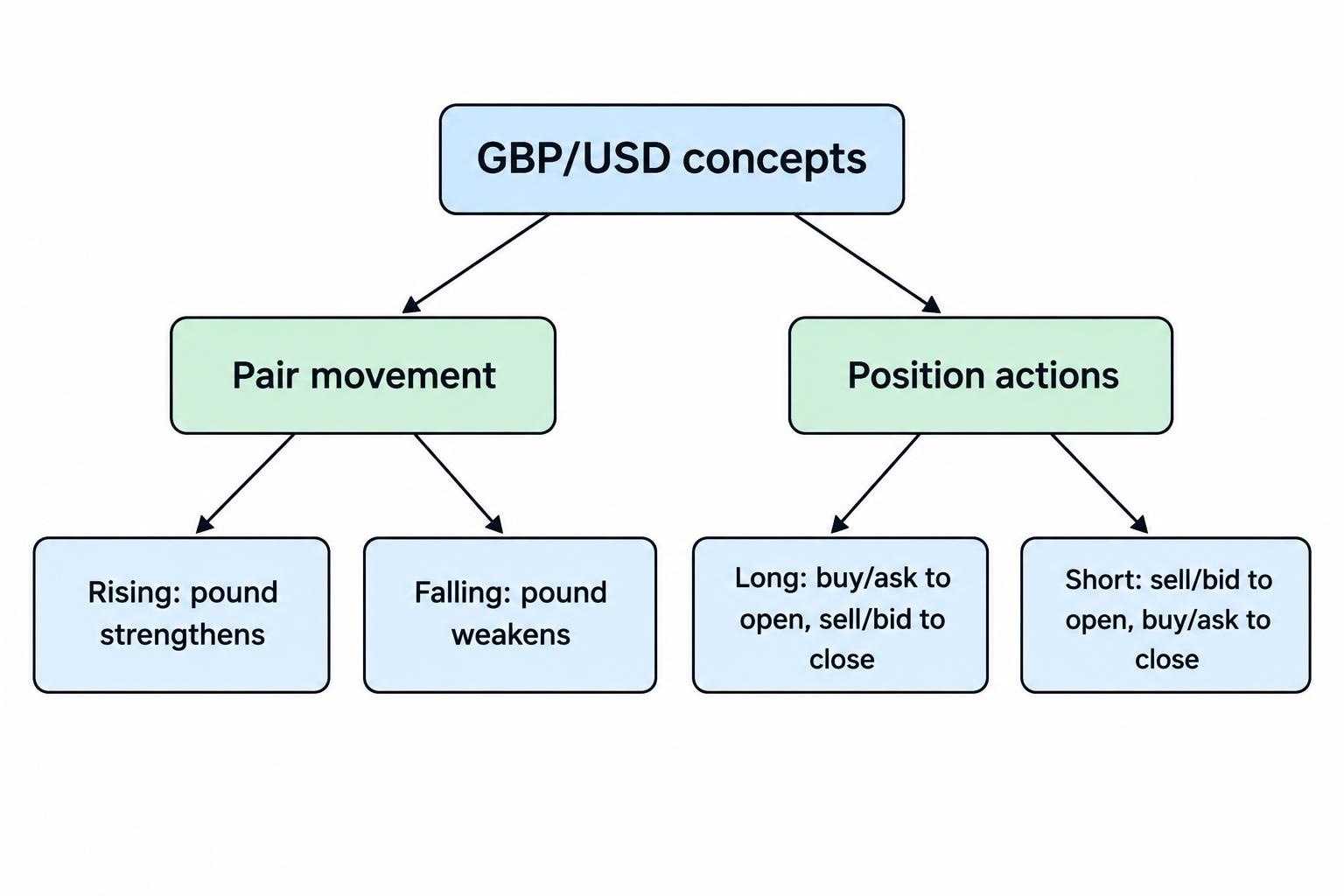
GBP/USD expresses how many US dollars one British pound buys. At an exchange rate of 1.2700, £1 is worth $1.27. GBP is the base currency; USD is the quote currency. A rise from 1.2700 to 1.2750 means sterling has strengthened against the dollar. A fall to 1.2650 means it has weakened.
A spread betting platform supplies two prices: a sell price, also called the bid, and a buy price, also called the offer or ask. You open a long position at the buy price and close it at the sell price. A short position works in reverse: you sell to open and buy to close.
You are trading the relationship between two currencies, not making a standalone judgement about Britain. GBP/USD can fall despite encouraging UK news if the dollar strengthens more. It can also rise during a weak period for the UK economy if the dollar weakens faster.
A sterling denominated spread bet can settle its profit or loss in pounds even though the underlying exchange rate is quoted in dollars. With a contract paying £2 per point, a favourable 20 point movement produces £40 before separate charges. You do not need to convert that result from dollars yourself.
Pips, points and fractional prices
For GBP/USD, one pip is a movement of 0.0001. A move from 1.2700 to 1.2710 is therefore ten pips, not one. Some platforms display the same prices as 12,700 and 12,710, while others show a fifth decimal place, such as 1.27005.
That fifth decimal is a fraction of a pip. Its presence does not, by itself, tell you what the broker means by “£1 per point”. Check the contract details rather than counting digits on the screen. All examples below assume that one spread betting point equals one pip, or 0.0001.
Under that convention, £1 per point means a 50 pip move changes the position’s value by £50. At £5 per point, the same movement changes it by £250. The stake per point calculation determines your exposure; the number of decimal places displayed does not.
GBP/USD spread betting examples
Suppose the platform quotes GBP/USD at 1.2700 sell / 1.2702 buy. The spread is two pips. You can buy at 1.2702 if you expect a rise, or sell at 1.2700 if you expect a fall.
The table shows four possible outcomes. Each exit price is the executable price needed to close that position, not a chart’s midpoint. Results include the effect of those entry and exit prices but exclude separate charges.
| Position | Entry fill | Exit fill | Stake | Result before separate charges |
|---|---|---|---|---|
| Buy, price rises | 1.2702 | Sell at 1.2732 | £5 per point | 30 points × £5 = £150 profit |
| Buy, price falls | 1.2702 | Sell at 1.2672 | £5 per point | 30 points × £5 = £150 loss |
| Sell, price falls | 1.2700 | Buy at 1.2670 | £3 per point | 30 points × £3 = £90 profit |
| Sell, price rises | 1.2700 | Buy at 1.2730 | £3 per point | 30 points × £3 = £90 loss |
For a long trade, subtract the opening buy price from the closing sell price. For a short trade, subtract the closing buy price from the opening sell price. Divide the exchange rate difference by 0.0001 to obtain points, then multiply by the stake.
The distinction matters when reviewing a chart. A midpoint reaching your target does not necessarily mean the closing side of the quote reached it. Use actual fills when reconciling a completed trade, particularly if the spread changed while the position was open.
Choosing a GBP/USD stake from your risk budget
Start with the loss you are prepared to accept, not the largest position the platform permits. Decide where the trade would no longer make sense, measure the distance from entry to that exit, then calculate a suitable stake.
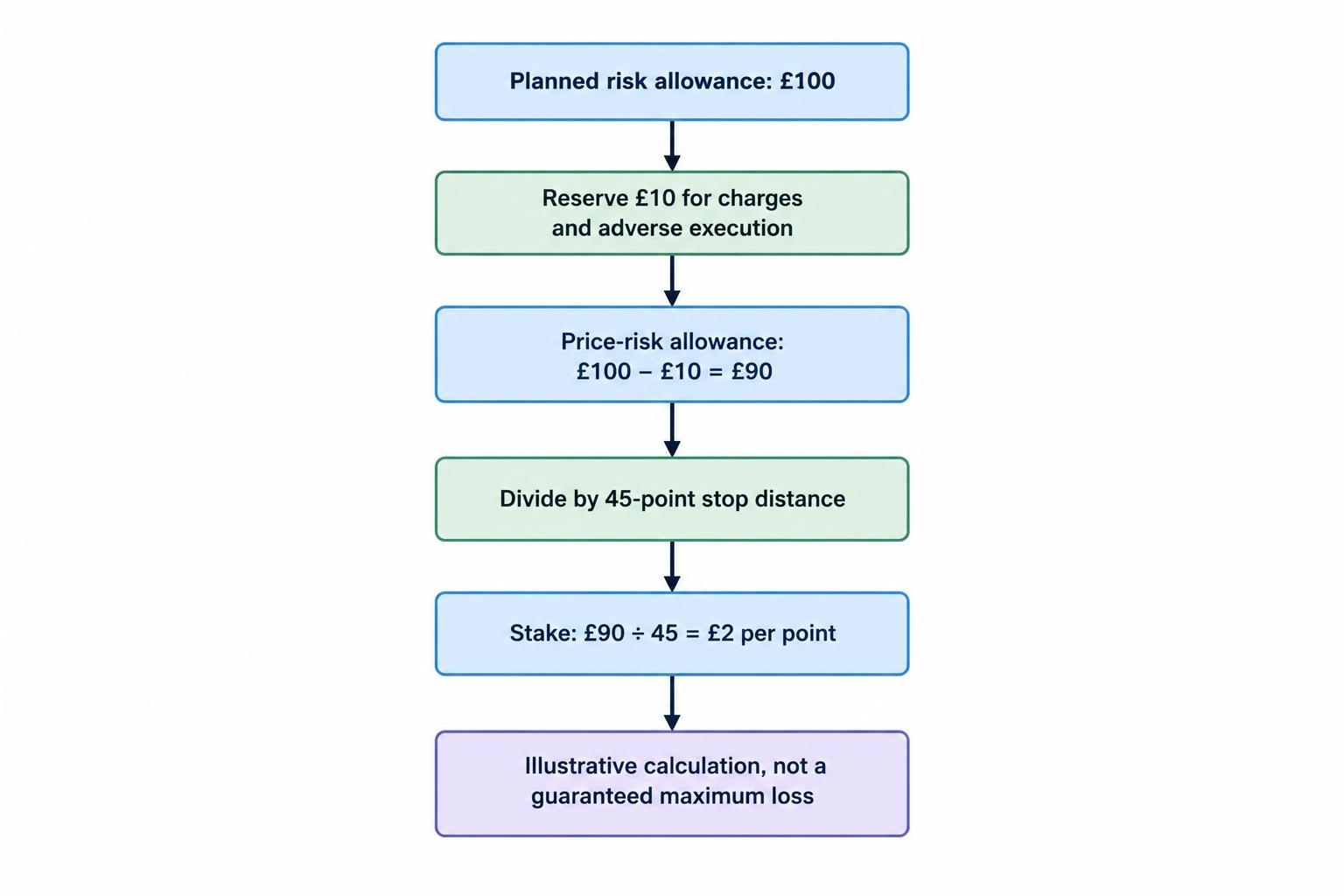
Suppose your total planned risk allowance is £100. You reserve £10 for charges and adverse execution, leaving £90 for the price movement to a stop 45 points away:
Stake per point = £90 ÷ 45 points = £2 per point.
If the stop executes at the intended price, the trading loss is £90 before separate charges. The extra allowance is a planning buffer, not a promise that the final loss cannot exceed £100. An ordinary stop can execute beyond its trigger during a fast move or a gap.
If the market conditions call for a 90 point stop instead, the same £90 price risk allowance supports £1 per point. Widening the stop without reducing the stake doubles the planned price risk. A stop should reflect the trade’s invalidation level, rather than being squeezed closer just to accommodate a larger bet.
Our guide to position sizing for spread betting develops this method across different markets. For GBP/USD, the practical starting point is always the same: confirm the point size before doing the arithmetic.
GBP/USD margin and retail client protections
Margin is the money required to support the position. It is not the purchase price of a currency holding, and it is not a maximum loss. A small deposit does not make a large position small.
For UK retail business covered by the rules, the FCA requires at least 3.33% opening margin on major currency pairs such as GBP/USD, commonly expressed as approximately 30:1 exposure. Account level close-out rules apply when net equity falls below 50% of the required margin, with positions closed as soon as market conditions allow. Negative balance protection caps liability for the covered investments at the funds in the account. These protections are set out in FCA COBS 22.5 on retail speculative investments.
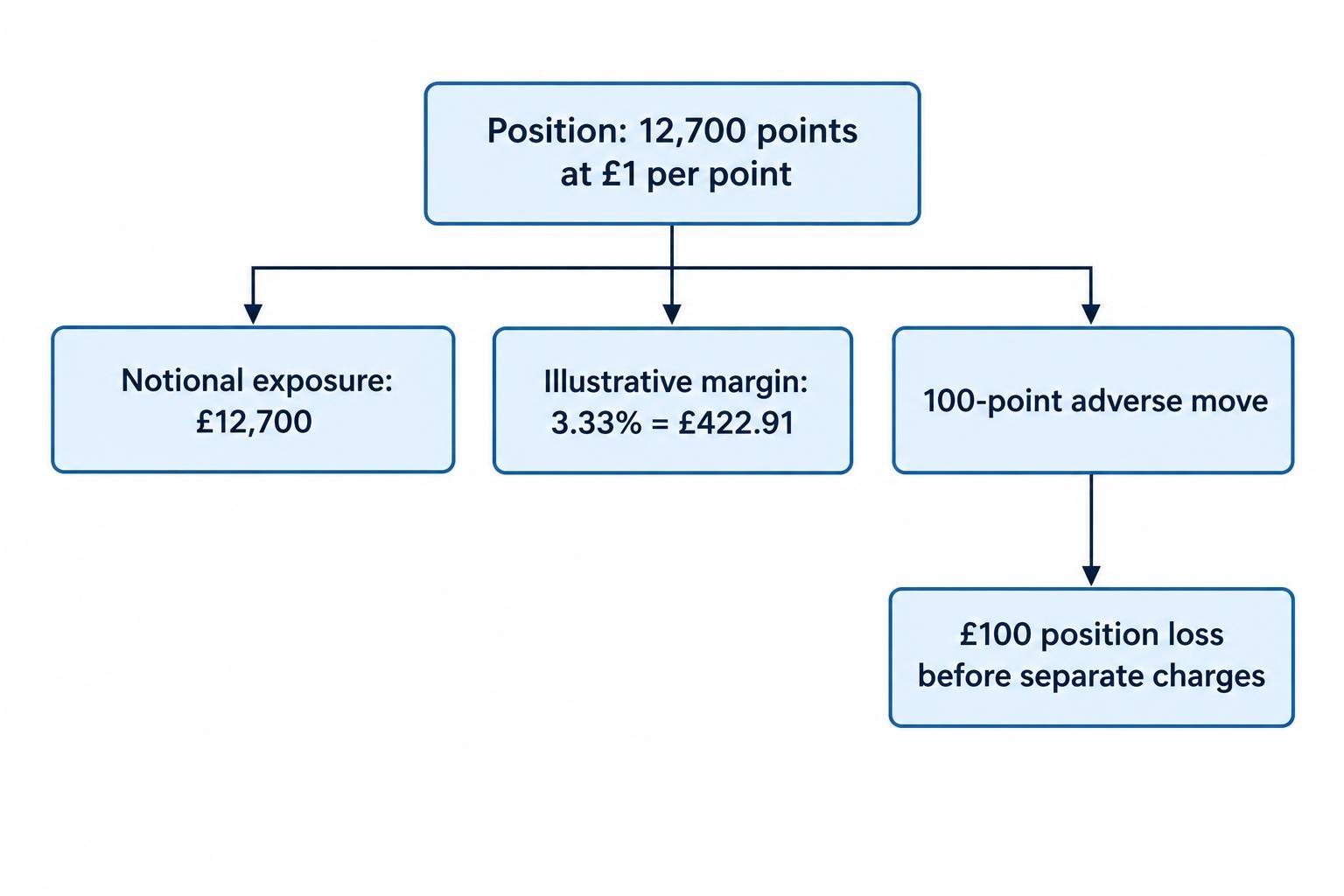
For a simplified contract with a price of 12,700 points and a stake of £1 per point, the notional exposure is £12,700. An illustrative 3.33% margin requirement would be £422.91. A 100 point adverse movement would still lose £100 before separate charges; margin does not reduce the stake’s sensitivity to price.
Use the platform’s actual margin preview rather than treating that illustration as a universal requirement. Leave room for losses, funding adjustments and other open trades. Committing nearly all available cash to opening margin leaves little breathing room.
The distinction between account equity, required margin and available funds is covered in spread betting margin. In practice, manage a GBP/USD exit yourself rather than relying on account close-out machinery to do the job.
What moves GBP/USD?
Relative interest rate expectations
GBP/USD responds to the relative appeal of holding pounds and dollars. Higher UK interest rates, with other influences unchanged, can support demand for sterling. The mechanism is outlined in the Bank of England’s explanation of exchange rate movements. It is a tendency, not a rule that every rate increase must lift the pound.
For trading decisions, separate the policy announcement from the expectation already reflected in prices. Consider a hypothetical UK rate increase that traders fully expected. If the accompanying statement suggests fewer increases ahead than anticipated, a bullish reading of the headline alone may be misleading.
Before holding a position through a UK decision, check the announcement date and the documents due alongside it. The Bank of England’s MPC calendar identifies policy announcements and meetings accompanied by a Monetary Policy Report.
The dollar side deserves equal attention. Review whether a US policy statement, press conference or projections release falls within your intended holding period. The Federal Reserve’s FOMC calendar and meeting documents provide the official schedule and associated materials.
Inflation, employment and economic growth
Build the UK part of your event calendar around inflation, wages, employment and growth releases. Verify publication times rather than assuming last month’s schedule still applies. The Office for National Statistics release calendar supplies the dates and times for UK economic publications.
For US inflation and employment announcements, use the Bureau of Labor Statistics release schedule. Its calendar uses Eastern Time, so check the conversion to your own trading clock before placing orders.
Read a release as a package rather than a single number. Suppose payroll growth beats expectations, but earlier figures are revised lower and wage growth slows. That combination is not the same trading proposition as an unambiguously strong report. The initial price movement need not settle the argument.
A useful preparation exercise is to write two scenarios before publication: what would support the trade, and what would invalidate it? “Good news for Britain” is too vague. A more workable question is whether the release changes the relative outlook for UK and US interest rates.
Political and fiscal announcements
Include relevant budget announcements, elections and major policy statements in your preparation. These events require judgement about more than the headline: the funding implications, likely policy response and competing developments in the US may all matter.
Avoid turning that judgement into a permanent directional bias. Being optimistic about the UK economy is not a reason to keep buying GBP/USD at any price. Your economic view and your trade’s entry, exit and holding period are separate decisions.
When to trade GBP/USD
Assess GBP/USD during the London morning and the period when London and New York business hours overlap. These are useful windows to observe, not a guarantee of favourable execution or profitable movement.
Compare the conditions you actually receive: the spread, price movement and execution around your chosen setup. A strategy targeting a few points is more sensitive to spread changes than one targeting a much larger move. The most active-looking chart is not automatically the cheapest trade.
For session boundaries, broker availability and clock changes, use the forex trading hours guide. UK and US daylight saving changes do not always occur on the same weekend, so a memorised UK release time can be wrong during the transition.
Check the contract’s daily breaks, funding cut-off and weekend closure arrangements before entry. A continuously moving weekday chart does not mean you can exit at any chosen price over a weekend. If your plan requires an exit before a closure or announcement, set a time for that decision rather than leaving it to chance.
The costs of a GBP/USD spread bet
The bid and ask spread
With a quote of 1.2700/1.2702, buying at £5 per point and immediately selling at an unchanged quote produces a £10 loss: two points multiplied by £5. The market must move far enough in your favour to cover that initial difference before the trade reaches break-even, excluding other charges.
Compare quoted spreads during the hours you intend to trade, not just the lowest advertised figure. For a short holding period, even a modest difference can consume a meaningful part of the planned target.
When calculating results from actual opening and closing fills, the spread is already reflected in those prices. Do not subtract it again. That common accounting mistake makes a trade look more expensive than it was.
Overnight funding
For a daily funded GBP/USD contract, check the overnight adjustment method, administration component and cut-off time. Do not calculate funding as though only the opening margin were the exposure, and do not assume a short position automatically earns a credit.
Weekend and holiday adjustments also need checking in the contract terms. The overnight financing guide covers the cost mechanics; for a planned GBP/USD holding, estimate the cash effect over the expected number of nights before entry.
If a dated contract is available, compare its quoted price, spread and expiry arrangements against the daily funded alternative. The absence of a separate daily debit is not enough to establish that one contract is cheaper.
Slippage and stop costs
A stop trigger and an execution price are not the same thing. If you buy at £2 per point and an ordinary stop fills ten points beyond its intended level, that adds £20 to the loss.
A guaranteed stop, where available, has different terms. Check its premium, permitted distance and charging conditions. The distinction between an ordinary trigger and a protected execution level matters more than the reassuring appearance of a stop line on a chart. Our slippage guide explains why the final fill can differ from the requested price.
Building a workable GBP/USD trading plan
Choose a setup you can define before the market moves. That might be a pullback within a trend, a rejection of an established range boundary or a breakout followed by a retest. None becomes a complete strategy until the entry conditions, invalidation level and exit process are written down.
For a breakout trade, decide whether you require a candle close beyond the level, a retest or immediate entry. Then specify what would show that the breakout has failed. Buying simply because the last candle was large replaces a plan with a reaction.
The breakout trading guide covers the wider method. Applied to GBP/USD, the extra checks are the nearby UK and US event schedule, the executable spread and whether your stop distance still fits your risk budget.
Keep the trade’s timeframe consistent. A position opened for an intraday move should not become a multiweek holding solely because the first exit would realise a loss. If the intended holding period changes, reassess the trade, funding and event exposure from scratch.
Also review related positions before adding another bet. Buying GBP/USD while holding other trades dependent on sterling strength or dollar weakness may concentrate the same underlying view. Different market names do not necessarily mean different risks; the portfolio correlation guide develops that account level check.
Checking a platform before trading GBP/USD
Compare the GBP/USD contract rather than choosing on the platform’s headline spread alone. Useful details include the minimum stake, stake increments, point definition, funding terms, stop controls and available trading hours. A minimum stake that is too large for your risk budget can rule out an otherwise suitable account.
The guide to forex spread betting brokers provides a framework for comparing those features. Read the relevant contract terms and confirm that the order ticket matches your intended exposure before committing funds.
Before submitting a GBP/USD order, check:
- Direction: does buying or selling express the view you intend?
- Point value: what movement does the displayed stake apply to?
- Risk: what is the loss to the planned exit, including an allowance for costs?
- Timing: which announcements, funding cut-offs or closures fall within the holding period?
- Account capacity: is there enough available equity beyond the opening margin?
Rehearse the order process through a spread betting demo account if the quote format or controls are unfamiliar. Check how opening, modifying and closing a position affects the displayed figures, without treating simulated results as proof of live execution quality.
A usable GBP/USD plan connects the exchange rate view to a defined trade: an executable entry, a correctly interpreted stake and an exit that fits the account’s risk budget. If any of those pieces is missing, waiting is a valid decision.