USD/JPY spread betting lets you speculate on the US dollar against the Japanese yen using a cash stake per point. Buy the pair and you profit if its price rises; sell it and you profit if it falls. Losses follow the same calculation in the opposite direction, with trading charges reducing the result.
The pair needs careful handling for two reasons: yen pip conventions differ from those used for most dollar pairs, and changes in interest rate expectations or Japanese currency intervention can produce abrupt moves. A small stake can still create substantial exposure.
This guide focuses on USD/JPY contracts offered through UK spread betting accounts. For the broader mechanics, see our guide to forex spread betting. All prices and trading examples below are hypothetical, not live quotes.
How to Read a USD/JPY Spread Betting Quote
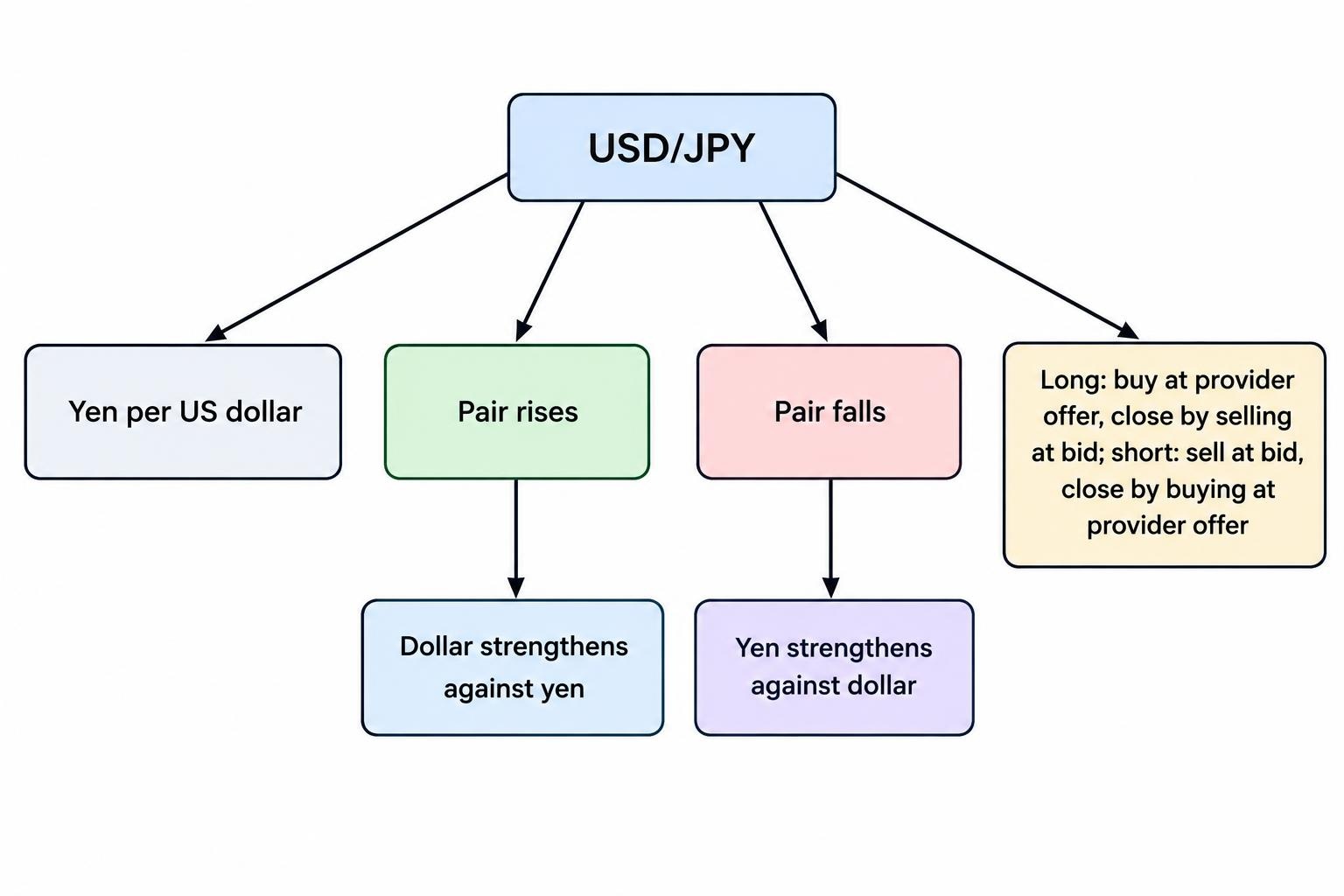
USD/JPY shows how many Japanese yen buy one US dollar. A price of 150.000 means $1 is worth ¥150. The dollar is the base currency and the yen is the quote currency.
If USD/JPY rises from 150.000 to 151.000, the dollar has strengthened against the yen. If it falls to 149.000, the yen has strengthened against the dollar. This direction matters: a bullish view on the yen means selling USD/JPY, not buying it.
A spread betting provider displays two prices. With a hypothetical quote of 150.000–150.020, you sell at 150.000 and buy at 150.020. The difference is the spread. A long position opens at the higher buying price and closes at the lower selling price; a short position does the reverse.
You do not receive dollars or yen when you open the bet. You enter a contract whose result depends on the price movement, your stake and the provider’s contract terms. A sterling stake can give you exposure to this currency pair without requiring a separate yen balance.
USD/JPY Pips, Points and Decimal Places
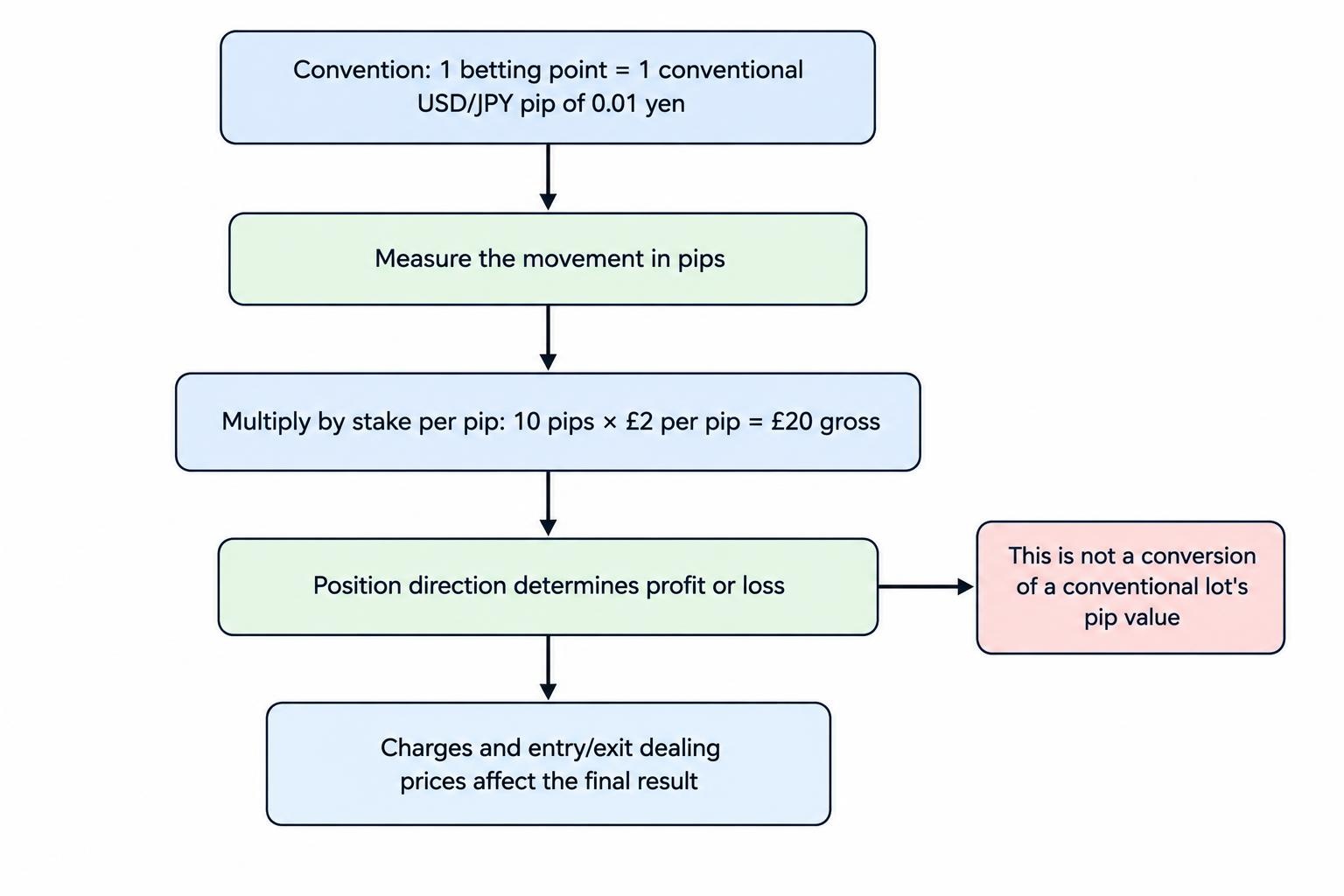
For USD/JPY, one conventional pip is 0.01 yen. A quote displayed to three decimal places includes a fractional pip: 0.001 is one tenth of a pip.
Do not assume that the smallest digit on the screen is the unit used for your stake. Platforms may display USD/JPY as 150.020, use a scaled quote, or define their betting point differently. Check the contract specification and the deal ticket’s cash value per movement before entering an order.
The examples in this article assume one betting point equals one conventional pip of 0.01.
| Price movement | Pip movement | Gross result on a long bet at £2 per pip |
|---|---|---|
| 150.000 to 150.010 | 1 pip higher | £2 profit |
| 150.000 to 150.100 | 10 pips higher | £20 profit |
| 150.000 to 151.000 | 100 pips higher | £200 profit |
These are movement calculations, not complete trade results: they exclude the difference between entry and exit dealing prices and any separate charges.
With a contract that fixes your stake at £2 per pip, a 10 pip movement produces £20 of profit or loss before charges. You do not then convert that £20 from yen into sterling. That differs from calculating the pip value of a conventional currency position measured in lots. Our guide to stake per point covers this distinction.
USD/JPY Spread Betting Examples
Buying USD/JPY
Suppose USD/JPY is quoted at 150.000–150.020. You expect the dollar to strengthen and buy at 150.020 for £2 per pip.
Later, the quote rises to 150.620–150.640. You close the long bet by selling at 150.620. The difference between your actual dealing prices is 0.600, or 60 pips:
60 pips × £2 = £120 profit before separate charges.
The spread is already reflected in this calculation because you entered at the buying price and exited at the selling price. Deducting another spread would count that cost twice.
If the selling price instead falls to 149.720, your loss is 30 pips:
(150.020 − 149.720) ÷ 0.01 × £2 = £60 loss before separate charges.
Selling USD/JPY
Now suppose you expect the yen to strengthen. You sell USD/JPY at 150.000 for £2 per pip. Later, you close by buying at 149.500.
The pair has moved 50 pips in your favour, producing a £100 profit before separate charges. If the closing buying price had risen to 150.500, the same position would have lost £100.
Use executed prices rather than a chart’s midpoint or the level where you intended to trade. Financing, premiums and other account adjustments may change the final result. The broader spread betting profit and loss calculation follows the same approach.
What Moves USD/JPY?
US and Japanese interest rate expectations
USD/JPY responds to changes in the expected path of US and Japanese interest rates. A shift towards relatively higher US rates can support the dollar, while a shift towards relatively higher Japanese rates can support the yen. These are possible responses, not dependable trading rules. Risk appetite and other forces also affect exchange rates, as documented in the Federal Reserve’s research on monetary policy and exchange rates.
The surprise matters more than the headline alone. A widely expected rate increase may produce little lasting movement. An unchanged rate accompanied by an unexpected change in guidance may provoke a much larger reaction.
Consider a hypothetical Japanese rate increase. Buying yen after reading the headline could still lose money if traders expected a larger increase, or if the accompanying statement points to a slower pace of future tightening. Trade the change in expectations, not just the word “increase”.
Economic releases and bond yields
US inflation, employment and spending releases deserve attention because they can change the outlook for Federal Reserve policy. Japanese inflation, wages and activity data can affect expectations for Bank of Japan decisions. Market reactions need not match whether a release looks good or bad in isolation.
US Treasury yields and Japanese government bond yields can help frame the interest rate picture. Treat them as context rather than an automatic entry signal. A correlation observed over one period is not a contract promising the next move.
Carry trades and position unwinding
A currency carry trade involves funding a position in a lower interest rate currency to hold a higher yielding currency or asset. When yen funded positions are unwound, buying back yen can put downward pressure on USD/JPY.
This risk is not theoretical. In early August 2024, the unwinding of leveraged currency and equity positions amplified market turbulence, and the yen appreciated sharply. The episode is examined in the BIS bulletin on the August 2024 carry trade unwind.
For a spread bettor, the practical issue is position size. A position sized for a quiet session may be far too large when many traders try to exit similar exposures at once.
Japanese foreign exchange intervention
Japan’s Minister of Finance decides whether to conduct foreign exchange intervention. The Bank of Japan executes those operations as the minister’s agent. This is separate from the Bank’s monetary policy decisions, a distinction set out in the Bank of Japan’s outline of intervention operations.
Do not treat a round exchange rate as a guaranteed intervention threshold. Speculation about official action is not confirmation that an operation will happen, or that it will produce a lasting reversal.
A sudden move can leave an ordinary stop executing beyond its requested level. That makes market gap risk relevant even when your longer term view on the pair has not changed.
Trading Hours and Event Timing
USD/JPY trades through the global weekday foreign exchange cycle, but your ability to open or close a spread bet depends on the provider’s dealing hours. Check daily maintenance breaks, holiday arrangements and weekend closures rather than assuming continuous access.
For UK traders, the practical question is which events will occur while you are away from the screen. A position opened during the London afternoon may still be exposed to Japanese announcements overnight. Our guide to forex trading hours covers the wider session structure.
Use the Bank of Japan’s monetary policy meeting schedule to check Japanese decision dates and associated publications. Review whether you want exposure through the decision itself and the later commentary. Knowing the date does not remove execution risk.
The Federal Reserve’s FOMC calendar provides US meeting dates and links to statements and related materials. Check the calendar again before carrying a position through an announcement. Do not rely on a date copied into an old trading plan.
Convert release times for the date concerned. Japan does not change its clocks, while the UK and US observe daylight saving changes on different schedules. A recurring announcement can therefore shift relative to your usual UK routine.
The Costs of Spread Betting USD/JPY
The dealing spread
A quote of 150.000–150.020 has a two pip spread under the convention used here. At £2 per pip, an immediate round trip with unchanged prices would lose £4.
Compare spreads during the hours you expect to trade, not just the lowest advertised figure. A spread can change, and a quote available in ordinary conditions does not promise the same cost around a policy announcement or during a thin market. Our guide to spread betting spreads explains how this affects entry and exit prices.
Cost also needs context. A two pip spread consumes 20% of a hypothetical 10 pip gross target before other charges. It consumes 2% of a 100 pip target. Neither target is automatically sensible, but the calculation shows why small targets leave less room for dealing costs.
Overnight financing
A rolling or daily funded USD/JPY bet may receive an overnight financing debit or credit under the provider’s formula. The result depends on direction, the applicable currency funding inputs and the provider’s adjustment. A favourable interest rate difference does not guarantee a credit after charges.
Check the daily cut off, the published calculation and the treatment of weekends and holidays. An adjustment covering several days need not appear as three identical daily entries. Evaluate overnight financing costs over your intended holding period rather than treating them as an afterthought.
A dated contract may account for funding through its price instead of a separate daily charge. That changes the cost structure; it does not make holding the exposure free.
Slippage and stop premiums
Slippage is the difference between the price you expected and the price you received. It can increase a loss when a market moves through an ordinary stop. A guaranteed stop, where offered, has its own premium and conditions. Compare those terms before relying on it.
Margin and UK Retail Protections
USD/JPY is a major currency pair. Under the UK retail rules, the minimum opening margin for major foreign exchange pairs is 3.33% of exposure, equivalent to roughly 30:1 leverage. The rules also require account based close out when equity falls below 50% of the required margin, as soon as market conditions allow, and restrict liability to funds in the relevant trading account. These requirements appear in FCA COBS 22.5 on retail speculative investments.
A provider may require more margin than the regulatory minimum. Check the amount shown on your ticket and any terms allowing margin requirements to change.
Suppose a ticket shows £15,000 of exposure. At a hypothetical 3.33% margin rate, the opening requirement would be £499.50. That figure is collateral, not a forecast of your loss and not the maximum amount that position could lose.
Do not calculate your stake by asking how much margin the account can just about support. Calculate an acceptable loss first, then check whether sufficient funds remain for margin and adverse price movement. Our guide to spread betting margin separates these calculations.
Sizing a USD/JPY Position Around the Stop
Start with the price level that would invalidate the trade. Then measure the distance from your proposed entry using the same point convention as the deal ticket.
Suppose a hypothetical £3,000 account has a self imposed £30 loss budget for a trade. A long entry at 150.020 and a stop at 149.420 are 60 pips apart. Before charges and slippage, the calculation is:
£30 ÷ 60 pips = £0.50 per pip.
This is an example, not a recommended risk allowance. A tighter budget, wider stop or allowance for charges would reduce the stake. If the provider’s minimum stake is too high for your calculation, skip the trade rather than squeezing the stop closer simply to make the ticket fit.
Our guide to position sizing for spread betting develops this method. The sequence matters: trade invalidation, stop distance, cash allowance, then stake.
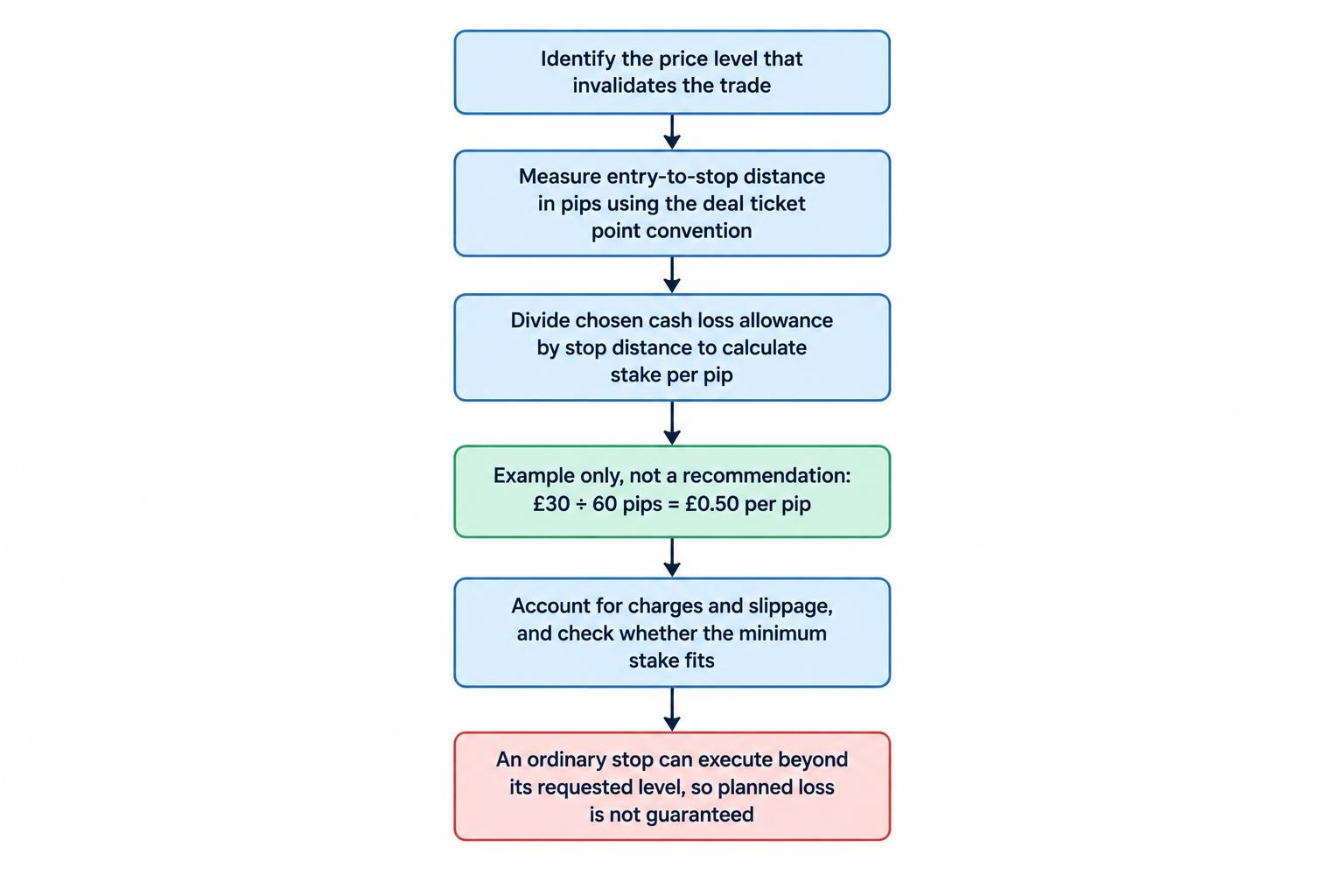
An ordinary stop does not guarantee the planned loss. A fill below 149.420 on that long position would increase the loss. If you need certainty about the exit level, check whether the market supports a guaranteed stop, including its premium, minimum distance and restrictions.
Account exposure also matters. A long USD/JPY position and other bets favouring dollar strength may express much the same view. Separate deal tickets do not necessarily create separate risks.
Matching the Trade to the Holding Period
A short intraday trade and a position held for several weeks need different preparation. For an intraday position, the spread, nearby announcements and execution conditions can dominate the calculation. For a longer holding period, financing and exposure to several policy or data events deserve more attention.
Technical levels can organise an entry without replacing the economic case. A breakout above resistance might provide an entry trigger, but it does not tell you whether an imminent policy announcement makes the stake excessive. Equally, a convincing macroeconomic view does not justify entering without an exit plan.
Avoid choosing a stake because the recent chart looks calm. Measure stop distances in pips and cash, and test what a larger adverse move would do to the account. A 100 pip move is £50 at 50p per pip and £500 at £5 per pip. The chart is identical; the financial consequence is not.
Checking a USD/JPY Deal Ticket
Before submitting an order, verify the terms on the actual contract rather than transferring assumptions from another currency pair.
- Direction: buying benefits from a rise in USD/JPY; selling benefits from a fall.
- Point value: confirm which price increment your cash stake applies to.
- Exit prices: check the relevant dealing side and how stop orders trigger.
- Costs and funding: review the current spread, overnight terms and any stop premium.
- Account exposure: check margin, other open positions and events during the intended holding period.
Pay particular attention to the chart price used for analysis. A midpoint chart is not necessarily the price that closes your position. A long closes at the selling price and a short at the buying price, so a widening spread can affect an exit even when the displayed chart appears not to have reached your level.
A spread betting demo account can help you check the platform’s point convention, stake entry and order controls without risking trading funds. It cannot establish how live execution will behave during a fast market. Use it to remove avoidable ticket errors before accepting the market risks that remain.