Interest rate spread betting lets you take a position on changes in an interest rate market without buying a bond or trading an exchange futures contract directly. Your profit or loss depends on the movement in the provider’s quoted price and your stake per point.
The first trap is direction. For the short term interest rate futures discussed here, prices use a “100 minus interest rate” convention. A higher price therefore means a lower implied rate. Buying because you expect interest rates to rise can put you on precisely the wrong side of the trade.
This guide focuses on UK spread betting accounts and short term rate contracts. They sit alongside bonds, currencies and indices within the wider range of financial spread betting markets. Availability, point values and settlement terms must be checked with the provider before placing an order.
What an Interest Rate Spread Bet Tracks
An interest rate spread bet is a contract with your provider. You trade its buy and sell prices, which may reference an underlying interest rate futures contract. You do not acquire the exchange contract, lend money to a bank or receive the benchmark interest rate as income.
Separate three things before deciding what to trade: the central bank’s policy rate, the market benchmark and the futures contract that references that benchmark. They are connected, but they are not interchangeable.
For sterling, SONIA measures the rates banks pay to borrow overnight from other financial institutions and institutional investors. It is calculated from actual transactions and administered by the Bank of England. The Bank of England’s SONIA benchmark description identifies what the rate measures; it is not simply another name for Bank Rate.
A futures contract adds a further layer by referencing a defined period or fixing. The bet therefore needs to match both your view on rates and the period over which you expect that view to matter.
Government bond prices also respond to interest rates, but bond contracts have different pricing and sensitivity. If your view concerns longer dated government borrowing costs rather than short term benchmarks, the relevant starting point is bond markets for spread betting.
Interest Rate Markets to Recognise
The contracts below are useful reference points when assessing a provider’s market list. Their existence on an exchange does not mean every spread betting provider offers them, or offers every contract month.
Sterling: Three Month SONIA
ICE Three Month SONIA futures settle against the effective interest rate achieved by reinvesting at daily SONIA throughout the contract’s accrual period. The price is 100 minus that rate. ICE names these contract months by the start of the accrual period, an important detail when matching a trade to future policy meetings. These conventions appear in the ICE Three Month SONIA contract specifications.
For a spread bet referencing this market, establish which underlying contract the provider uses. A sterling rate label alone does not tell you which quarter your position covers.
US Dollars: Three Month SOFR
SOFR reflects overnight borrowing secured by US Treasury securities. Three Month SOFR futures reference daily compounded SOFR over a defined quarter and use the same 100 minus rate price convention. The reference dates and settlement calculation are set out in CME Group’s SOFR futures contract explanation.
A SOFR position is not a direct bet on the Federal Reserve announcing one particular target rate. Check the benchmark, reference period and contract identifier rather than treating all dollar interest rate products as substitutes.
Euros: Three Month Euribor
Three Month Euribor futures reference the EMMI Euribor rate for three month euro deposits. Unlike the overnight compounding approach above, final settlement uses the relevant Euribor fixing. The ICE Three Month Euribor specifications also define the quotation as 100 minus the numerical interest rate.
The practical point is simple: two markets can share a quotation convention without measuring the same kind of rate.
How to Read an Interest Rate Quote
For a contract quoted on a 100 minus rate basis:
Implied contract rate (%) = 100 − futures price
A price of 96.20 corresponds to an implied contract rate of 3.80%. A price of 96.45 corresponds to 3.55%. The price has risen by 0.25, while the implied rate has fallen by 0.25 percentage points, or 25 basis points.
One basis point is 0.01 percentage points. Do not confuse a one percentage point rate change with a one basis point change: the former is 100 times larger.
Under this quotation convention, buying the price expresses a position that benefits from a fall in the implied contract rate. Selling expresses a position that benefits from a rise. Your view must concern a change from what is already priced, not just whether rates look high or low in isolation.
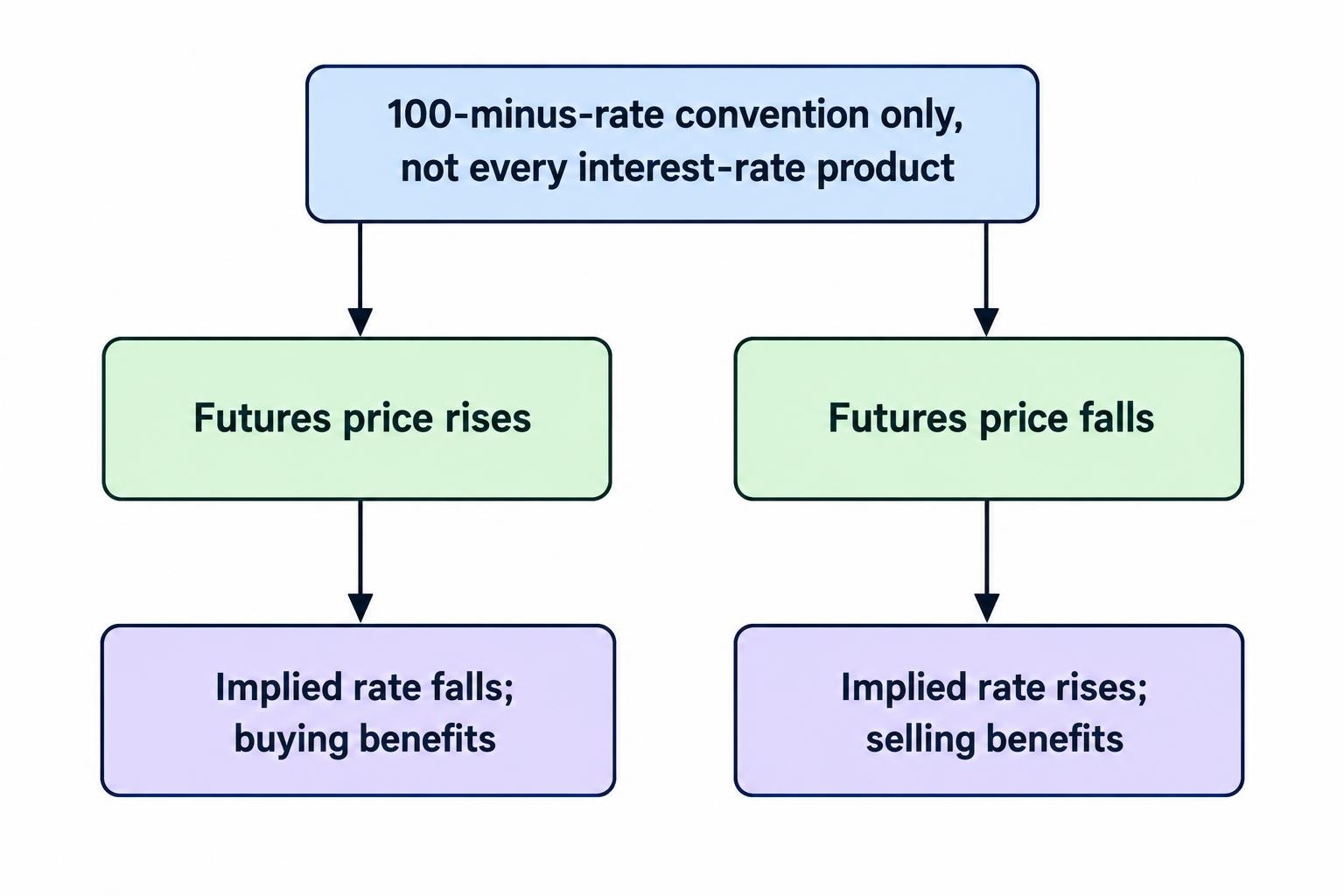
The distinction between long and short spread bets concerns the quoted instrument. A long futures price position can therefore be a falling rate position. “Long rates” is too ambiguous to use as an order instruction.
There is another trap in the word “point”. A provider might display a price as 96.20, or use a scaled display such as 9,620. Its dealing terms define the movement to which your stake applies. Never assume that one full displayed unit, one tick and one basis point all mean the same thing.
Before trading, write down the cash result of a small price move. If you cannot calculate the gain or loss from a move equivalent to ten basis points, the stake is not ready to submit.
Trade the Change in Expectations, Not Just the Rate Decision
Financial markets respond to expectations about future policy as well as implemented rate changes. Expected future Bank Rate affects rates beyond the overnight horizon, and financial conditions can adjust before a policy decision takes effect. That relationship is covered in the Bank of England’s analysis of monetary policy transmission.
Consider a hypothetical market that already reflects substantial rate cuts. You buy a rate futures price because you also expect cuts. The central bank then cuts, but signals fewer further reductions than traders had anticipated. Your broad economic prediction may be correct while your position still loses.
The useful question is not simply, “Will rates fall?” It is, “Will the rate represented by this contract fall further than the current price implies, within my holding period?”
Apply that question to economic releases. If stronger wage data cause traders to expect fewer cuts, a 100 minus rate contract could fall. If weaker activity data lead them to expect faster easing, it could rise. These are conditional scenarios, not mechanical trading rules. A release can contain conflicting details, and the starting price matters.
For an event trade, record the prevailing market assumption, the result you expect and the result that would invalidate the position. Include the timing of the response. A view that takes three months to become persuasive may be unsuitable for a trade that must be closed this afternoon. The broader execution issues are covered in news trading with spread bets.
Policy probabilities also need careful interpretation. They are model outputs, not promises or a poll of central bankers. The CME FedWatch calculation methodology derives probabilities from Federal Funds futures using stated assumptions, including assumptions about the size of policy changes. Those probabilities concern a different underlying rate from SOFR.
Choose the Right Contract Period
A sound rate view can be paired with the wrong contract. Before opening a position, distinguish the reference period, the exchange’s last trading date and the spread betting provider’s own dealing deadline.
The reference period determines which rates enter the underlying settlement calculation. The provider’s deadline determines how long you can keep your bet open. Neither should be guessed from the month displayed beside the market name.
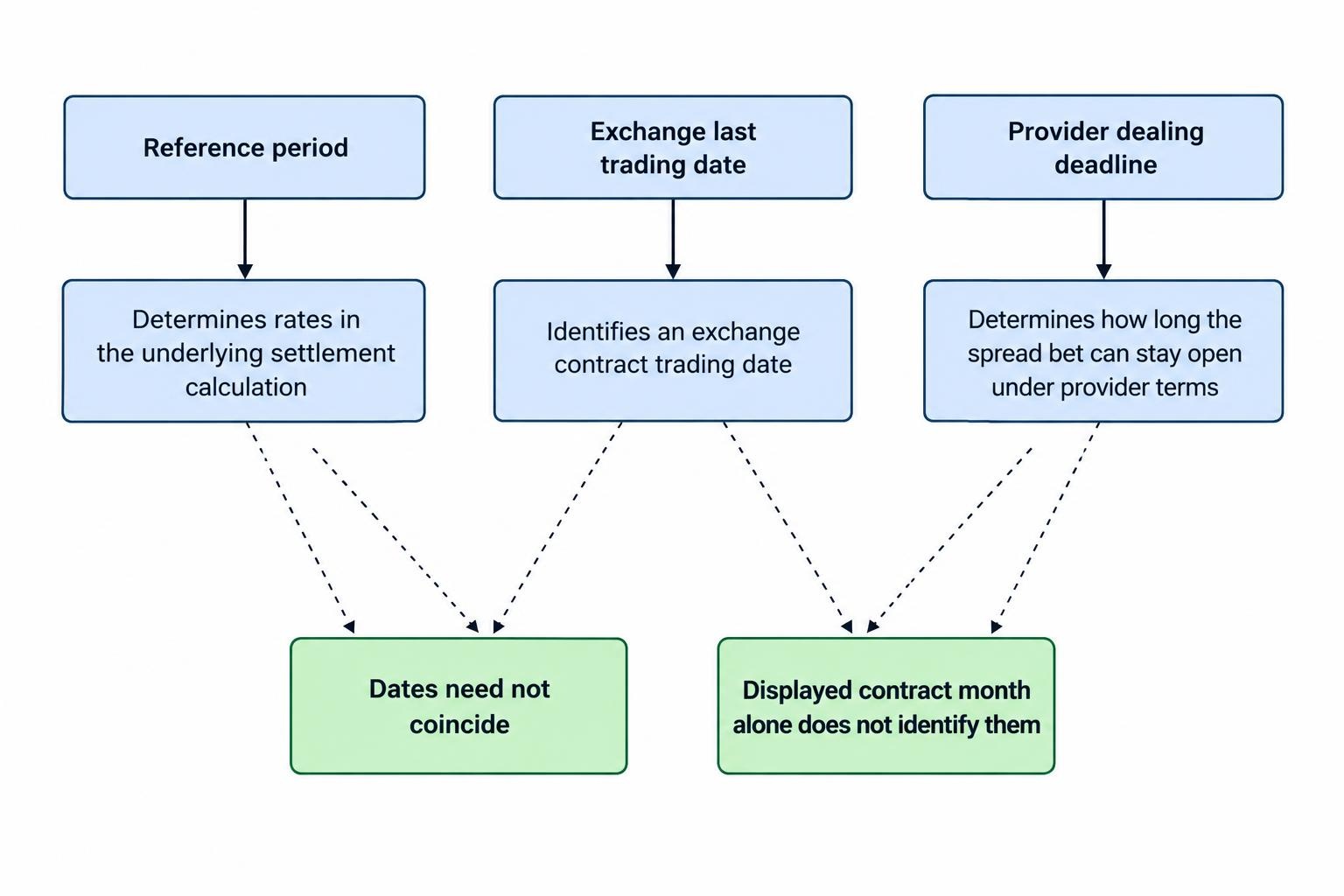
For a contract based on rates compounded over time, part of the period may already have elapsed. Published rates for those elapsed days are known; only the remaining days are still exposed to future rate outcomes. A late policy decision therefore does not rewrite the rates already recorded earlier in that period.
This explains why a 25 basis point policy change does not automatically produce a 25 basis point move in every rate contract. The decision may have been anticipated, may affect only part of the reference period, or may change expectations for later decisions in the opposite direction.
If your view concerns policy well beyond the nearest contract, assess whether a later contract better matches it. Do not choose the nearest expiry solely because it is the first line on the dealing screen.
Also establish what happens if you do nothing. The position may settle under the provider’s terms, or a rollover may be available. Closing one contract and opening another can involve further spread costs and a different underlying rate period. The operational detail belongs in your review of spread betting expiry dates.
Interest Rate Spread Betting Worked Example
The following prices and dealing terms are hypothetical. They illustrate the calculation, not an available market or recommended trade.
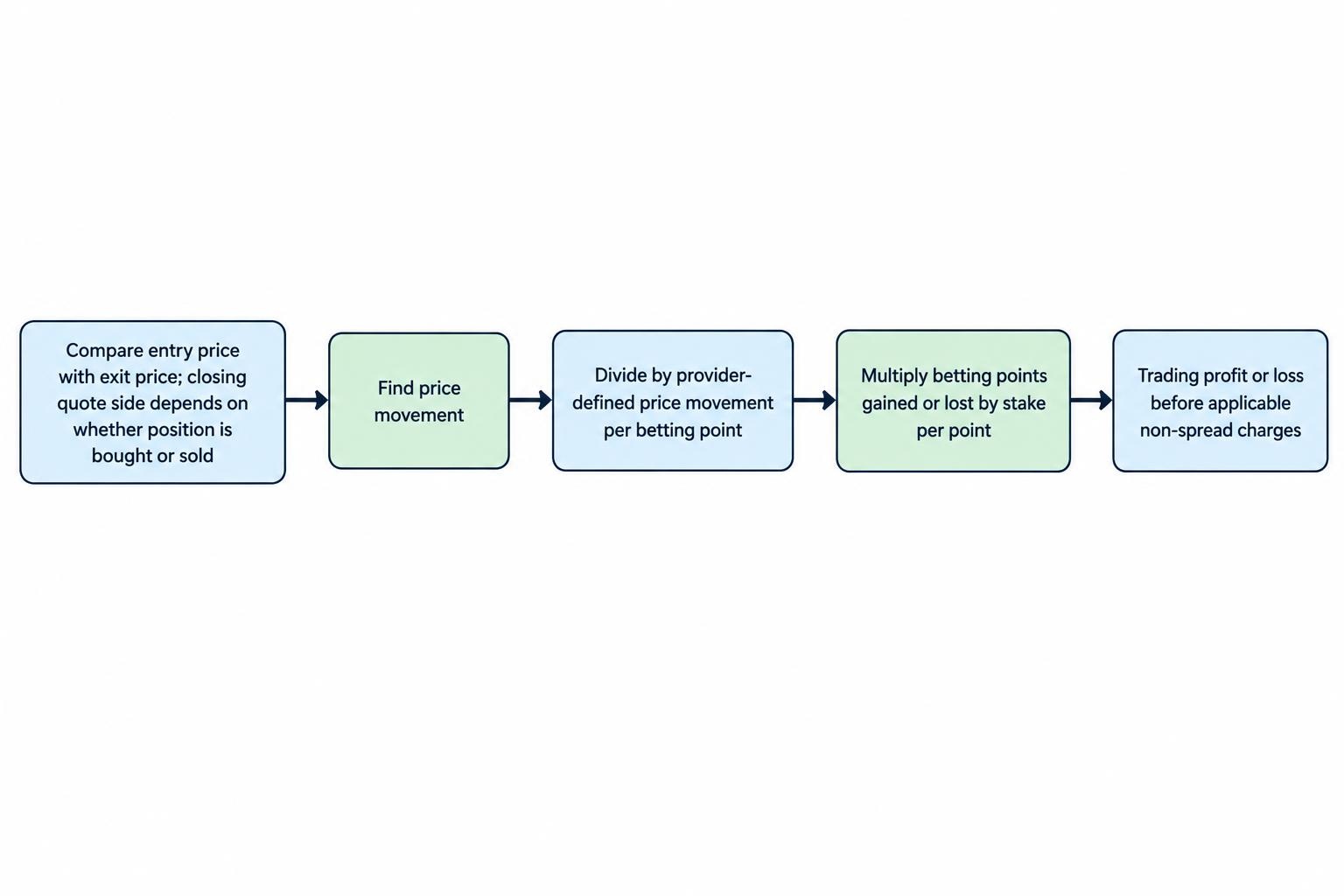
Assume a provider quotes a 100 minus rate contract at 96.20 to sell and 96.22 to buy. Its terms define one betting point as a 0.01 price movement. You choose a stake of £5 per betting point.
The opening spread is therefore two betting points. An immediate round trip at unchanged prices would lose £10: two points multiplied by £5. The stake per point determines the cash sensitivity, not the amount of money you can lose in total.
Buying for a Rise in the Contract Price
You buy at 96.22. Later, the quote rises to 96.67 to sell and 96.69 to buy. You close your long position at the sell price of 96.67.
Your price gain is 0.45. Dividing by the provider’s 0.01 point size gives 45 betting points. At £5 per point, the trading profit is £225, before any charges beyond the quoted spread.
If the quote instead falls to 95.90 to sell and 95.92 to buy, you close at 95.90. That is a 32 point loss from your 96.22 entry, costing £160.
Selling for a Fall in the Contract Price
Alternatively, you sell the original quote at 96.20. If it later falls to 95.90 to sell and 95.92 to buy, you close by buying at 95.92. The 0.28 price decline gives you 28 betting points, producing a £140 trading profit.
The different outcomes reflect both direction and the side of the quote used to close.
| Position | Opening price | Closing price | Points gained or lost | Trading profit or loss |
|---|---|---|---|---|
| Buy, then price rises | 96.22 | 96.67 | +45 | +£225 |
| Buy, then price falls | 96.22 | 95.90 | −32 | −£160 |
| Sell, then price falls | 96.20 | 95.92 | +28 | +£140 |
| Sell, then price rises | 96.20 | 96.69 | −49 | −£245 |
These calculations already include the effect of entering and exiting across the quoted spread. Do not deduct the same spread again when calculating the final result.
Spreads, Financing and Rollover Costs
Assess costs in cash relative to the movement you expect to capture. A two point spread at £5 per point costs £10 for an unchanged round trip. If your intended gain is only five points, the spread consumes a large part of the opportunity before execution risk enters the calculation.
Compare the executable bid-ask spread, not just a chart’s midpoint. A chart can touch your target without the closing side of the provider’s quote reaching it.
Check whether the bet has an expiry or uses another funding arrangement. Do not assume that a rate market has the same charging structure as a daily funded equity index bet. Establish whether financing is charged separately, reflected in pricing, or handled through another contractual adjustment.
The benchmark rate being traded and the financing rate charged on an account are separate matters. A position that benefits from falling implied rates does not automatically receive an interest credit. Review any applicable overnight financing costs for the actual product.
For a position held across contract changes, include the cost of closing and reopening. Also check guaranteed stop premiums, data charges and any currency treatment that applies. Use the provider’s written terms rather than assuming that an absence of a commission line means the trade has no costs.
Margin and Position Sizing
Margin is collateral required to support a position. It is not the purchase price of an asset and should not be treated as your planned maximum loss. A modest opening requirement can support a position whose cash value changes much more sharply.
Keep the provider’s spread betting margin requirement separate from your own loss allowance. The first determines whether the account can support the trade. The second determines whether the trade belongs in the account at all.
Start with a price level that would invalidate the trade, then calculate the stake. Suppose your hypothetical loss allowance is £100 and the distance from entry to the intended stop execution level is 20 betting points. The arithmetic gives £5 per point, before allowing for execution uncertainty and other charges.
If that stake is below the provider’s minimum, the trade does not fit the allowance. Moving the stop closer simply to make the numbers work changes the trade, not the market. A consistent position sizing method should determine the stake before the order is submitted.
For UK retail accounts covered by the rules, providers must close positions as soon as market conditions allow when account net equity falls below 50% of the required margin. Negative balance protection also restricts liability for the relevant speculative investments to funds in the account. These are account protections under FCA COBS 22.5 retail trading rules, not a guarantee that an individual trade will stop at your preferred loss.
Leave enough account capacity for adverse movement and other open positions. An eventual correct forecast offers little comfort if the position has already been closed for insufficient equity.
Execution Around Announcements
Plan announcement trades around executable prices. A fast repricing can leave little opportunity to enter or exit at the level visible before the release. An ordinary stop order does not guarantee its execution price if the market moves through the trigger.
In the worked example, an extra ten betting points of adverse execution would cost £50 at a £5 stake. That additional loss needs no dramatic change in your economic view; it follows from the price at which the order actually fills. This is the practical effect of slippage.
Check whether guaranteed stops are available for the chosen market, along with their premium, minimum distance and restrictions. Do not assume that a feature available on a major index is also offered on an interest rate contract.
Trading hours need the same care. Verify the provider’s dealing session, any daily closure and the final dealing deadline. Exchange trading hours alone do not establish when your spread bet can be closed.
Before a scheduled release, decide whether to hold, reduce or close the position. Making that decision after the first price jump is a different process, and usually a less orderly one.
Can Interest Rate Spread Bets Hedge Borrowing Costs?
In principle, a position that gains when implied rates rise can offset part of another exposure that suffers from higher rates. Under a 100 minus rate quotation, that would generally involve selling the contract price rather than buying it.
The match is rarely exact. A mortgage, business loan or bond portfolio may reference a different rate, reset on different dates and respond by a different amount. The spread bet also creates a separate cash demand through margin and interim losses.
Consider a borrower whose costs will reset next year. A nearby contract covering an earlier quarter may not match that exposure, even if both relate to sterling rates. Matching currency is only the beginning.
A proposed hedge needs an exposure calculation, a time match and a plan for funding adverse movements in the trading account. The wider principles of hedging with spread bets apply, but a rate bet should not be treated as a ready made substitute for fixing a loan rate.
Checks Before Opening an Interest Rate Spread Bet
Keep the order review short enough to use and precise enough to catch expensive mistakes:
- Identify the underlying: confirm the benchmark, futures contract and reference period, not just the platform label.
- Confirm direction: state whether the trade benefits from a higher price, a higher implied rate, or both under a different quotation convention.
- Translate points into cash: record the point size, stake, opening spread and loss from a plausible adverse move.
- Check the contract terms: verify margin, trading hours, funding, stop availability, expiry and settlement treatment.
- Set the exit conditions: define the price, event or change in expectations that would end the trade, including a time limit where appropriate.
Write the position in plain English before submitting it. “Buy this contract because I expect its implied rate to fall below the level currently priced” is clearer than “bet on the central bank”. If that sentence does not match the order ticket, stop.
When This Market Fits Your Trading Plan
Interest rate spread betting is most relevant when your view concerns a named benchmark over a defined period, and you can explain how it differs from the current market price. A general opinion that borrowing is expensive is not enough to specify a trade.
Before committing money, use a spread betting demo account to practise the quotation convention and cash calculations where the relevant market is available. Demo trading can help expose point size mistakes, but it does not establish how live orders will execute.
The arithmetic is straightforward. Choosing the correct rate, period, direction and stake is the harder part. Resolve those four decisions before opening the position, not after the market has supplied an expensive explanation.