Spread betting risk management starts with a decision made before entry: how much money can this trade lose without damaging the account or your finances? The stake, stop level, available margin and other open positions must all fit that answer. A convincing market view does not get an exemption.
The aim is not to eliminate losing trades. It is to keep ordinary losses manageable, prepare for worse execution than expected, and stop a trading mistake from becoming a financial problem. Position sizing does most of the work, but it needs support from sensible exposure limits, reliable execution procedures and clear rules for stepping away.
This guide brings those controls into one practical process for UK financial spread betting. All prices, account sizes and trading results below are hypothetical. The percentages illustrate how a plan can work; they are not recommended settings or assurances of safety.
Separate trading capital from money you need
Start with the account, not the next trade. Trading capital should be money you can lose without affecting household bills, debt repayments, emergency reserves or other commitments. A stop order cannot make money affordable to lose if it was needed elsewhere before the position opened.
Set an account funding limit and a separate rule for adding money. Depositing more cash after losses can disguise deteriorating results and keep an oversized position alive. Any further funding should follow a fresh assessment, not an urgent attempt to avoid closing a losing bet.
There is also a difference between money allocated to trading and money held with a provider. Keep enough account liquidity for the positions you deliberately choose, but do not treat every pound of savings as emergency margin. The wider principles of protecting your trading capital begin with that boundary.
Use current equity when calculating risk
Account balance records completed activity. Equity also reflects unrealised profit or loss on open positions. If the balance is £10,000 but open bets are losing £600, the account has roughly £9,400 of equity before any other adjustments. Calculating a new stake from the original £10,000 ignores money already lost economically.
Choose a consistent basis for sizing. One cautious approach is to use the lower of current equity and a fixed reference amount reviewed periodically. That avoids increasing stakes automatically because an open trade briefly shows a profit. Whatever method you choose, write it down and apply it to every position.
Calculate the stake from the loss budget
The stake per point determines how much an adverse price movement costs. Choose it after identifying the exit level, not before. Starting with a comfortable-looking stake and squeezing the stop closer to make the arithmetic work reverses the process.
The basic relationship is:
Planned price loss = stake per point × distance from entry to stop.
A more useful sizing calculation reserves room for costs and imperfect execution:
Maximum stake per point = (cash risk budget − additional cost and execution allowance) ÷ stop distance.
This is a planning calculation, not a maximum-loss guarantee. An ordinary stop can execute beyond its trigger level, and an allowance can prove too small. The purpose is to stop knowingly committing more money than the trade budget permits.
A worked position-sizing example
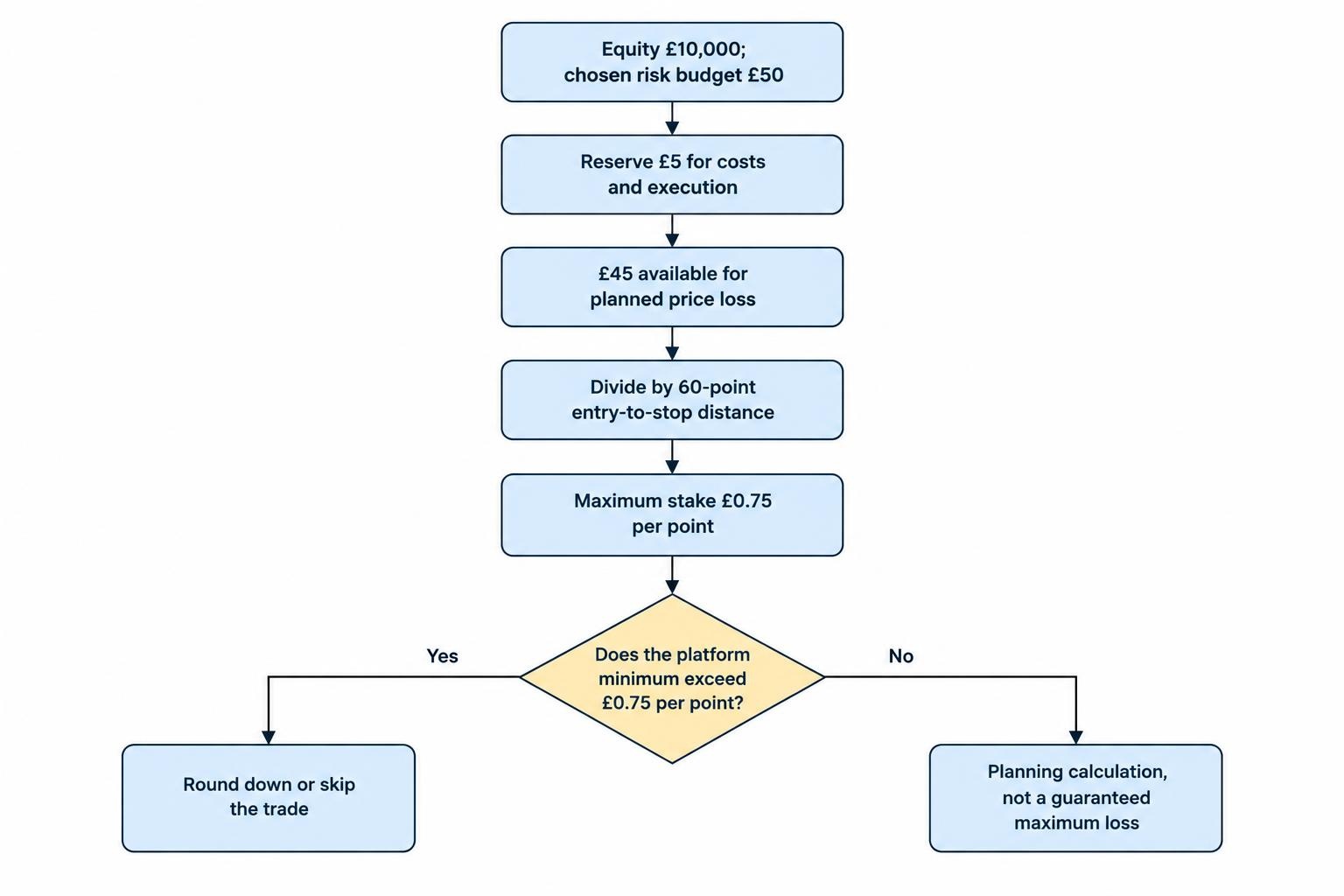
Suppose an account has £10,000 of equity. The trader chooses an illustrative risk budget of 0.5%, or £50, for one index spread bet. The proposed long entry is 8,000, with an ordinary stop at 7,940.
| Input | Amount |
|---|---|
| Account equity | £10,000 |
| Chosen cash risk budget | £50 |
| Entry to stop distance | 60 points |
| Additional cost and execution allowance | £5 |
| Amount available for the planned price loss | £45 |
| Calculated maximum stake | £0.75 per point |
At £0.75 per point, a 60-point adverse move produces a £45 price loss. The remaining £5 is a planning allowance. A worse fill or higher charges can still take the realised loss beyond £50.
Measure the distance using the actual entry and the relevant closing-side price. If that calculation already captures the spread, do not add the same spread cost again. Any separate allowance should cover costs or execution effects not already included.
If the platform does not permit £0.75 per point, round down to an available stake. Where the minimum stake is too large, skip the trade or choose a suitable alternative market. The broker’s minimum is not a reason to exceed your own maximum. The position-sizing guide covers the calculation across different trade setups.
A wider stop requires a smaller stake
If the same idea needs a 90-point stop, the available £45 supports only £0.50 per point. Keeping the £0.75 stake would increase the planned price loss to £67.50 before the extra allowance.
This adjustment matters when market conditions change. A wider stop may be justified by larger price swings, but it does not justify a larger cash loss by default. If the stop has to move farther away before entry, recalculate the stake. Once the trade is open, widening the stop increases the risk already accepted.
Give every trade a clear exit condition
A useful stop level marks where the reason for holding the position no longer applies. That might be a failed breakout, a broken support level or a price move inconsistent with the trade’s premise. It should not simply be the nearest level that makes a large stake look affordable.
The sequence is straightforward: define what invalidates the trade, allow for ordinary price movement around that area, then calculate the stake. If the resulting trade offers too little potential reward or requires an impractically small stake, reject it. There is no obligation to turn every market opinion into an order.
Using stop losses as a risk control also requires a management rule. Decide before entry whether the stop remains fixed, moves after a defined price development, or follows a trailing method. Changing the method because the position is uncomfortable defeats the purpose.
Check what triggers the stop
A long position closes by selling, while a short position closes by buying. Check which quoted price triggers the stop and whether the chart displays bid, ask or midpoint prices. A chart can appear not to have reached a level even though the relevant executable quote has reached it.
A conventional stop does not guarantee its execution price. During a fast move or a gap, the available closing price can be worse than the trigger. A stop-limit order introduces a different risk: its price restriction can prevent execution altogether. Neither arrangement makes an unsuitable stake safe.
Use guaranteed stops where the terms fit the risk
A guaranteed stop provides a contractual closing-price guarantee under the provider’s terms. Check availability, minimum distances, amendment restrictions and the premium, including when that premium becomes payable. Do not assume every market or position qualifies.
The distinction between managing risk with guaranteed stops and using ordinary stops matters most where a gap could make the planned loss unacceptable. Include any premium in the trade budget rather than treating it as an unrelated account charge.
A guarantee can control one trade’s exit price. It does not prevent losses across several positions, remove financing costs or make repeated poor decisions harmless.
Keep leverage and margin separate from the loss budget
Margin is the money required to support a position. It is not the position’s maximum loss. A platform may permit a trade that is much larger than your risk plan permits, because available margin answers a different question from affordability.
For a simple index spread bet quoted per whole index point, approximate notional exposure is the index level multiplied by the stake per point. At an index level of 8,000, a £5 stake represents £40,000 of exposure. Against £10,000 of equity, that is effective leverage of four times account equity.
A 1% adverse index move is 80 points. At £5 per point, it produces a £400 price loss, or 4% of that account’s equity, before costs. This is the practical meaning of leverage risk: the account moves by a larger percentage than the underlying market.
Understand the regulatory backstops
UK retail rules set minimum opening margins by asset class. For covered products, firms must close positions as soon as market conditions allow when account net equity falls below 50% of the relevant margin requirement. Negative balance protection caps liability for covered trading at the funds dedicated to that account. These are account-level safeguards, not guarantees that an individual bet will lose only its initial margin; the requirements are set out in FCA COBS 22.5 on retail speculative investments.
Do not confuse the 50% close-out threshold with permission to lose only half the account, or expect an ordinary stop to cap the loss at its trigger. Nor should you assume the same safeguards apply after a change in client classification or contracting entity.
Leave room for adverse movement
Maintain a margin buffer that can absorb adverse prices, charges and any requirement changes permitted by the agreement. Review the provider’s calculation and liquidation terms before opening positions. Its contractual controls may act earlier than the regulatory backstop.
Use margin risk controls alongside trade sizing. If a position needs an emergency deposit to survive a routine adverse move, the account structure deserves attention. Do not make the broker’s close-out process your planned exit.
Limit combined exposure, not just individual trades
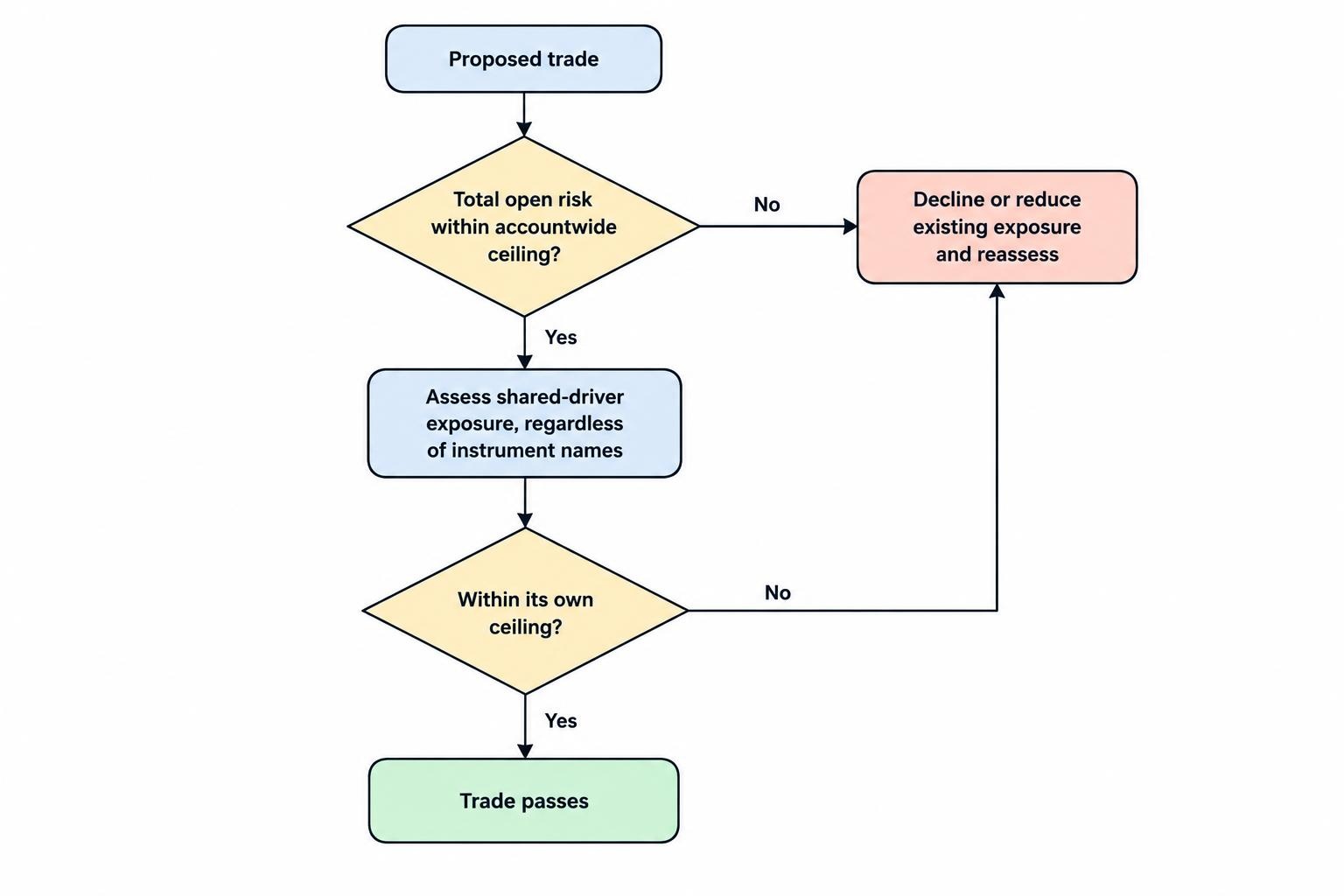
Three trades with £50 of planned risk create £150 of combined planned downside if all reach their stops. They do not become safer because they appear on separate lines in the account. Set an accountwide ceiling for open risk before adding another position.
Also group trades by the event or economic force that could hurt them. A long equity index bet, a long technology index bet and a long technology share position may all depend on continued enthusiasm for growth stocks. Different instrument names can conceal the same underlying wager.
Managing portfolio correlation in spread betting therefore needs more than a historical correlation figure. Ask what would happen to the positions after a sharp change in interest-rate expectations, an equity sell-off or an unexpected currency move.
Use both total and shared-driver limits
A plan can cap total open risk while imposing a smaller allowance on positions exposed to the same driver. That prevents several versions of one idea from consuming the whole account budget. The figures should reflect the strategy and the account, not a desire to fill every available position slot.
Do not automatically cancel opposite positions against each other. Two instruments may react differently, their relationship may change, and one leg may close before the other. Treat a hedge as a separate trade with its own costs, execution risks and exit conditions.
Recalculate exposure after partial closes, additions and stop amendments. A portfolio that complied at the start of the session can exceed its limits after several individually modest changes.
Stress-test gaps, volatility and event risk
The planned stop loss describes one exit assumption. Stress testing asks what happens when that assumption fails. Consider a worse executable price, a wider spread, several positions losing together and an interruption to your ability to trade.
Return to the £0.75-per-point index example. Entry was 8,000 and the stop was 7,940. If the market gaps and the first available closing price is 7,840, the price loss becomes 160 × £0.75, or £120, before other charges. That is more than twice the £50 planning budget.
This is not a forecast or a worst-case bound. It demonstrates why market gap risk belongs in the sizing decision rather than being dismissed after the stop has been entered.
Match the trade to the conditions
A stake that is manageable during orderly trading can be too large when price ranges expand. Review both the distance required for the trade to remain valid and the possibility of worse execution. Reducing the stake, using an appropriate guarantee or declining the trade are all valid responses.
Historical range measures can help put current price movement in context, but they do not predict the next shock. The purpose of assessing volatility and trading risk is to challenge the trade’s assumptions, not to turn a recent average into a promise.
Before a scheduled announcement, decide whether the strategy genuinely requires exposure through the release. Interest-rate decisions, inflation figures and company results deserve deliberate treatment. Finding out that an announcement is due while the position is already moving against you is avoidable preparation failure.
Review overnight and weekend positions separately
Holding beyond the active session introduces periods when the relevant underlying market may be closed or less accessible. News can arrive before the next practical exit opportunity. A market being quoted for longer hours does not mean its liquidity and spread remain unchanged throughout.
Review positions held overnight before the session ends. Confirm the reason for holding, upcoming events, financing treatment and the loss you could tolerate after a gap. If the answer depends on checking the phone every few minutes, consider whether the stake is too large.
Include trading costs in the risk calculation
The price movement shown on a chart is not the complete trading result. Spreads, financing, guaranteed-stop premiums and other applicable charges affect how much the account can lose and how much a winning trade retains.
For a short-duration trade with a small price target, the spread can consume a large share of the intended gain. For a longer holding period, financing can change the economics even if the market eventually moves in the expected direction. Estimate costs for the proposed holding period before entry.
Use a consistent method for spread betting costs. Calculate price profit or loss from actual executable entry and exit prices, then add separate charges that those prices do not already capture. This avoids both missing costs and counting the spread twice.
Costs also interact with behaviour. Repeatedly opening and closing positions adds transaction costs even where the market goes nowhere useful. A strategy can be directionally reasonable and still produce poor net results because its turnover is too high for the opportunity available.
Reassess a trade if the holding period changes. Keeping an intended intraday position for several days is not just a timetable adjustment. It introduces a different cost profile and potentially a different set of events that the original risk budget did not cover.
Judge reward against realistic losses
A profit target twice as far from entry as the stop creates a planned reward-to-risk ratio of two to one before costs. It does not establish that the trade is attractive. The target must have a reasonable basis, and the strategy must reach worthwhile exits often enough to cover losses and expenses.
Use risk-reward ratios to compare potential outcomes, not to manufacture a target. Moving a target farther away on the chart improves the displayed ratio without improving the market opportunity.
Measure results in units of planned risk
Define one R as the initial cash risk assigned to a trade, using a consistent treatment of costs. If one R is £50, a £100 net profit is +2R and a £75 net loss is −1.5R. Recording the actual outcome preserves evidence of execution losses beyond the plan.
Expectancy combines the frequency and size of wins and losses. In a hypothetical strategy, winning 40% of trades at an average +2R and losing 60% at −1R produces an average +0.2R per trade before costs: 0.4 × 2 minus 0.6 × 1.
If costs average 0.15R per trade, that falls to +0.05R. At costs of 0.25R, it becomes −0.05R. These figures are arithmetic examples, not performance estimates.
Risk management cannot turn a strategy with negative net expectancy into a profitable one. Smaller stakes can slow the damage, but the trade selection or execution method still needs to change. Review outcomes from completed trades rather than relying on the ratio originally displayed on the order ticket.
Plan for drawdowns before they happen
A drawdown is a decline from an earlier equity peak. Managing it requires a separate rule because a series of individually acceptable losses can still produce an account decline you are unwilling to tolerate.
The recovery arithmetic becomes less forgiving as losses grow. A 10% decline needs an 11.1% gain to recover. A 20% decline needs 25%, while a 50% decline needs 100%. This is why managing trading drawdown belongs in the plan before the account reaches a painful level.
Position size changes the damage caused by a losing sequence. Ten consecutive losses of exactly 1% of then-current equity reduce the account by about 9.6%. Ten losses of exactly 5% reduce it by about 40.1%. Those calculations assume execution exactly matches the chosen percentage and exclude further costs.
Set review points, not recovery targets
A drawdown rule might require smaller stakes at one threshold and a pause at another. Establish the triggers in advance, define whether they use balance or equity, and state what evidence is required before normal sizing resumes. There is no universally correct threshold.
During a review, separate ordinary strategy losses from execution problems and rule breaches. Did the market invalidate otherwise valid setups, or did the trader widen stops, enter late and add unplanned positions? Those problems need different responses.
Rules for managing losing streaks should never require a larger stake to recover previous losses. The next trade has to qualify on its own merits. The account’s earlier peak does not create a deadline for earning the money back.
Make behavioural limits observable
“Stay disciplined” is too vague to enforce. Replace it with actions that can be checked: no increase in stake after a loss, no stop widening outside a documented method, and no new entries after the session loss allowance is exhausted.
Rules should also cover profitable sessions. A strong start can encourage larger stakes, lower entry standards and the belief that profits are somehow less real than deposited money. They are part of account equity and deserve the same protection.
Practical trading psychology controls reduce the number of decisions left to an emotional moment. Predefined stakes, order checks and pause triggers are more useful than promising to feel calm during a fast market.
Distinguish a new setup from a repeated attempt
Closing a losing position and immediately reopening it can bypass the intended risk limit without changing the underlying idea. Decide whether repeated entries in the same market share a single idea-level budget. Otherwise, a £50 trade allowance can become several hundred pounds of losses through repeated attempts.
The same applies to averaging down. If adding to a losing position is part of a tested method, the complete sequence needs a budget before the first entry. An improvised addition because the new price looks cheaper is a different decision.
Use overtrading controls based on setup quality, cumulative losses and rule compliance. A profitable trade can still be a rule breach; a losing trade can still have been executed correctly.
Control order-entry and platform mistakes
Operational errors deserve their own checks. Before submitting an order, confirm the market, direction, stake per point, point convention, product type and stop. A £5 stake entered instead of £0.50 changes the exposure tenfold. The market does not need to do anything unusual for that mistake to hurt.
After submission, verify the actual fill and confirm that the intended protective order is active. Do not assume clicking the button completed every part of the instruction. Check partial fills, rejected amendments and any remaining pending orders after a position closes.
Practise these procedures in spread betting demo accounts, especially when changing platforms. Simulation can help establish the workflow, but it cannot guarantee live fills or reproduce the financial pressure of a real loss.
Keep a contingency procedure for a platform interruption. Know how to contact the dealing desk, where to find your account details and how to verify whether an order already executed before trying again. Duplicate orders can create a second problem while you are still investigating the first.
Automation needs the same controls. Check default stakes, order permissions, alert behaviour and any conditions that could generate repeated entries. Convenience should reduce routine work, not remove exposure checks.
Check the firm and the account agreement
Market risk is only one part of the decision. Verify the legal entity holding the account, its permissions and its contact details. Match those details against the official record rather than trusting an advert, a copied registration number or a familiar trading name. The FCA’s firm-authorisation checking guidance covers permissions and clone-firm checks.
Keep a record of the entity named in the agreement and review any proposed transfer. The practical process for checking a broker on the FCA Register is separate from comparing platform features or quoted spreads.
Compensation arrangements do not reimburse ordinary trading losses. FSCS eligibility depends on the firm, activity and circumstances; its investment protection rules exclude claims based solely on poor investment performance.
Read the provisions covering stop execution, margin changes, liquidation, price disputes and complaints. Keep copies of terms and relevant trade records. These documents matter more during a disagreement than a promotional description of the account.
Before changing classification, review retail versus professional client status. Do not treat greater borrowing capacity as an improvement to a risk plan. Ask what protections change and whether the existing strategy needs the additional exposure at all.
Combine the controls into a written risk plan
A useful plan needs figures and decision rules, not several pages of intentions. Consider this hypothetical framework for a £10,000 account. Its purpose is to show how separate limits interact, not to prescribe suitable percentages.
- Per-trade budget: no more than £50, including a stated allowance for additional costs and execution.
- Total open-risk ceiling: £100 across all positions, measured using the remaining downside allowed by the plan.
- Shared-driver ceiling: £50 across positions that express substantially the same market view.
- Session loss allowance: £150, reduced by realised losses and reserved downside on open positions, without replenishment from intraday gains.
- Drawdown review trigger: a £500 equity decline from the chosen reference peak requires a pause and review.
- Gap rule: reduce, guarantee or reject exposure where a plausible adverse gap would exceed the accepted loss.
Every new trade must satisfy all the limits. Passing the per-trade check does not override a full portfolio allowance. Spare margin does not override either one. A provider allowing the order is not evidence that the order belongs in the plan.
Apply the plan to an actual decision
The proposed index trade risks £50 including its allowance. An existing position already uses the entire £50 shared-driver budget. The new trade fails the plan even though total open risk would remain within £100.
The trader can decline the new trade, reduce existing exposure or choose between the two ideas. Opening both and promising to watch closely is not another risk control.
Now suppose there is no conflicting position, but the minimum available stake would create £70 of planned downside. The trade again fails. Moving the stop closer without a market-based reason would change the setup just to obtain permission from the spreadsheet.
Finally, suppose the position fits every numerical limit but an upcoming event creates unacceptable gap exposure. The event rule takes precedence. A good plan has several independent reasons to reject a trade because different risks are not interchangeable.
Use a repeatable review routine
Before the session, record current equity, existing exposure, available margin and the remaining loss allowance. Check relevant announcements and confirm which positions need attention before the underlying market closes. This creates a starting point against which later decisions can be assessed.
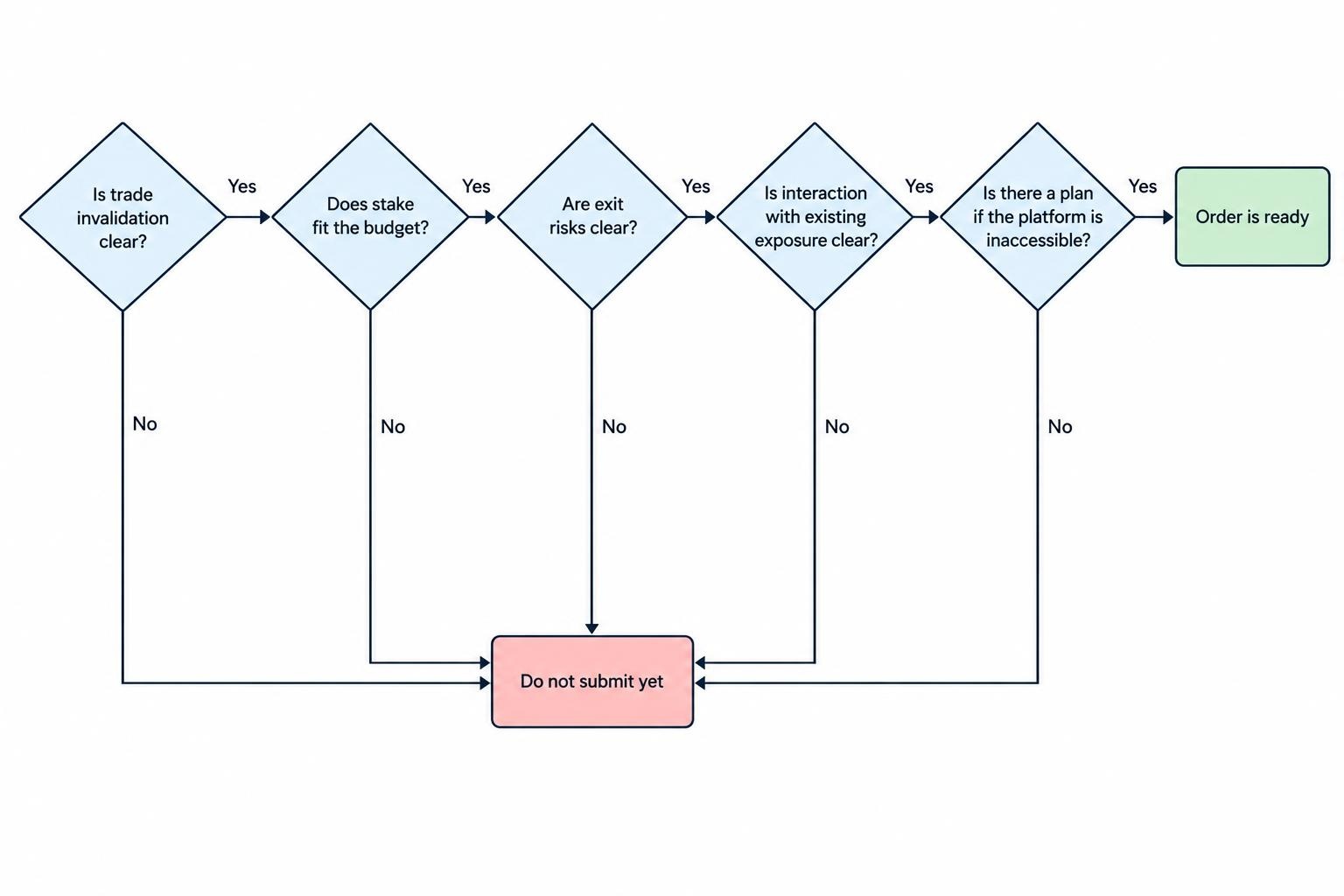
Before each order, answer five questions: what invalidates the trade, what stake fits the budget, what could make the exit worse, how does the position interact with existing exposure, and what happens if you cannot access the platform? If an answer is missing, the order is not ready.
During the session, update the account after meaningful changes rather than relying on opening figures. Stop amendments, financing charges, partial closes and new unrealised losses can all affect the capacity available for another trade.
After the session, compare planned and realised outcomes. Record the entry, initial stop, stake, intended risk, actual net result, execution difference and any rule breach. Keep enough detail to distinguish a weak strategy from poor implementation without turning the journal into an administrative burden.
Review patterns across a useful sample of trades. Look for repeated slippage, costs larger than forecast, losses concentrated around particular events and additional entries that performed worse than the original setup. Change rules in response to evidence, not simply because the last trade lost.
Know when not to trade
Do not open a position when the minimum stake is too large, the required stop is unclear, combined exposure exceeds the plan or a plausible gap would create an unacceptable loss. Pause when platform problems prevent reliable order checks or when you are trying to recover money rather than assess a setup.
The same applies when account losses begin to affect money needed outside trading. At that point, reducing financial exposure matters more than finding a better entry.
A risk plan earns its value through the trades it prevents as well as the losses it contains. The practical standard is simple: decide the acceptable damage first, build the position around it, and decline the trade when the numbers or conditions do not fit.