Position sizing for spread betting means choosing a stake per point that matches a planned cash loss. The calculation starts with your trading equity, the amount you are prepared to risk and the distance between your entry price and stop. It does not start with the largest position your available margin will support.
The basic formula is straightforward: divide your cash risk budget by your stop distance in points. A £50 budget and a 50-point stop give a stake of £1 per point, before allowing for costs and execution risk. Double the stop distance and the stake must halve to keep the same planned loss.
The harder part is choosing sound inputs and recognising what the calculation cannot control. Ordinary stops can slip, correlated positions can lose together and a small stake can still consume too much margin. Position sizing therefore belongs within a broader spread betting risk management plan, rather than acting as a substitute for one.
All prices, account sizes and risk percentages below are hypothetical. They illustrate the arithmetic, not recommended trades or a universally suitable level of risk.
The spread betting position sizing formula
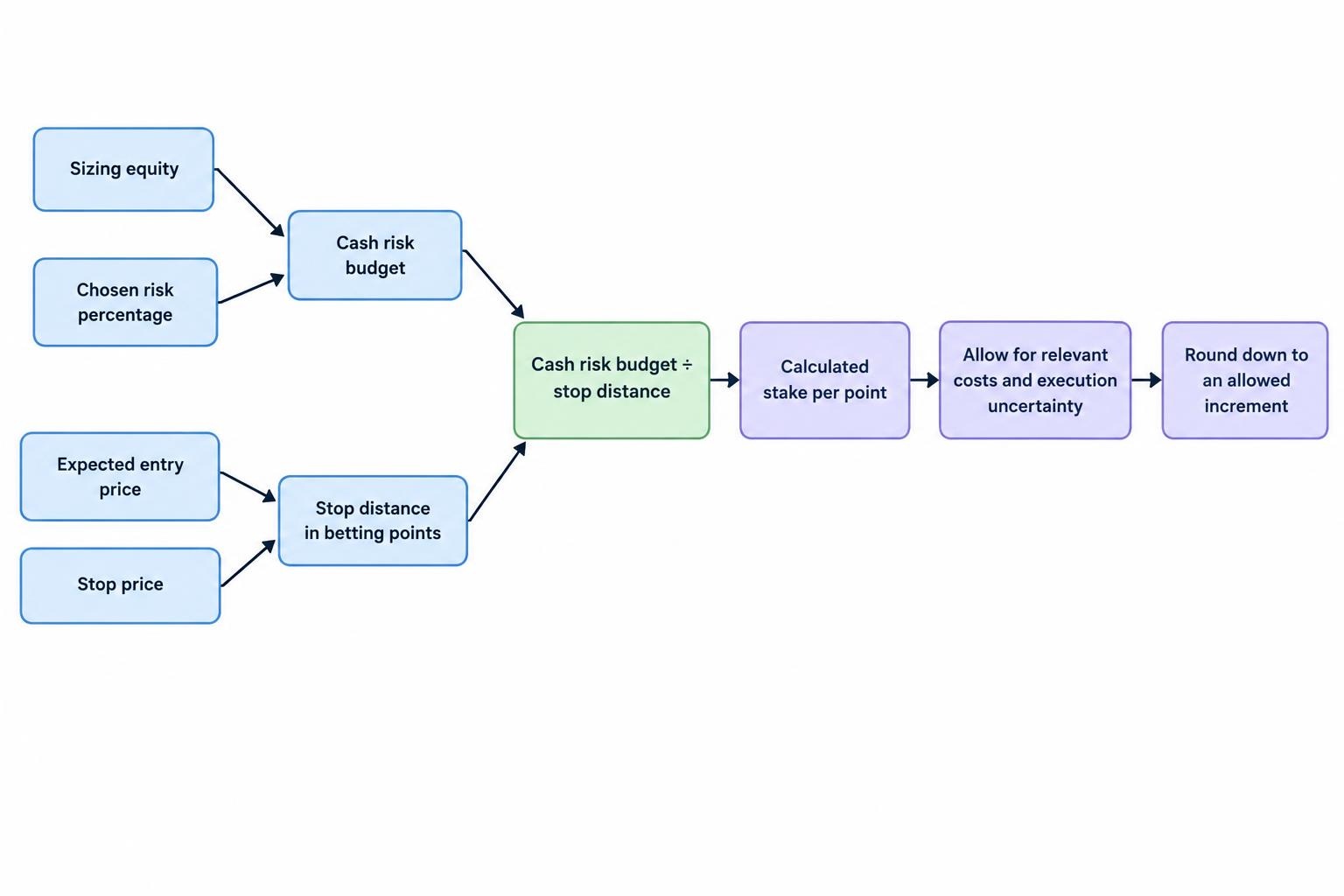
For a position with a planned stop, calculate the stake in two stages:
Cash risk budget = sizing equity × chosen risk percentage
Stake per point = cash risk budget ÷ stop distance in points
Suppose your sizing equity is £5,000 and you allocate 1% to a trade. Your cash risk budget is £50. If the distance from the intended entry to the stop is 40 betting points, the calculation gives:
£50 ÷ 40 = £1.25 per point
If the position closes exactly 40 points against you, the trading loss is £50 before any charges outside that price difference. The same calculation applies to a long or short position; what changes is the direction of the adverse price move.
The starting inputs are the stop location and the cash amount you can accept losing, not a desired position size. Both belong in a trading plan before the order is placed (CME Group position sizing framework).
This is a planned-loss calculation, not a promise about the final loss. It assumes the entry and exit prices used in the calculation are achieved. An ordinary stop does not make that assumption certain.
The stake also needs to use the contract’s own betting unit. A platform might define a point as one index point, one penny of a share price or a stated increment in a currency pair. Check the stake per point and contract point definition before entering any numbers.
Choose the equity figure and risk budget first
Use a consistent sizing base
Account balance and account equity are not interchangeable. Balance usually reflects settled activity, while equity also reflects the current value of open positions. A balance of £5,000 with £400 of open losses does not represent the same financial position as an account with £5,000 and no open trades.
For a repeatable method, define the equity figure you will use before trading. One cautious approach is to cap the sizing base at the lower of current account equity and a separately assigned trading-capital amount. This prevents an unused cash deposit or a temporary floating gain from automatically increasing every new stake.
For example, if the assigned trading capital is £5,000 but current equity has fallen to £4,600, a 1% allocation produces a £46 budget, not £50. If equity later reaches £5,300, retaining the £5,000 sizing cap keeps that budget at £50 until a planned review.
There is no requirement to increase stakes whenever equity rises. A sizing rule should describe when increases are allowed, not leave the decision to the mood after a profitable morning.
No percentage makes a trade safe
A percentage such as 0.5% or 1% is a policy choice, not a safety certificate. Its suitability depends on the capital you can afford to lose, the strategy, execution conditions, the number of open positions and the losses you can tolerate across a sequence of trades.
Smaller percentages reduce the planned cash loss per trade. They do not turn a strategy with poor results after costs into a profitable one. Nor does a low percentage remove the possibility of losses exceeding an ordinary stop.
Keep money needed for living expenses, emergencies and other commitments outside the trading risk budget. If losing the assigned capital would cause financial difficulty, the position sizing formula cannot fix that problem.
Worked example: sizing a long index spread bet
Assume an index spread bet has a hypothetical sell price of 7,999 and buy price of 8,001. Each betting point represents one index point. You plan to buy at 8,001 and place a stop at 7,951.
Your sizing equity is £5,000 and the chosen risk allocation is 1%, giving a £50 budget. The entry-to-stop distance is:
8,001 − 7,951 = 50 points
The stake calculation is:
£50 ÷ 50 = £1 per point
If the position opens at 8,001 and closes at 7,951, the price loss is £50. If it closes at 8,101 instead, the price profit is £100. Neither figure includes charges that sit outside those execution prices.
The two-point opening spread means the position initially shows a £2 loss at a £1 stake, assuming the quotes have not changed. That spread is already reflected when measuring from the actual buy price of 8,001 to a sell-side exit of 7,951. Adding it again would count it twice.
The stop level should have a trading reason. It might mark the failure of a setup or sit beyond a price area used by the strategy. Do not move it closer simply because a larger stake looks more attractive. The practical relationship between stop placement and cash exposure is covered in managing risk with stop losses.
The same calculation for a short position
Now assume another market has a sell price of 5,999 and buy price of 6,001. You intend to sell at 5,999 with a stop at 6,039. The adverse distance is 40 points, so a £50 budget gives £1.25 per point before other allowances.
If the permitted stake increment is £0.10, round down to £1.20 rather than up to £1.30. The planned price loss becomes £48. A £1.30 stake would produce a £52 loss at the stop and breach the £50 budget before costs.
Unused risk budget is not a calculation error. There is no obligation to spend every available penny of it.
How stop distance changes the permitted stake
Holding the cash budget steady makes the relationship clear. Wider stops require smaller stakes. Narrower stops permit larger stakes mathematically, though margin, costs and execution risk can still make those larger positions unsuitable.
| Stop distance | Calculated stake | Stake rounded down | Price loss at the stop |
|---|---|---|---|
| 20 points | £2.50 per point | £2.50 per point | £50 |
| 40 points | £1.25 per point | £1.20 per point | £48 |
| 80 points | £0.625 per point | £0.60 per point | £48 |
| 100 points | £0.50 per point | £0.50 per point | £50 |
This method avoids treating £1 per point as a standard position across every market. At that stake, a 20-point stop represents £20 of planned price loss; a 100-point stop represents £100. The stake is identical, but the exposure to the chosen exit is not.
A tight stop also increases the stake and notional exposure for a given cash budget. It can make small execution differences more expensive in pounds. A five-point adverse fill costs £12.50 at £2.50 per point, compared with £2.50 at £0.50 per point.
Measure the stop in the correct betting points
Use execution prices, not an unexplained chart distance
A chart may display a bid price, offer price, midpoint or another reference. That matters because a long position opens at the buy price and closes at the sell price; a short position does the reverse.
For sizing, use the expected opening execution price and the expected closing execution price at the stop. Check which quote triggers the order and how the platform describes a stop entered as a distance. Do not assume that “50 points from the chart” means a 50-point cash loss from your actual entry.
The bid-ask spread belongs in this measurement. When you already use the correct executable prices, do not add the same spread again as a separate cost. When you start from a midpoint chart, you may need to translate both entry and stop into the relevant dealing prices.
Check forex decimals, commodity increments and share units
Suppose a forex contract defines one betting point as 0.0001. An entry at 1.2650 and stop at 1.2600 are 50 betting points apart:
(1.2650 − 1.2600) ÷ 0.0001 = 50 points
An extra displayed decimal does not automatically change that definition. Confusing the smallest displayed price change with the contract’s betting point can produce a tenfold sizing error.
The same issue arises elsewhere. A commodity price move of 10.00 represents ten betting points if the contract defines a point as 1.00, but 100 points if it defines a point as 0.10. For shares, confirm whether the price and betting unit use pence, pounds, cents or another scale.
Also check the stake currency. If a contract expressly pays £1 per betting point, that point is worth £1 even if the underlying market is quoted in US dollars. Do not add an unnecessary currency conversion. If the contract or account uses another currency, establish how the platform converts the resulting profit, loss and charges.
Allow for charges and execution uncertainty
The basic formula allocates the entire budget to the entry-to-stop price difference. A fuller calculation leaves room for costs outside that difference and an adverse execution allowance.
Where charges can reasonably be expressed this way, use:
Stake = (cash risk budget − fixed cash costs) ÷ (stop distance + adverse execution allowance + stake-linked cost equivalent)
Distances and cost equivalents in the denominator must all use the same betting-point unit. A cash charge that increases with stake can be converted into the number of betting points it represents. Do not treat a stake-linked charge as a fixed amount.
For illustration, assume a £50 budget, a 40-point stop, a five-point adverse execution allowance, £2 of fixed charges and other estimated charges equivalent to one point. These are invented inputs for the calculation, not a broker fee schedule.
(£50 − £2) ÷ (40 + 5 + 1) = approximately £1.043 per point
With £0.10 increments, round down to £1 per point. Under those assumptions, the combined allowance is £48: £40 to the stop, £5 for adverse execution, £1 of stake-linked costs and £2 of fixed costs.
The allowance does not guarantee that the loss will stay within £50. It is a planning estimate. A larger gap or worse execution can exceed it.
For positions held beyond the trading day, estimate financing and any other relevant charges over a stated holding period. Revisit the calculation if that period changes. The separate guide to spread betting costs covers the charges themselves; the sizing task is to leave room for them without counting any item twice.
Set the stop for the trade, then size around it
Position sizing and stop placement answer different questions. The stop identifies where the trade should end if the market moves against it. Sizing determines the stake that fits the cash budget at that distance.
Reversing this order creates trouble. A trader chooses £5 per point, discovers that a logical 50-point stop means £250 of exposure, then squeezes the stop to ten points to make the calculation show £50. The arithmetic works. The trade logic has changed.
A wider stop is not automatically better either. It needs a reason, and the resulting smaller stake must still satisfy the contract’s dealing conditions. If a reasonable stop and an affordable stake cannot coexist, reject the trade rather than forcing the inputs to fit.
Adjust stakes when volatility changes
A volatility-based method can help make stop distances responsive to market conditions. Average True Range, or ATR, measures recent price ranges and can be used as one input to a stop rule. The ATR guide for spread betting covers the indicator rather than the sizing calculation.
Assume a strategy uses a stop of twice ATR. With ATR at 24 betting points, the stop distance is 48 points. A £50 budget gives approximately £1.04 per point, rounded down to £1 if the increment is £0.10.
If ATR rises to 40 points, the same rule produces an 80-point stop. The stake falls to £0.625, rounded down to £0.60. Both rounded positions have £48 of planned price loss at their stops.
This adjusts stake size to the chosen stop rule. It does not guarantee equal realised risk across markets or protect against jumps larger than recent ranges. The ATR value, chart timeframe and contract point definition must also match.
Check margin separately from planned loss
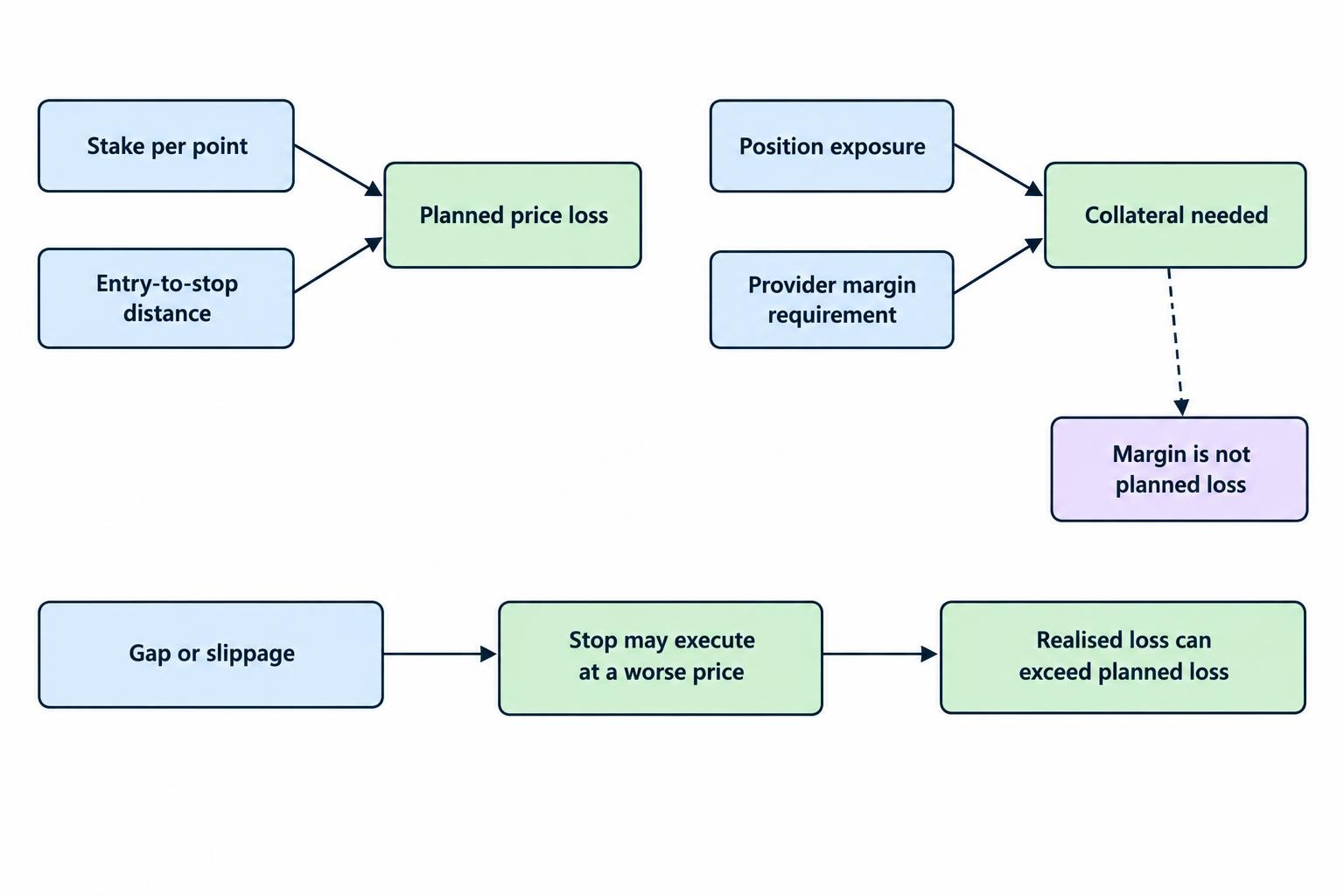
Margin is collateral required to support a position. It is not the amount you intend to lose, and it is not a substitute for a stop-based calculation.
Return to the long index example: entry at 8,001, stake of £1 per index point and a 50-point stop. The approximate notional exposure is £8,001. At an assumed 5% margin rate, the opening margin is about £400.05, while the planned price loss at the stop is £50.
Those figures answer different questions. The £400.05 concerns the collateral needed to open and maintain the position. The £50 concerns a planned exit. Neither figure, by itself, describes every possible loss.
For covered UK retail spread betting accounts, the FCA margin close-out rule requires firms to close positions as soon as market conditions allow when account net equity falls below 50% of the required margin. This is an account-level rule, not a personalised loss limit for each trade (FCA COBS 22.5 margin and close-out requirements).
Check the platform’s current requirements, margin tiers and close-out terms. Leave headroom for floating losses, other positions and charges. A position can fit your stop-based budget yet be inappropriate because it uses too much available margin. The spread betting margin guide covers the collateral mechanics in more detail.
Do not multiply the result by leverage again
If the contract pays £1 per point, a 50-point adverse move produces a £50 price loss. Do not multiply that £50 by an advertised leverage ratio. Leverage is already reflected in the exposure supported by the margin deposit.
Likewise, reducing the margin rate does not reduce the loss per point. It changes the collateral requirement, not the stake’s cash sensitivity. Treating spare margin as permission to enlarge a position is a direct route to greater leverage risk.
Ordinary stops, market gaps and guaranteed stops
For an ordinary stop, describe the output as planned risk rather than maximum risk. A stop can trigger at the selected level but execute at a worse available price.
In the long index example, buying at 8,001 with a stop at 7,951 produces a planned £50 price loss at £1 per point. If a gap leads to an execution at 7,911, the loss becomes £90 before separate charges. The original stake calculation was correct; its execution assumption did not hold.
An allowance for slippage can make the plan less optimistic, but an allowance is not insurance. Stress-test larger moves, particularly where the position may remain open through an announcement, a trading break or a weekend.
A valid guaranteed stop changes the treatment of the covered exit because the provider commits to the agreed stop price under the contract’s terms. Include any applicable premium and check the permitted distance, availability and amendment conditions. Charges outside the guaranteed price movement may still apply.
The decision is not simply whether the guaranteed version permits a larger stake. Compare the resulting cash exposure, premium and margin requirement. The guide to managing risk with guaranteed stops covers that protection in more detail.
UK retail negative balance protection is different again: it restricts liability for covered products to the funds in the account. It does not protect a chosen £50 trade budget, and the account funds remain at risk (FCA retail product protection policy).
Control total exposure across open positions
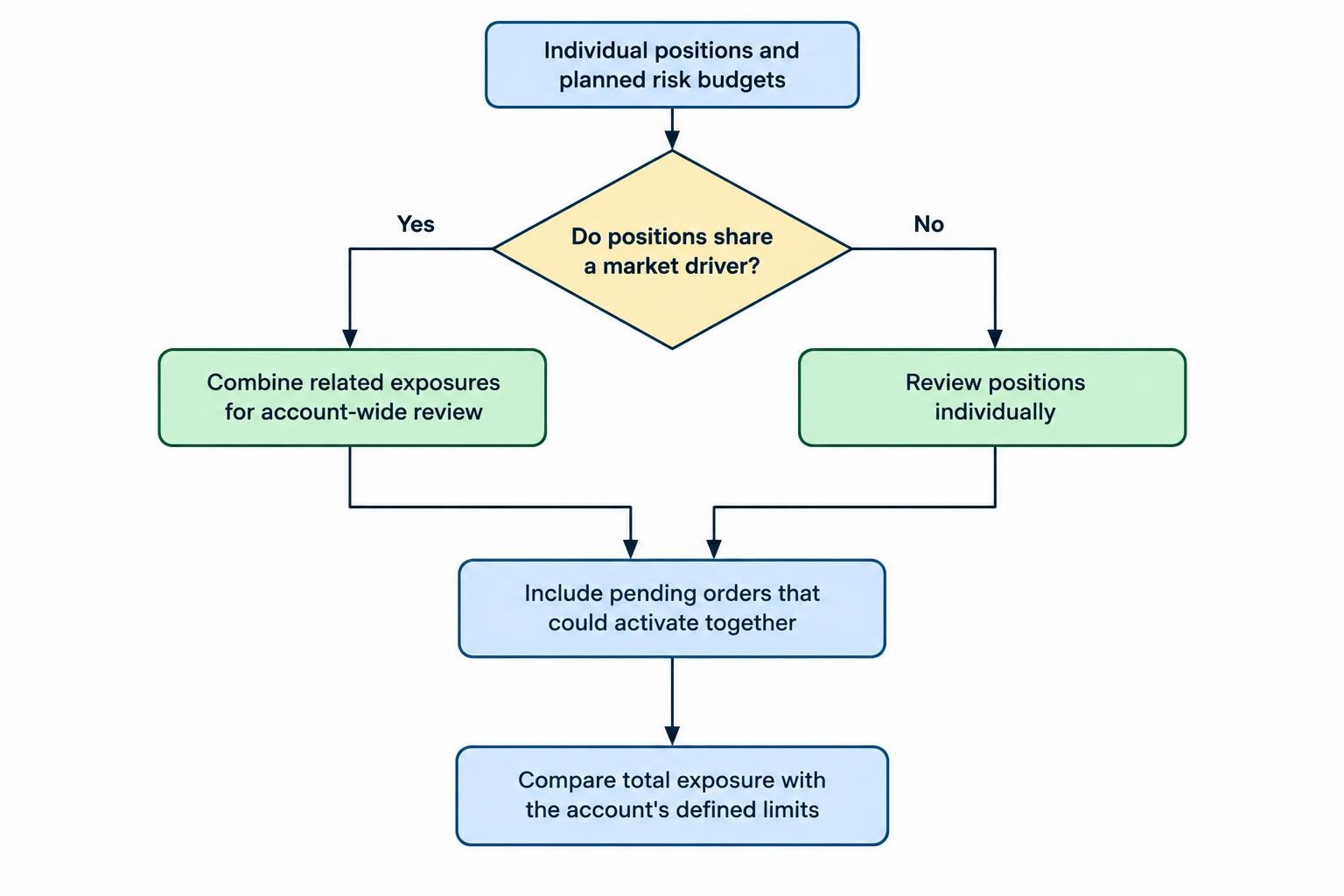
A per-trade rule needs an account-wide companion. Three positions with £50 of planned loss each create £150 of combined planned loss before costs and execution differences. On £5,000 of sizing equity, that is 3%, not 1%.
Define the maximum number of positions, total account exposure and daily loss allowance alongside the individual trade limit. These are separate decisions within a risk plan (CME Group trade plan risk parameters).
Do not assume different market names mean independent risks. Long positions in several equity indices may express much the same view. Several currency positions may all depend on the same currency weakening. Positions in an index and some of its constituent shares can also overlap.
Where trades share a common driver, consider allocating one risk budget across the group rather than giving every position a full standalone allocation. A £50 theme budget might be divided into two £25 allocations instead of creating two £50 positions. This is a budgeting method, not a claim that correlations will remain stable. The guide to portfolio correlation and spread betting risk examines those relationships.
Keep your accounting basis consistent. An original-risk ledger tracks the budgets assigned at entry. A current-equity stress test measures additional losses from current executable prices to stressed exits. Do not mix the two and count an existing floating loss twice.
Also include pending orders that could activate together. An account with no open trades can still acquire too much exposure if several entry orders trigger during the same move.
Reduce position sizes as equity falls
Fixed-percentage sizing reduces the cash budget after losses, provided you recalculate using the lower equity. Keeping a fixed £50 budget while equity falls does the opposite: it raises the percentage at risk.
At £5,000, £50 is 1%. At £4,000, the same £50 is 1.25%. At £2,500, it is 2%. The stake may look familiar, but its effect on the remaining account has grown.
The following calculation shows ten consecutive losses, each equal to the chosen percentage of then-current equity. It assumes exact planned exits, continuous stake sizing, no separate costs and no gaps. It is arithmetic, not a forecast of likely results.
| Risk per trade | Equity remaining | Drawdown |
|---|---|---|
| 0.5% | 95.11% | 4.89% |
| 1% | 90.44% | 9.56% |
| 2% | 81.71% | 18.29% |
| 5% | 59.87% | 40.13% |
Recovery also becomes harder as losses grow. A 25% drawdown requires a 33.33% gain on the remaining capital to return to the starting amount. A written drawdown management policy can set review points, reductions in risk and conditions for pausing.
Increasing stakes to recover losses breaks the original budget. A losing sequence is a reason to check execution, assumptions and strategy performance, not an automatic reason to double the next trade.
What if the calculated stake is below the minimum?
The minimum stake can make a trade unsuitable for a small account even when the margin requirement can be met.
Suppose sizing equity is £500 and the chosen risk allocation is 0.5%, producing a £2.50 budget. With a 50-point stop, the calculated stake is £0.05 per point before costs. If the minimum is £1 per point, the minimum position represents £50 of planned price loss, or 10% of the account.
Do not round £0.05 up to £1 and call it the same plan. The available choices include a contract with a genuinely smaller betting unit, a provider offering lower stakes, continued practice without live exposure, or no trade. Comparing spread betting brokers for small stakes can help identify dealing conditions, but a smaller minimum does not establish suitability by itself.
Nor should the account size determine an arbitrary tighter stop. If the trade needs room that the budget cannot fund, the trade does not fit. A minimum stake is a dealing condition, not a risk recommendation.
Recalculate before adding to an existing position
Scaling into a trade creates another sizing decision. An additional entry increases exposure unless a reduction elsewhere offsets it. Calling the addition a separate trade does not separate its financial effect.
Assume you buy £0.50 per point at 8,001 with a stop at 7,951. The planned price loss is £25. You then consider another £0.50 at 8,021 with the same stop. The new portion has a 70-point distance and £35 of planned price loss. Combined, the positions represent £60 from their respective entries to the stop, before costs.
The second portion is not another £25 allocation simply because its stake matches the first. Every entry needs its own distance calculation, followed by a combined check.
Moving a stop to the original entry price does not make an addition “free”. The existing position can still give back floating profit, incur charges or suffer adverse execution with an ordinary stop. Measure the added trade against current equity and the account’s remaining risk budget.
After any partial close, stop amendment or addition, update the ledger. A position that complied at entry can stop complying after changes.
A repeatable position sizing routine
Keep the calculation short enough to use consistently. A worksheet or trading journal should record the equity figure, risk budget, contract point definition, expected entry, stop, cost allowances, rounded stake and margin requirement.
- Set the budget. Use the defined sizing equity and risk allocation, then check the remaining account-wide allowance.
- Validate the trade. Choose an entry and stop with a trading reason, using the correct executable quote sides.
- Calculate the stake. Allow for relevant charges and execution uncertainty, then round down to a permitted increment.
- Check constraints. Confirm minimum stake, margin headroom, related positions and pending orders.
- Verify the ticket. Check direction, stake currency, point definition, stop type and the platform’s displayed cash exposure.
- Record the outcome. Compare the planned loss with actual fills and charges, then revise assumptions where evidence supports a change.
If the entry changes before execution, recalculate. If an actual fill creates more risk than planned, follow a predefined response rather than moving the stop farther away to avoid closing. Test the process with spread betting demo accounts, while recognising that simulated fills cannot establish how every live order will execute.
The purpose of position sizing is consistency: a defensible cash budget translated into the correct stake, checked against costs, execution risk and account exposure. When those checks do not fit, the appropriate position size is zero.