A guaranteed stop can make the downside of a spread bet easier to budget. Once the provider accepts the order, it commits to the agreed exit price if the stop triggers, even when a market gap would leave an ordinary stop facing a worse fill. That distinction is reflected in the Financial Ombudsman decision on ordinary and guaranteed stop execution.
The practical benefit is control over the price loss on that position. It is not protection against every trading cost, repeated losses or poor decisions. A guaranteed exit can still produce an entirely unaffordable loss if the stake is too large.
This guide focuses on using that protection within a risk plan: setting a cash budget, allowing for charges, choosing a sensible stop level and checking the effect on the rest of your account. For the order mechanics, see how guaranteed stop-loss orders work.
What a Guaranteed Stop Actually Protects
With an ordinary stop, the trigger level and execution price can differ. A guaranteed stop removes that adverse execution uncertainty when the accepted guarantee applies. The provider takes responsibility for the difference between the agreed stop price and a worse available market price.
That matters when prices skip levels rather than trade smoothly through them. Suppose you buy an index at 8,500 and place a stop at 8,460. If the next available selling price after adverse news is 8,390, an ordinary stop could close well below the planned level. An accepted guaranteed stop at 8,460 protects that exit price.
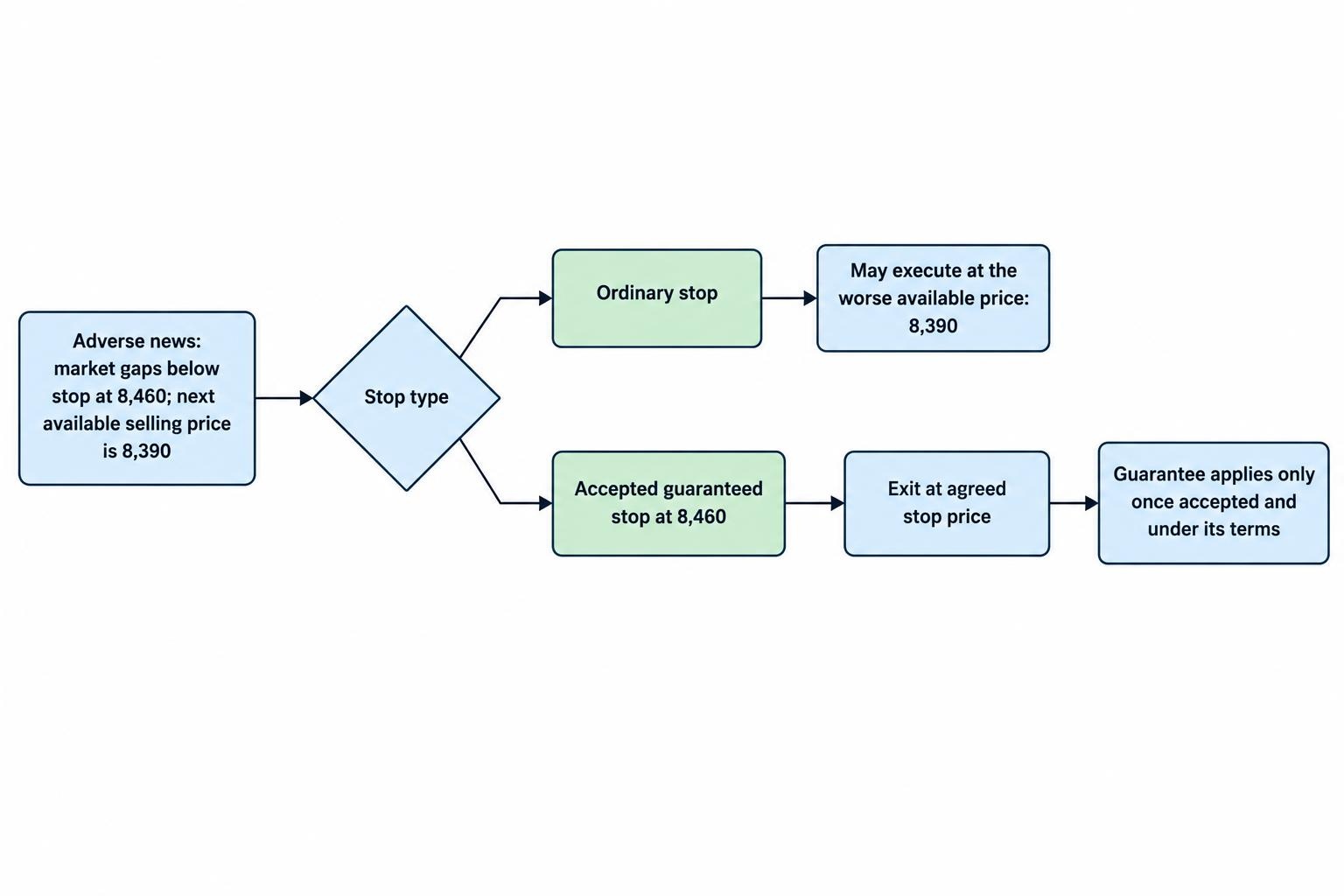
It does not prevent the market moving against you, or prevent the full planned loss happening quickly. Nor does it mean the position must remain open until the stop triggers. Account funding requirements and other contractual terms still matter.
The protection is therefore most useful when your concern is a loss exceeding its planned amount because of market gap risk. It does not improve the trade’s entry, target or likelihood of success.
Build the Cash Risk Budget Before Opening the Trade
Start with the amount you are prepared to lose, not the stake you would like to trade. Then work backwards from the stop distance and the applicable charges.
For a position with its guaranteed stop on the loss side of the entry:
Budgeted loss at the guaranteed stop = entry-to-stop distance × stake per point + applicable guarantee premium + other trading costs.
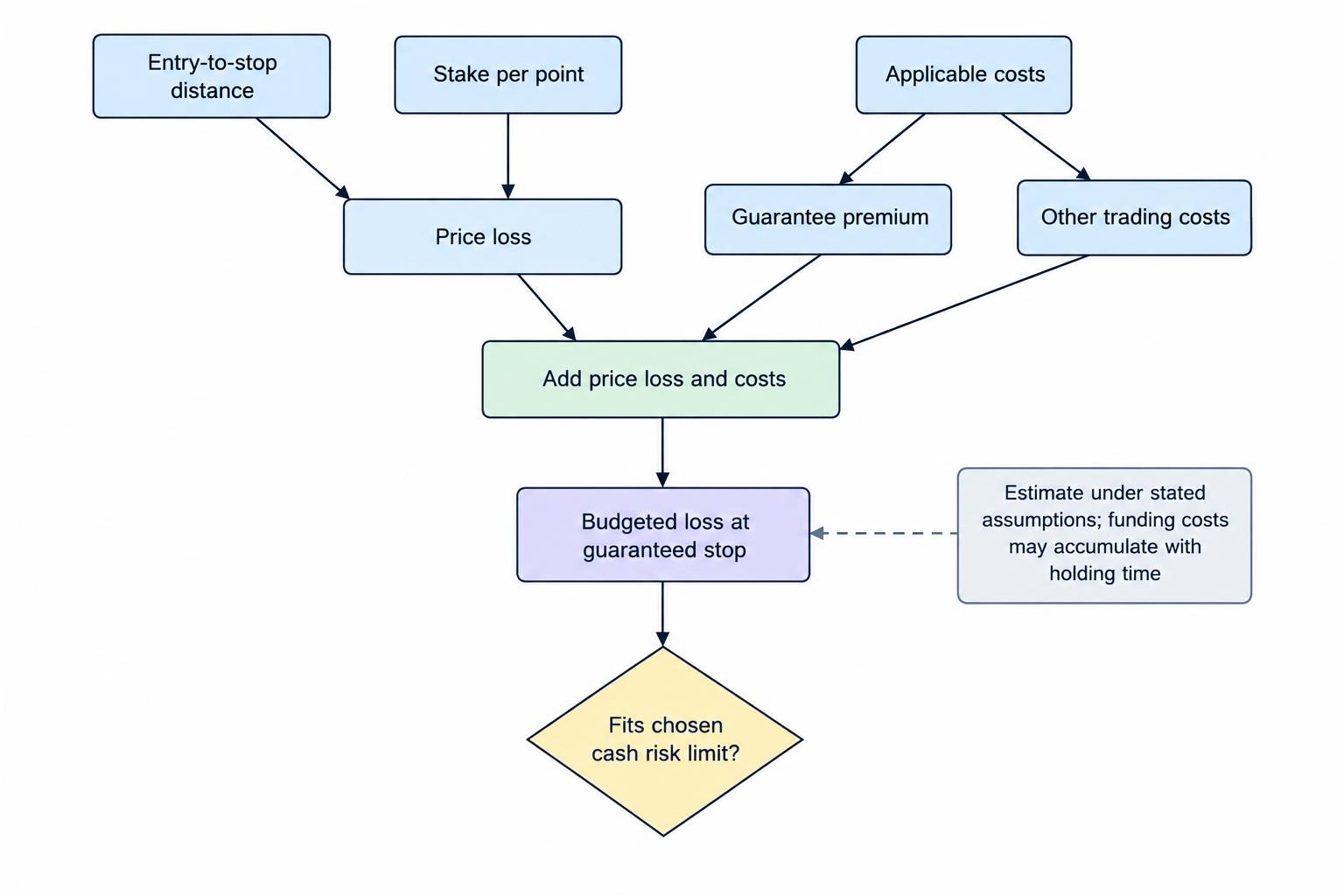
The price loss is fixed by the accepted entry, stop and stake. Charges need separate treatment. Funding can accumulate during the holding period, so a price guarantee does not necessarily fix the eventual cash loss to the penny before you know how long the trade will remain open.
Use the executed opening price and guaranteed exit level when measuring the distance. If that calculation already captures the spread through the dealing prices, do not add the same spread again. A consistent position-sizing method helps prevent both underestimating costs and counting them twice.
Worked example: keeping the loss below £75
Assume a hypothetical account has £10,000 of equity and the trader chooses a £75 risk budget, equal to 0.75% of that equity. This is an illustration, not a recommended risk percentage.
The trader buys an index at 8,500 with a guaranteed stop at 8,460. Assume the guarantee costs two points multiplied by the stake if triggered, and the trader allows £3 for other charges over the planned holding period.
| Risk calculation | Amount |
|---|---|
| Entry-to-stop distance | 40 points |
| Chosen stake | £1.70 per point |
| Price loss at the guaranteed stop | 40 × £1.70 = £68.00 |
| Assumed guarantee premium | 2 × £1.70 = £3.40 |
| Allowance for other charges | £3.00 |
| Total budgeted loss | £74.40 |
The maximum stake under those assumptions is (£75 − £3) ÷ 42, or about £1.714 per point. Choosing £1.70 leaves a small amount within the budget, assuming the platform permits that stake increment.
If the market gaps to 8,390, the guaranteed price loss remains £68. An ordinary stop filled at 8,390 would produce a £187 price loss at the same stake, before charges. That comparison illustrates what the guarantee buys; it does not predict how an ordinary stop would fill in a real event.
Check the actual charging method rather than copying the example. The treatment of guaranteed stop premiums belongs in the risk calculation, including when the charge becomes payable and whether any refund applies.
Choose the Stop Level Before Choosing the Stake
A stop should reflect where the trade’s reasoning fails. It should not sit at an arbitrary distance simply because that distance allows a larger stake.
For a long position based on a price floor holding, the relevant question is where a break would invalidate that idea. For a short position based on a failed rally, ask what upward move would contradict the setup. Price structure, including support and resistance, can help frame that decision without guaranteeing the outcome.
Once you have a defensible exit level, calculate the stake that fits the cash budget. A wider stop requires a smaller stake if the budget stays unchanged. The guarantee does not alter that arithmetic.
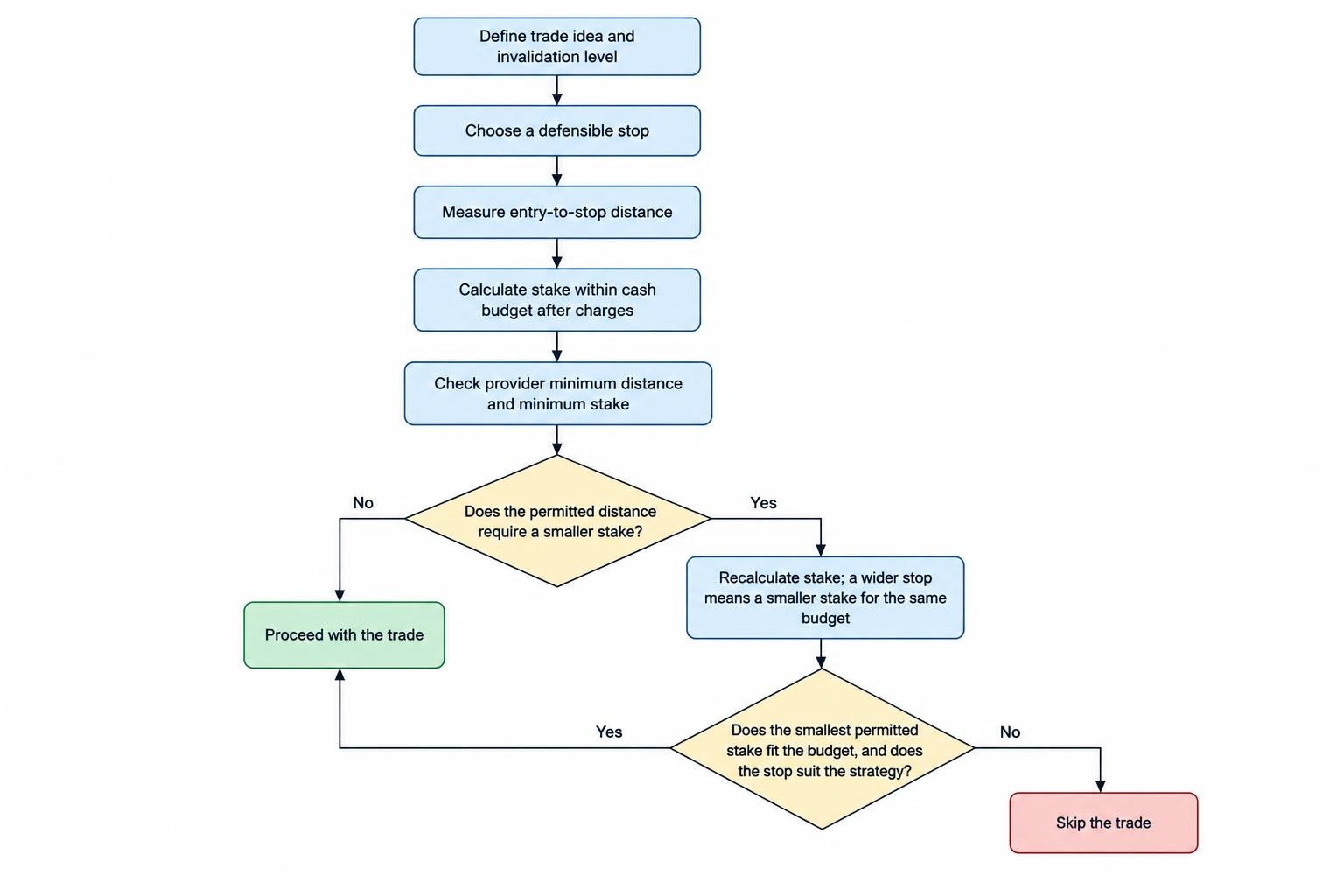
A provider’s minimum permitted distance can complicate the plan. If the platform requires a stop farther away than you intended, recalculate the stake using that distance. Do not retain the original stake and pretend the risk is unchanged.
There is also a point where the trade stops being workable. If the smallest permitted stake produces too much cash risk, or the required stop position no longer fits the strategy, skip the trade. The order ticket is not a negotiation with your budget.
When Paying for the Guarantee May Make Sense
Consider the guarantee where a worse exit would materially damage the account or breach your loss budget. The decision is about the consequence of a bad fill, not just whether you expect one.
Holding through a market closure
If a position will remain open while its market is closed, ask whether you could tolerate an adverse reopening beyond the stop. Monitoring the news does not itself provide an executable exit.
Compare three choices: keep the position with a guarantee, reduce its size, or close it before the break. The wider considerations around holding spread bets overnight still apply, particularly funding costs and the time you intend to remain exposed.
Holding through a scheduled announcement
Before an earnings release or economic announcement, decide whether your strategy genuinely requires exposure through the result. A guarantee can cap the adverse price loss, but it cannot make an unfavourable outcome profitable.
Ask whether the expected opportunity still justifies the premium and planned loss. Paying for protection should not become an excuse to hold through every announcement.
Protecting a firm cash limit
A guarantee can also help where a trade is acceptable only if the price loss stays within a defined amount. That is a stronger reason than using it simply to feel more comfortable with an oversized position.
Do not judge the decision solely by whether the stop triggers. Protection that goes unused was not automatically wasted. Equally, attaching a guarantee to every trade without reviewing its cost is not a risk policy.
Check Restrictions Before You Need the Protection
Do not assume you can add or tighten a guarantee whenever you choose. Trading hours and minimum stop distances can restrict amendments. A rejected attempt to convert an ordinary stop outside market hours features in the Financial Ombudsman decision on guaranteed stop amendment restrictions. That case illustrates why the provider’s accepted terms matter, rather than establishing one rule for every platform.
Before opening the position, check:
- Availability: whether the exact market and position size support a guaranteed stop.
- Acceptance: whether the order confirmation expressly identifies the stop as guaranteed and covers the intended stake.
- Placement and amendments: minimum distances, permitted trading hours and any restrictions on adding, moving or removing the order.
- Costs and triggers: the premium basis, payment conditions and dealing price used to trigger the stop.
Check the confirmation, not just the selection made in the ticket. Keep a record of the accepted stop level and covered size. If you later increase the position, verify the protection again rather than assuming the added stake is covered.
For a buy position, inspect the selling price used to close it; for a sell position, inspect the buying price. A chart displaying a different price basis is not enough to assess whether your stop should have triggered.
A Guaranteed Stop Does Not Replace a Margin Buffer
Cash risk at the stop and the cash required to keep the account funded are different calculations. A guarantee addresses the execution price when its stop triggers. Margin rules address whether positions can remain open.
For UK retail accounts within the applicable rules, firms must close open positions as soon as market conditions allow when account net equity falls below 50% of the required margin. Separate negative balance protection caps the client’s liability for the covered investments at the funds in that account. These are account-level protections, not a chosen loss cap for each trade, under FCA COBS 22.5 margin close-out and negative balance rules.
Keep enough free equity to support the intended positions rather than funding the account right against its threshold. Review the provider’s calculation and closure process alongside the margin close-out rule.
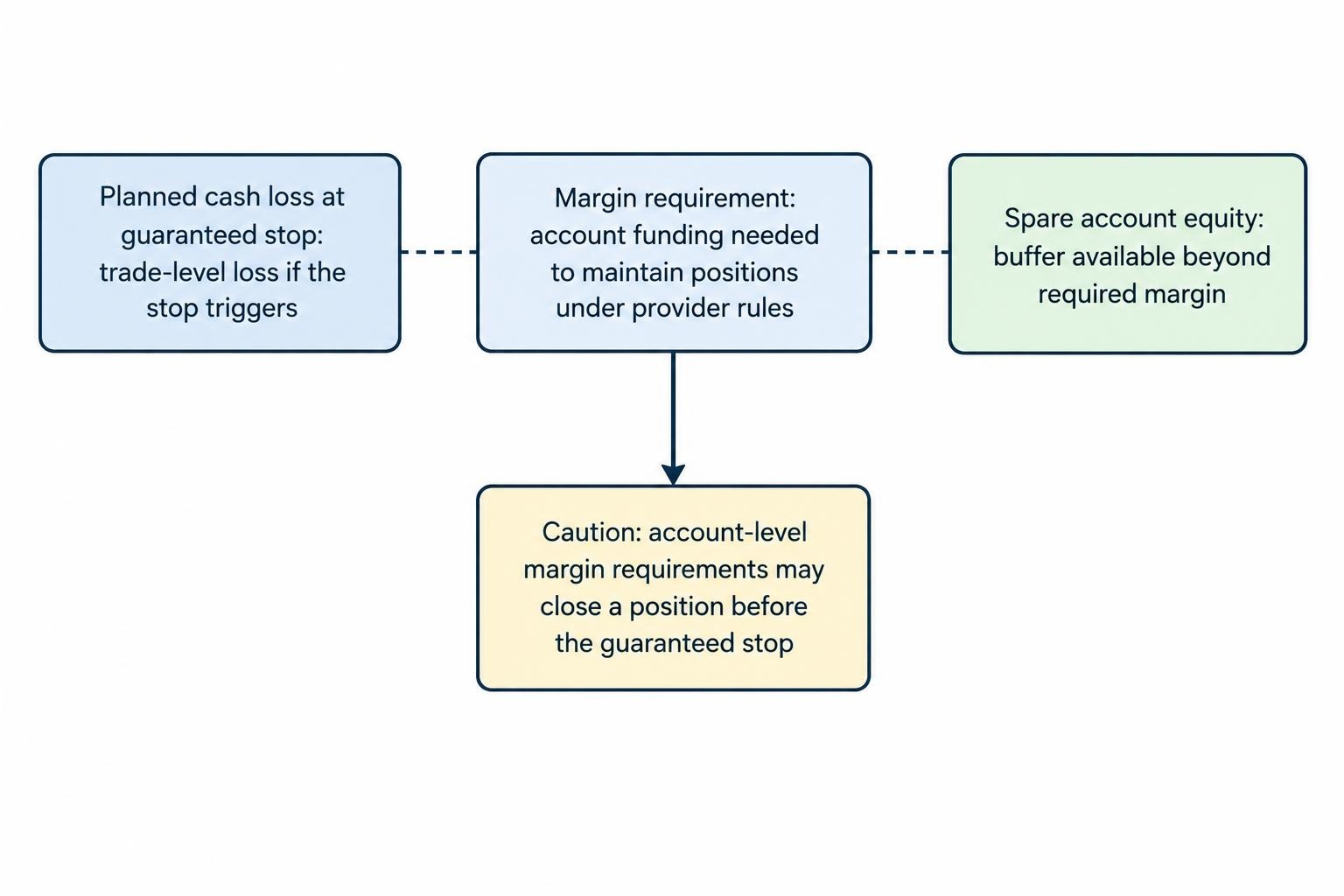
A position with a guaranteed stop may close before reaching that stop because of account-level margin requirements. This interaction is expressly addressed in ESMA’s Q&A on guaranteed stops and margin close-out. The guarantee is not a right to keep the position open until your preferred exit level.
Keep three figures separate in your plan: the loss at the guaranteed stop, the margin requirement, and the spare account equity. None is a substitute for the other two.
Budget for Several Stops Triggering Together
Controlling each position does not automatically control the account. Several acceptable trade losses can add up to an unacceptable combined loss.
Suppose four open positions each have a £75 budgeted loss. The combined amount is £300 if all four stop out under those assumptions. Calling each trade “small” does not reduce the total.
The concern grows when positions depend on the same market move. Long exposure to several equity indices, for example, should not be treated as four unrelated ideas simply because the tickets have different names. Review portfolio correlation and spread betting risk before adding another position.
Set an account-wide limit on combined planned losses. Then test whether several stops triggering together would remain tolerable after premiums and other charges. Include unprotected positions separately; do not assign them a guaranteed cash cap based on an ordinary stop.
Also distinguish the original trade budget from the loss possible from current equity. A position showing a £200 unrealised gain could give that gain back and still reach its original £75 loss allowance. Measured from current equity, that would be a £275 decline before any further charges.
Keep the Risk Plan Intact After Entry
The guarantee only preserves the protection you have actually agreed. Moving a stop farther away increases the price loss it permits, unless you reduce the stake enough to offset the change.
At £2 per point, increasing the entry-to-stop distance from 40 to 70 points raises the price loss from £80 to £140. The exit remains guaranteed, but the risk budget has changed. A tidy order label cannot hide untidy arithmetic.
Before accepting any amendment, recalculate its effect on the trade and account. Include changes to premiums or funding assumptions where relevant. Avoid removing the guarantee just because the position has moved against you and the charge now feels inconvenient.
If you move a stop to the entry price, do not automatically label the trade risk-free. A zero price loss can still leave a net loss after applicable premiums and other costs. Check amendment permissions and the resulting cash outcome.
After closure, record the planned loss, actual result, premium and reason for exit. Review whether repeated stop-outs reflect poor entries, unsuitable stop placement or unnecessary exposure through events. The guarantee may perform exactly as agreed while the trading method still loses money.
Make Guaranteed Stops Part of a Repeatable Risk Process
Before placing a trade, you should be able to state its cash budget, why the stop belongs at that level, what stake fits after costs, and what happens if other positions lose at the same time. Confirm that the provider has accepted the guarantee, then check the remaining margin buffer.
If those answers depend on moving the stop later, finding more cash or avoiding an awkward market event, the plan is not finished. Reduce the exposure or leave the trade alone.
Spread betting remains a high-risk product within the FCA’s CFD product framework, and it is not suitable for every retail consumer. A guaranteed stop changes one part of the risk; it does not change that assessment.
Use it alongside a broader spread betting risk management plan. Its strongest use is straightforward: protect a defensible exit, size the position to an affordable cash loss, allow for charges and resist the temptation to enlarge the risk once the trade is open.