Spread betting costs come from more than the difference between the buy and sell prices. The spread is the most visible charge, but overnight financing, contract pricing, execution and account fees can change what a trade costs from opening to closing.
The right calculation depends on what you trade, your stake per point and how long you hold the position. A narrow spread may suit an intraday trade yet offer poor value for a position held for several weeks. A contract without a separate overnight debit can still contain a cost of carrying the exposure.
This guide explains how the main charges work, how to avoid counting them twice and how to estimate your total cost before placing a bet. All prices and rates in the examples are hypothetical, not current broker quotes.
What costs do you pay when spread betting?
Separate costs into three groups: charges embedded in the dealing price, charges posted to your account and execution differences that affect the price you receive. Not every item applies to every contract.
| Cost | When it matters | Where to look |
|---|---|---|
| Bid-ask spread | When opening and closing a position | The difference between the quoted sell and buy prices |
| Overnight financing | When a funded position remains open through its charging cutoff | Contract funding terms and account debits or credits |
| Carry within a dated contract | When comparing futures or forward bets with cash-style contracts | Contract price, spread, expiry and rollover terms |
| Guaranteed stop premium | When using a guaranteed stop, subject to the provider’s charging terms | Order ticket and contract details |
| Currency conversion | When a cash amount requires conversion into the account currency | Conversion rate, markup and statement entries |
| Account, platform or data fees | When an account or subscription meets the charging conditions | Fee schedule and subscription settings |
| Slippage | When execution differs from the reference or expected price | Order records and actual fill prices |
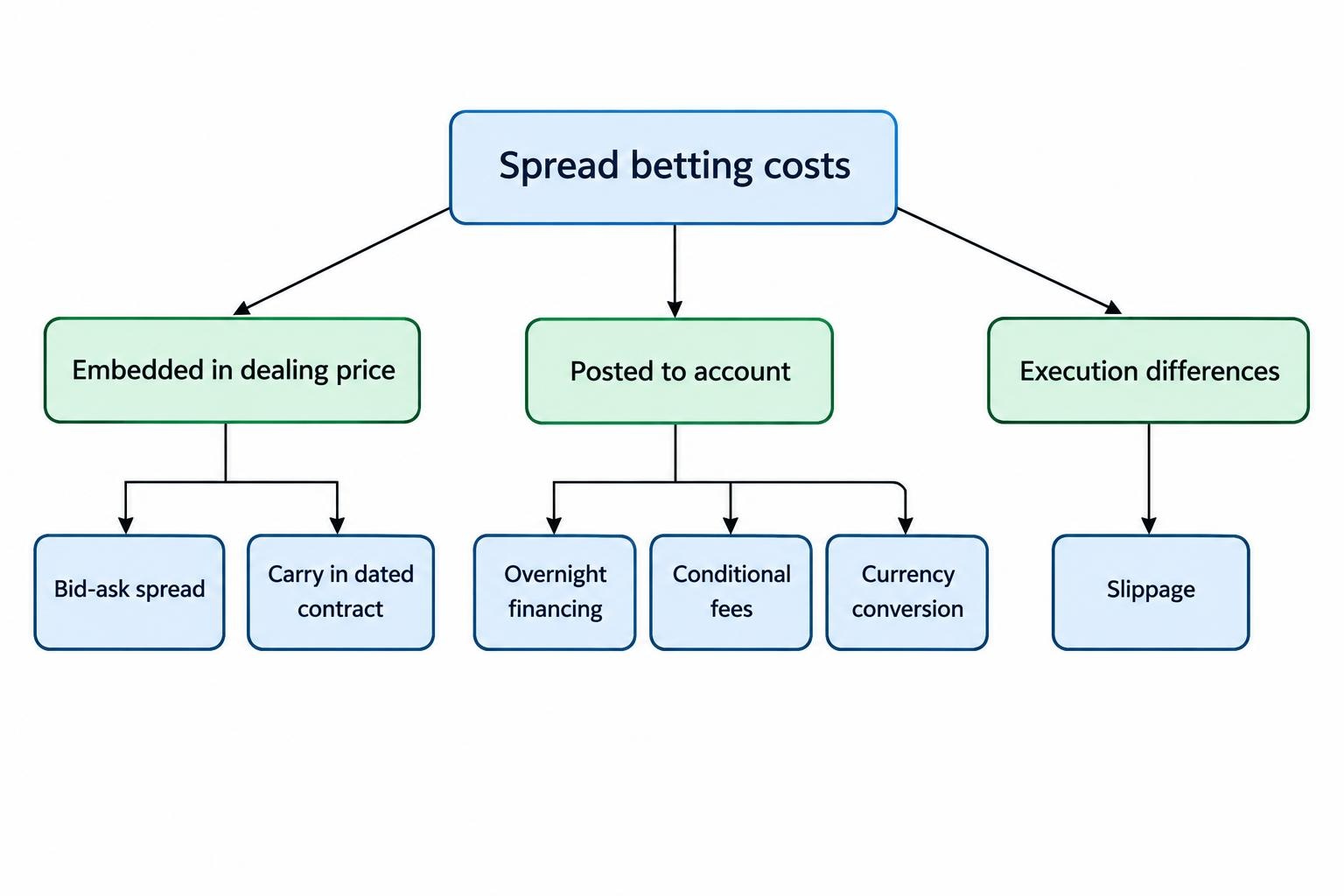
“Commission free” describes one part of the bill, not the entire bill. A contract can have no separate dealing commission while still carrying a spread, funding charge and other conditional fees.
The FCA’s cost disclosure categories recognise embedded price markups, foreign exchange costs and financing costs alongside separately charged fees. That distinction matters when a transaction looks inexpensive on the order ticket but costs more over its full holding period.
The spread: your starting cost
The sell price is the bid and the buy price is the ask. You normally open a long position at the ask and close it at the bid. A short position follows the reverse sequence: sell at the bid, then buy back at the ask.
Suppose an index is quoted at 7,999–8,001. The spread is two points. Buying at £2 per point and immediately closing at the unchanged sell price produces a £4 loss:
Two points × £2 per point = £4.
That is the cost of an immediate round trip at an unchanged quote. You do not then add another £4 because there were two transactions. The buying and selling prices already capture both sides of the trade.
For more on how the quote becomes a monetary cost, see the guide to the bid-ask spread.
Do not subtract the spread twice
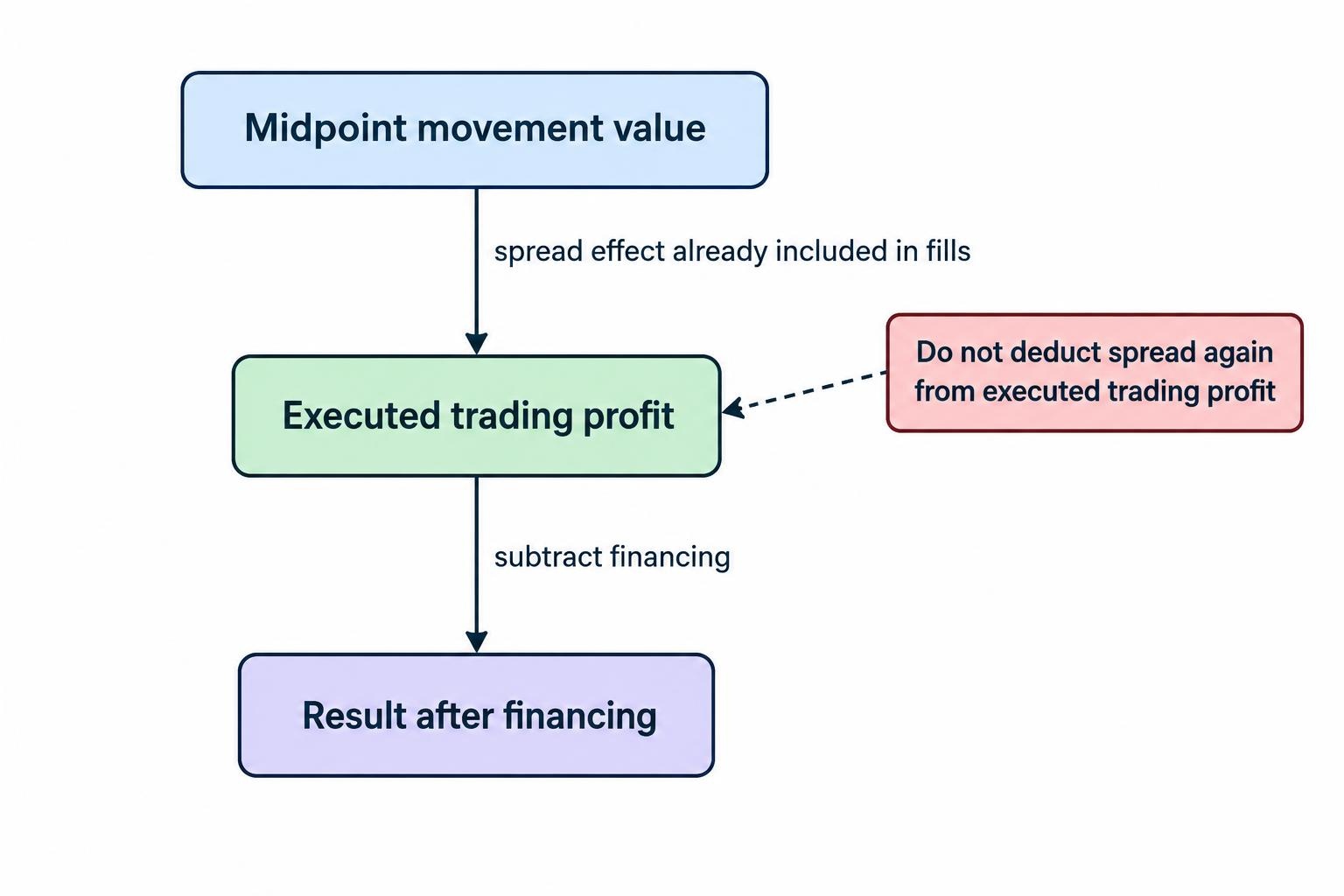
If you calculate trading profit from your actual opening and closing prices, the spread is already included. Subtracting it again understates your result.
There are two valid approaches. You can start with the market’s midpoint movement and deduct the spread effect, or start with the executed prices and deduct only charges not already captured in those prices. Mixing the two methods creates an imaginary extra expense.
When comparing fills with the midpoint at each execution, the spread effect is half the entry spread plus half the exit spread, multiplied by your stake. With an unchanged two-point spread, that totals two points of drag. If the spread widens before you close, the cost can be greater.
Why the advertised minimum is not enough
A minimum spread does not tell you what the quote will be during your trading session. Spreads can differ across market hours and become wider around news, thin trading or market disruption.
Compare quotes for the same instrument, contract type, stake and time of day. A cash-style index bet and a quarterly index bet are not interchangeable quotes, even if their names look nearly identical.
Also check what one “point” means. An index point, a share-price increment and a currency-market point need not represent the same price change. A smaller displayed spread is not automatically a smaller sterling cost.
Frequency then multiplies the effect. At £4 per completed trade, 20 round trips cost £80 in spreads under the same assumptions, before funding or other charges. The spread is small, the turnover is not.
Overnight financing: the cost of keeping exposure open
Daily funded bets can attract financing when they remain open through the provider’s funding cutoff. The charge generally relates to the position’s funding notional, rather than just the margin deposited to support it.
For a straightforward index contract quoted in whole index points, an index level of 8,000 at £2 per point represents approximately £16,000 of exposure. Other markets require their own point conventions and contract calculations.
A common illustrative structure for a long-position charge is:
Funding notional × annual funding rate × chargeable days ÷ annual day count.
Assume £16,000 of funding notional, an annual rate of 6.5% and a 365-day calculation. One chargeable day costs about £2.85. Thirty chargeable days would cost about £85.48 if the notional and rate stayed unchanged.
The 6.5% rate is an example, not a market quote. In practice, check the reference rate, provider markup, valuation method and day-count convention. The amount may change as the market price or funding rate changes.
The overnight financing cost guide covers these calculations in more detail, including the differences between long and short positions.
The cutoff matters more than your bedtime
“Overnight” is a charging convention, not a description of how many hours you have held a trade. A position opened shortly before the cutoff may attract funding even if it has been open for only a few minutes.
Weekend and holiday treatment also matters. A provider may book several days of funding in one adjustment. Check the schedule for the contract rather than assuming every debit represents one day.
Short positions need a separate estimate. Depending on the reference rate and provider adjustment, short financing can produce a debit or a credit. Short share bets may also involve stock borrowing charges. Do not assume that selling instead of buying reverses every cost neatly.
On 15 October 2026, the FCA reported continuing concerns about the level, application and disclosure of overnight charges among CFD firms, including spread betting providers. Its concerns also covered matched buy and sell positions. The FCA’s review of CFD firms’ charging practices reinforces the need to obtain a clear funding estimate rather than judge price by the spread alone.
Daily funded bets versus futures and forward bets
Contract choice changes how costs appear. A daily funded bet commonly separates the dealing spread from ongoing financing. A dated futures or forward bet may reflect carrying costs in its price rather than apply an equivalent daily funding debit.
That does not make the dated contract free to hold. Interest, expected dividends and other market carry factors can affect its fair value. The difference between a cash price and a futures price is not automatically a broker fee, either: part of that difference can come from the economics of the underlying contract.
For a short holding period, a tighter spread on a funded contract may outweigh a small financing charge. Over a longer period, the balance can change. Compare the two using your expected holding time and the actual terms, not the presence or absence of a daily statement entry.
The comparison of daily funded bets versus futures addresses the contract choice beyond this cost overview.
Expiry adds another consideration. Continuing the exposure may require closing the expiring bet and opening the next contract. Check any rollover spread, concession or administrative adjustment. Do not count the entire price difference between two expiries as a fee: changing contract value and transaction cost are separate matters.
Some rolling commodity contracts also use product-specific pricing adjustments. A simple interest-rate formula should not be applied to every market with “daily” in its name.
Other charges that can change the total
Separate commissions and minimum dealing charges
A spread-based charging model can replace a separately itemised commission, but the contract terms decide what applies. Check for additional dealing charges and minimum amounts, particularly when comparing different product types.
A minimum charge can weigh heavily on a small position. If a hypothetical contract charged £5 on entry and £5 on exit, the round trip would cost £10 before any spread or funding. Describing the headline percentage alone would hide that effect.
Use the spread betting commission guide to distinguish separate transaction charges from charges included in the quote.
Guaranteed stop premiums
A guaranteed stop provides contractual protection against execution beyond its agreed level, subject to the provider’s terms. That protection can carry a premium. The charging trigger may depend on the contract: check whether the premium applies when the order is placed, when it is triggered or under another stated condition.
Calculate the premium in pounds. A hypothetical premium of three points at £2 per point costs £6 if it becomes payable. Minimum stop distances and restrictions on changing the order can also affect whether the feature suits the trade.
The guide to guaranteed stop premiums covers the charging mechanics. Treat the premium as a defined protection expense, not as interchangeable with uncertain slippage on an ordinary stop.
Currency conversion charges
A foreign market quotation does not, by itself, prove that your trading profit needs conversion. A bet settled at a sterling stake per point can calculate its price-movement result in pounds even when the underlying market is quoted in dollars.
Other amounts may still require conversion, depending on the account and contract. Funding, adjustments, transfers or balances in another currency can involve a conversion rate and markup.
Inspect the cash flow that actually needs converting. A hypothetical 0.5% markup on a £200-equivalent conversion costs about £1. Applying that percentage to the entire exposure would be wrong unless the charging terms expressly used that basis.
The currency conversion cost guide explains how to separate settlement charges from the market exposure itself.
Market data, platform and inactivity fees
Check whether live exchange data, charting tools or other subscriptions carry a recurring fee. Any waiver may depend on trading activity or other conditions. Include the fee in your budget unless you reasonably expect to meet those conditions.
A £20 monthly subscription allocated across four trades adds £5 per trade to an activity-based cost estimate. Across 100 trades, it adds 20p. The subscription still costs £20 either way; placing unnecessary trades to dilute it only adds more dealing costs.
Review the terms for market data fees before enabling subscriptions, including whether cancellation takes effect immediately or at a later billing date.
Accounts that are not being used deserve attention too. Check the period of inactivity that triggers a charge, what counts as activity and whether fees stop when the balance reaches zero. The conditions for account inactivity fees can matter more than the headline monthly amount.
Deposit, withdrawal and payment costs
Check the available payment methods for transaction fees, minimum withdrawal amounts and currency conversion. Distinguish the provider’s charge from any charge imposed by your bank or payment service.
A deposit is not itself an expense: it transfers money into the account. Only an associated fee or conversion loss belongs in the cost calculation. The same distinction applies when withdrawing funds.
Slippage is an execution cost, not a posted fee
Slippage occurs when the execution price differs from a chosen reference, such as the price expected when submitting the order. It can be adverse or favourable.
Suppose a long position has an ordinary stop at 7,980, but the market gaps and the position closes at 7,972. At £2 per point, the eight-point difference adds £16 to the loss compared with execution at the stop level.
That £16 will not necessarily appear as a separate fee. It is already reflected in the closing price and trading result. Deducting it again from the actual loss would count the same effect twice.
To measure the cost of slippage, record the reference price, execution price, direction, stake and market conditions. Compare similar order types rather than treating every fill difference as a broker charge.
Limit orders control the worst acceptable execution price but may not fill. Ordinary stop orders can execute beyond their trigger level. Neither order type offers a free combination of guaranteed execution and guaranteed price.
A worked example of total spread betting costs
Consider a hypothetical long index bet at £2 per point. The opening quote is 7,999–8,001, so the position opens at 8,001. Three chargeable days later, the quote is 8,049–8,051 and the position closes at 8,049.
The midpoint has risen from 8,000 to 8,050. Your executed gain is 48 points because you bought above the opening midpoint and sold below the closing midpoint.
For this example, assume the funding calculation holds the reference value at £16,000, uses a 6.5% annual rate and applies three days on a 365-day basis. There are no other fees or adjustments.
| Item | Calculation | Amount |
|---|---|---|
| Midpoint movement value | 50 points × £2 | £100.00 |
| Spread effect within the fills | 2 points × £2 | −£4.00 |
| Trading profit | (8,049 − 8,001) × £2 | £96.00 |
| Overnight financing | £16,000 × 6.5% × 3 ÷ 365 | −£8.55 |
| Result after financing | £96.00 − £8.55 | £87.45 |
The £4 spread effect explains the difference between the £100 midpoint movement value and the £96 trading profit. It is not another deduction from £96.
Measured against midpoint movement, total cost is £12.55: £4 of spread effect plus £8.55 of financing. At £2 per point, the market needs to move about 6.28 points in your favour to cover those costs under these assumptions. Actual funding may differ because providers can use changing daily reference values and their own contract conventions.
How to compare the total cost of two contracts
Build a comparison around the trade you expect to place. Use the same market, direction, monetary exposure, trading session and holding period. Then include the costs that apply to that scenario.
Suppose Contract A has a one-point spread and costs £3 per chargeable day to fund. Contract B has a two-point spread and costs £2 per chargeable day. Both use a £2-per-point stake and have no other charges in this hypothetical comparison.
With no funding charge, A costs £2 and B costs £4. After three chargeable days, A costs £11 and B costs £10. The narrower spread does not produce the cheaper three-day trade.
The crossover occurs when the accumulated funding difference exceeds the initial spread saving. Real comparisons also need to account for variable spreads, rate changes, weekend treatment and execution quality.
Use a total spread betting cost comparison rather than ranking providers by one advertised number. A useful estimate should show the assumptions clearly enough that you can change the holding period without rebuilding the calculation.
Express the result in both pounds and points. Sterling shows the account impact; points show how much favourable market movement is needed to cover costs. Compare that threshold with the trade’s intended target, not just the account balance.
What is not automatically a trading cost?
Margin is collateral, not a fee
Margin supports an open position. It is not normally an amount paid away simply because the trade exists. When a position closes, the account’s available funds change to reflect the released requirement, trading result and applicable charges.
The distinction matters because a modest margin requirement can support much larger exposure. Financing can therefore look substantial relative to the cash committed, even when its annual rate seems modest.
The guide to spread betting margin explains the account mechanics. Do not confuse a lower deposit requirement with a lower cost of holding the same exposure.
Dividend adjustments are not ordinary service fees
Cash-style share and index bets may receive dividend-related adjustments. These address the effect of the underlying market moving ex-dividend rather than simply charging for account access.
A long-position credit is not free profit detached from the associated price adjustment. A short-position debit is not necessarily an administrative fee. Contract terms can also affect the amount credited or debited.
Keep dividend adjustments separate from dealing fees in your records, but include them when reconciling the position’s complete cash result.
Tax treatment does not remove trading costs
For UK capital gains tax purposes, financial spread betting produces neither chargeable gains nor allowable losses under HMRC’s financial spread betting guidance. That does not make spreads, financing or trading losses disappear, and it should not be stretched into a universal statement about every tax situation or jurisdiction.
Tax is a separate assessment. A trade must first cover its commercial costs before favourable tax treatment has any value.
Check the estimate against your account statement
Before opening a position, save the quote and note the funding terms that apply. Afterwards, reconcile the estimate with the actual fills and account entries. This helps distinguish a calculation error from a changed rate, an extra chargeable day or an unexpected fee.
- Record the contract name, direction, stake, opening price and closing price.
- Match financing debits or credits to the relevant charging dates.
- Identify premiums, conversions, subscriptions and other separate charges.
- Keep dividend and rollover adjustments distinct from service fees.
- Check that embedded spread and slippage effects have not been deducted twice.
Allocate recurring account costs consistently when reviewing performance. You might divide them across trades for analysis, but retain the original monthly amount so the allocation does not obscure what was actually paid.
The most reliable way to reduce costs is to remove avoidable turnover, select a suitable contract and check the full holding-period bill. Do not increase your stake to make a fixed fee look smaller, or hold an unwanted position just to avoid paying another spread.
Lower costs reduce the hurdle a trade must clear. They do not make an unprofitable strategy profitable by themselves, and they do not prevent rapid losses from adverse market moves.