The bid-ask spread is the gap between a spread betting provider’s sell price and buy price. You sell at the lower price, called the bid, and buy at the higher price, called the ask or offer. That gap creates a trading cost before the market moves in either direction.
A narrow spread gives a trade a smaller cost hurdle. A wider spread requires a larger favourable move to reach break-even. The cash effect depends on your stake per point, and the spread is only one part of your spread betting costs and fees.
How to Read a Bid-Ask Quote
Suppose an index spread bet shows a quote of 7,999–8,001. The bid is 7,999, the ask is 8,001 and the spread is two points.
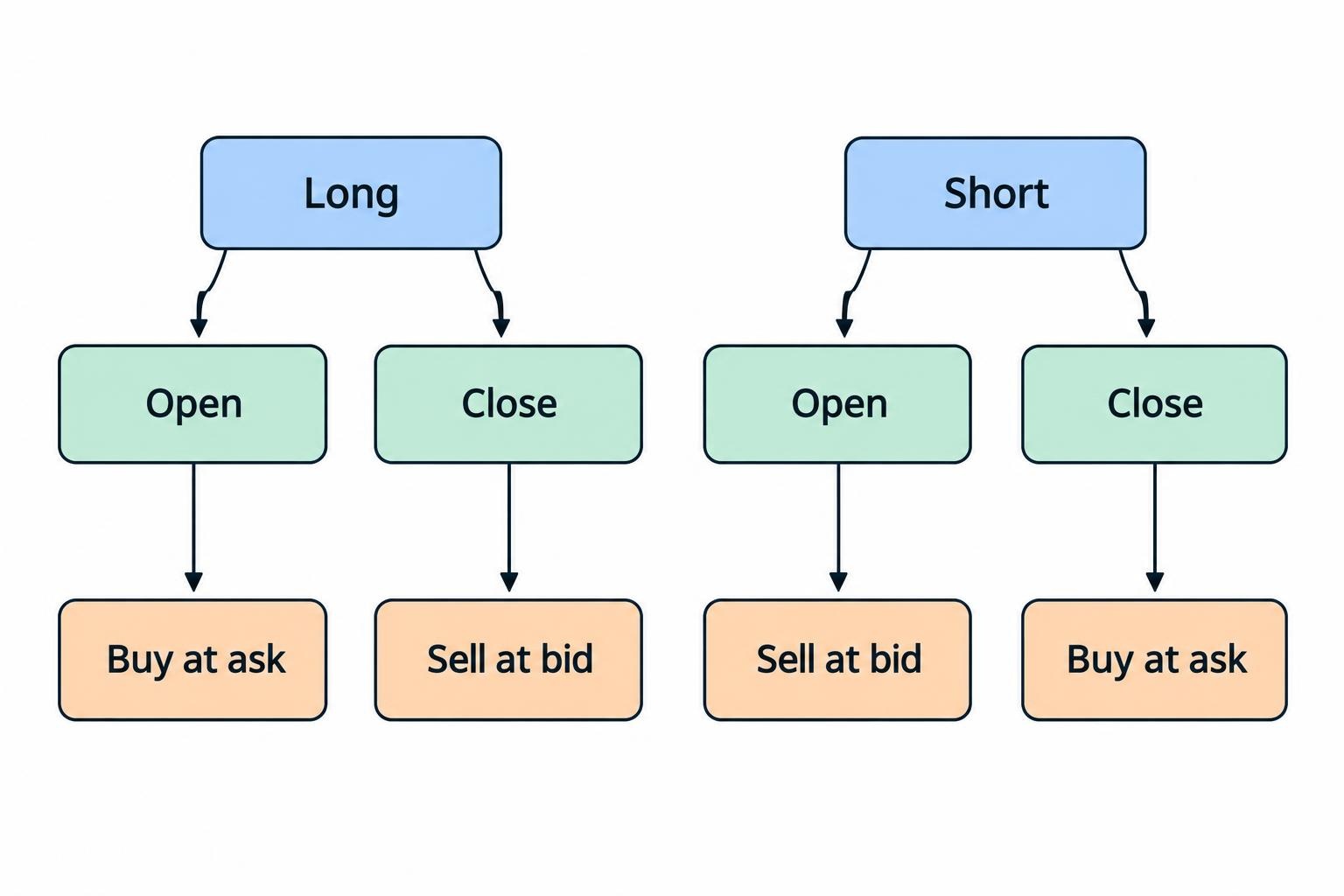
The labels describe the provider’s side of the transaction. The provider bids to buy from you and offers to sell to you. From your perspective, the practical rule is simpler: buy at the ask, sell at the bid.
| Transaction | Price used | Example price |
|---|---|---|
| Open a long position | Ask: you buy | 8,001 |
| Close a long position | Bid: you sell | 7,999 |
| Open a short position | Bid: you sell | 7,999 |
| Close a short position | Ask: you buy | 8,001 |
Going short does not avoid the spread. It reverses the order of the transactions: you sell first and buy back later, rather than buying first and selling later.
How to Calculate the Spread Cost
For an immediate opening and closing transaction at an unchanged quote, the calculation is:
Spread cost = spread in points × stake per point
At a two-point spread and £5 per point, buying at 8,001 and immediately selling at 7,999 produces a £10 loss. A £1 stake produces a £2 loss at the same prices. Your stake per point converts the price gap into a cash amount; the spread alone does not tell you how expensive the trade is in pounds.
All prices and stakes in these examples are hypothetical. They exclude financing, slippage and other charges.
Why a New Position Starts at a Loss
A long position bought at 8,001 can initially be closed only at the bid of 7,999. Its closing value is therefore two points below its opening price, even though the quote has not moved.
For that long position to reach break-even before other costs, the bid must rise to 8,001. If the spread remains two points wide, the quote would then be 8,001–8,003.
For a short position opened at 7,999, the ask must fall to 7,999 to reach break-even. With the same spread, that would mean a quote of 7,997–7,999.
The relevant price is always the one available to close your position, not whichever number looks most encouraging on the chart.
Do You Pay the Spread Once or Twice?
Both entry and exit affect the result, but two transactions do not automatically mean two full spreads.
In the unchanged 7,999–8,001 example, buying at 8,001 and selling at 7,999 costs two points in total, not four. Measured against the midpoint of 8,000, the purchase is one point above the midpoint and the sale is one point below it.
When quotes are centred symmetrically around their midpoints, the combined spread effect can be measured as:
Spread effect in points = half the entry spread + half the exit spread
If the entry spread is one point and the exit spread is three points, the combined effect is two points relative to the change in the midpoint. The actual trading result still comes from your executed opening and closing prices.
This distinction prevents double counting. If you calculate a long trade’s result using the opening ask and closing bid, those prices already include the spread. Do not deduct it again. The same principle applies when calculating spread betting profit and loss on a short position.
What Determines the Spread?
A provider’s quote can reflect both the spread in its underlying price inputs and an added dealing margin. The entire customer spread should not automatically be treated as the provider’s profit. The distinction between an underlying spread and an added markup is set out in ESMA’s Q&A on CFD pricing and spread markups.
For the customer, the complete executable gap matters. Knowing how that gap is constructed can help explain why it changes, but your cash calculation still uses the prices offered to you.
Liquidity, Volatility and Trading Sessions
Liquidity concerns how readily a market can absorb transactions without a large price change. When uncertainty rises, market makers may protect themselves against rapidly changing prices by widening their quotes or offering smaller quantities. This relationship between volatility, liquidity and dealing spreads is examined in the Bank of England’s analysis of gilt market liquidity.
For a spread bettor, the practical question is whether the live spread suits the planned trade. Check it again around announcements, session changes and periods when the underlying market is closed. Do not assume a quote observed during a busy session will remain available later.
A provider may offer a market outside its main exchange session, but that does not make the pricing conditions identical. Check the contract’s spread betting trading hours and any separate spread schedule before relying on an out-of-hours quote.
Fixed, Variable and Minimum Spreads
A fixed spread is a stated width that applies under the provider’s published conditions. Check those conditions rather than assuming “fixed” means every hour, every order size and every market event.
A variable spread changes with the quote. A minimum spread is the lowest advertised width, not a promise about the price available when you place an order.
A “from 0.8 points” headline therefore answers a narrower question than “what spread will this trade face?” Use the live ticket and the relevant pricing terms to answer the second one.
Points, Pips and Cash Cost
Spread comparisons only work when the units match. An index point, a forex pip and a share price increment are not interchangeable.
For a hypothetical EUR/USD quote of 1.08500–1.08508, the gap is 0.00008. Using the conventional pip size of 0.0001, that equals 0.8 pips. If the stake were £10 per pip, an immediate round trip at that unchanged quote would cost £8 before other charges.
Check how the provider defines a point on the deal ticket. Some displays include fractional increments. An extra decimal place does not, by itself, tell you the value of a one-point move.
For comparisons between different markets, convert the spread into pounds at your intended stake. A smaller displayed number is not necessarily a smaller cash cost.
How Spread Widening Affects Positions and Stops
A spread can widen without its midpoint changing. That can worsen the available closing price even when a midpoint chart appears flat.
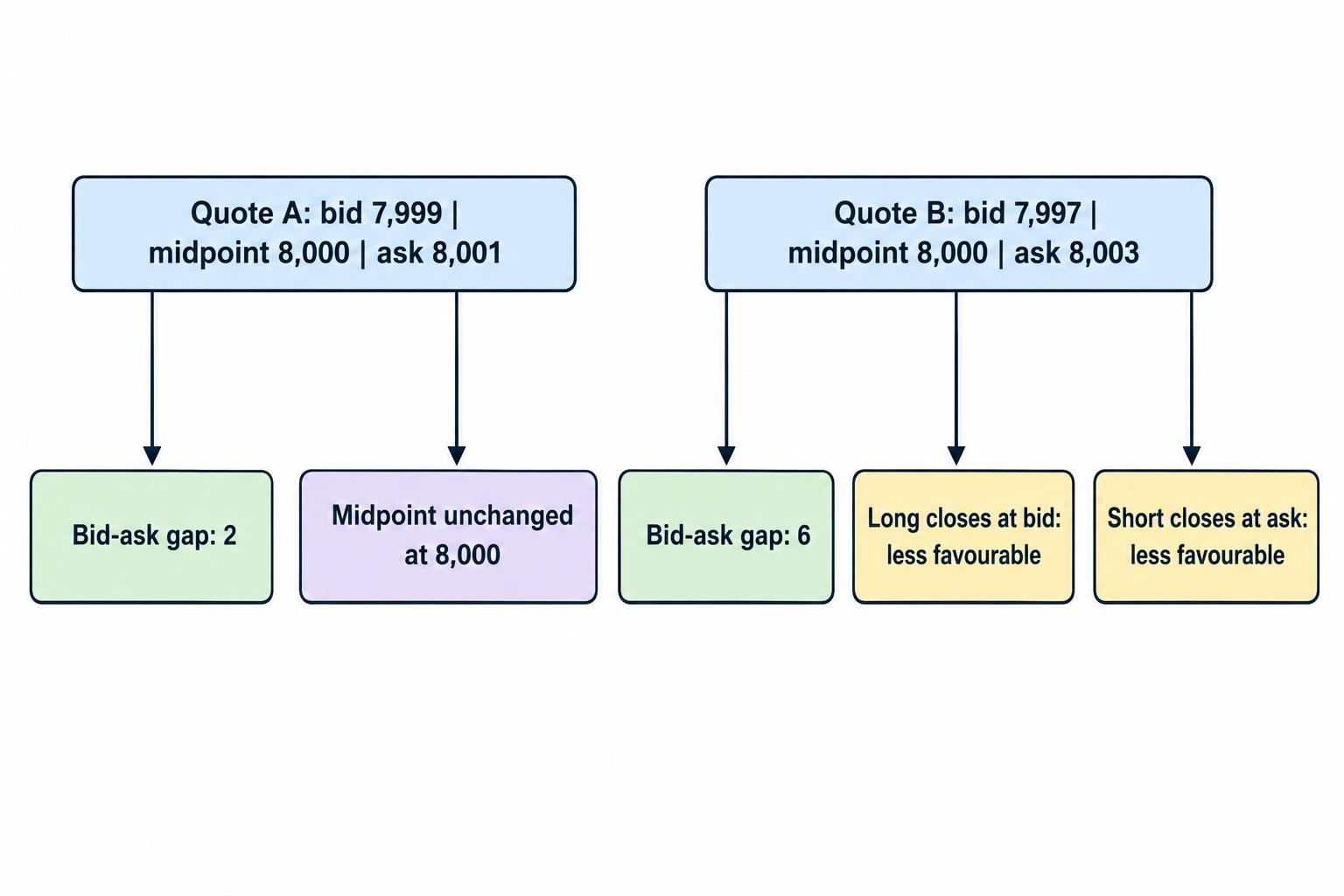
Take the original quote of 7,999–8,001, with a midpoint of 8,000. Suppose it widens to 7,997–8,003. The midpoint remains 8,000, but the bid has fallen two points and the ask has risen two points.
A long position bought at 8,001 would now show a four-point loss if valued at the closing bid of 7,997, rather than the previous two-point loss. At £5 per point, that is a £20 floating loss instead of £10. A short position also faces a worse closing price because it must be bought back at the higher ask.
The same distinction matters for stop orders. Under terms that trigger a long position’s stop using the bid, a stop at 7,998 could be triggered by that widening, despite an unchanged midpoint. Confirm the trigger basis for your stop-loss orders; do not infer it from the chart display.
Charts may display bid, ask, midpoint or another reference price. Check the setting before deciding that an order was triggered at a price the market “never reached”.
Spread widening is also different from slippage. Widening changes the gap between the quoted prices; slippage is the difference between an expected execution price and the actual fill. Both can affect one transaction, but they should remain separate in your assessment of execution costs.
Why Small Targets Make Spreads More Expensive
The spread takes a larger share of a small price target than a large one.
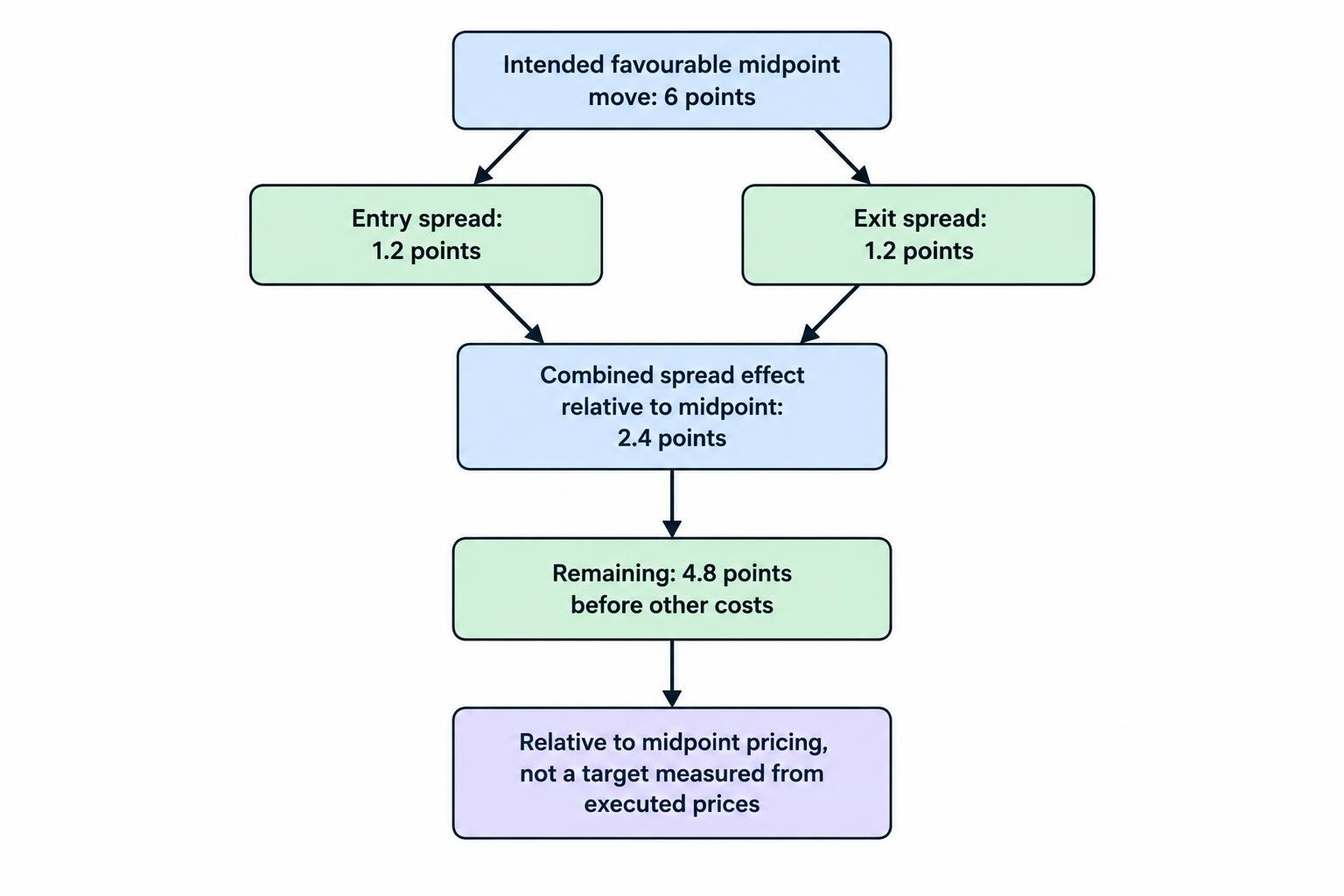
Suppose a trade aims to capture a six-point favourable move in the midpoint, with a 1.2-point spread at both entry and exit. Before other costs, the resulting gain would be 4.8 points. The spread has absorbed 20% of the intended midpoint move.
That is not the same as setting a six-point profit target measured from your actual entry to your executable exit. In that case, the six-point trading gain already accounts for the spread through the prices used.
Frequent trading also repeats the cost. At £5 per point, 40 completed trades with a 1.2-point spread at entry and exit create £240 of spread friction relative to midpoint pricing. At 2.4 points, the equivalent figure is £480. These are illustrative calculations, not estimates of what a trader normally pays.
This arithmetic deserves particular attention in short-term scalping strategies, where small targets leave less room for transaction costs. A tighter spread can reduce that hurdle; it cannot turn a weak trading method into a profitable one.
How to Compare Spreads Properly
Compare the same contract, at the same time, for the same intended stake. A daily funded index bet and a dated contract are different products, even if both reference the same index.
A useful comparison should answer four questions:
- What is the executable width? Record both sides of the live quote rather than relying only on a published minimum.
- When does it apply? Match the trading session and check any scheduled changes.
- Does the stake qualify? Confirm whether the price applies to your intended order size.
- What happens at exit? Allow for the conditions in which you expect to close, not just those available when opening.
Several observations during your intended trading window are more useful than one favourable screenshot. Keep a simple record of the instrument, time, bid, ask and stake. If the spread changes, record that variation rather than selecting only the smallest reading.
Use those observations as one input to a total spread betting cost comparison. Execution terms and holding charges can outweigh a small difference in quoted width.
The Spread Is Not the Whole Trading Bill
In its November 2025 review, the FCA found that many providers’ value assessments concentrated too heavily on spreads and gave insufficient attention to other charges, including overnight funding. That finding supports a broader comparison than the headline dealing gap alone: FCA review of CFD and spread betting price and value.
If you expect to hold a position across funding cutoffs, calculate the likely overnight financing cost separately. Check any other applicable charges, including guaranteed stop premiums and currency conversion. None belongs inside the simple spread-times-stake calculation.
The FCA’s October 2026 follow-up continued to identify concerns about overnight charges and the information firms provide about them. A narrow opening spread does not resolve those separate cost questions: FCA findings on trading charges and customer disclosures.
Check the Closing Price Before Opening
Before placing a spread bet, identify the bid, ask, spread width and cash value at your intended stake. Then check which price would close the position, how the stop is triggered and whether the spread terms change during your expected holding period.
Those checks will not predict the market. They will tell you what the trade must overcome before it makes money—and prevent the spread from being counted twice, ignored entirely or mistaken for a mysterious platform fee.