Spread betting through a company does not normally preserve the tax treatment associated with personal spread betting. When a UK company enters financial spread bets, the contracts generally fall within the corporate derivative contracts rules. Profits can therefore enter its Corporation Tax calculation, even though the product is called a bet. The distinction appears in HMRC’s guidance on spread bets entered into by companies.
A company structure also raises questions beyond the tax on each trade: who owns the account, how open positions are valued, whether losses qualify for relief, and how money eventually reaches shareholders. Putting “Ltd” after the account holder’s name is not a tax strategy by itself.
This article covers a UK resident limited company trading its own money. It does not cover operating a spread betting brokerage, managing customers’ money or the treatment of partnerships. For the wider personal tax position, start with our UK spread betting tax guide.
Personal spread betting and company spread betting are different arrangements
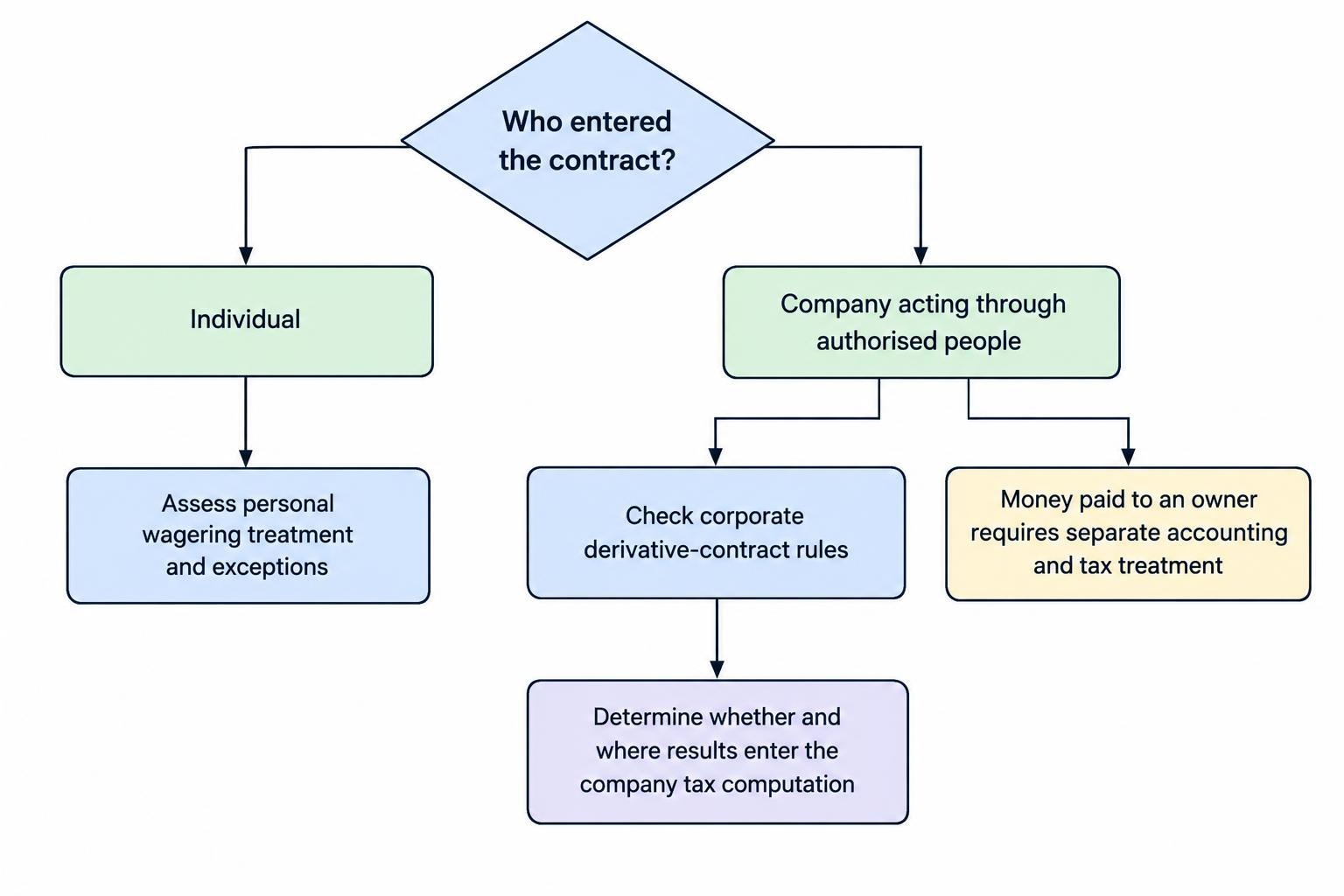
The starting question is who enters the contract. A director placing trades on behalf of a company is not necessarily making personal bets. Equally, transferring money from a business bank account into a director’s personal trading account does not, by itself, establish a properly documented corporate arrangement.
Identify the contracting party before considering tax rates. Check the account application, client agreement, funding records and authority under which the person placing trades acts.
| Issue | Personal account | Company account |
|---|---|---|
| Contracting party | The individual | The company, acting through authorised people |
| Starting tax analysis | Whether the bets are personal wagers or have another commercial purpose | Whether the contracts fall within the corporate derivative contracts rules |
| Treatment of losses | Ordinary personal wagering losses generally provide no tax relief | Relief may be available under the applicable corporate rules |
| Money needed personally | No company distribution is involved | A payment to the owner needs its own accounting and tax treatment |
The personal side of that comparison needs care. Our guide to when spread betting is tax free examines the circumstances and exceptions. Do not assume that a statement about an individual’s wagering profits also applies to a separate company.
Before opening an account, write down the intended arrangement in one sentence: “The company will enter these contracts, fund them and bear the resulting profits and losses.” If the account documents tell a different story, resolve the mismatch before placing a trade.
How company spread betting profits and losses are taxed
The corporate derivative contracts regime generally brings profits into tax as income. Where a contract serves a trade carried on by the company, the relevant amounts enter its trading calculation. Otherwise, they generally enter the non-trading loan relationship calculation. Exceptions can apply, including to some contracts involving shares or property. These distinctions form part of HMRC’s rules for charging derivative contract profits and losses.
This means two separate questions need answering: does the contract fall within the regime, and where do its results belong within the company’s tax computation? Calling the activity “trading” in a spreadsheet does not settle either question.
Give the accountant the actual product terms, not just a screenshot showing a profit. The market being referenced, settlement terms and purpose of the position can matter. An ordinary cash-settled index bet and an unusual equity-linked arrangement should not be assumed to receive identical treatment.
Incorporation is also a different question from whether someone carries on a business. The distinctions are covered separately in our guide to spread betting as a business.
Can the company claim relief for losing trades?
Corporate losses may enter the relevant trading or non-trading calculation, rather than being disregarded as personal wagering losses. That is not a promise of an immediate refund. Ask the accountant to identify the category of loss, the profits against which relief can be claimed, any restrictions and the claim deadline.
A company with no usable taxable profits should not budget for cash relief simply because its broker statement shows a loss. Nor should a director assume that a loss belonging to the company can reduce their personal salary or investment income.
Consider a purely illustrative £6,000 loss. If the entire amount qualifies for immediate relief against profits taxed at 25%, the tax reduction would be £1,500. The company would still be £4,500 worse off after that assumed relief. A deduction reduces the damage; it does not turn a losing position into a worthwhile one.
The separate guide to tax treatment of spread betting losses examines the broader distinction between personal losses and potentially relievable business amounts.
Which Corporation Tax rate applies?
At 21 October 2026, the main Corporation Tax rate is 25%. Eligible companies with profits of £50,000 or less can pay the 19% small profits rate, while marginal relief may apply between £50,000 and £250,000. Those thresholds are adjusted for short accounting periods and associated companies. Check the current Corporation Tax rates and threshold rules against the company’s accounting period.
Do not automatically apply 19% because the spread betting account is small. The relevant calculation concerns the company’s tax position, not the balance in one broker account.
The close investment-holding company issue
A close investment-holding company cannot use the standard small profits rate or marginal relief. The statutory tests examine the company’s purposes, with permitted purposes including carrying on a trade commercially and certain property or group activities. The exclusions and definition sit within Part 3A of the Corporation Tax Act 2010.
This deserves attention where an owner forms a company principally to speculate with their own capital. Do not assume that frequent transactions establish a commercial trade for this purpose. Equally, do not assume every company holding a derivative is an investment-holding company.
Ask for a written assessment of the company’s status before comparing structures. A comparison built on an incorrect 19% rate can look attractive right up to the point the tax computation arrives.
For an existing business, request a calculation using its other profits and associated companies as well. Assessing spread betting in isolation can miss the rate that applies to the next pound of profit.
Accounting for open positions, deposits and trading costs
A corporate trading account needs more than a list of closed winners and losers. The tax calculation normally starts from amounts recognised in profit or loss in accounts prepared under generally accepted accounting practice, subject to statutory adjustments. The starting rule is set out in HMRC’s guidance on derivative amounts recognised in company accounts.
Where fair value movements on open contracts enter profit or loss, they can affect the tax calculation before the positions close. “I have not withdrawn it” is therefore not a reliable test of whether a company has taxable profit.
Ask the accountant which accounting framework applies and how it treats the contracts. Have that discussion before the year end, especially if positions may remain open across it.
An illustrative year-end calculation
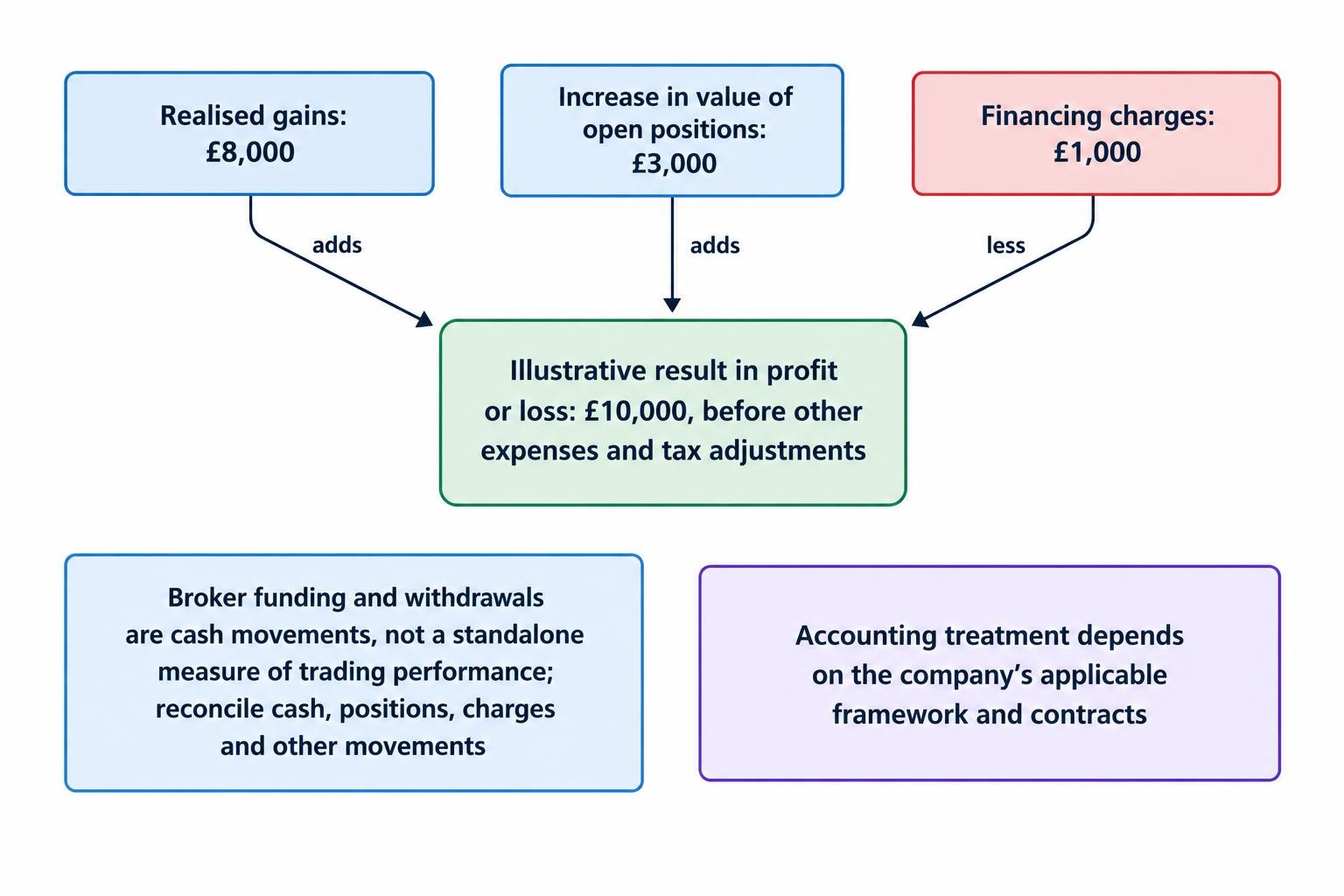
Assume a company’s accounting treatment recognises all the following amounts in profit or loss for the period:
It has £8,000 of realised trading gains, a £3,000 increase in the value of open positions and £1,000 of separately recorded financing charges. On those assumptions, the combined result is £10,000 before other expenses and tax adjustments. Reporting only the £8,000 of closed gains would miss part of the assumed accounting result.
This is a reconciliation example, not a universal method for completing a tax return. The treatment of a particular contract still needs checking.
Keep funding movements separate from trading performance. If the company transfers £20,000 to its broker and later receives £12,000 back, those transfers alone do not establish an £8,000 trading loss. Reconcile the remaining cash, open positions, charges and any other movements.
Our explanation of spread betting margin helps distinguish money supporting a position from the position’s profit or loss.
Take the same care with expenses. Request separate ledger treatment for financing, platform subscriptions, data and professional fees, then ask which amounts qualify for tax relief. A broker statement is useful evidence, but it is not the company’s completed accounts. For longer holding periods, review overnight financing costs before estimating the strategy’s return.
Taking profits out of the company
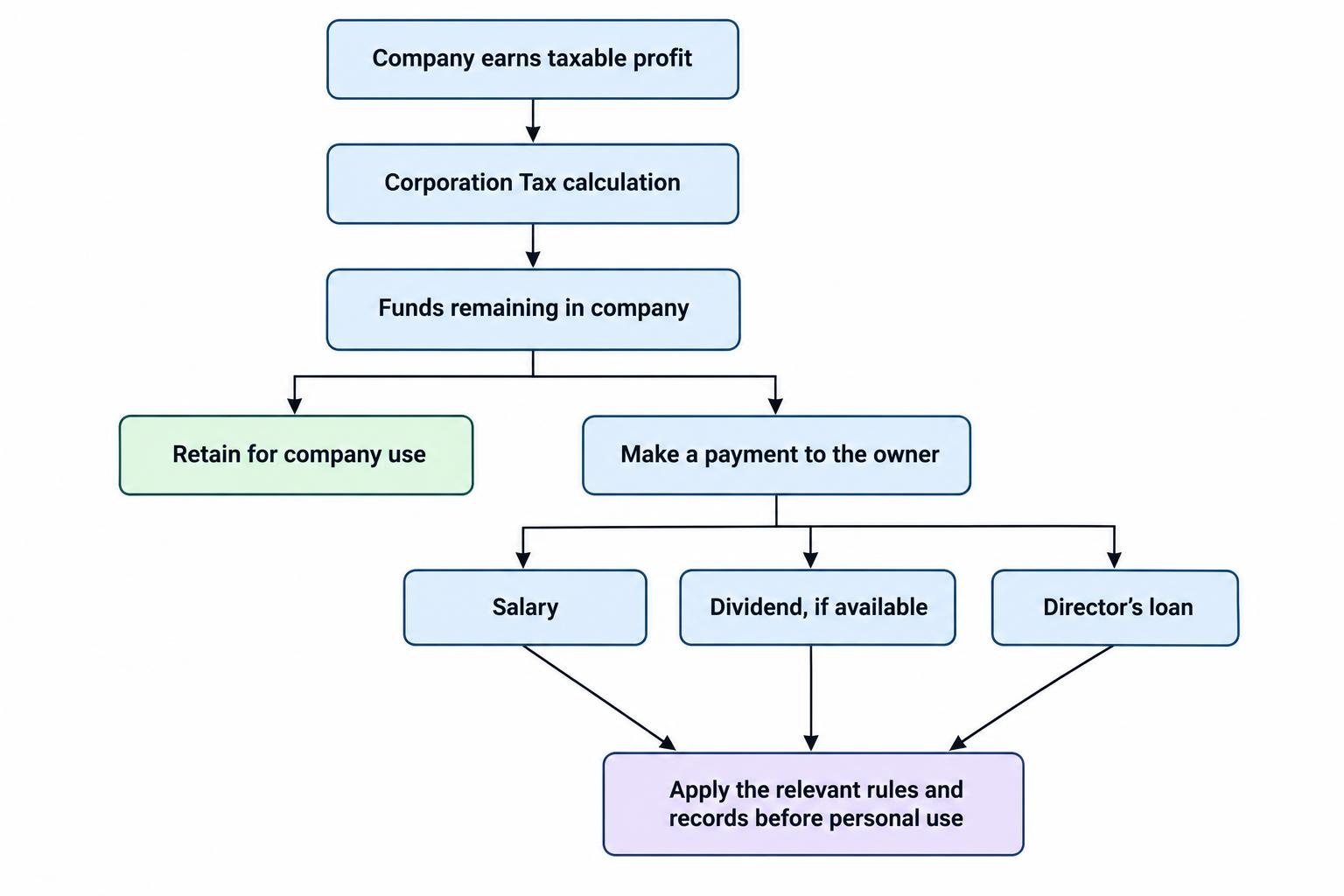
Moving money from the broker account to the company bank account is different from paying it to a shareholder. Plan the second step before deciding that a corporate structure is cheaper.
Salary payments involve payroll and potentially Income Tax and National Insurance. Dividends are not deductible when calculating Corporation Tax and cannot exceed available profits from the current and previous financial years. Directors’ loans require records and have their own tax rules. These routes are covered in the government’s rules for taking money out of a limited company.
Do not treat a payment as a dividend simply because that description produces a preferred tax result. Establish what the payment actually represents, whether it is permitted and what paperwork supports it.
A profit is not the same as personal spending money
Assume an existing company earns an additional £20,000 of taxable spread betting profit, after relevant costs. Also assume the whole additional amount is taxed at the 25% main rate, with no losses or reliefs changing the calculation.
The Corporation Tax attributable to that profit would be £5,000, leaving £15,000 in the company. That is the amount remaining before any tax arising from paying it to the shareholder.
The example deliberately stops there. A useful personal comparison needs the shareholder’s other income, proposed withdrawal method and timing. Quoting a company tax rate without modelling extraction leaves half the calculation unfinished.
If the company retains the money for future positions, model that separately from a plan to withdraw every year’s profit. The two plans have different cash requirements, even when the trading results are identical.
Also separate fresh capital from accumulated profits. When an owner provides money, decide whether the records should show share capital, a loan or another arrangement. Before returning that money, have the accountant reconcile the balance. An informal label such as “taking my deposit back” is not enough to explain several years of mixed funding and trading.
Using cash already held by an existing company
The decision can look different when the money already belongs to an operating business. A consultancy with retained cash is not starting from the same position as an individual with personal savings.
A sensible comparison models both routes from the same starting point. One route leaves the cash within the company and uses a corporate account. The other first makes a properly documented payment to the owner, then considers personal trading. Include the cost of getting money out, the treatment of future profits and the consequences of losses.
Do not compare a personal account funded with money already available to spend against a corporate account funded with money that has not yet reached the shareholder. That is not a like-for-like comparison.
Protect the operating business first
Before calling cash “surplus”, deduct the amounts needed for tax, payroll, suppliers, debt repayments and a working capital reserve. Then stress-test the proposed trading allocation against a bad month in the underlying business.
Consider a company with £100,000 in the bank but £70,000 of expected commitments. Treating the entire £100,000 as trading capital would ignore the reason much of that cash is there.
Directors must act within the company’s constitution and comply with their duties. The duty to promote the company’s success includes regard to longer-term consequences and other matters, and remains subject to rules concerning creditors in relevant circumstances. The governing provision is section 172 of the Companies Act 2006.
For practical control, document why the proposed activity serves the company, who can authorise trades and the maximum capital at risk. Set a point at which trading stops for review. A board minute does not remove market risk, but it can prevent the risk budget from becoming whatever happens to be left in the bank.
If a separate company is proposed, obtain advice on ownership, funding, guarantees and the effect on the wider business before transferring money. Do not assume a second incorporation alone achieves the intended separation.
Corporate hedging needs a different analysis from speculation
A commercial hedge should begin with an identified exposure. Write down what the company is trying to protect, its amount, currency and expected date, then explain how the proposed position relates to it.
For example, a business expecting a foreign currency receipt might consider a position intended to offset exchange rate movements. The review should test whether the proposed contract actually matches that receipt, rather than simply moving in a broadly related market.
Ask the accountant to assess the tax and accounting timing of both sides. Do not assume that a gain on the hedge and a loss on the underlying exposure will automatically cancel within the same accounting period.
Our guide to hedging with spread bets and tax deals with that subject in more detail. Keep speculative positions outside the documented hedge mandate unless a separate decision authorises them.
There is also no reason to assume that a company must use a spread bet rather than another instrument. Compare contract terms, execution, financing and administration. The familiar personal tax distinction should not replace a corporate analysis; see spread betting versus CFD tax treatment for the broader comparison.
A company account is not automatically a professional account
Tax status and regulatory client classification answer different questions. Incorporating does not, by itself, make every company a professional client.
The FCA framework identifies categories of professional client and requirements for elective professional treatment. For an entity requesting elective treatment, the assessment of expertise, experience and knowledge concerns the person authorised to transact on its behalf. The rules also require warnings and acknowledgements about protections that may be lost. These requirements appear in FCA COBS 3.5 on professional clients.
Ask the provider to confirm the company’s classification in writing, along with the contracting legal entity and applicable terms. Do not interpret a corporate application form as confirmation of professional status.
For covered retail accounts, FCA rules include margin close-out requirements and negative balance protection. The latter restricts liability for the relevant investments connected to the account to funds in that account. The provisions sit within FCA COBS 22.5 on retail speculative investments.
That protection is not a guarantee against losing the account balance. Before accepting another classification, compare what changes using our guide to retail versus professional client status.
Set the company’s risk budget independently of the maximum position the platform permits. Base it on money the company can afford to lose, not on available margin alone. Our guide to position sizing for spread betting covers that calculation.
Opening and running the account properly
Confirm that the provider accepts the proposed company and offers the intended product to it. A corporate account offering CFDs is not necessarily a corporate spread betting account, even if the trading screen looks familiar.
Request the application requirements before committing to a structure. Ask about company documents, ownership information, authorised traders, funding evidence, any Legal Entity Identifier requirement and the available reporting exports.
It is worth testing the reporting process before funding a larger balance. Ask whether you can export transactions, financing entries, cash movements and dated open-position valuations in a format the accountant can use. Discovering an awkward export after several thousand trades is an avoidable administrative hobby.
Check the contracting entity’s permissions through the process described in our guide to checking a broker on the FCA Register. A familiar trading name is not a substitute for identifying the firm named in the agreement.
Keep records that explain the full account
Companies must keep adequate accounting records that explain their transactions and show their financial position with reasonable accuracy. That obligation comes from the Companies Act duty to keep accounting records.
For practical purposes, maintain a file containing the client agreement, account statements, trade history, financing entries, funding records and year-end valuations. Keep the trading authority and any hedging rationale alongside them, rather than scattered across emails.
Reconcile broker cash to the ledger regularly. Record who reviewed the reconciliation and investigate unexplained differences while the transactions are still easy to trace. Preserve evidence of opening and closing positions, not just the net figure displayed on the dashboard.
Agree the retention period and filing timetable with the accountant. Our spread betting record keeping guide provides a starting point for organising transaction evidence.
Decide on the structure before placing the first trade
Ask for a written comparison built around the actual money, contracts and withdrawal plan. It should answer five questions:
- Who will legally enter the contracts and own the account?
- How will profits, losses and open positions enter the company’s accounts and tax computation?
- Which Corporation Tax rate and company-status rules apply?
- How will the owner fund the arrangement and receive money back?
- What client protections and operational controls will apply?
Include expected administration costs and an adverse trading scenario, not just a profitable year. If the plan works only when losses receive immediate relief or all profits can be withdrawn without further consequences, revise the assumptions.
A company account may fit a documented corporate purpose. It should not be opened on the assumption that personal spread betting tax treatment follows the money into a company. Establish ownership, obtain advice on the contracts, and complete the full after-tax comparison before funding it.