Financial spread betting lets you take a position on a market’s price without owning the underlying asset. You choose whether to buy or sell, then set a cash stake for each point the price moves. That stake determines how quickly both profits and losses build.
The mechanics are straightforward. Controlling the exposure takes more care. A small deposit can support a much larger position, an ordinary stop can fill beyond its trigger price, and holding costs can turn a modest trading profit into a loss.
This spread betting beginner’s guide focuses on UK retail accounts. It covers the decisions you need to make before trading: reading quotes, calculating risk, checking a broker, practising on a demo and knowing when to leave the trade alone. All prices and account figures below are hypothetical, not live quotes or recommendations.
What You Are Actually Trading
A financial spread bet is a contract with a provider based on the movement of a quoted market. You might trade a share price, a stock index, a currency pair or a commodity. Your return depends on how far the provider’s price moves between opening and closing the position, multiplied by your stake per point.
You do not acquire the shares, currency or commodity. A bet on a share price does not give you shareholder voting rights. A bet on gold does not leave you deciding where to store a bar of bullion.
The provider quotes a selling price and a buying price. You buy if you expect the price to rise, or sell if you expect it to fall. The difference between those prices is the spread, which creates an immediate trading cost.
The explanation of financial spread betting covers the product’s structure in more detail. For a beginner, the first distinction to keep clear is between predicting direction and managing exposure. Getting the direction right eventually does not help if the position closes at a loss before that happens.
Long and Short Positions
A long position starts with a buy. It gains value when the price at which you can sell rises above your opening purchase price. A short position starts with a sell. It gains value when the price at which you can buy back falls below your opening sale price.
Neither direction is inherently safer. A falling market can rebound sharply, while a rising market can reverse before you close. Both positions need an exit plan that works when the forecast is wrong, not just when it is right.
Read the Quote Before Looking at the Chart
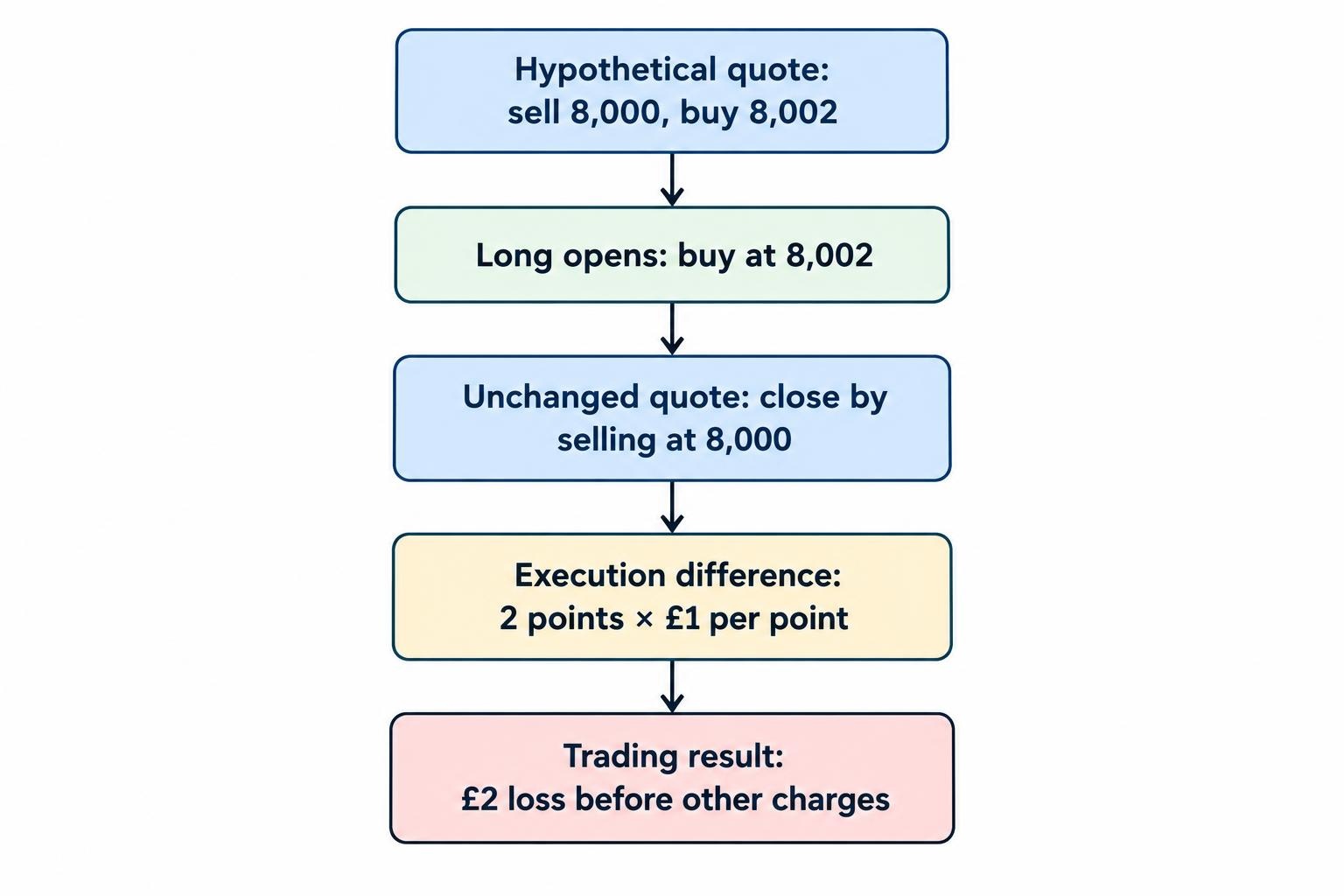
Suppose an index has a sell price of 8,000 and a buy price of 8,002. The spread is two points. At £1 per point, buying at 8,002 and immediately selling at an unchanged quote of 8,000 would produce a £2 loss before other charges.
That initial loss is not necessarily a platform error. It is the effect of crossing the spread. To reach break even before other costs, the price at which you can close must reach your opening execution price.
Check what the contract means by a point. An index contract might use one index point, while a share contract might use a one penny movement. Currency contracts can use different display conventions. The dealing ticket and contract details should settle this before you enter a stake.
A £1 stake does not mean you have invested £1. It means each one point movement changes the position’s value by £1. A 100 point adverse move would therefore produce a £100 trading loss before charges. The stake per point guide explains how that cash sensitivity changes with position size.
Which Price Does Your Chart Show?
Check whether the chart displays the bid, ask or midpoint. The bid is the selling price; the ask is the buying price. A midpoint sits between them and is not necessarily an executable price.
This matters when setting exits. A long position normally closes by selling at the bid, while a short closes by buying at the ask. A chart can appear not to have touched your chosen level even though the relevant execution side has reached it. Check the provider’s order trigger rules rather than assuming every line on the screen uses the same price.
A Beginner’s Spread Betting Example
Using the hypothetical index quote of 8,000–8,002, suppose you expect the market to rise and buy at £1 per point. Your opening execution price is 8,002.
| Closing sell price | Calculation | Trading result before other charges |
|---|---|---|
| 8,030 | (8,030 − 8,002) × £1 | £28 profit |
| 8,002 | (8,002 − 8,002) × £1 | £0 |
| 8,000 | (8,000 − 8,002) × £1 | £2 loss |
| 7,970 | (7,970 − 8,002) × £1 | £32 loss |
The spread is already reflected in the opening and closing execution prices. Do not subtract it again. Financing, premiums and other applicable charges still need to be included to find the final account result.
For a short position, reverse the price calculation. Selling at 8,000 and later buying back at 7,970 would produce a 30 point gain, or £30 at £1 per point. Buying back at 8,030 would produce a £30 loss.
The worked spread betting example follows a position through its calculations. Before placing an order, you should be able to calculate both a winning and losing outcome without relying entirely on the platform display.
Open Profit Is Not a Completed Result
An open position’s profit or loss changes with the available closing price. It becomes a realised trading result when you close, although related charges or adjustments may appear separately on the statement.
A position showing £40 profit can return to break even or move into loss. Decide how you will exit before the changing cash figure starts making the decision for you.
Margin and Leverage: The Deposit Is Not the Risk
Margin is the money required to support a position. Leverage describes the relationship between that position’s market exposure and the capital supporting it. Neither changes the cash value of a one point move once your stake is set.
Consider an index around 8,000 traded at £1 per index point. Its approximate exposure is £8,000. If the assumed margin rate is 5%, the opening margin would be about £400.
A move of 80 points against the position would still produce an £80 trading loss. That is roughly 1% of the exposure but 20% of the £400 opening margin. The margin payment has not made the market less risky; it has reduced the amount required to open the exposure.
This is why “I only put down £400” is not a useful loss limit. A trade can lose more than its initial margin. The spread betting margin guide separates opening requirements from the account funds needed to keep positions running.
UK Retail Safeguards
The FCA rules for retail speculative investments provide safeguards for covered UK retail spread betting accounts:
- Minimum opening margin: 3.33% for major currency pairs and relevant sovereign debt; 5% for major stock indices, minor currency pairs and gold; 10% for minor stock indices and other commodities; and 20% for shares and other assets within the rule.
- Account margin close out: if net equity falls below 50% of the required margin, the firm must close open positions as soon as market conditions allow.
- Negative balance protection: liability for covered speculative investments is capped at the funds dedicated to them in the account.
Providers can require more margin than these minimums. Negative balance protection does not protect your deposit from trading losses, and the close out rule is not a guaranteed execution price.
Leave Room Between Your Plan and Forced Closure
Available margin is not a spending allowance. Using nearly all of it leaves little room for adverse price movements or changes in requirements. Several positions can also drain account equity at the same time.
Your intended exit should not depend on the provider closing positions for you. If the account cannot support the proposed trade with a sensible cash buffer, reduce the stake or do not open it. Adding funds under pressure is not a substitute for sizing the position properly.
Choose a Market You Can Follow
Start your research with one market rather than a watchlist containing everything that moves. You need to know its contract terms, trading hours, usual cost structure and the events that could disrupt your plan.
A major stock index offers exposure to a group of companies, but it can still move sharply after economic releases or changes in interest rate expectations. A single share brings company news and earnings announcements into the calculation. Currency pairs respond to developments affecting both currencies, while commodities have their own supply, demand and contract issues.
The index spread betting guide is a useful starting point for studying index contracts. That does not make an index trade automatically suitable or safe. Familiarity with a market’s name is different from knowing how its spread betting contract behaves.
Check whether you are looking at a cash style contract or one linked to a dated future. They can have different prices, charges and expiry arrangements. Two tickets with similar names are not necessarily interchangeable.
Your schedule matters too. A market is a poor fit if the periods you can monitor it consistently conflict with your intended trading method. More screen time is not always better, but a plan should account for the hours when you will be absent.
Calculate the Costs Before Assessing the Opportunity
A forecast can be correct and still fail to produce a net profit. Small expected price moves leave little room for trading costs, particularly if you enter and exit repeatedly.
The Spread
The spread creates a gap between the price you pay and the price available for an immediate exit. Its cash effect depends on your stake. A two point spread costs £1 at 50p per point, £2 at £1 per point and £10 at £5 per point, assuming an unchanged quote.
Do not judge a contract solely by an advertised minimum spread. Check the price during the hours you intend to trade and review whether spreads can widen around market openings, announcements or less liquid periods.
The spread betting costs guide sets out the charges to compare. The useful question is what your proposed trade could cost over its expected holding period, not which headline number looks smallest.
Holding Costs
Daily funded positions can attract overnight financing. The calculation depends on the market, direction, position value and provider terms. A short position is not automatically free to hold, and any potential credit should be checked rather than assumed.
Dated contracts can incorporate financing into their quoted price instead of using the same daily charging structure. That changes how you compare costs; it does not make the financing disappear.
Before holding a spread bet overnight, check the charging time, weekend treatment and any scheduled adjustments. An intraday trade that stays open because it is losing has acquired a new cost profile, even if you have not changed its label.
Other Charges and Adjustments
Read the terms for guaranteed stop premiums, short borrowing costs, currency conversion, market data and account fees where applicable. Share and index contracts may also receive dividend related adjustments. Those adjustments are not a free return detached from the market price.
For an initial cost estimate, separate entry and exit pricing from holding charges and other fees. This makes it easier to see whether the proposed price target offers enough room after costs.
Use Orders That Match Your Intention
The main distinction is between choosing when an order becomes active and choosing the price you are willing to accept. These are related, but they are not the same thing.
A market order seeks execution at the available price. A limit order sets a price or better, but may never fill. A stop order becomes active after its trigger condition is met; an ordinary stop does not guarantee the final execution price.
The spread betting order types guide covers the mechanics. On any platform, practise entering, amending and cancelling orders before you need to do it with money at risk.
A Stop Loss Is a Planned Exit, Not Always a Fixed Loss
Suppose you buy at 8,002 and place an ordinary stop at 7,982. The intended distance is 20 points. At £1 per point, that represents a planned £20 trading loss before charges, assuming execution at the stop level.
If the market gaps through the trigger, the position can close at a worse price. A stop at 7,982 followed by execution at 7,960 would produce a 42 point loss from the 8,002 entry, not a 20 point loss.
A guaranteed stop loss order addresses this execution risk under the provider’s contract terms. Availability, minimum distances, premiums and amendment restrictions need checking. It is not a reason to increase the stake.
Check for Orders Left Behind
After closing a position, confirm what happened to its associated orders. Depending on the platform and how the orders were entered, a pending entry order or separate order may remain active.
Also check whether placing an opposite trade closes your existing position or creates a separate one. The intended action is what matters, not the fact that you clicked the other coloured button.
Set the Stake From the Loss You Can Accept
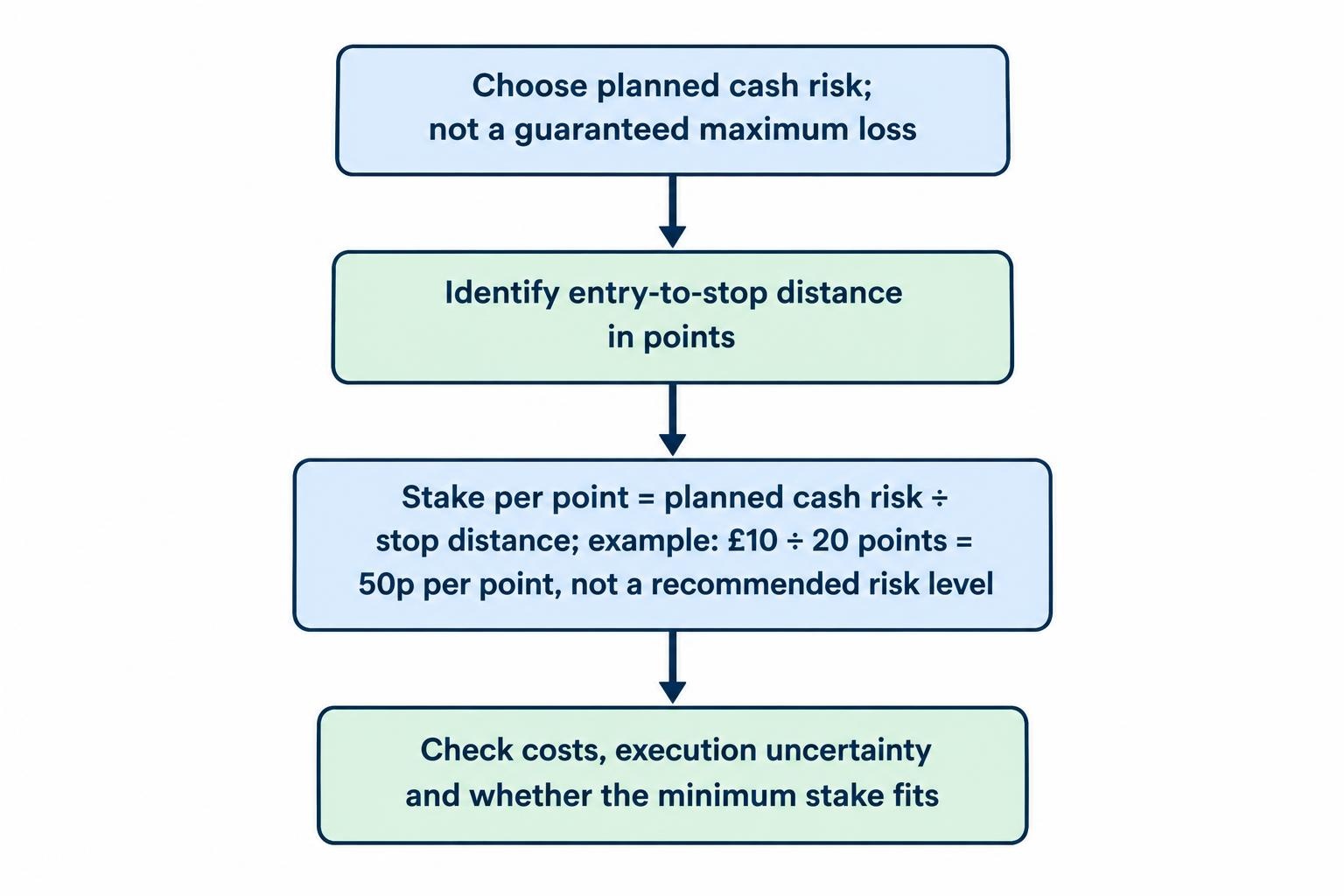
Choosing a stake first and then squeezing a stop around it puts the process backwards. Begin with the market level that would invalidate your trade idea. Calculate the distance to that level, then work out whether an affordable stake is available.
A basic calculation is:
Stake per point = planned cash risk ÷ stop distance in points
Suppose a hypothetical account contains £2,000. For illustration, the trader chooses a £10 planned loss, equivalent to 0.5% of that account. This is an example, not a recommended risk percentage.
If the intended entry is 20 points from the stop, dividing £10 by 20 gives a stake of 50p per point. If the stop needs to be 40 points away, the equivalent stake is 25p per point.
The position sizing guide develops this calculation. It should include room for charges and execution uncertainty rather than treating distance multiplied by stake as a guaranteed maximum loss.
What If the Minimum Stake Is Too Large?
If the provider’s minimum stake is £1 per point, a 40 point stop implies a planned £40 trading loss before costs and slippage. The fact that you intended to risk £10 does not change that.
Do not move the stop closer just to make the arithmetic look affordable. A stop should reflect the trade idea and market behaviour. If the available contract size does not fit your risk budget, skip the trade or research another suitable contract.
Add Up the Risk Across Positions
Three positions with £10 planned risk each create £30 of planned exposure to losses before costs and execution differences. If they respond to the same market event, all three may lose together.
Buying an index, several large companies within it and another closely related index does not necessarily spread the risk. Review portfolio correlation in spread betting before treating separate tickets as independent ideas.
A cash buffer also belongs in the calculation. The account needs to support the positions as well as absorb their movement. Passing a position sizing check does not automatically mean the margin requirement is affordable.
Check the Broker and the Contracting Entity
Begin with the legal entity that will hold your account, not the brand name at the top of the page. Read the client agreement and confirm which entity provides the spread betting service.
Check its authorisation, relevant permissions and contact details using the FCA guidance on checking a financial firm. Matching a firm reference number alone is not enough: clone firms can copy genuine details. Confirm that the contact information you use matches the regulator’s records.
Once that check is complete, assess the product fit. Minimum stakes, platform controls, order handling, charges and withdrawal arrangements matter more than a long list of markets you do not intend to trade.
The guide to spread betting brokers for beginners provides a comparison framework. A suitable starting point is a contract you can size conservatively on a platform whose behaviour you understand.
Protection Does Not Mean Trading Loss Insurance
Compensation arrangements address different risks from a losing trade. The FSCS investment protection rules may cover eligible claims after a firm fails, subject to the relevant conditions. They do not reimburse poor investment performance. Do not treat compensation eligibility as protection against an adverse market move.
Answer Application Questions Honestly
If an application asks about your knowledge, experience or finances, answer accurately. Copying answers to get through a questionnaire defeats its purpose.
Read any request to change your client classification or contracting entity carefully. A higher available exposure is not a benefit if you have not assessed the accompanying terms and protections.
Use a Demo to Practise a Process
A demo account is useful for learning the controls without risking cash. It can help you check point values, observe spreads, place orders, amend stops and identify where the platform displays margin and account equity.
Use a realistic practice balance and stakes you could plausibly afford. A large virtual balance can hide poor sizing decisions. Repeatedly resetting the account after losses removes the very information the exercise should reveal.
Compare spread betting demo accounts by the tasks you need to practise, rather than treating virtual trading profits as the main result.
What a Demo Cannot Establish
Demo execution may differ from live execution. Treat it as platform practice, not proof of future fills. Virtual losses also do not test how you will react when the money belongs to you.
A useful practice objective is to complete a series of trades without operational errors: wrong direction, mistaken stake, missing stop, accidental duplicate order or forgotten pending order. A profitable demo session with repeated mistakes is not a clean rehearsal.
Record the reason for each trade, its intended exit and whether you followed the plan. If you keep changing the rules after seeing the outcome, you cannot tell whether the original method was workable.
Build a Repeatable Trading Routine
A routine should reduce decisions made under pressure. It does not need to predict every market event. It needs to state what permits a trade, what invalidates it and what you will do if conditions change.
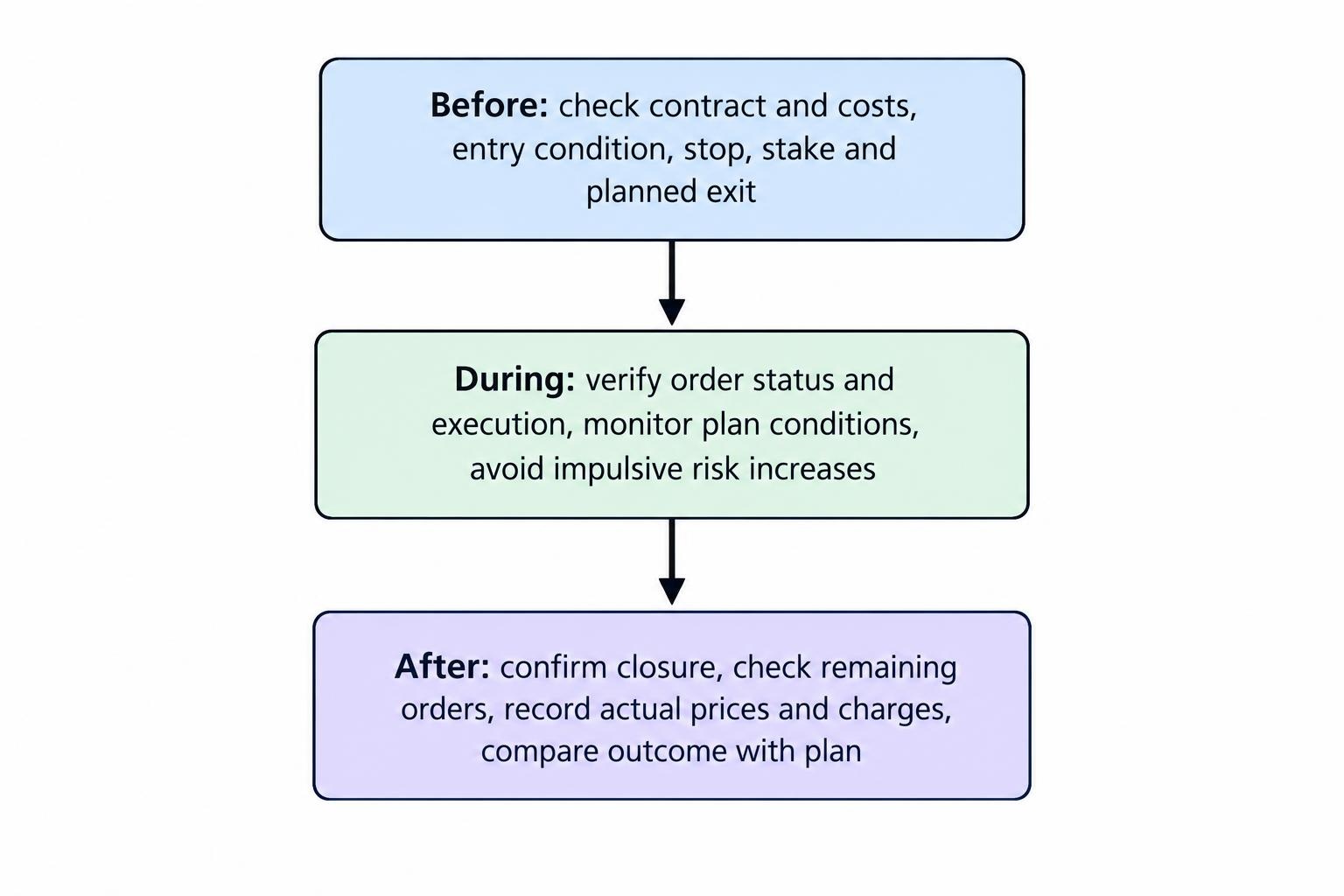
Before Opening the Position
Check the contract name, point value, spread, trading hours and any expiry. Review scheduled events during the intended holding period. Decide whether you are prepared to remain exposed through them rather than noticing the announcement countdown after entry.
Write down the entry condition, stop level, planned stake and exit method. If the trade requires a price that has not arrived, waiting is a valid decision. Chasing a move changes the entry distance, risk and potential return.
Keep the starting method narrow. The spread betting strategies section covers different approaches, but switching between them whenever a trade loses makes evaluation difficult.
On the Dealing Ticket
Read the completed ticket before submitting it. Confirm the direction, stake, order type and stop distance. Check the estimated margin and whether a premium or other charge applies.
After submission, verify the actual status. An order can be pending, filled, partially dealt with where applicable, rejected or cancelled. Do not assume a click created the intended position. Check the execution price and the protection attached to the trade.
The step by step guide to placing a spread bet follows the dealing process. Platform labels vary, so learn the controls on the account you are using rather than relying on a screenshot from elsewhere.
While the Trade Is Open
Monitor the conditions your plan requires, not every flicker of the profit display. If your approach uses a set exit, decide in advance what would justify changing it.
Moving a stop further away increases the loss you are prepared to accept. Adding to a losing position increases exposure. Neither action becomes risk management simply because the platform allows it.
After Closing
Confirm that the position is closed and review remaining orders. Record the actual entry, exit, charges and reason for closure. Compare the result with the plan.
Separate decision quality from outcome. A rule following trade can lose, while an impulsive trade can make money. Repeating the second because it happened to win is an expensive way to confuse luck with a method.
Common Beginner Mistakes
Using the Deposit as a Loss Limit
The opening margin tells you what the provider requires to support the position. It does not tell you what the position can lose. Work from stake, price distance, execution risk and total account exposure.
Increasing the Stake to Recover a Loss
A previous loss does not improve the next trade’s chances. Increasing the stake to get back to a preferred account balance ties the new decision to a past result rather than the present opportunity.
Set a session loss boundary before trading and stop when the plan requires it. If the urge to recover money is driving entries, the guide to avoiding overtrading is more relevant than another indicator.
Confusing Activity With Progress
Every new trade creates another exposure and another set of costs. Watching a market does not create an obligation to trade it. A session with no valid entry can be a correctly executed session.
Letting a Short Trade Become a Long Commitment
A trade planned for minutes should not become an overnight position by default. Holding it longer changes the exposure to announcements, financing and market gaps. Reassess those risks rather than waiting for the price to return to your entry.
Assessing Only the Win Rate
The size of gains and losses matters alongside their frequency. In a simplified ten trade example, seven £10 wins and three £30 losses produce a £20 loss before costs. A 70% win rate is not much comfort in that account statement.
Review net results, average gains, average losses, costs and rule adherence together. A small run of trades can also give a misleading impression of a method’s reliability.
What Beginners Should Know About UK Tax
For an individual’s financial spread betting, no chargeable capital gains or allowable capital losses arise from the bets. That means losses do not become deductible capital losses simply because they are financial. The treatment is set out in HMRC’s financial spread betting capital gains guidance.
Income tax needs a separate check where bets relate to a trade or business. Taxability depends on the contract and economic substance; taxable wins must arise from carrying on the trade, rather than just an opportunity it presents. Those conditions appear in HMRC’s spread betting income tax guidance.
Do not stretch a statement about an individual’s UK position into a promise covering companies, business hedging or another country’s tax rules. A sterling account does not determine your tax residence.
The UK spread betting tax guides separate these questions. Keep transaction records and obtain tax advice where your circumstances are not straightforward. Tax treatment is not a reason to accept a trade whose market risk or costs do not make sense.
Questions Before Moving Beyond Practice
How Much Money Do You Need to Start?
A provider’s minimum deposit and the capital required for your intended trading are different figures. The workable amount depends on minimum stakes, stop distances, margin, costs and the cash buffer you need.
If the smallest available position risks more than you can comfortably afford to lose, that contract does not fit. A smaller deposit requirement does not solve the sizing problem. Do not use money needed for bills, emergency savings or debt repayments.
Can Spread Betting Provide a Regular Income?
It should not be treated as dependable income for a beginner. Trading results can be uneven, and losses can occur across several sessions or longer periods. A target such as £50 per day does not create a suitable opportunity to earn it.
Judge readiness by whether you can follow a defined process, account for costs and accept losses without changing the rules to chase them. Even then, future profits are not assured.
Is Spread Betting the Same as CFD Trading?
Both can provide leveraged exposure without ownership of the underlying asset. Spread betting expresses position size as a stake per point, while CFDs use the contract’s units or quantity conventions. Tax treatment and account terms also need separate attention. The spread betting versus CFDs comparison covers the distinctions.
When Should You Consider a Live Account?
Only after you can read the contract, calculate a losing outcome, size the trade and operate the platform without guessing. You should also know what happens if the market gaps, the order does not fill or your connection fails.
Moving from practice to live trading is optional. If you do proceed, use exposure small enough that a loss does not pressure you into abandoning the plan. Increase neither the stake nor the trading frequency just because a few early trades worked.
A Practical Starting Point
Begin with one contract, one written method and a clear cash risk calculation. Verify the provider, learn the platform on a demo and check every cost that could apply over your intended holding period.
Before each trade, answer three questions: what would make the idea wrong, what could the position lose, and how will it close? If any answer depends on hoping the market comes back, the plan is unfinished.
Use the spread betting learning hub to work through the topics that remain unclear. There is no prize for placing the first live trade quickly. The useful goal is reaching the point where you can explain the exposure before accepting it.